Quick Take
- Scientists spent over a decade ruling out every obvious culprit, and in the end the true infectious agent broke the fundamental rules of how cancer works. See the decade-long investigation →
- Vermont has 90 lakes with bullhead catfish, but the contagious melanoma exists in only one of them. The reason why points directly at human behavior. Explore the single affected lake →
- A fishing app designed for bragging about catches is now scientists' best weapon against tracking this spreading plague. See how Fishbrain tracks cases →
Cancer is a collection of diseases caused by the uncontrollable spread of certain cells in the body. This produces an increasingly dangerous number of malignant cells that often form tumors. Human cancers are not contagious. At most, certain genes that can lead to certain kinds of cancers are heritable. But cancer can be transmissible in other species. Recently, researchers discovered a contagious cancer in catfish. This marks only the fourth example of tumor cells that transmit from one creature to another.
Certain sexual tumors can be passed between dogs, and two distinct cancer lines can spread between Tasmanian devils. Several tumor lines also affect aquatic mollusks like clams, cockles, and mussels. The latest discovery of transmissible cancer involves a type of melanoma infecting brown bullhead catfish living in a lake on the US-Canada border. Let’s learn more about this frightening disease, how it affects bullhead catfish, and where it might originate.
Initial Observations

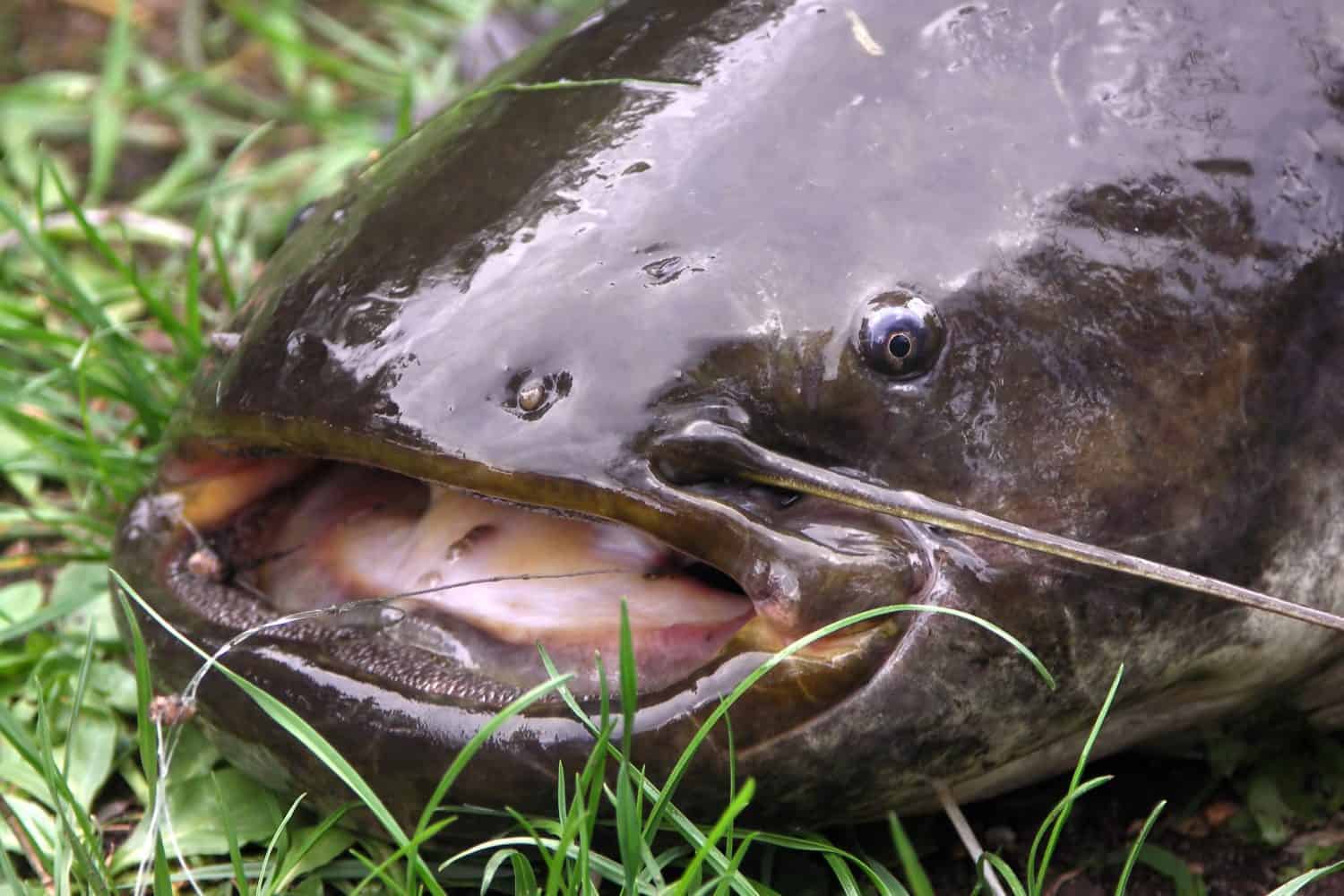
A contagious form of melanoma is spreading between brown bullhead catfish in Vermont’s Lake Memphremagog.
©JFGagnonPhoto/Shutterstock.com
The first evidence of a new cancer in fish came from a routine catch in a North American lake. In 2012, anglers and biologists began observing brown bullhead catfish with raised black lesions in Lake Memphremagog in northeastern Vermont. The bullhead had what appeared to be tar or mud coating its skin. Curious about the mark, the fisherman brought it to Peter Emerson, a fish biologist with the Vermont Fish and Wildlife Department. Though Emerson had surveyed the lake since 2009, he had never seen anything like it.
Three years later, those black growths had spread to between 25 and 40% of the lake’s bullhead catfish population. In a new study, published in Nature, researchers explain just what these spreading black marks are: a type of contagious melanoma. This makes it the fourth type of transmissible cancer known to science. It is also the first type of transmissible cancer found in fish and the first found in freshwater.
The effects of this type of contagious melanoma on bullhead fish are severe. The black growths can appear anywhere on a bullhead catfish’s body, including inside the mouth and on the barbels the fish use to find food. As Emerson said in an article from Forbes, “It looks like a plague. There should be long barbels, but when you’ve got cancer, melanoma on them, they get short. So that is affecting the way they feed.”
The Research Process
This study, which definitively links these black body smears on bullhead catfish to cancer, has been more than a decade in the making. Clusters of cancer typically result from an infection or chemical carcinogen. Since brown bullhead catfish are sentinel species for pollution (they often develop liver tumors in water contaminated with polycyclic hydrocarbons), scientists looked for similar causes for this new cancer.
Initially, biologists thought that Tropical Storm Irene would reveal a source after it ran through Vermont in 2011. Instead, they found that water with higher pollution levels contained unaffected fish. Samples of infected bullhead catfish were continually sent to the bioinformatics core at the University of Vermont from 2014 onward. Yet, sequencing revealed no virus or microbes.
These results prompted Julie Dragon, a research associate professor of microbiology and molecular genetics, to search for a shared mutation. Conventional cancers involve tumors that are genetically related to the animal in which they develop. Dragon found the opposite: hundreds of thousands of mutations were shared between cancers, but were noticeably absent from the hosts. In a statement to Forbes, Dragon said, “It’s not driven by a bacteria or a virus. It’s the infectious agent itself, and it’s moving from fish to fish.”
A Growing Problem
While the tumours affecting Memphremagog’s catfish are related to bullheads found across the northeast, only those in the Vermont lake show signs of infection.
©Beneda Miroslav/Shutterstock.com
When the research team re-surveyed Lake Memphremagog in 2017, they found the cancer present at four different sites in a lake more than 25 miles long. Supporting Dragon’s findings, the tumors from bullhead catfish in the lake are more closely related genetically to healthy bullhead found in New Hampshire and Maine than to those in other locations. These genetic similarities are found throughout the Northeast, from Nova Scotia in Canada down to Pennsylvania and as far west as Wisconsin. Vermont has 90 lakes containing bullhead, but the contagious cancer is found in only one. The researchers believe that the tumors might be spread by contact. While it spreads rapidly, it doesn’t seem to be deadly; bullhead catfish can live for years with these tumors on their bodies.
This pattern of scarcity in one lake and abundance across the region suggests human transport rather than natural infection. When a cancer is genetically related to specimens in dozens of lakes but only infects those found in one, it suggests movement via people, similar to the spread of an invasive species. To better track this contagion, the research team is relying on a fishing app called Fishbrain. Since it allows fishermen to post photographs of bullheads, the team is using Fishbrain as a biodiversity informatics tool. The appearance of bullhead catfish with contagious melanoma on the app suggests that this cancer is more widespread and simply underreported.
How to address this contagious cancer remains an open question. Some scientists believe that doing nothing and observing what happens is the best approach, as the bullhead catfish could recover on their own. Others, however, like members of the research team behind this latest study, suggest revisiting invasive species rules for Memphremagog.