
Quick Take
- Raising an endangered chick means fighting your own instincts, and one reflexive human habit could undo months of conservation work.
- The costume is just the beginning. The full job description of a whooping crane handler is far stranger and more demanding than it sounds.
- A species that once numbered over 10,000 crashed to the edge of oblivion, and its comeback hinges on a method most people would never guess.
- Getting a captive-raised crane to migrate correctly requires a step that goes well beyond the costume, and the timing of that step is critical.
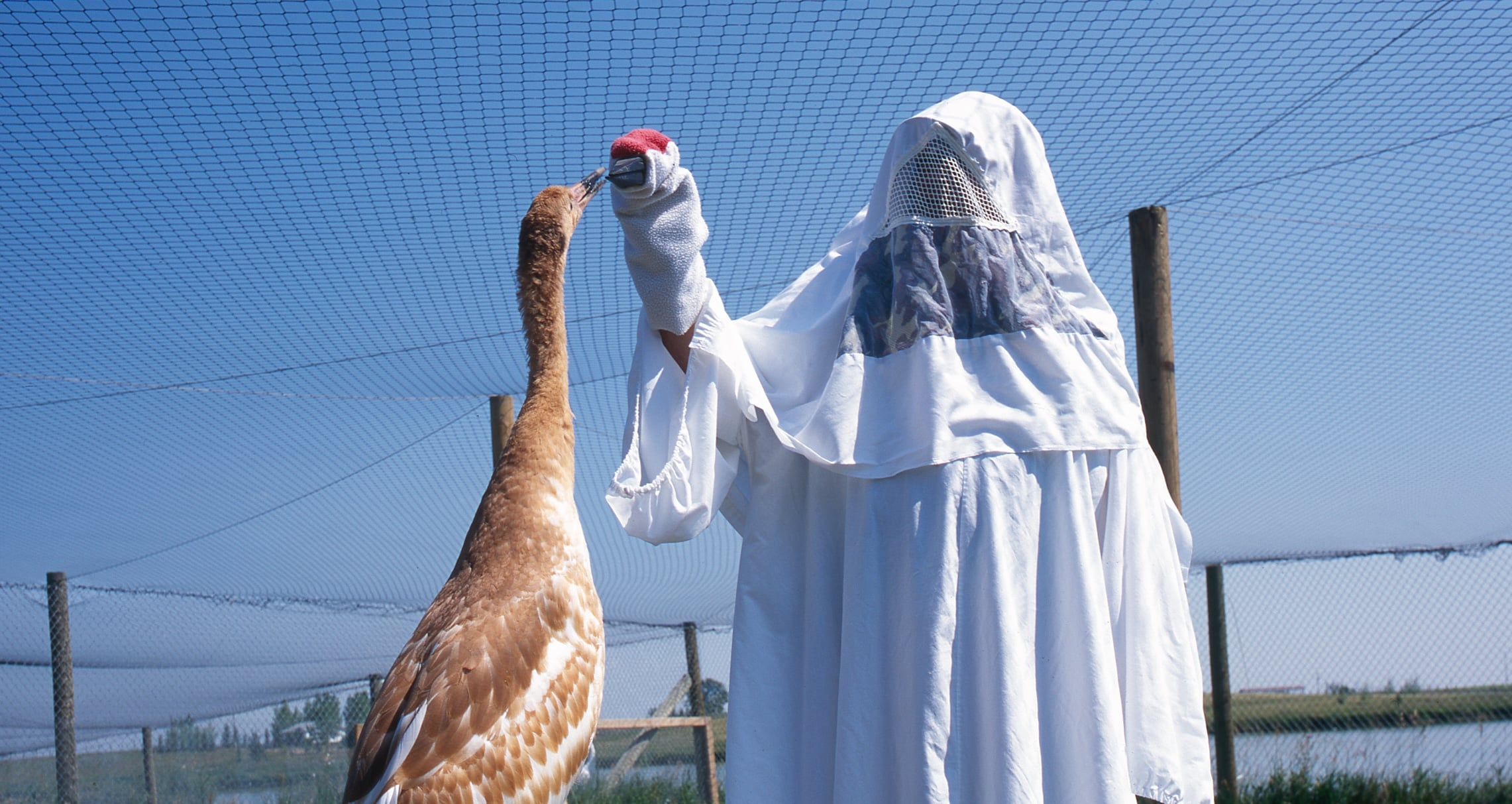
Like ghosts, people dressed in white gowns cautiously wade into shallow waters. Covered head-to-toe in shapeless cotton frocks, their human forms are camouflaged, and their only view of the outside world is through a mesh-netting window around their eyes. Each handler wears a hard hat to prevent injury from aggressive pecks or sharp beak jabs and is also equipped with a handheld puppet shaped like the head of an adult whooping crane on one arm. A black wing-tip hand cover on the non-puppet arm and matching boots further mimic the appearance of the endangered bird.
The whooping crane costume has been a critical tool for conservationists raising baby whooping cranes for approximately four decades. Developed by Dr. Robert Horwich and colleagues at the International Crane Foundation, the ensemble has been used in whooping crane conservation efforts since the mid-1980s.
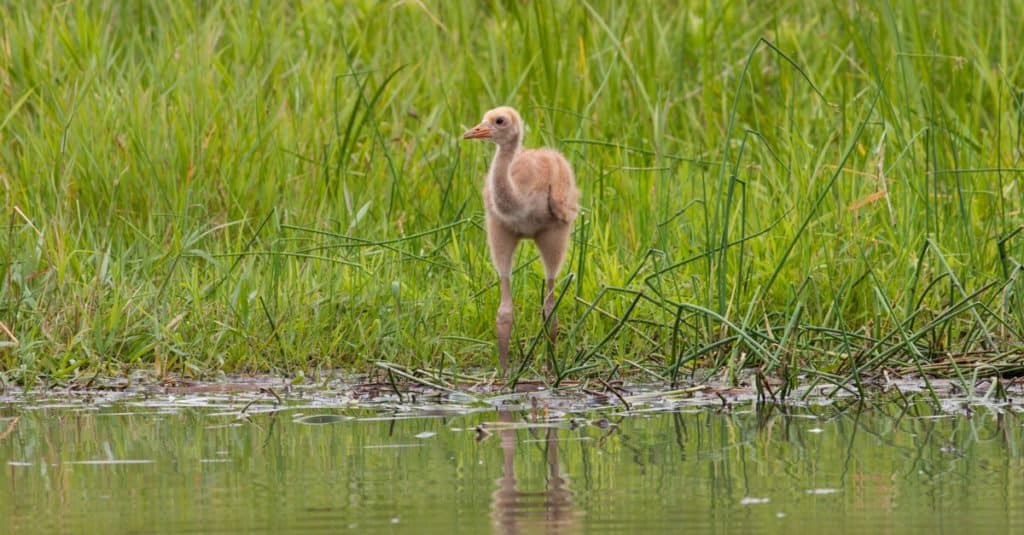
Conservationists have been using the costume to raise baby whooping cranes for approximately four decades with great success.
©SCOTT E NELSON/Shutterstock.com
This specialized role — handlers dressed as surrogate parents to endangered chicks, replicating a mother crane and concealing any human attributes — has been successful in increasing the whooping crane population.
“I still hold that experience near and dear to me,” says Kim Boardman, aviculturist for the International Crane Foundation (ICF), who spent the first half of her career with the Baraboo, Wisconsin-based non-profit conservation organization, suited up while working closely with whooping crane hatchlings.
Surrogate Crane Parents
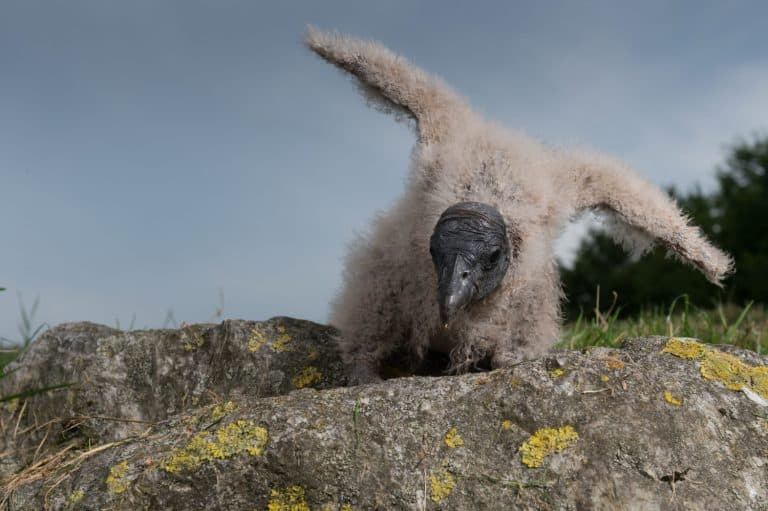
“From the time the chicks hatch, they only see their caretakers as costumes,” adds Boardman. “The face is obstructed, so if the chicks are looking in at us, they’re not seeing our human face directly.” Within their first few weeks of life, baby chicks are more dependent and require additional attention. Working within protected pens on the 250-acre property in Baraboo, ICF handlers raise chicks each summer while in costume, even as temperatures rise.
Handlers also typically work 12-hour shifts or longer with the chicks and must remain quiet most of the time. This quiet deception ensures that chicks see the handlers only as a mother crane and do not bond with or identify humans as their parents instead of other birds. A typical day for a handler can start around 7 a.m. and end around 7 p.m., according to Boardman, before they return around 9 p.m. for an “end-of-evening” check.
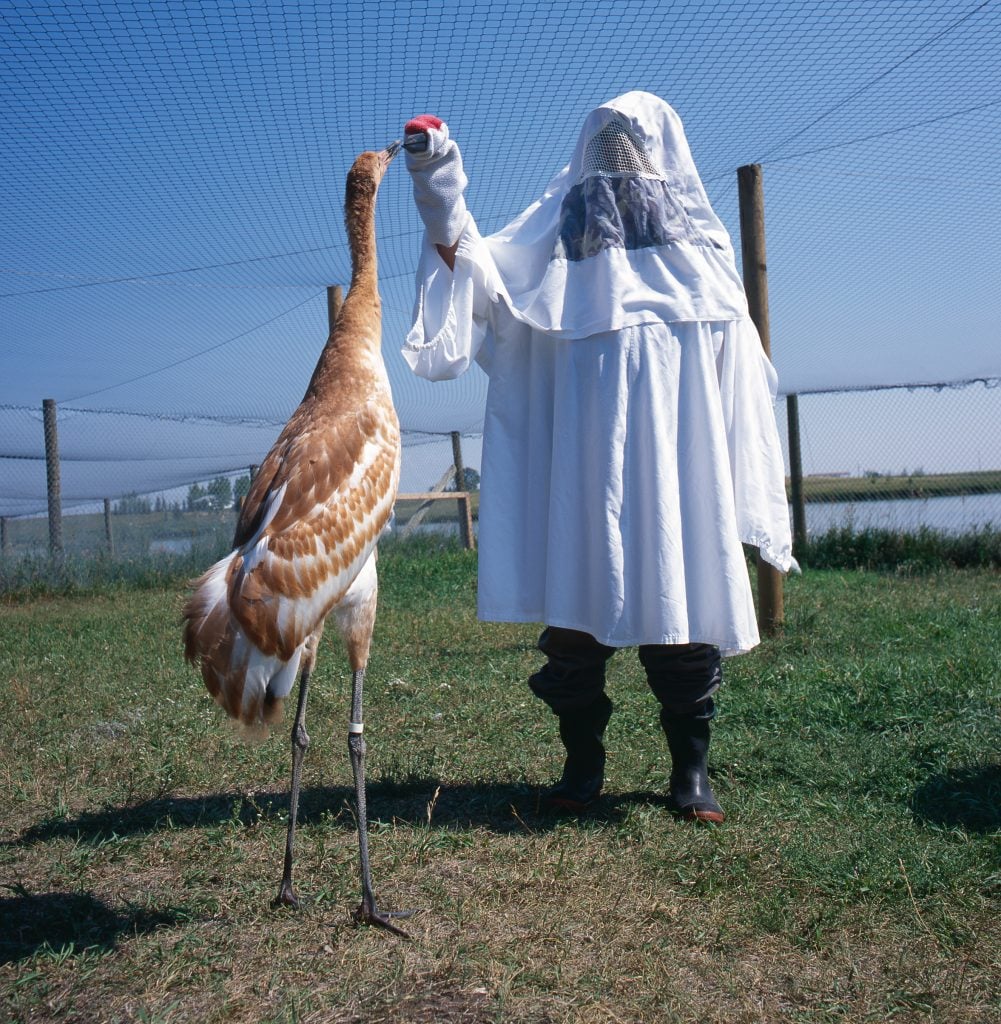
Costumed whooping crane handlers use recorded crane brood and alarm calls to help younger birds become familiar with common sounds of their species.
©iStock.com/westphalia
The costume is also essential to raise the large wetland bird, which can grow as tall as five feet with a wingspan of up to seven feet. Along with mimicking the body of a crane in costume, the hand puppet is used to teach chicks how to drink water, forage, interact like a crane, and alert growing chicks to predators like raptors.
“If a predator is flying overhead, our first instinct as humans is to look up with our heads, but we have to remember that we’re cranes, and our heads as cranes are our puppet,” explains Boardman. “So we have to lift our puppet head to look up and train the chicks to be alert in that way.”
Handlers also use a concealed MP3 player with recorded crane brood and alarm calls to help younger birds become familiar with common sounds.
“We communicate with the chicks in a real-life way,” says Boardman. “We’ll play that brood call when we want to get their attention, and they come running over to us.” Some behaviors are also instinctual, says Boardman, while others require practice, including bobbing underwater to forage for food. To help guide the young cranes in their hunt, handlers strategically place treats underwater and point them out to the birds using the puppet head, encouraging the chicks to dunk their heads in and forage.
Trying to find ways to continue to make sure that they have safe places is one of the biggest challenges. And every animal counts towards their recovery.
Kim Boardman, Aviculturist, International Crane Foundation
Eventually, handlers will move into deeper waters, where the cranes should naturally gravitate, to help reinforce their wetland behavior. “The water is generally going to be a safe habitat from predators,” says Boardman, “so that should be a place they’re spending a lot of their time.”
Natural Habitats
Though younger birds are initially raised in protected pens, the ICF property in Baraboo offers plenty of natural habitat and wetlands, allowing the birds to naturally become proficient at foraging for grasshoppers, small fish or minnows, tadpoles, and frogs.
“We’re fortunate to have a large property with some natural habitat,” says Boardman. “We can take them out for a prairie or marsh walk and give them opportunities to forage, encounter things outside the fence, and experience some of those wild food items.”
As birds start plunging into water and flying on their own, handlers start moving them into the field for more experience. Often, they’ll flap the wing-tip arm of their costume to encourage the birds to run behind them and practice flying, building their flight muscles.
Boardman says they are very cautious about the birds not imprinting on the ICF facilities where they’re being reared. “We don’t want them flying too high, where they’re starting to set landmarks of their natal area. We want that to be in the wild where we’re going to be releasing them, so moving them to the field shortly after they fledge is important. We want them to return to the places where we release them, not to ICF.”
When it comes time to help captive-raised birds successfully migrate, handlers operate ultralight aircraft, including the Cosmos Phase II delta-wing motorized trike, to guide the birds along a safe migratory route.
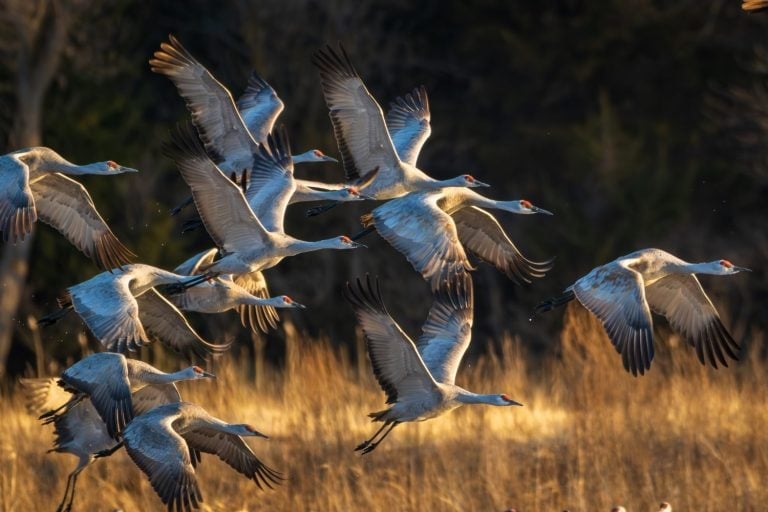
Within the protected area in Wisconsin, adult cranes are also present in pens, so younger birds are not only learning from humans. Elder cranes help teach birds more nuanced interactions, including predator vigilance, courtship, migratory navigation, and more complex flock dynamics that cannot be taught by costumed handlers.
At ICF, conservation efforts begin before whooping crane chicks even hatch, setting them up for a long, successful life. On average, whooping cranes can live 22 to 30 years.
Raising Cranes
During the winter, the ICF starts determining which birds will be bred and which chicks will be part of their release program. Since whooping crane reproduction is a slow process, with birds taking three to five years to reach maturity, laying only two eggs per year, and typically raising only one chick, the ICF uses artificial insemination with the adult birds to help produce eggs and maintain a healthier number of future, surviving chicks.
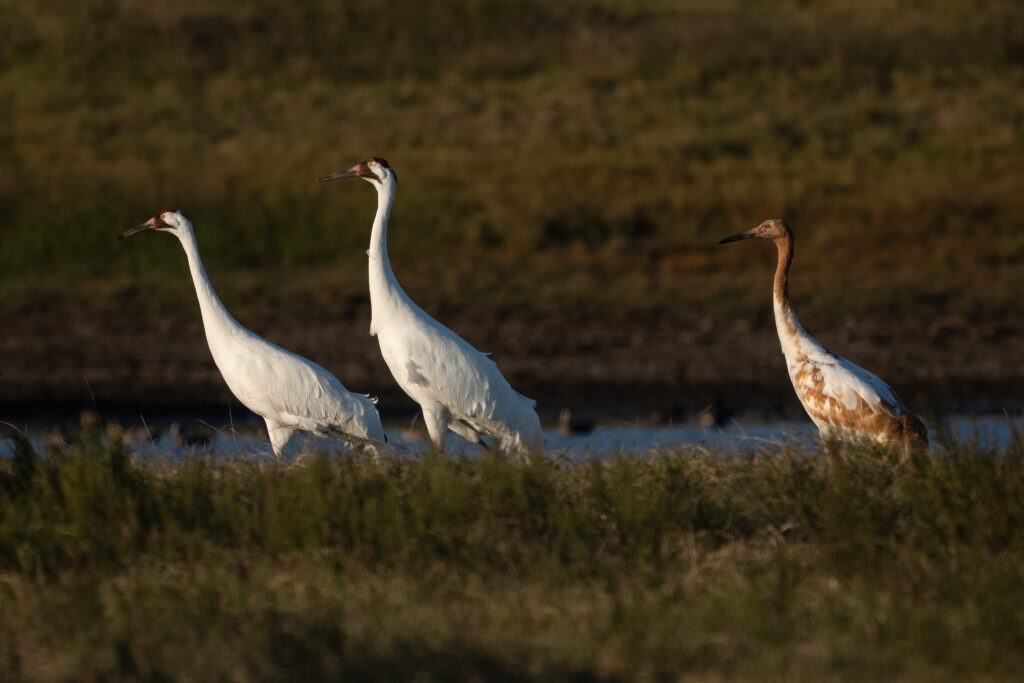
The global population of whooping cranes, which once numbered more than 10,000, dropped to around 21 by the 1940s.
©Ryan Michalesko/International Crane Foundation
They also incubate the eggs, and chicks generally hatch in May and remain with ICF through October. After they are released, ICF continues to track and monitor the birds using a remote transmitter, following their movements and winter migration through their return to Wisconsin during the spring. They also have a vast pool of volunteers and people on the ground checking in on them and ensuring they are in the proper habitats.
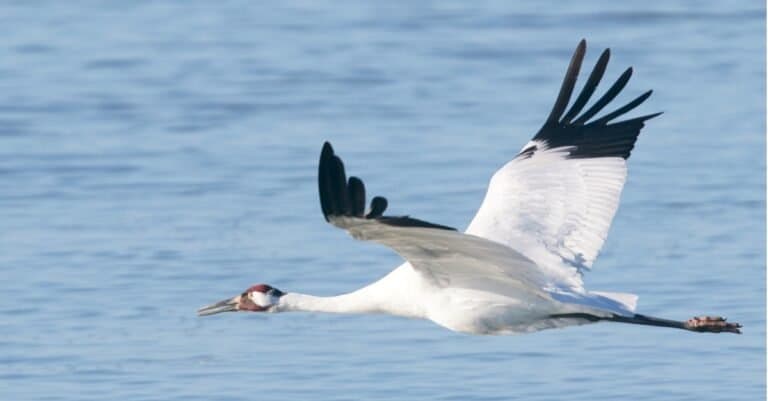
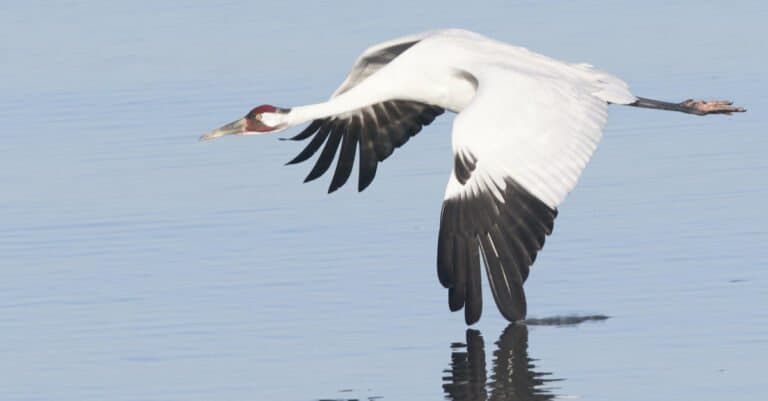
Predominantly inhabiting agricultural fields, coastal wetlands, and marshes in Louisiana, Texas, and Wisconsin, the whooping crane became endangered during the late 19th and early 20th centuries due to its slow reproduction cycle, along with unregulated hunting and habitat loss due to the development of farms, industrial sites, and towns.
Once numbering more than 10,000, according to the U.S. Fish and Wildlife Service (FWS), the global population of whooping cranes dwindled to around 15 to 21 by the 1940s. Only two small flocks remained in Louisiana by the late 1930s — one non-migratory flock and one migratory flock that went to southeast Texas during the winter and Canada for the summer. A hurricane in 1940 further destroyed Whooping Crane habitats, making their numbers drop to 21 by mid-decade.
The near-extinct numbers prompted immediate conservation efforts by the National Audubon Society and the establishment of the Aransas National Wildlife Refuge, which protected the migratory flock during the winter months in Texas. Public awareness campaigns were also put in place to stop illegal hunting of the bird under the 1918 Migratory Bird Treaty Act, which broadly prohibits the taking, killing, capturing, selling, and transport of protected migratory birds, in order to save remaining habitats.
Near-Extinction
By 1967, the bird was listed as threatened and officially became endangered in 1970, three years before the inception of the ICF, which was founded by Canadian ornithologist George Archibald and American ornithologist Ron Sauey while both were students at Cornell University.
Today, the conservation and revival of the whooping crane population is supported by partners, including the FWS, but the program faces significant challenges due to recent and proposed federal budget cuts to endangered species and wildlife conservation programs in 2026. Boardman says the greatest challenge to expanding the whooping crane population is habitat protection, which has been devastated by human land use and climate change, including dramatically shifting water levels in coastal habitats and wildfires impacting their breeding grounds.
“Trying to find ways to continue to make sure that they have safe places is one of the biggest challenges,” she says. “And every animal counts towards their recovery.”
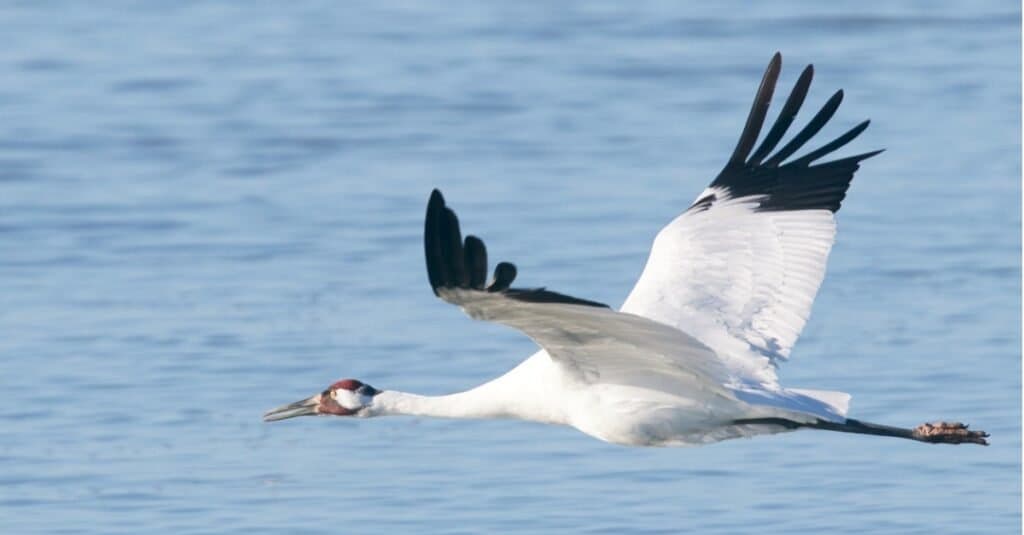
The greatest challenge facing the whooping crane population is habitat destruction impacted by human land use and climate change, including wildfires and shifting water levels in coastal areas.
©iStock.com/kellington1
Wild populations of whooping cranes reared by ICF have become self-sustaining, migrating from Wood Buffalo National Park to winter along the Texas coast. ICF is also working with an eastern migratory population, which is released in Wisconsin in the fall before migrating southeast — primarily to Indiana and Alabama — with a population of approximately 64 individuals as of 2026.
“We’ve done so much to protect their habitat and educate the public as we’ve started these reintroductions,” says Boardman. “These birds are not something many people are used to seeing on the landscape, so we want them to understand what whooping cranes are all about, how endangered they are, why they’re important, and why conserving their habitat is critical to them and so many other species.”
Another population of non-migratory whooping cranes in Louisiana is being raised with the help of several partners, including the Association of Zoos and Aquariums, which continues to assist with costumed rearing. As of early 2025, the Louisiana non-migratory population included approximately 75 fledged individuals, with ongoing releases and successful chick hatching reported in 2026.
“This is a long-lived bird with a slow reproduction rate, so it’s going to take time to see improvements and changes,” says Boardman, “but we continue doing everything that we can for this amazing species.”