

Quick Take
- Arctic reindeer have the impressive ability to change their eye color.
- In the summer months, their eyes are a deep brown, but in the dark winter months, their eyes are a vivid light blue.
- Scientists believe the change allows the reindeer to better find food and see predators in winter’s dark, twilight months.
- Research revealed this change is likely due to the reindeer changing the density of fibers found in the tapetum lucidum.
When you hear the word reindeer, you probably think of magical creatures that pull Santa’s flying sleigh one night a year. But reindeer have an impressive trick up their sleeve that doesn’t involve stories about soaring above the rooftops. It’s something else entirely, and it’s grounded in science. Reindeer possess the incredible ability to change their eye color.
How Reindeer Change Their Eye Color
In 2013, scientists first discovered that the eyes of the Arctic reindeer, Rangifer tarandus, changed color to mimic the light conditions present in the Arctic region. In the summer, when bright sunlight is plentiful, reindeer have deep brown irises. But when winter arrives, and the region is plunged into a perpetual deep twilight, reindeer eyes turn a mesmerizing shade of crystalline blue.
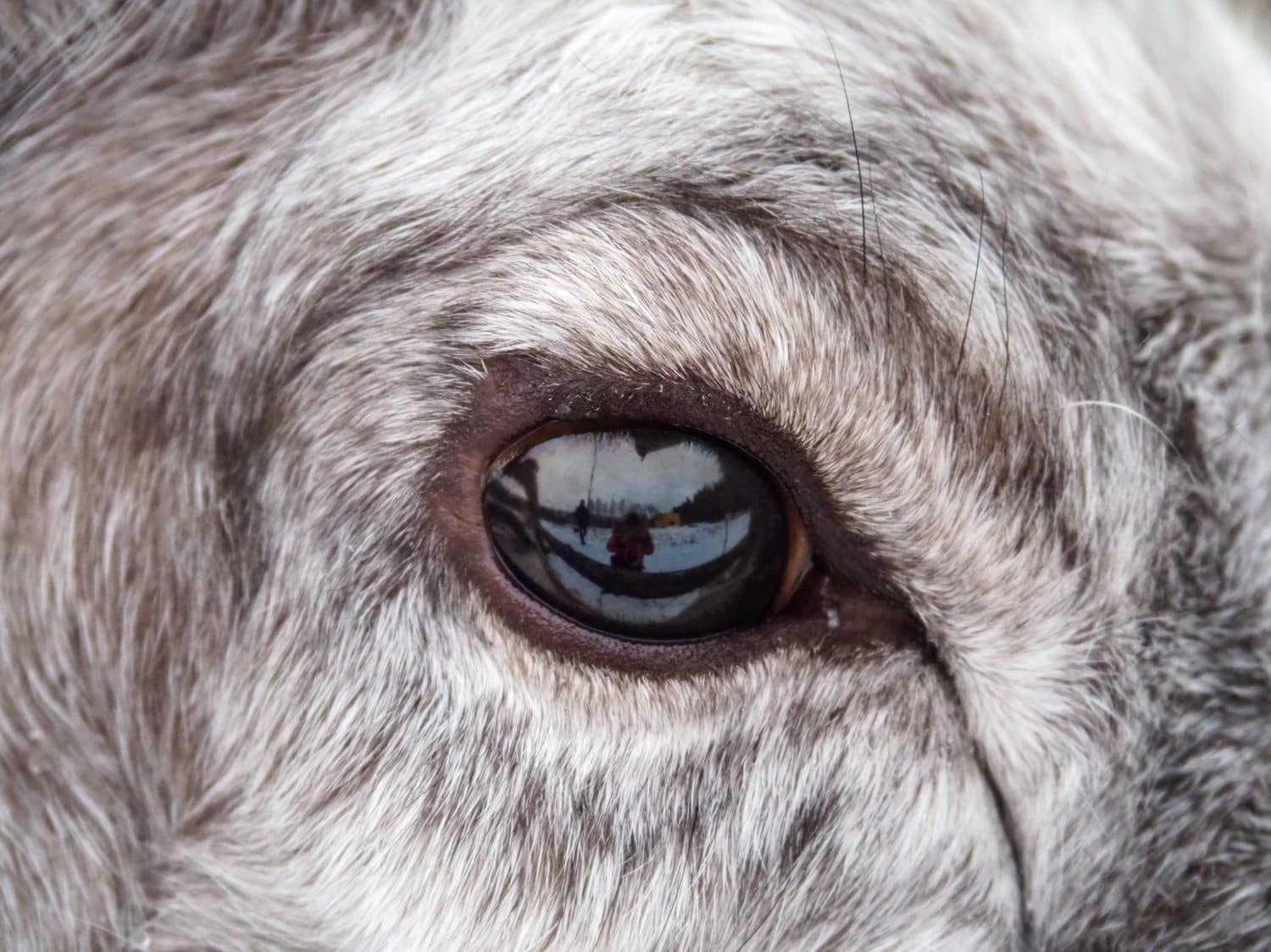
In the summer months, the Arctic reindeer has deep brown eyes.
©Polina_PM/Shutterstock.com
The ability to change their eye color is thanks to the reindeer’s tapetum lucidum, a reflective layer that sits behind the animal’s retina. The tapetum lucidum’s function is to help improve low-light vision. Not all mammals have it; it is most common in nocturnal and crepuscular animals, though some diurnal species and other animals may also possess a tapetum lucidum.
The tapetum lucidum is responsible for the golden-turquoise glow of cat and dog eyes when bright light shines on them in the dark. Even if an animal has a tapetum lucidum, though, it doesn’t mean they can change their eye color. So far, scientists have found that only the Arctic reindeer can accomplish this feat.
Why Reindeer Change Their Eye Color
For most nocturnal and crepuscular animals, the amount of time they spend moving around in low-light conditions is limited to a few hours or overnight. For the Arctic reindeer, it is a different story. In their native Arctic habitats, especially at and above 70°N latitude, the winter months mean a complete lack of sunlight. In places like Utqiagvik, Alaska, and Tromsø, Norway, the sun spends more than 60 days hiding below the horizon. This means the reindeer that live there have to cope with 24 hours of low-visibility twilight for months at a time.

Arctic winters provide very little to no natural sunlight for reindeer.
©Danita Delimont/Shutterstock.com
Winter twilight is up to 100,000 times dimmer than the light of a bright summer day. Unlike summer twilight, which has a rich, golden hue, winter twilight casts a cool blue tint across the skies. And unlike other mammals that switch between daytime and nighttime vision on a daily cycle, reindeer have to spend months in a perpetual low-light state.
Scientists believe the changing eye color is one strategy to help reindeer adapt and survive during the harsh, dark winter months. By changing the color of the tapetum lucidum, the reindeer are better able to see the lichen they depend on for food during winter. They can also more easily detect predators, like wolves and polar bears, in low-light conditions.
The Science Behind The Eye Color Change
While the ability for reindeer to change their eye color with the seasons was discovered in 2013, it took another nine years for scientists to begin to understand the dynamics behind how the change takes place. Success relied on the combined efforts of an astrophysicist and a neuroscientist. Their findings were published in 2022.
The scientists started with eyeballs collected from deceased reindeer by members of the Sami tribe of Scandinavian Indigenous people. The Sami are the traditional reindeer herders in the region. The eyeballs the Sami collected were divided into two groups: reindeer that died in the summer and those that died in the winter.
Reindeer tapeta consist of microscopic collagen fibers suspended in fluid. Scientists dissected the eyes and made a significant discovery. The summer eyes had tapeta fibers that floated freely, while the winter eyes had fibers that were densely packed together.

During Arctic summers, reindeer enjoy many hours of bright, golden sunlight.
©Dean Biggins – Public Domain
When the fibers float freely, the reflective tapetum lucidum best captures reddish-gold light from the UV spectrum. That is the kind of natural light present in the Arctic summer. When the fibers are packed together, more blue light is reflected. This adaptation helps maximize visibility in the Arctic’s winter lighting conditions.
Scientists believe the tapeta fiber change occurs because reindeer continuously dilate their pupils during the winter months. When the pupils are dilated, the normal drainage hole for eye fluid is blocked. This, in turn, increases the eye pressure, which compresses the tapetum fibers and changes the tapetum’s shape.
According to the scientists, the result is that reindeer eyes are much more sensitive in winter than in summer. However, the scientists stopped short of concluding that it is only Arctic reindeer that possess this unique ability. They point out that other similarly situated animals have yet to be studied in this way. Researchers plan to study other Arctic mammals in the future to see if they share this ability.