
Quick Take
- Those drab, female-looking ducks in your backyard this summer aren't imposters. Your drake mallards are hiding in plain sight for a very specific reason. See the disguise explained →
- Once a year, male mallards do something so drastic that it leaves them completely defenseless for weeks. It is not what you would expect from such a common bird. Discover the eclipse molt →
- Scientists tried to figure out what triggers this dramatic transformation and got a surprising answer. The real cause isn't what they originally suspected. See the surprising trigger →
Have you noticed something strange about the drake mallards in your neighborhood this month? Are they covered in mud? Are they ill? Have they disappeared and been replaced by other ducks that look more like females? Don’t worry—the mallards are still there! They’ve just temporarily changed their appearance. Let us explain why and how.
About Mallard Ducks
Mallards (Anas platyrhynchos) are among the most common ducks in the world. They are native to much of the Northern Hemisphere, including North America, Europe, and Asia, and have also been introduced to regions such as New Zealand and parts of Australia. In terms of population, they dominate the Northern Hemisphere and are a familiar sight to many people.
These ducks prefer to live in wetlands where they can find plenty of insects, worms, gastropods, arthropods, and vegetation to eat. They are also known to take advantage of human food sources, such as grain from crops.
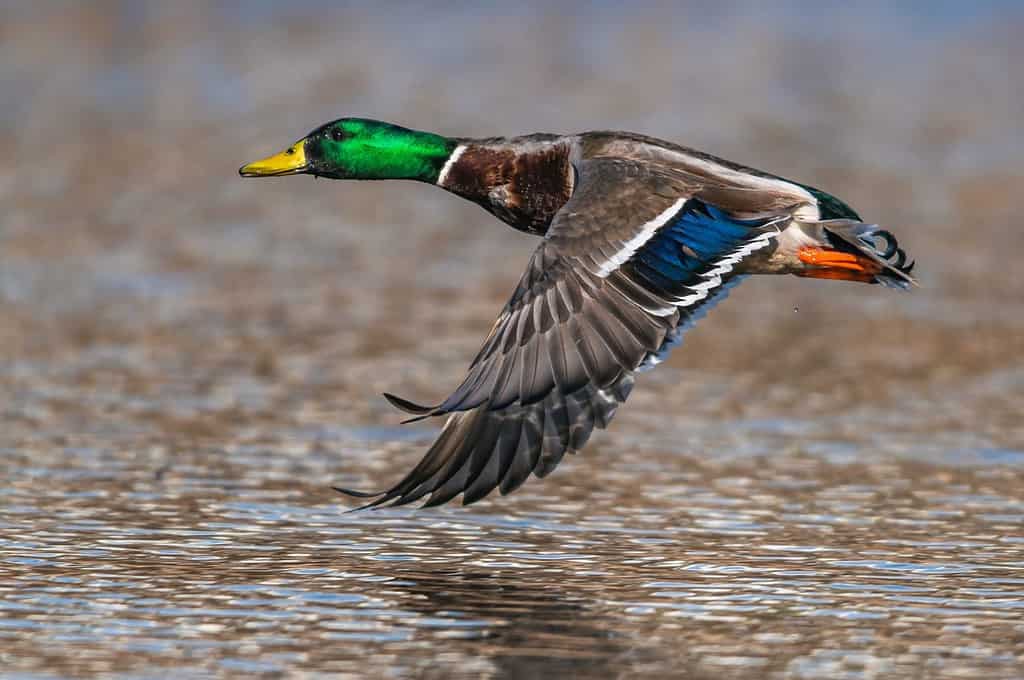
Mallard drake plumage is highly recognizable.
©Maciej Olszewski/Shutterstock.com
Mallards migrate from northern latitudes to warmer southern areas. That said, not all mallards migrate, and some choose to spend the winter in cooler areas as long as food and shelter are available. These are called resident populations.
Drake mallards are among the most easily recognizable waterfowl in the world. They have green iridescent plumage on their heads and necks, curled black feathers on their tails, and a white collar around their necks. In contrast, females have mottled brown plumage.
Mallard Breeding Season
When it comes to breeding, bonding starts as early as October and continues through March. As is the case with many birds, the male’s plumage is designed to attract a mate. Males with impressive plumage are showing off their virility and their credentials as good fathers. All female ducks want their offspring to inherit good genes!
After mating, the male mallard leaves. The female then lays between nine and thirteen eggs in a nest she builds on the ground, always near a body of water such as a lake or river. The eggs hatch after 26 to 28 days, and the female leads her ducklings to the water, where she continues to care for them. They do not return to the nest.
What Is the Mallard Eclipse Molt?
After the breeding season, drake mallards no longer need their colorful plumage and begin to replace their worn-out feathers. Unlike some birds that molt gradually, mallards lose all of their flight feathers at once. For about a month, they are unable to fly and become very vulnerable to predators, so they tend to hide during this period.
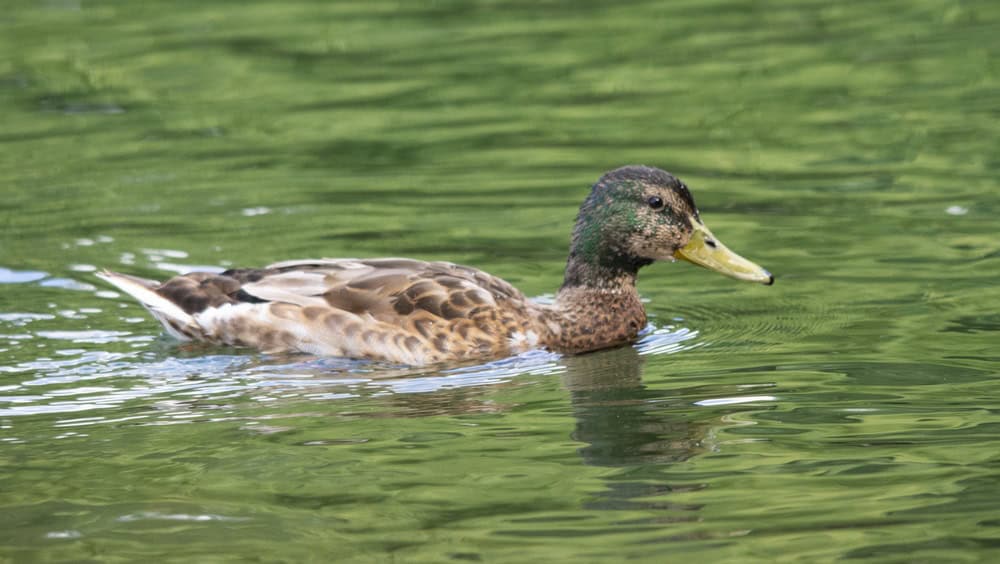
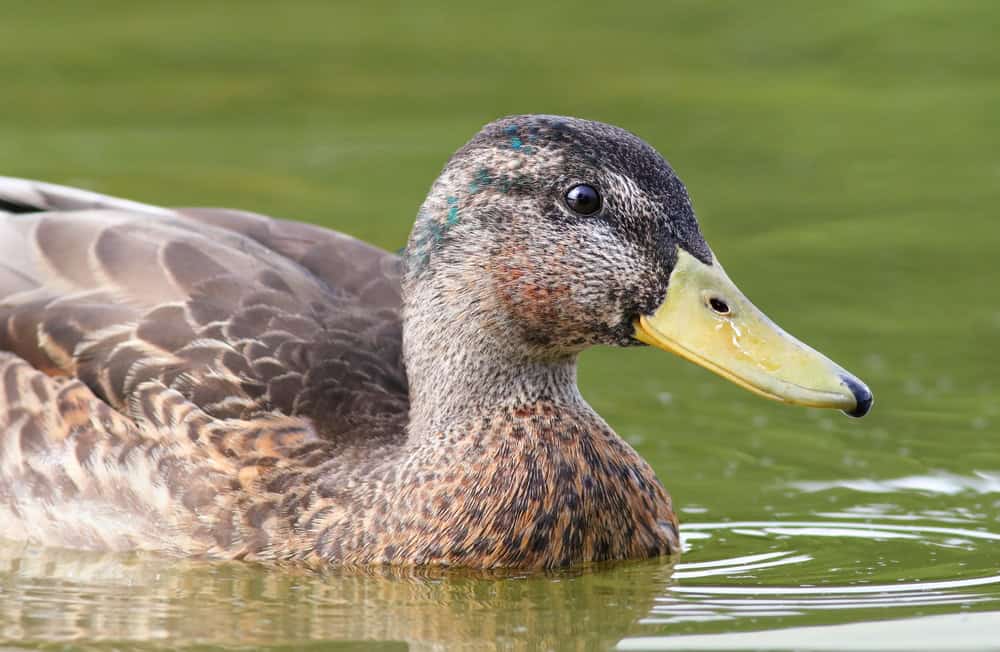
Drake mallard eclipse plumage is drab.
©Ahmet27/Shutterstock.com
This plumage is called ‘eclipse’ and lasts until the fall. During this time, it may seem as if all the males have disappeared, but in reality, they are camouflaged among the females. If you look closely, you can distinguish drake mallards by their uniform yellow bills, while females have orange bills with black markings.
The males then undergo a second molt, during which they lose their drab feathers and regrow their colorful plumage. This molt is less severe, and the ducks remain able to fly. One advantage of the plain plumage is that it helps the ducks blend in more easily with their surroundings.
What Causes the Eclipse Plumage?
Scientists have investigated exactly what triggers such a drastic molt in male mallards. They were able to trigger a premature molt in February and March by exposing the birds to artificial light in addition to normal daylight. When researchers castrated male mallards, it did not prevent an eclipse molt in the first year. In the second year, however, the eclipse molt did not occur. These studies indicate that the eclipse plumage is not caused by the direct action of testicular hormones on the feather follicle. It’s more likely that it is connected with another endocrine organ, which eventually responds to the lack of testicular hormones. These hormones make the bird’s body sensitive to seasonal light changes. It is the light changes that produce the hormones that lead to the eclipse.
Which Other Birds Have Eclipse Plumage?
Mallard ducks are not the only birds to experience an eclipse molt. It’s also seen in many other waterfowl. This includes the American wigeon (Mareca americana). Breeding males have a wide green stripe behind their eyes, a white cap with green secondary feathers on their wings, and white feathers under the wings. The eclipse male has a brownish-gray head and a dark smudge around the eye. The white patch on the wing and the green secondaries are not always visible.
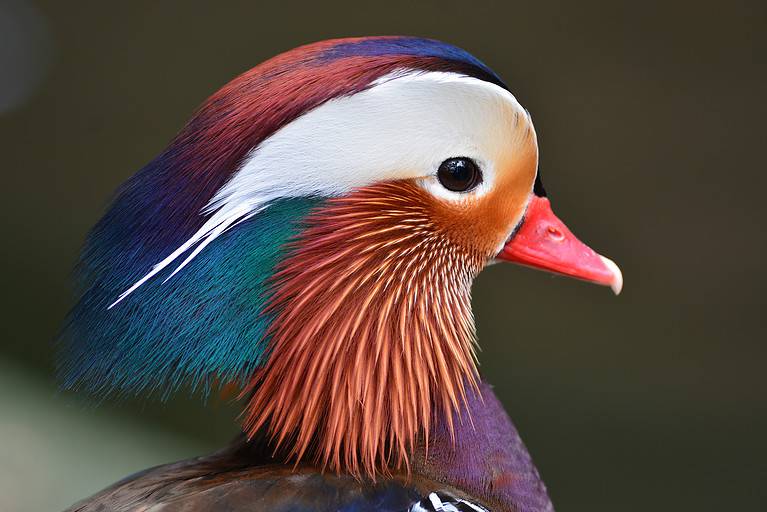
Eclipse plumage is also seen in other birds, including the cinnamon teal, Eurasian teal, common goldeneye, and mandarin duck.