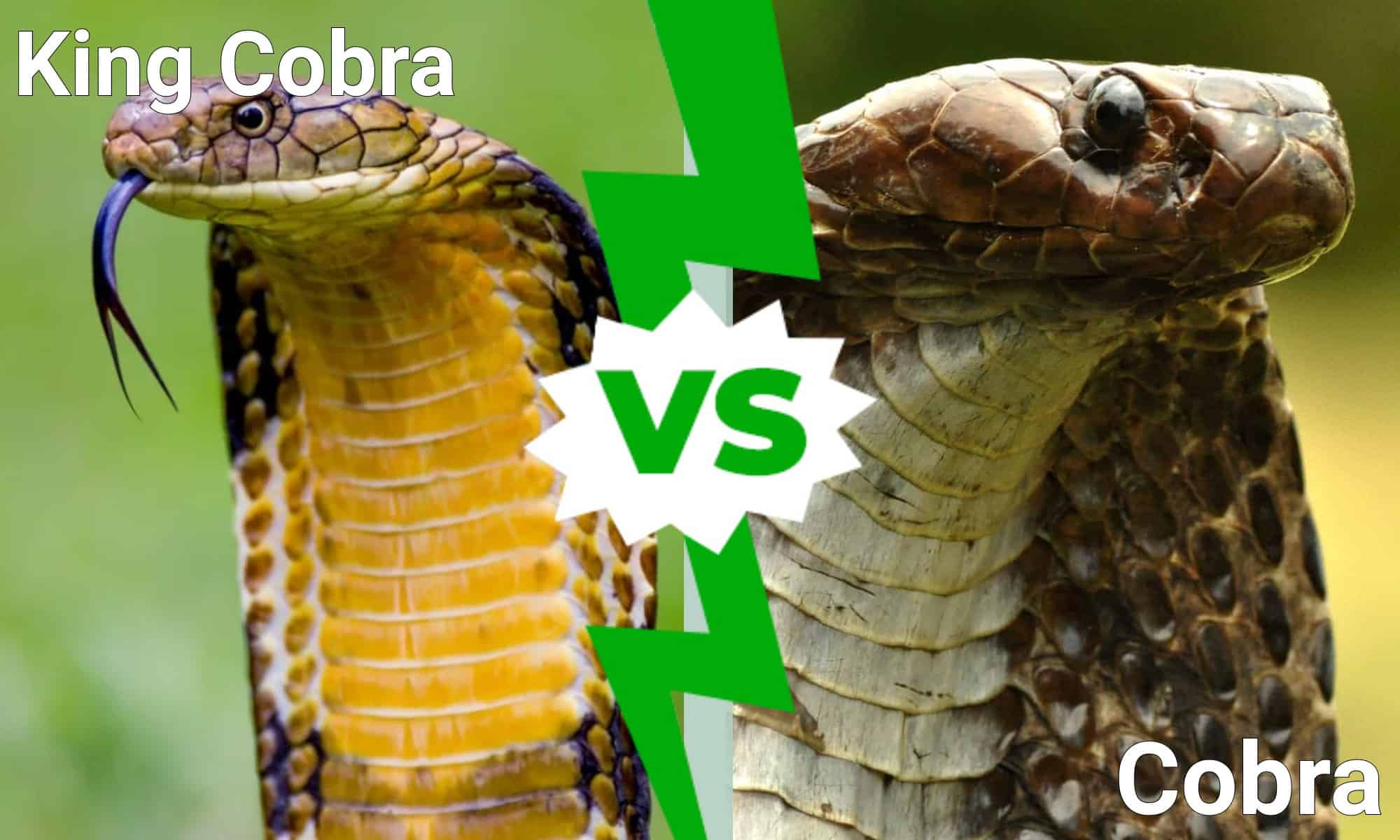

Have you ever wondered what the difference is between a cobra vs. a king cobra? Or why a specific cobra is called the “king?” If you spotted these two types of snakes in the wild, could you tell them apart? While they share a few characteristics, some key characteristics set them apart. Not only are there important genetic distinctions between these snakes, but there are also significant differences in size, appearance, diet, venom, behavior, and habitat. Learn how these snakes match up in our comparison of the cobra vs. king cobra.
When Is a Cobra Not a Cobra?
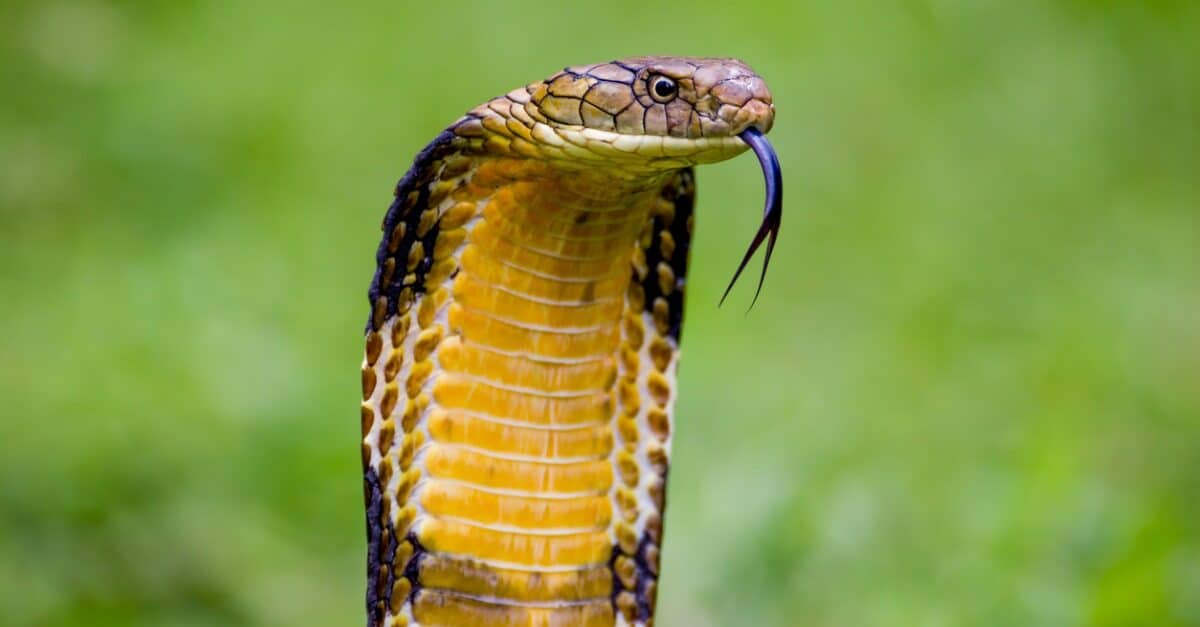
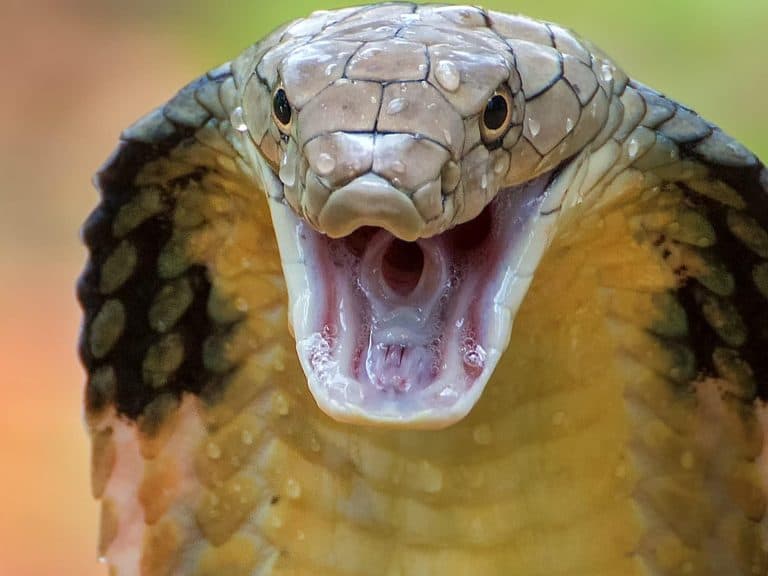
King cobras are more closely related to mambas than cobras.
©iStock.com/takeo1775
Although these snakes both flare their hoods and share the name “cobra,” king cobras belong to the genus Ophiophagus, while other cobras belong to the genus Naja. In fact, biologists do not even consider the king cobra to be a cobra at all. Only the snakes in the genus Naja are considered true cobras. So, why don’t they share a genus?
Both cobras and king cobras belong to the Elapidae family. Elapids are venomous snakes with short, fixed, forward-positioned fangs. However, genetic studies have shown that the king cobra is a branch off the lineage that led to mambas, rather than Naja cobras. So, genetically speaking, the king cobra is more closely related to mambas than cobras.
King Size
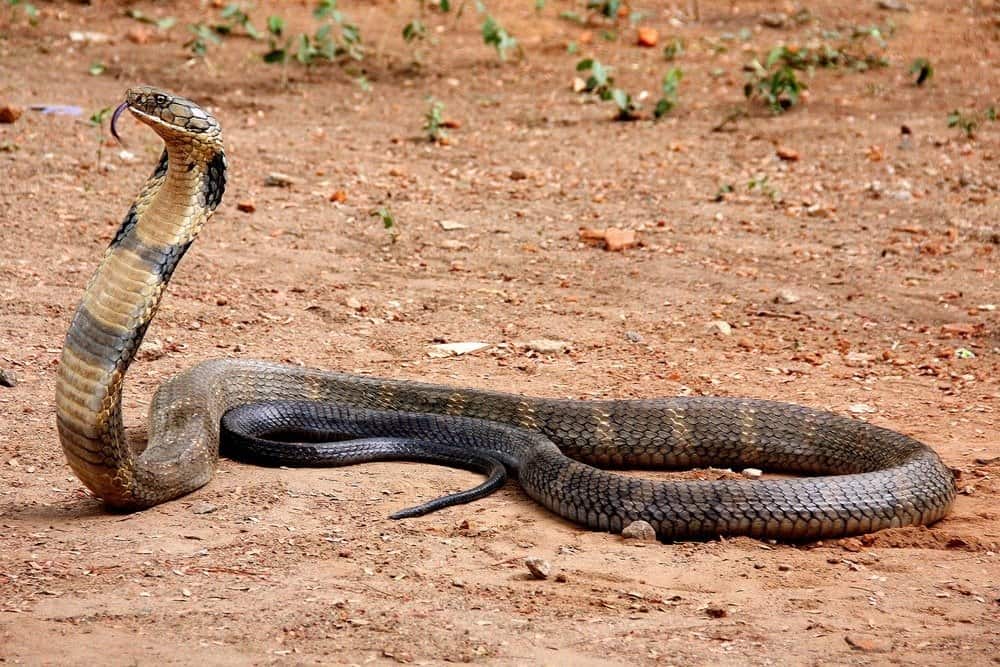
King cobras can reach lengths of around 18 feet.
©Jolly Therattil/Shutterstock.com
The most obvious difference between a cobra and a king cobra is their relative size. King cobras are the largest venomous snakes on the planet. Among the four king cobra species, these snakes typically grow to between 10-12 feet in length. However, some cobras have been documented to reach upwards of 18 feet long. The longest cobra on record reached an incredible 18.7 feet in length. King cobras are also bulky snakes, weighing from 13 to 26 pounds.
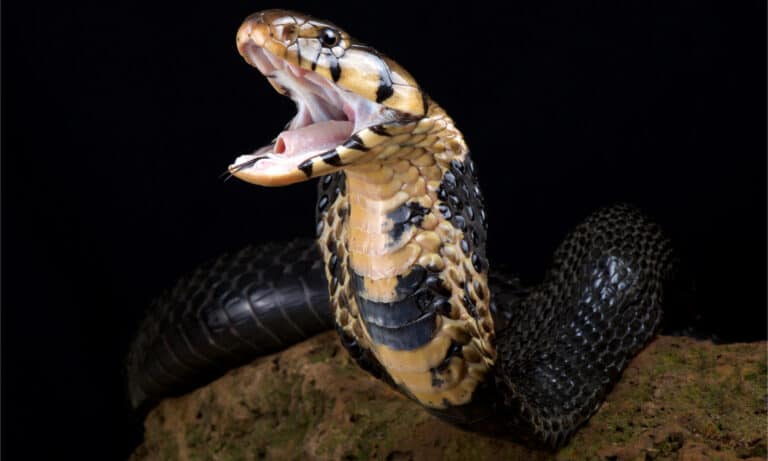
Although there are over 30 different Naja cobra species, they generally only grow to between 3-7 feet long. The longest Naja cobra is believed to be the forest cobra (Naja melanoleuca) found across sub-Saharan Africa. This cobra has a maximum recorded length of around 9 feet. The forest cobra is also thought to be the heaviest true cobra, weighing up to around 8 pounds. This makes the largest king cobras twice as long and over three times as heavy as the largest true cobras.
Appearances Can Be Deceiving
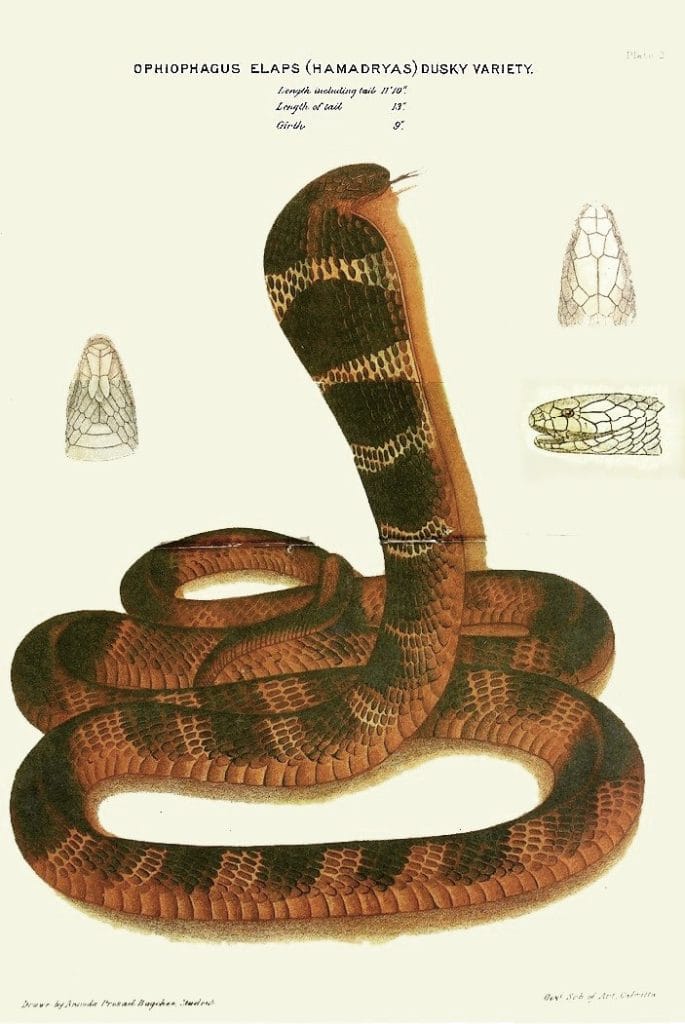
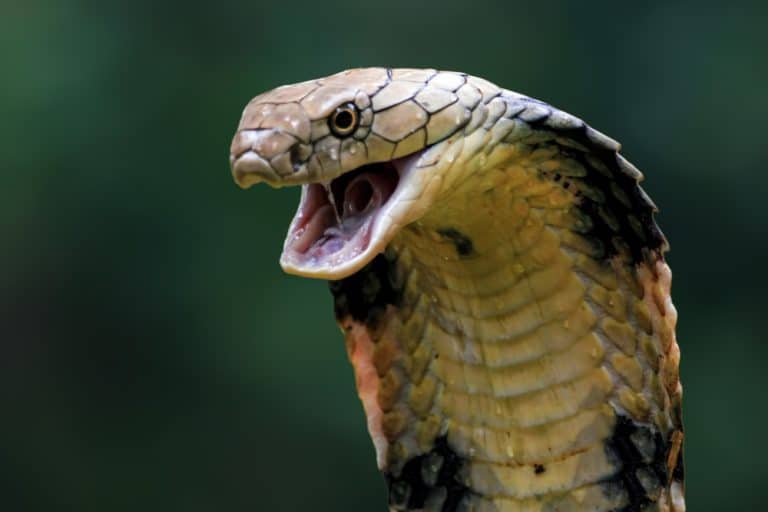
The king cobra has a pair of large occipital scales on the back of the head, shown at the bottom of the image in the top right-hand corner.
There are other differences in appearance in addition to size. One difference is their hoods. When king cobras are threatened, they display a long, narrow hood similar to that of a mamba. Their hoods typically have narrow bands or chevron-like patterns, as shown in the image above. True cobras have shorter, broader hoods with a more conspicuous flare. Cobras also have a wide variety of markings on their hoods, depending on the species.
Other differences are the shape of their heads and their head scalation. King cobras have longer, broader heads in proportion to their bodies than true cobras. King cobras also have a pair of large, elongated scales, called occipitals, on the back of their heads, as shown in the top right-hand corner of the image above. These are located behind the nine-scale arrangement typically found on other elapids and colubrids. However, true cobras do not have occipital scales at all.
You Are What You Eat
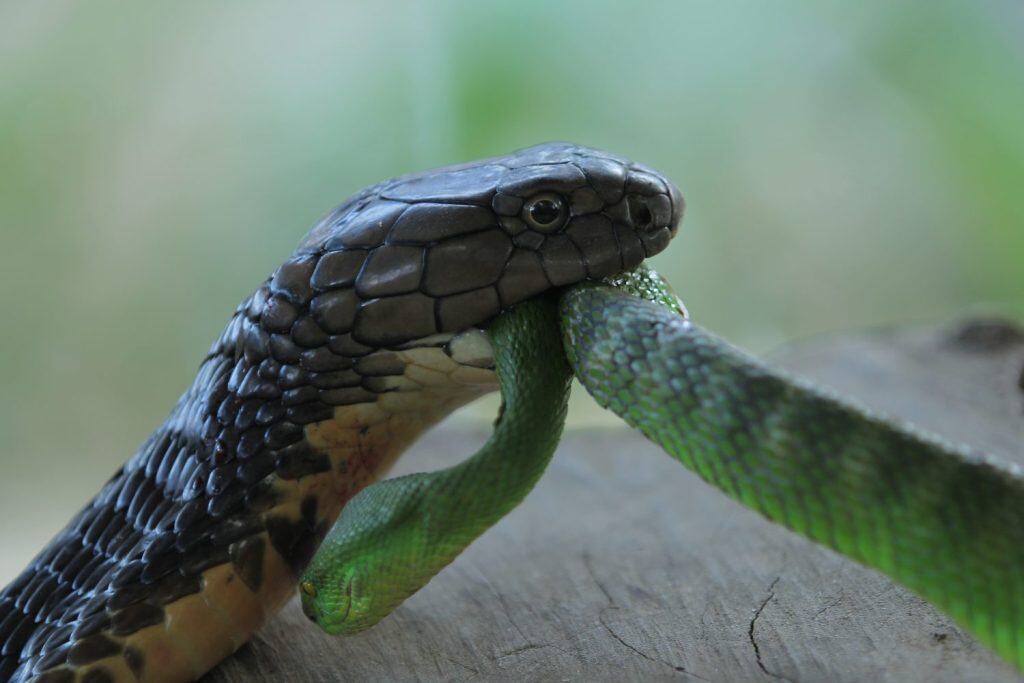
King cobras eat other snakes, including other venomous snakes like this green pit viper.
©Mufti Adi Utomo/Shutterstock.com
The genus of the king cobra, “Ophiophagus,” is derived from the Greek words that mean “snake-eating.” The king cobra primarily preys on other snakes, including venomous snakes, such as other king cobras. The snake’s resemblance to cobras and its ability to subdue other snakes is how the “king” cobra earned its name. Harmless snakes in the king cobra’s diet include rat snakes and pythons, while venomous snakes include kraits, pit vipers, and other cobras. They have also been documented eating other cold-blooded prey such as large monitor lizards, as well as small mammals and birds when food is scarce.
In contrast, Naja cobras are more opportunistic hunters, eating a wider variety of prey. They tend to consume more warm-blooded prey, such as rodents, rabbits, and other small mammals, depending on the prey that is available in the snake’s habitat. However, cobras also eat birds and their eggs, amphibians such as frogs and toads, small reptiles (including various lizard species and young turtles), and even fish if their habitat is close to water.
Full of Venom

A king cobra bite can contain as much as 1 gram of venom.
©Ton Ponchai/Shutterstock.com
Both cobras and king cobras have primarily neurotoxic venom, meaning it affects the nervous system. Cobras and king cobras strike and inject their prey with venom to immobilize it, then they swallow their prey whole. The differences lie in the complexity and the amount of venom these snakes inject. Cobras have long been said to have more concentrated venom than king cobras. A commonly held belief is that king cobras compensate for a lack of potency by injecting their victims with more venom. However, that’s not always the case. Researchers have found that although king cobra venom is relatively less complex than Indian cobra (Naja naja) venom, it is equally potent. They have also found that the venom of some king cobra species is more lethal than others.
Scientists believe king cobra venom may have less diversity in toxin types than Naja cobras because king cobras are specialist predators. True cobras eat a wider variety of prey, so they have evolved more diverse toxin types. King cobras are also thought to deliver so much venom per bite because they require more venom to overpower large, dangerous snakes. Their bites can contain up to 1 gram (dry weight) of venom, which is enough to kill 20 humans, or even an elephant. The most venomous Naja cobra, the Caspian cobra (Naja oxiana), was found to have a maximum of 784mg of venom. However, most cobras only have one-quarter the amount of venom as the king cobra.
Civil Serpents

Despite their aggressive reputations, king cobras are typically more cautious than other cobras.
©Kurit afshen/Shutterstock.com
King cobras are generally more cautious than other cobras. They are not particularly aggressive unless cornered or threatened, although a nesting mother may attack without provocation. Despite their size and reputation, these snakes prefer to avoid confrontation. King cobras kill fewer than five people each year, but envenomation from Naja species is one of the leading causes of death in Asia.
The king cobra is also the only snake species known to build a nest for its eggs. Females use their bodies to push leaves into a pile, often under a large tree. The mother remains on or near the nest during the 75- to 100-day incubation period and fiercely guards her eggs. Most snakes abandon the eggs as soon as they are laid. While both king cobras and Naja cobras hiss, only king cobras growl. Normal hissing sounds fall between 3,000 and 13,000 Hz. However, king cobras make low-pitched growling sounds under 2,500 Hz, with most sounds closer to 600 Hz. Unlike most snakes, the king cobra has special pouches in the walls of its trachea that help these lower frequencies resonate.
Inhabiting Their Native Habitats
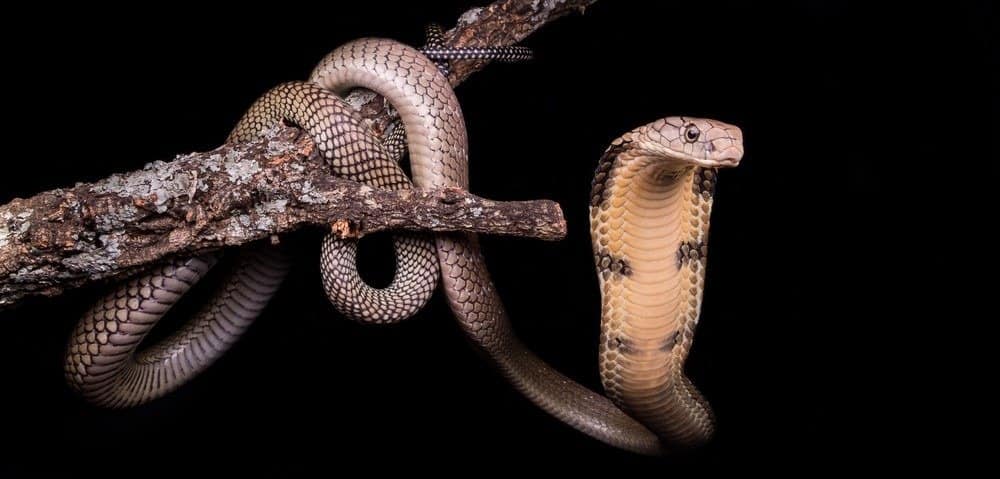
King cobras spend around one-quarter of their time in trees.
©Sibons photography/Shutterstock.com
King cobras are found across South and Southeast Asia, from northern India eastward to southern China. Just as king cobras have a more specialized diet, they also prefer a more specialized habitat. Although they are known to be adaptable, king cobras favor tropical forests near water sources due to the more humid climate conditions. They also flourish in environments with dense vegetation, like mangrove swamps and bamboo forests. King cobras are skilled climbers and spend about a quarter of their time in trees. Among true cobras, only the forest cobra is known to spend a significant amount of time in trees.
With so many different species, it’s no surprise that Naja cobras inhabit a wide variety of habitats. These snakes also inhabit Southeast Asia, but unlike king cobras, Naja cobras have a wide distribution throughout Africa and the Middle East. Across Asia and Africa, cobras inhabit woodlands, grasslands, savannas, forests, plains, steppes, mountains, rocky hillsides, wetlands, and even deserts. Many cobra species, including Indian cobras and forest cobras, are also known to be adaptable, living in various environments throughout their range.