
Quick Take
- Legend says King Arthur never truly left Tintagel, and the chough's striking red features are said to be the proof of his enduring presence. Why these birds carry his legacy is stranger than you'd expect. Discover the Arthurian legend →
- Cornwall's 'national bird' vanished for a century, and its comeback was no accident. One quiet conservation secret kept it alive long enough to matter. See the conservation comeback →
- Egg collectors weren't the only threat that nearly wiped choughs from Cornwall forever, and the real culprit behind their collapse is hiding in plain sight across the coastline. Explore the real causes of decline →
- Conservationists spotted choughs at Tintagel months before telling anyone, and their reason for staying silent reveals exactly what it takes to bring a lost species back. Read the Tintagel secret →
After an absence of a hundred years, a bird steeped in English legend has returned to its atmospheric castle home. English Heritage has announced that rare red-billed choughs have been spotted in the area of Tintagel Castle in the rugged county of Cornwall. This is none other than the site of the legendary King Arthur’s conception!
What We Know About Red-Billed Choughs
Red-billed choughs (Pyrrhocorax pyrrhocorax) are members of the crow family. They have a distinctive appearance with shiny, black plumage. Their bill is long, curved, and bright red, and they also have bright red legs. This sets them apart from other corvids.
They are a non-migratory species and are found throughout southern Europe and in mountainous areas in Central Asia, India, and China. These choughs form colonies and roost on rock crevices, ledges, cliff faces, and sometimes in abandoned buildings.
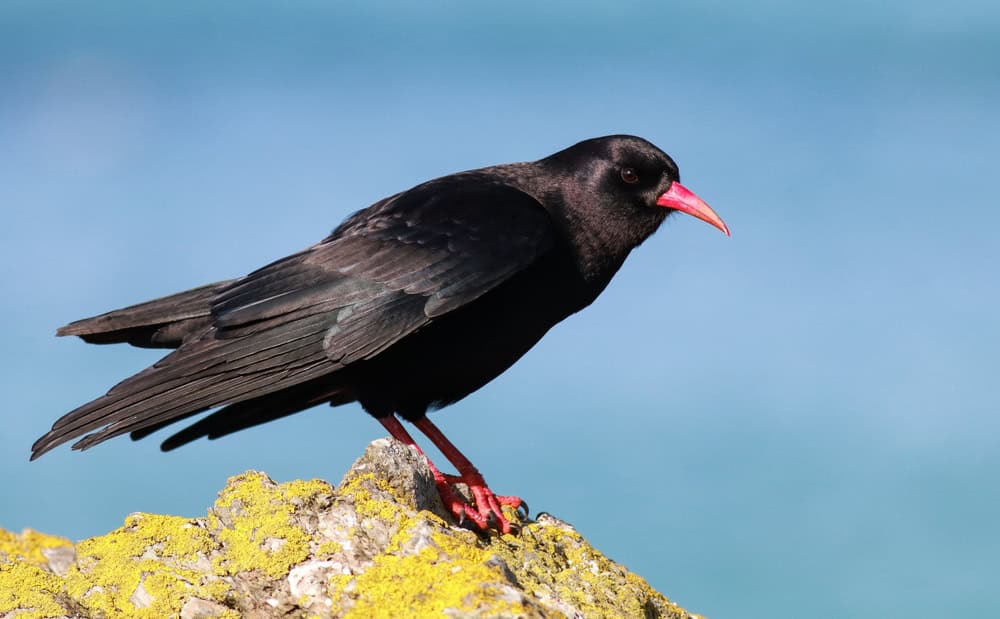
Red-billed choughs have long, red bills and red legs.
©Ed Betteridge/Shutterstock.com
They prefer to live in short coastal pastures, especially those grazed by sheep. As an insectivore, they mainly feed on insects but will also eat other invertebrates. Their diet is usually made up of ground-dwelling beetles, ants, fly larvae, and spiders. However, they will also eat earthworms, berries, and even cereal grains. These birds feed as breeding pairs as part of the larger colony.
They form monogamous lifelong bonds and build loosely constructed nests of sticks lined with moss, grasses, and animal fur. These are usually concealed within cracks in cliff faces or deep inside caves. They may also build nests in buildings. Nests are often recycled and used for many years. Each year, they are refurbished with some new animal fur lining.
Why Are These Birds So Special in Cornwall?
The red-billed chough is considered Cornwall’s “national bird” and even features in its coat of arms. Tintagel Castle’s mysterious ruins stand partly on the mainland and partly on an island. The castle has a long association with the Arthurian legends, and in the 12th century, Geoffrey of Monmouth wrote that King Arthur was conceived here. Since then, numerous poems, illustrations, engravings, and paintings have linked the legendary king with this area. It’s claimed that his spirit lives on in the birds and that their bright red feet and beak represent his blood.
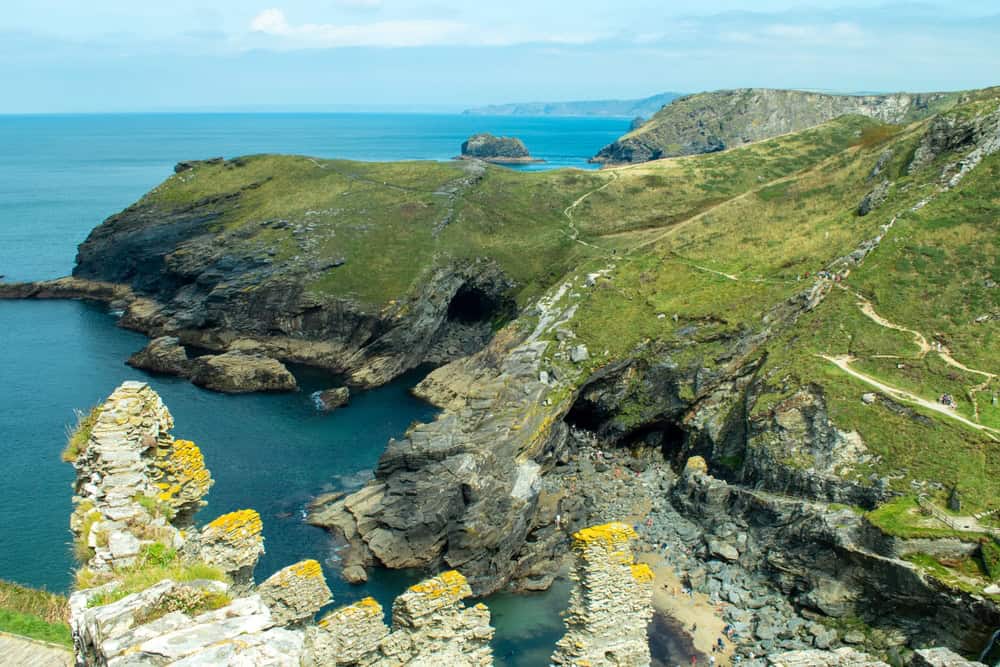
Tintagel Castle is steeped in legend.
©Jonathan Angle/Shutterstock.com
These birds were once widespread along the UK coast, with Cornwall serving as a stronghold. However, they struggled due to the loss of their cliff-top habitats. Many well-grazed coastal pastures, once common, have been ploughed for arable crops or have become overgrown with scrub. Additionally, the practice of low-intensity grazing has largely been abandoned. Egg collectors and trophy hunters put additional pressure on the birds’ populations, which was further compounded by bad weather and predation. The last chough was seen nesting in Cornwall in 1952. But now they are back!
Working to Return Choughs to Cornwall
Chough conservationists knew that there were around 300 breeding pairs in other parts of the UK, including in Wales, the Isle of Man, and western Scotland. Dedicated conservation work has brought them back to other areas of the UK, including Kent. There is also a larger population in Ireland. For many years, they have been working to restore suitable habitats for the birds in Cornwall. There was great excitement in 2001 when four wild choughs were seen in west Cornwall, and three took up residence. In 2002, two of these birds began nesting. That year, the first clutch of eggs for 50 years was laid in the county. Volunteers provided round-the-clock protection to keep them safe from egg collectors.
By the summer of 2019, there were nearly 100 birds in Cornwall, and they were going from strength to strength.
Keeping a Secret at Tintagel
These amazing birds have actually been seen from time to time at Tintagel since September 2024, but the local conservationists kept it a secret. They wanted to give the birds time to settle into their new home without being disturbed. Now, however, the word is out, and their return has been widely reported in both local and national media.
Speaking in this English Heritage Press Release, Hilary Mitchell and Steve Ashby of Cornwall Birds said: “This is an amazing conservation success story, a testament to the work done by conservation organisations, farmers, landowners, and volunteers. Their dedication restored habitat essential for our Chough to thrive and kept the birds safe so that they could recolonise the Cornish coast.”
If you visit Tintagel Castle this year, you may be lucky enough to see a red-billed chough for yourself. There are a few pairs of binoculars available to loan from the visitor center. Catching a glimpse of this legendary bird with the castle as a backdrop would be a very special experience!