
Quick Take
- Angel sharks haven't meaningfully changed in 150 million years, and the reason evolution left them alone says something unsettling about how predators reach perfection. Explore their ancient origins →
- These sharks can't breathe the way other sharks do, and the workaround they evolved is also what makes them nearly undetectable ambush killers. See how spiracles enable ambush →
- The most common angel shark species faces a collapse that has nothing to do with predators or habitat loss, with the cause hiding in plain sight. Discover the trawling threat →
- Angel sharks are generally considered harmless, yet one species earned a name that tells a very different story, and the reason behind it is weirder than you'd think. Meet the sand devil namesake →
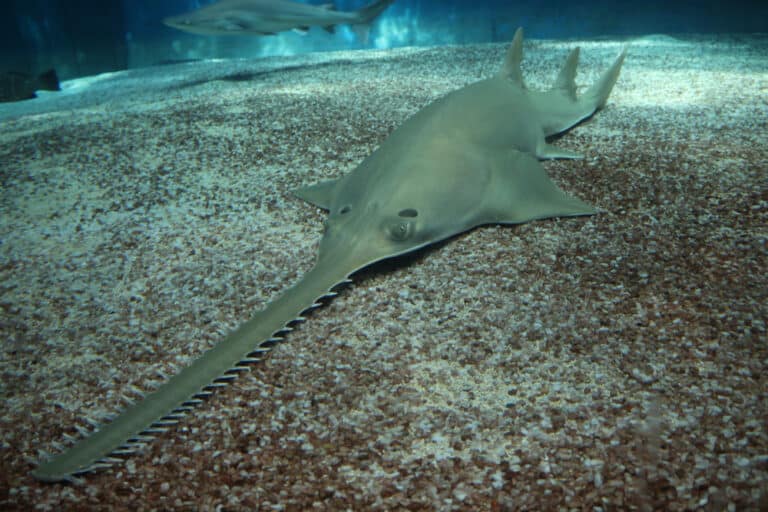
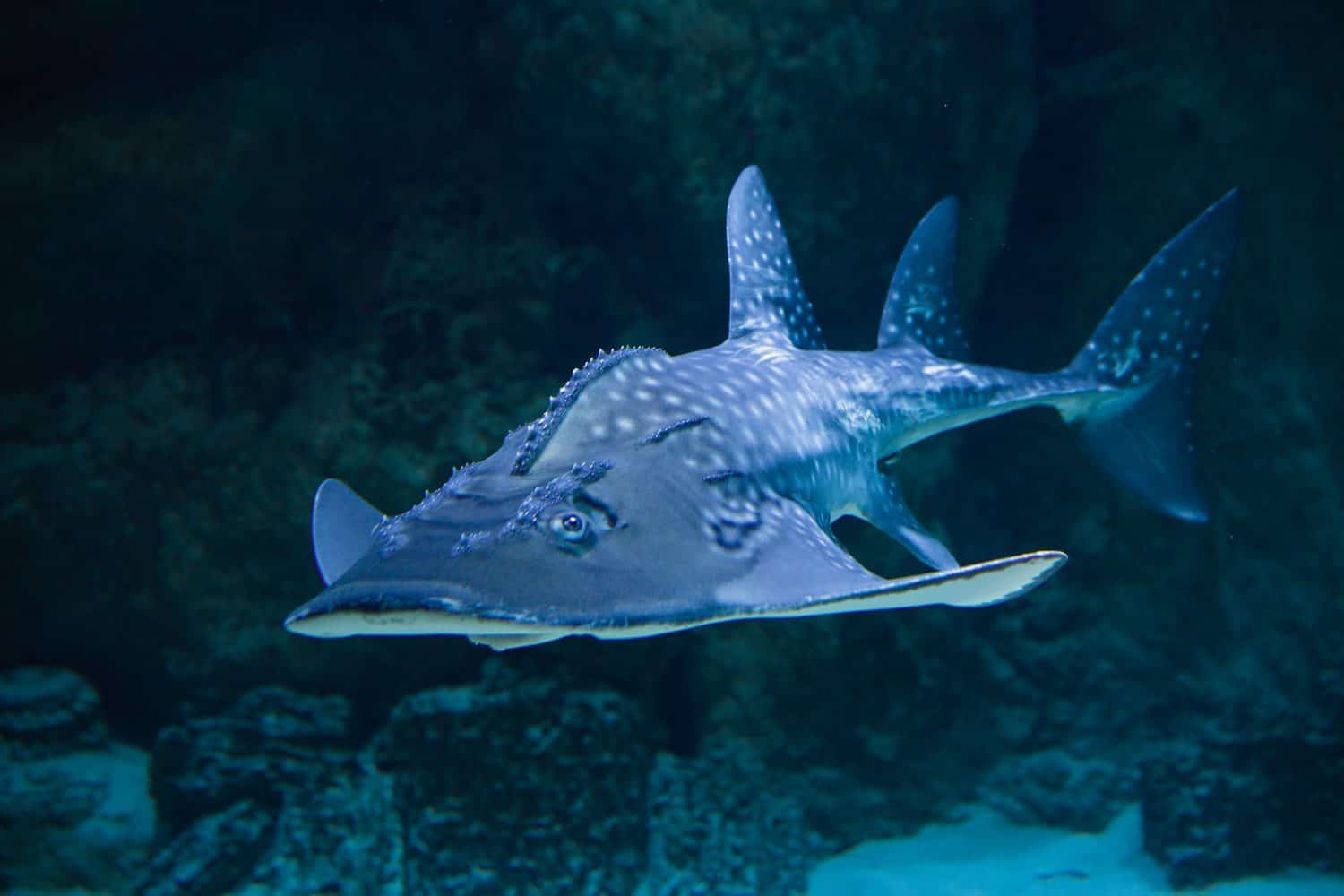
One look at the Squatiniformes order of sharks and you can easily see why people confuse them with stingrays. This order contains only a single family and a single genus, comprising over 20 species. Squatiniformes are found worldwide, often living on tropical and temperate continental shelves. Very different from the sharks that are often depicted in movies, Squatiniformes are bottom-dwellers, with flat, ray-like forms, wide pectoral fins, and dorsal eyes. They may not be cresting waves like their larger relatives, but their features make them remarkable ambush predators.
Squatiniformes are like the missing link between sharks and stingrays. What make them stand apart, however, are their broad pectoral fins separated from the head. They feature anterior lobes that largely conceal their five pairs of gill slits, which are laterally situated on the sides of the body. Like other shark species (such as dogfish), Squatiniformes lack anal fins but feature two spineless dorsal fins near the base of their tails. On the whole, Squatiniformes are a smaller order, typically ranging between 1 and 2 meters in length. These modest sizes help them hide on the seafloor where they use nasal barbels to detect prey.
Quick Strikes
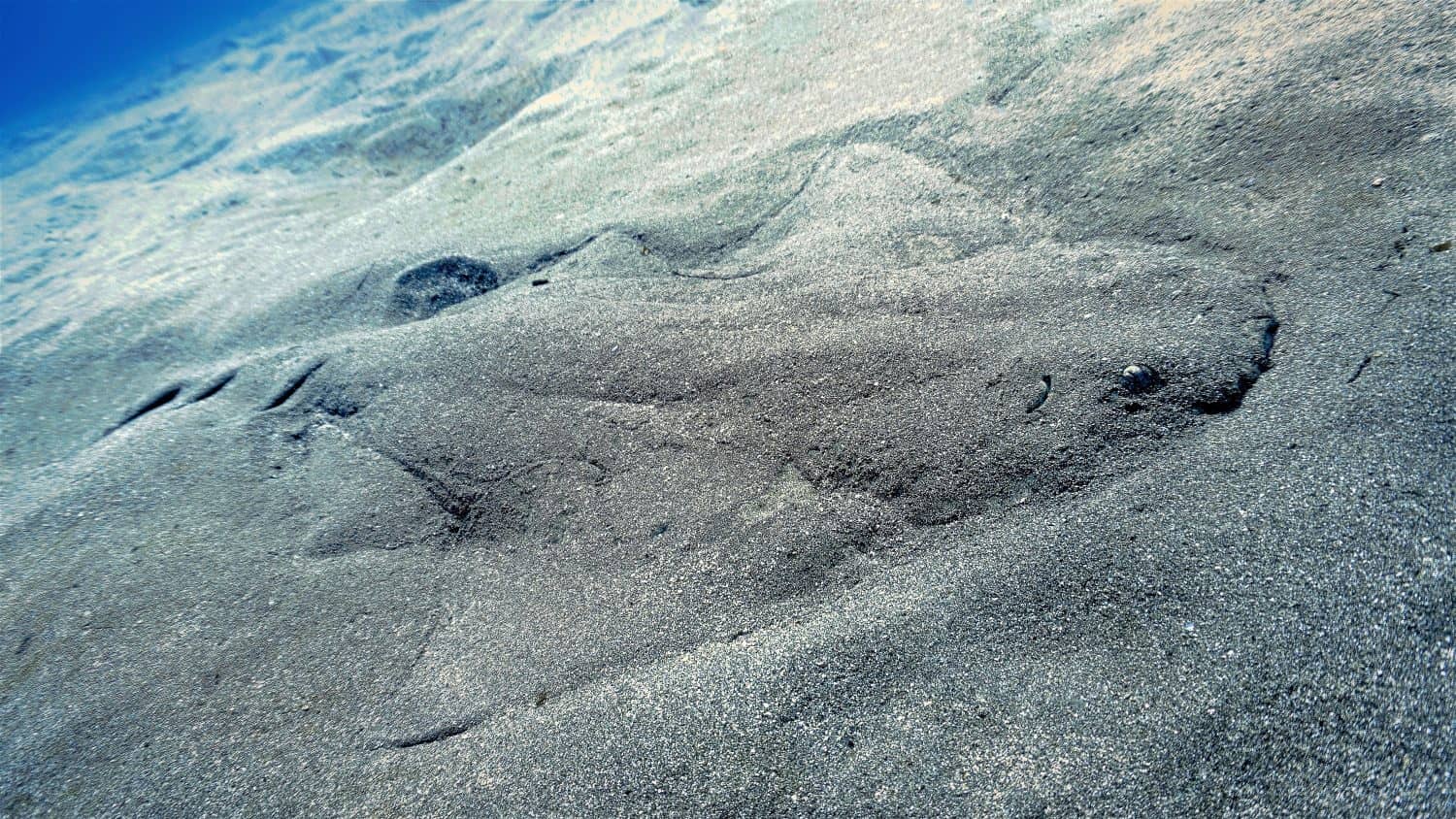
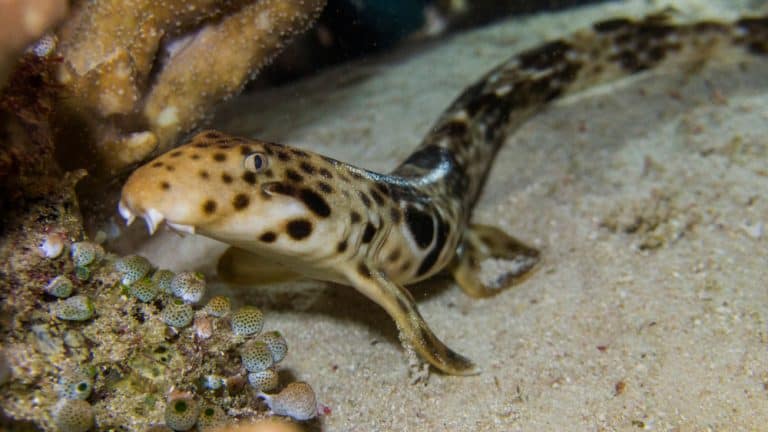
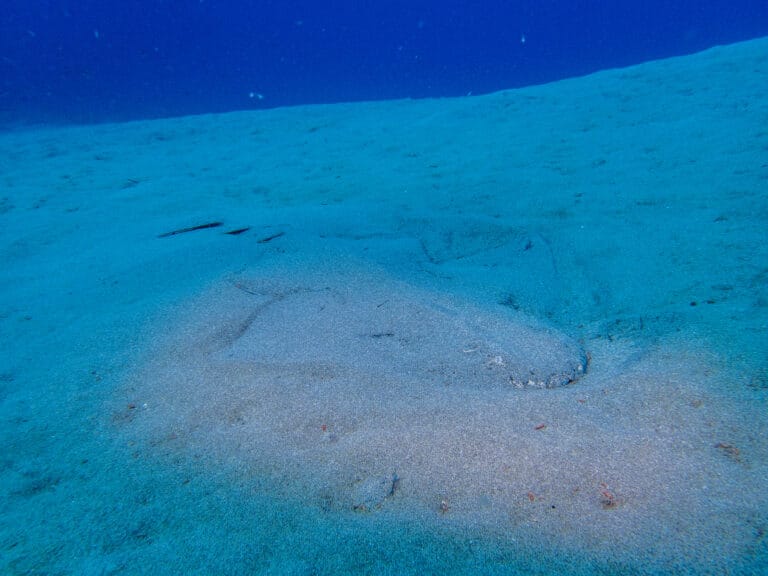
The squatiniform tendency to submerge in the sand makes them difficult to spot.
©Johan Holmdahl/Shutterstock.com
Once they do detect prey, however, Squatiniformes strike with incredible speed, emerging from the seafloor sediment with unhinged jaws to snatch and swallow prey whole in under 100 milliseconds. In the process, their unhinged jaws take in a considerable amount of water along with their targets. Typically, these targets are fish, mollusks, crustaceans, and other creatures found on the ocean floor.
Whereas other creatures rely on sight to spot prey and attack, Squatiniformes sharks detect potential meals with nasal barbels. These whisker-like appendages can detect water displacement, and their electroreceptors can find nearby fish and crustaceans.
Waiting on the ocean floor sediment and mud all day, however, requires specialized breathing. Larger shark species must keep swimming to wash water over their gills. Squatiniformes use muscle contraction to breathe. They rely on tube-like holes that sit below their eyes, called spiracles. They contract their throat muscles, pulling water through their spiracles before pushing it out of their underside gills. This allows these sharks to breathe clean water for extended periods without giving away their ambush-ready positions in the sediment.
An Ancient Order
The earliest evidence of the Squatiniformes order comes from Late Jurassic era fossils found in Germany. Though they lived some 150–160 million years ago, these early examples, like the Pseudorhina fossil, featured the same characteristics as modern Squatiniformes: wide pectoral and pelvic fins, and flat bodies suited for ambush hunting along the seafloor.
We’ve been using the proper term Squatiniformes so far, but it’s important to note that many species in this order are called angelsharks. Fossils dated to tens of millions of years ago are nearly identical to modern angel sharks. It seems that ambushing prey from the ocean floor was so efficient that these sharks had little reason to change over millions of years. Let’s learn more about these species and their unique characteristics.
Common Angelshark
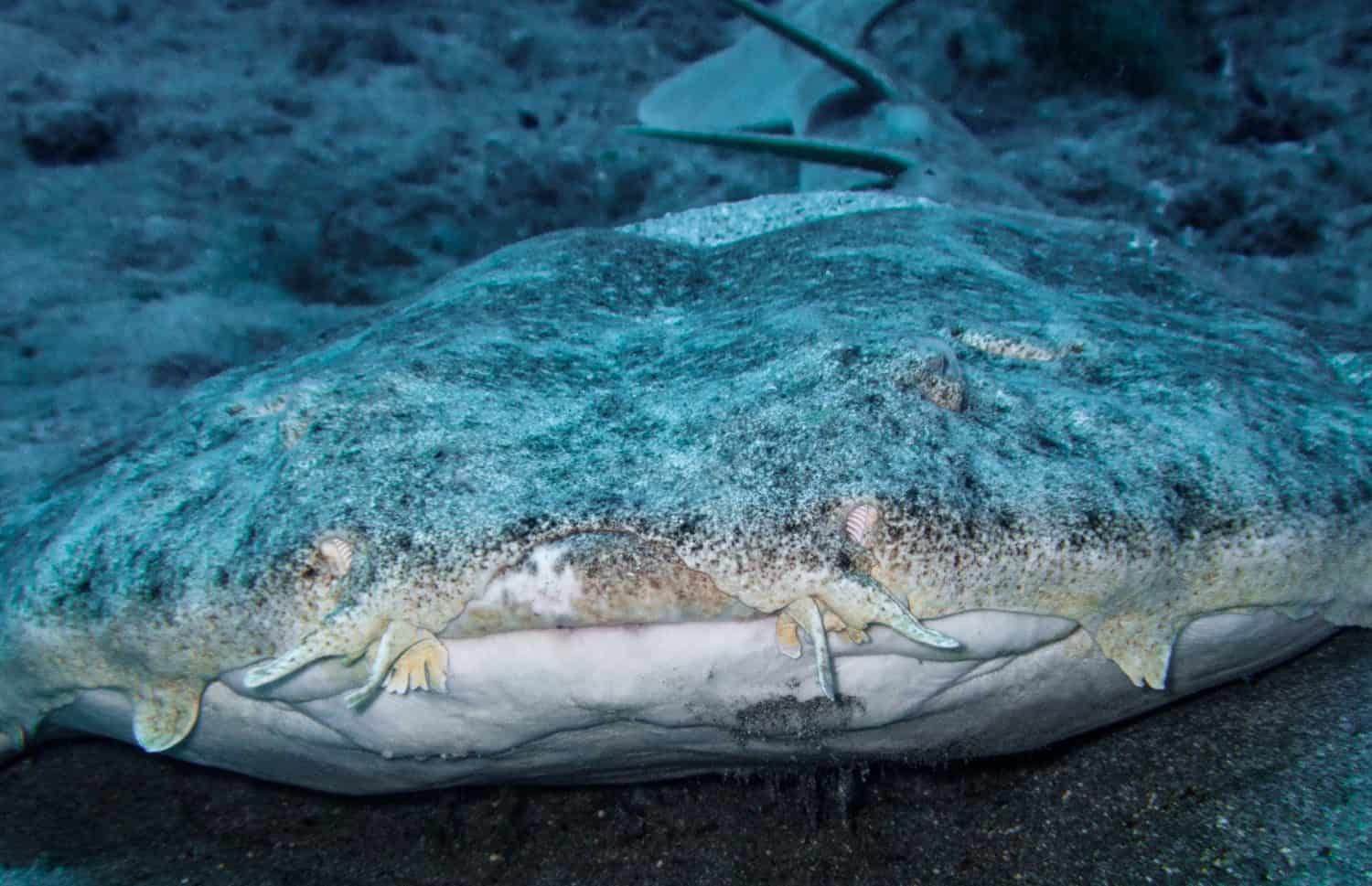
Like other angel sharks, common angel sharks rely on nasal barbels to detect water displaced by nearby prey.
©LuisMiguelEstevez/Shutterstock.com
The common angelshark (Squatina squatina) is arguably the most prominent species of Squatiniformes. They range between two and two-and-a-half meters in length and feature wide, flat bodies with reddish-grey patterns that help them blend in with underwater sand. In the daytime, they are quite still, hiding on the ocean floor with only their eyes visible above the sediment. At night, they become more active. Common angelsharks are also migratory, travelling north during the summer months.
Perhaps the most standout feature of this species is its increasing rarity. They used to be a common sight along the European coasts. However, their tendency to lie on the shallow coastal floors has made them a prime target for bottom-trawling fisheries. The common angel shark population has declined by over 80% in recent years due to fishing. Only around the Canary Islands do they remain in stable numbers.
Sand Devil
Also known as the Atlantic Angel shark (Squatina dumerili), sand devils are a species of angel shark found along the Atlantic coast of North America. They supposedly earned their devilish name due to a tendency to snap back at fishermen who disturb them. Smaller than the common angel shark, sand devils typically grow to between 91 and 122 centimeters, occasionally reaching up to 1.8 meters. They have flat bodies with reddish-grey markings, along with small, sharp denticles running the length of their backs and tails.
Other Squatiniformes undergo seasonal migrations, but sand devils perhaps undergo the biggest environmental changes, depending on the season. During the winter, they are known to swim deeper, down to 450 meters, to reach the offshore continental slopes. In the summer, they return to shallower depths found in bays and estuaries.
Sawback Angelshark
Sawback angelsharks (Squatina aculeata) are found in warmer waters along the Mediterranean Sea and eastern Atlantic coasts. Their name comes from the prominent line of thorny spines running from the midline of their backs to their tails. With their armored appearance, sawbacks are the most battle-ready-looking of the angel sharks. They grow slightly larger than sand devils, reaching nearly two meters, and feature a solid light-brown color with random dark blotches.
Whereas common angelsharks tend to inhabit shallow waters, sawback angelsharks prefer deeper, muddier depths. There, they use their spiny backs as protection against predators like groupers and other larger shark species.
Smoothback Angelshark
Another type of angel shark found in the eastern Atlantic Ocean and the Mediterranean is the smoothback angel shark (Squatina oculata). Compared to the area’s sawbacks, smoothbacks have no spines on their bodies. However, they blend in effectively, thanks to their eye-like spots dotting their tails and pectoral fins. These angelsharks tend to stick to the deeper parts of the continental shelf. There, they use their fringed barbels to sense crustaceans in nearly pitch-black conditions.
Australian Angelshark
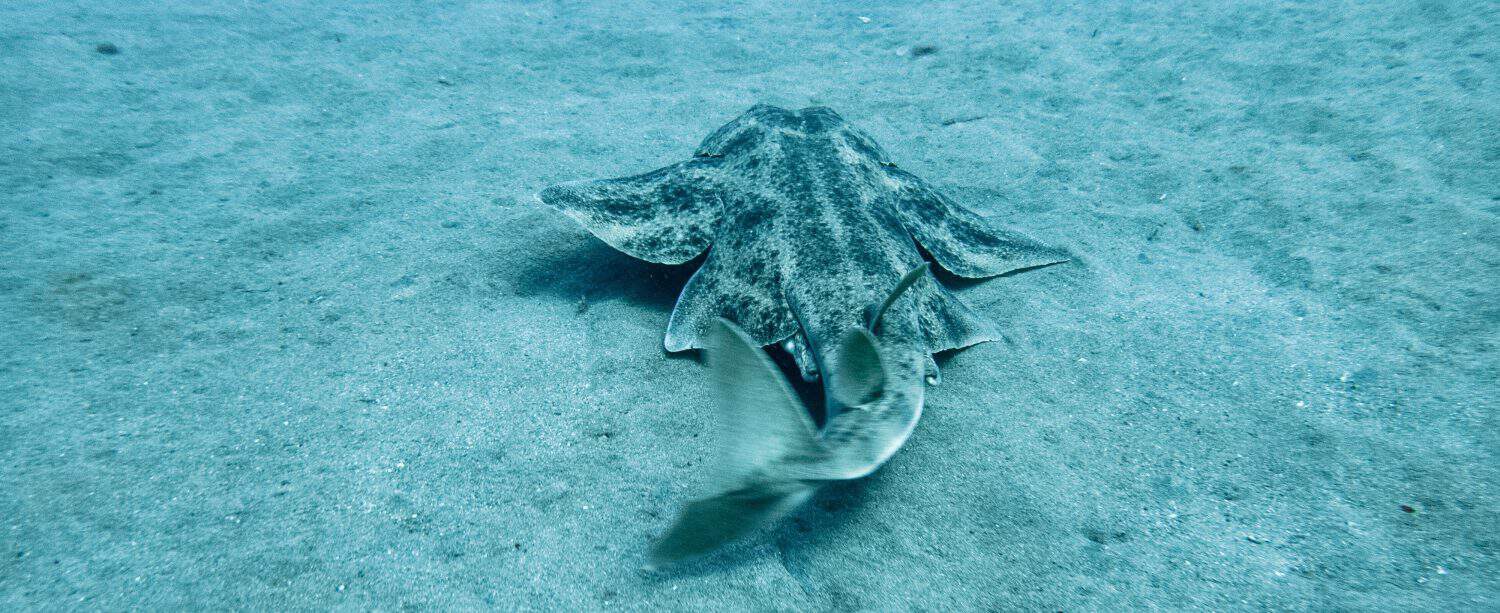
Some angelshark species, like Australian angelsharks, have vibrant colorations to blend in with the environment.
©LuisMiguelEstevez/Shutterstock.com
Whereas other angelsharks have reddish-grey to brown colorations, Australian angelsharks (Squatina australis) are camouflage masters. Their meter-and-a-half body features complex patterns of white spots and grey-brown markings. This camouflage helps them blend in with the shell-heavy seabeds of southern Australia. They also have some of the more widely arranged spiracles and barbels that are shaped like spoons. All angelsharks target mollusks and crustaceans, but the Australian angelshark also hunts teleost fish found in Australia’s reefs.
Ornate Angel Shark
The land down under can be a colorful place, and this sense of drama extends to the area’s angelshark species. The ornate angelshark (Squatina tergocellata) lives along Western Australia’s continental shelf and is even more vibrant looking than the Australian angelshark. It features a yellowish-brown body with large dark rosettes and circular patterns to match the ocean’s coral. Ornate angelsharks also have pushed-back pectoral fins and nasal barbels that give the appearance of feathers. Like other angelsharks, ornate angelsharks use these barbels to detect the slightest displacement of water.
Pacific Angel Shark
Pacific angel sharks (Squatina californica) are considered the most aggressive species in the order. They are known to ambush prey along rocky reefs and kelp beds. Though all angelsharks strike quickly, Pacific angelsharks use their flexible necks to snap their jaws open at steep angles. They also play an important role in kelp forest ecosystems, where they blend in with grey-to-brown colorations containing thick black blotches.
Japanese Angelshark
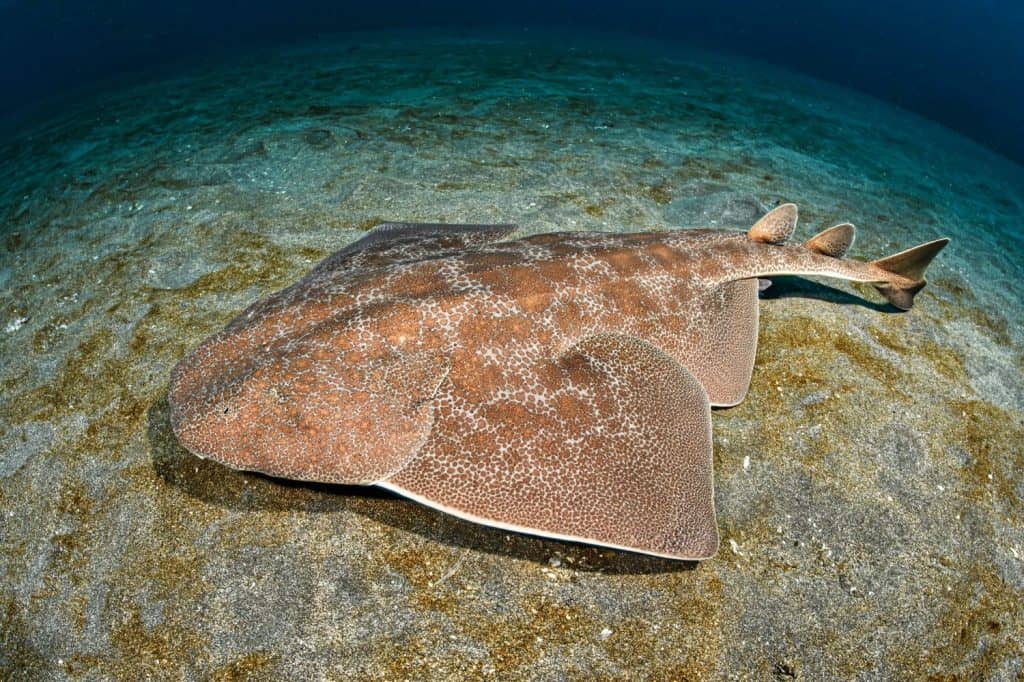
Japanese angelsharks have bodies with rusty-brown coloration featuring lighter blotches.
©Martin Voeller/Shutterstock.com
Angelsharks spread across the world millions of years ago, and one species established itself in the North Pacific. The Japanese angelshark (Squatina japonica) is native to the waters around Japan, Northern China, and Korea. They feature one-and-a-half-meter bodies with rusty brown coloration featuring black spots and lighter blotches. Like several other Squatiniformes species, Japanese angelsharks have small thorns running along the center of their backs and tails.
Typically, Japanese angelsharks are found on the continental shelf down to depths of about 300 meters. Whereas open ocean species have a more varied diet, Japanese angelsharks tend to hide in volcanic sediment, where they prey on teleost fish, ray-finned sea breams, and squid.
Are Squatiniformes Dangerous?
Sharks of the Squatiniformes order are not as dangerous as larger, more open-ocean sharks like great whites or bull sharks. They are on the smaller side and do not view people as prey. That said, the sand devil got its name for a reason.
Angelsharks spend most of their time half-submerged in the sand, so if people accidentally walk over them, they are at risk of being bitten. These sharks sit waiting, spring-loaded to attack, so they will bite if provoked or accidentally disturbed. While such bites are almost never life-threatening, angelshark teeth are sharp and can produce considerable wounds to the skin.
These sharks are occupied with catching fish and mollusks, so as long as you keep a respectable distance, they pose almost no threat.