Quick Take
- Cownose rays are known to travel in large migratory groups called fevers.
- The 3-foot wingspan of the Cownose creates hydrodynamic resistance within shallow-water channels.
- These creatures have been unfairly treated as scapegoats for dwindling clam populations in regions like the Chesapeake Bay.
It’s easy to forget about the legion of mysterious creatures that live in the ocean. That is, until you are right on top of them. Like schools of fish, some creatures, such as cownose rays, travel and migrate in large groups based on size and sex. As seen in this Instagram video, several people on a boat were quickly outnumbered as they unexpectedly moved through a massive group of cownose rays.
Like a living brown blanket, these cownose rays moved like a well-trained military formation. Swimming in a synchronized manner and numbering in the thousands, cownose rays undertake an annual migration, moving from the cooler waters in the north around Chesapeake Bay down to the Caribbean and Florida in the late fall, and returning north in the spring. While this video illustrates some impressive numbers to an almost intimidating degree, cownose rays pose little threat to humans. Let’s learn more about these fascinating sea creatures. We will discuss how they get their unique name and why they can easily overwhelm even a sizeable armada of boats.
Meet the Cownose Ray

Due to their synchronized swimming, cownose rays are sometimes called living brown blankets.
©Instagram/wfla – Original
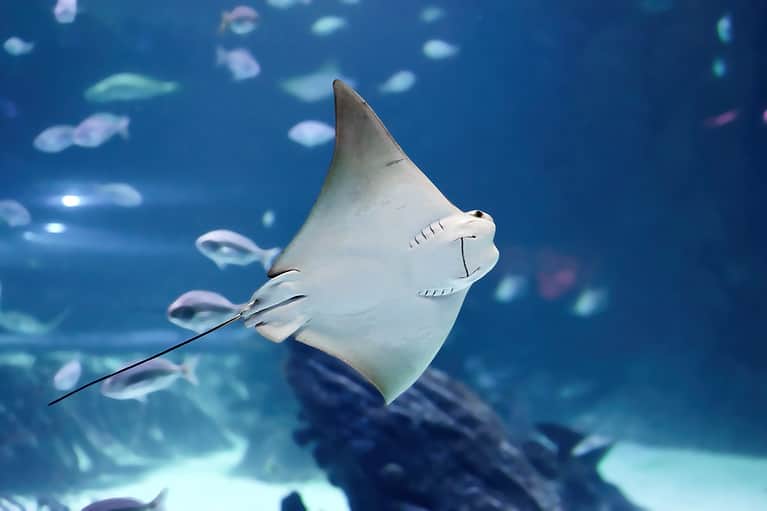
Cownose rays are among the more interesting creatures in the ocean. A member of the Chondrichthyes class, cownose rays are, surprisingly, the closest living relatives to sharks. More specifically, cownose rays are members of the family Rhinopteridae. Rhinoptera is the only genus in that family and is defined by unique, bovine-like snouts at the front of their bodies. These snouts are formed by two subrostral lobes. They feature plenty of electroreceptors to help rays detect the slightest change in electrical signals. These subtle shifts help rays find prey hiding deep beneath the ocean floor.
Cownose rays are characterized by meter-long wingspans, brownish-olive colored dorsal sides, and white underbellies. They typically feed on clams, oysters, and snails. Using the electroreceptors in their snouts, cownose rays scan the ocean floors. Once they find prey, they use their pectoral fins to stir up the sand, simultaneously sucking water through their gills in a type of shoveling maneuver. If food is uncovered, cownose rays grab it with their mouths. Since they often move in large migratory groups, cownose rays can quickly turn clear water into an opaque cloud from all the digging.
Interestingly, cownose rays are ovoviviparous. This means that female cownose rays produce eggs that hatch internally. Even so, most cownose ray mothers only give birth to one pup after an 11-month-long gestation period. Cownose rays, in general, are highly social creatures known to travel in massive schools called fevers. When grouped up, these creatures engage in impressive synchronized swimming, flapping their pectoral fins in unison. While other types of rays prefer to be camouflaged, cownose rays spend much of their time near the surface. As seen in this Instagram video, this behavior can produce some awe-inspiring displays.
We are Legion

Cownose rays travel in migratory groups called fevers, containing up to 10,000 individuals.
©Instagram/wfla – Original
People have long known that cownose rays travel across the ocean in large migratory groups. They are strong swimmers, capable of covering large sections of the Atlantic Ocean. As seen in this Instagram video, a ‘fever’ of cownose rays can easily dwarf a sizeable boat when swimming together. This video was taken in Tampa Bay, Florida, which tracks with the typical migratory patterns of cownose rays. The population in the Gulf of Mexico is known to migrate in schools of as many as 10,000 individuals.
In fact, the boat featured in this video belongs to a company that capitalizes on the impressive aquatic displays. The boat is see-through, allowing tourists or any would-be watchers to see what these fascinating creatures look like up-close. After a close-up shot, the camera (likely attached to a drone) pulls up into the sky. This reveals such a large group or ‘fever’ of cownose rays that they practically replace the water itself. Thousands of them move through the water in such close proximity and with such impressive swimming synchronization that they truly live up to their ‘living brown blanket’ reputation.
This battalion of cownose rays may seem dangerous, but in truth, they only pose a moderate risk to humans. However, they do have tails and barbs that can be used as weapons if they feel threatened. A cownose ray sting can be very painful, but it is typically not fatal unless it occurs in the abdomen.
Misunderstood
In previous decades, people have used cownose rays as scapegoats for several oceanic problems. They were blamed for shellfish depletion and thought to be overpopulated. This resulted in campaigns like “Save the Bay, Eat a Ray” in the Chesapeake Bay area, which encouraged a hunting and fishing free-for-all. However, more recent scientific studies suggest that ray populations remain stable. Furthermore, evidence suggests that they are not the primary cause of shellfish depletion.
Regardless, their status was updated to Vulnerable on the IUCN Red List in 2019. This Instagram video shows an impressive collection of cownose rays, but that does not mean these creatures would not benefit from more direct conservation efforts.