
Quick Take
- Carcharhiniformes is the largest order of sharks, containing around 270 species with a remarkable variety of sizes, habitats and behaviours.
- Ground sharks share distinctive features including five pairs of gill slits, two dorsal fins, an anal fin and a protective nictitating membrane. Discover the shared anatomy →
- Carcharhiniformes includes highly migratory ocean sharks, coastal species, reef dwellers and even sharks capable of surviving in freshwater. Read about the new species →
- Species in this order include tiger sharks, bull sharks, hammerheads, blue sharks, and oceanic whitetips.
With around 270 different species, Carcharhiniformes is the largest order of sharks and contains some of the best-known species, including tiger sharks and bull sharks. Members of the Carcharhiniformes order live in a wide range of marine habitats and have important roles as key predators within their ecosystems. Although Carcharhiniformes sharks all share some basic features, they actually vary greatly in their size and behavior.
What Makes Carcharhiniformes Different?
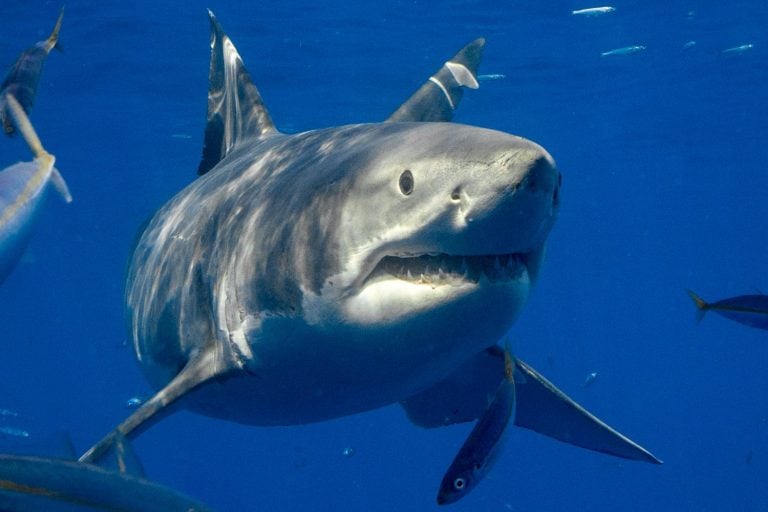
Carcharhiniformes is the largest of the eight orders of sharks, and they are commonly known as ground sharks. Carcharhiniformes includes species from twelve different families, which show a wide variation in size and behavior. However, all of the sharks in Carcharhiniformes share a number of characteristics that help to distinguish them from other shark orders. All ground sharks have five pairs of gill slits, two dorsal fins, and an anal fin. They also have a nictitating membrane, which is sometimes called a third eyelid. This is a thin layer that can be drawn across the eye for protection from thrashing prey or debris. Although some other sharks have a nictitating membrane, this is most often associated with only the ground sharks.
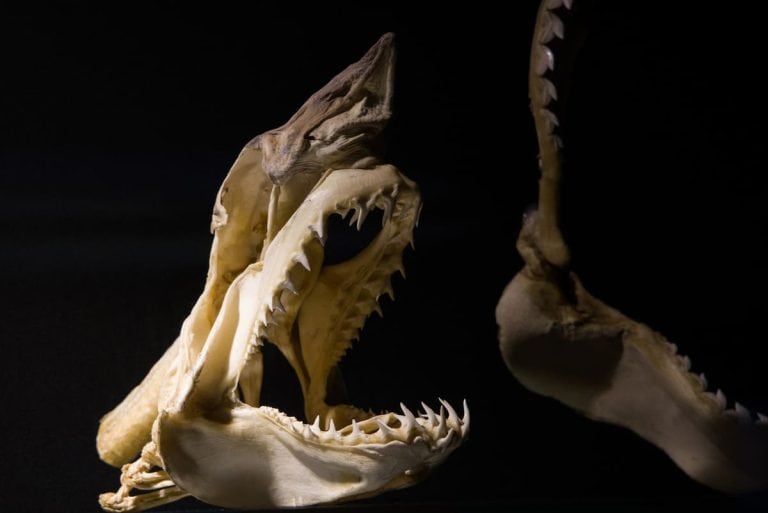
Not every feature of sharks in Carcharhiniformes is exactly the same, though. For example, some ground sharks have barbels, but not all of them. However, they do all have a large mouth that extends beyond their eyes. Their teeth vary depending on their diet, although many species have triangular-shaped teeth with serrated edges.
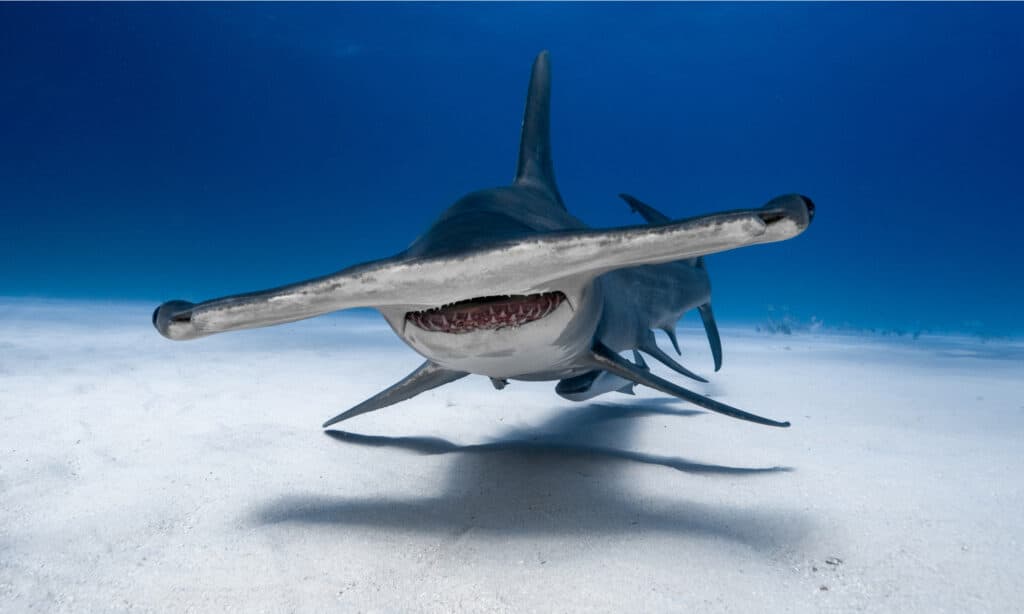
Despite having widely different appearances, sharks in Carcharhiniformes all share a set of unique characteristics.
©Sail Far Dive Deep/Shutterstock.com
Carcharhiniformes Sharks Around the World
Ground sharks have a widespread distribution and live in most oceans around the world. Most ground sharks favor tropical and temperate waters, both in the open seas and in the coastal regions. The order includes both highly migratory sharks that travel across entire ocean basins and species that spend much of their lives in a relatively small area. There are approximately 270 species of sharks in the Carcharhiniformes order, and there have been some new additions in recent years. The most recent of these was the Indian houndshark, which was discovered in 2025. The shark was discovered in the eastern region of the Arabian Sea and has a distinct dark brown to black appearance.
Carcharhiniformes is one of the most diverse shark orders in the world. Let’s take a look at some of the other species it includes.
Tiger Shark
Tiger sharks are some of the most distinctive ground sharks due to the stripes on their bodies that resemble those of a tiger. The stripes are clearer on juveniles and fade as the shark ages. Tiger sharks are officially the second-most dangerous shark in the world, after great whites. They can reach up to 25 feet long and are often referred to as the “garbage can of the sea.” This is due to their opportunistic nature and tendency to eat anything they can swallow.
Leopard Shark
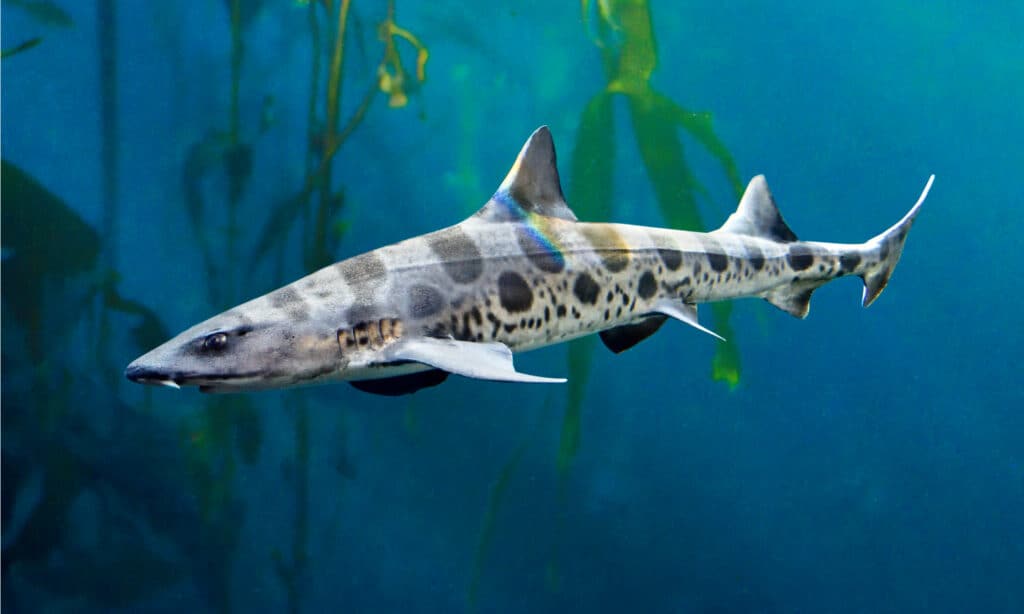
The leopard shark has one of the most distinctive appearances.
©Barbara Ash/Shutterstock.com
Leopard sharks are known for their stunning appearance, which includes black saddle-like markings and spots across their back. They have a slender appearance and can reach almost five feet in length. Leopard sharks inhabit the coastal waters along the west coast of North America, from Oregon to Mexico. They do not migrate and typically remain in the same area for their entire life. Leopard sharks are bottom feeders and often use suction to pull prey into their mouths. Their diet varies depending on their size, but they often prey on animals such as crabs, clams, shrimp, and worms.
Lemon Shark
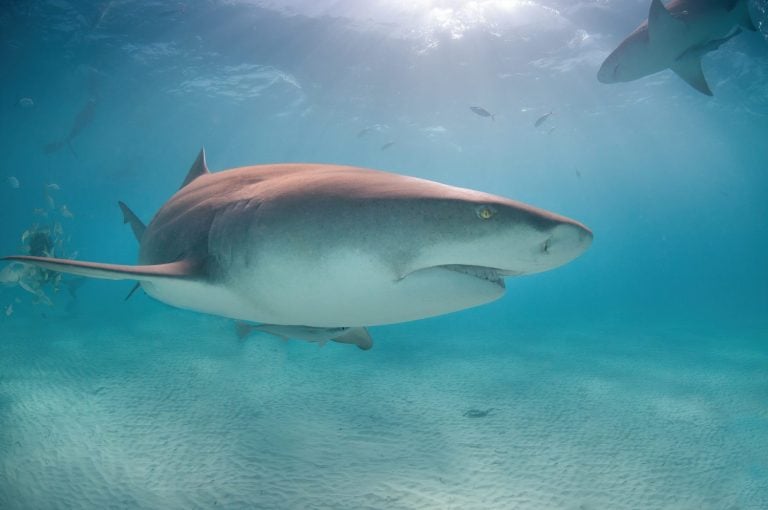
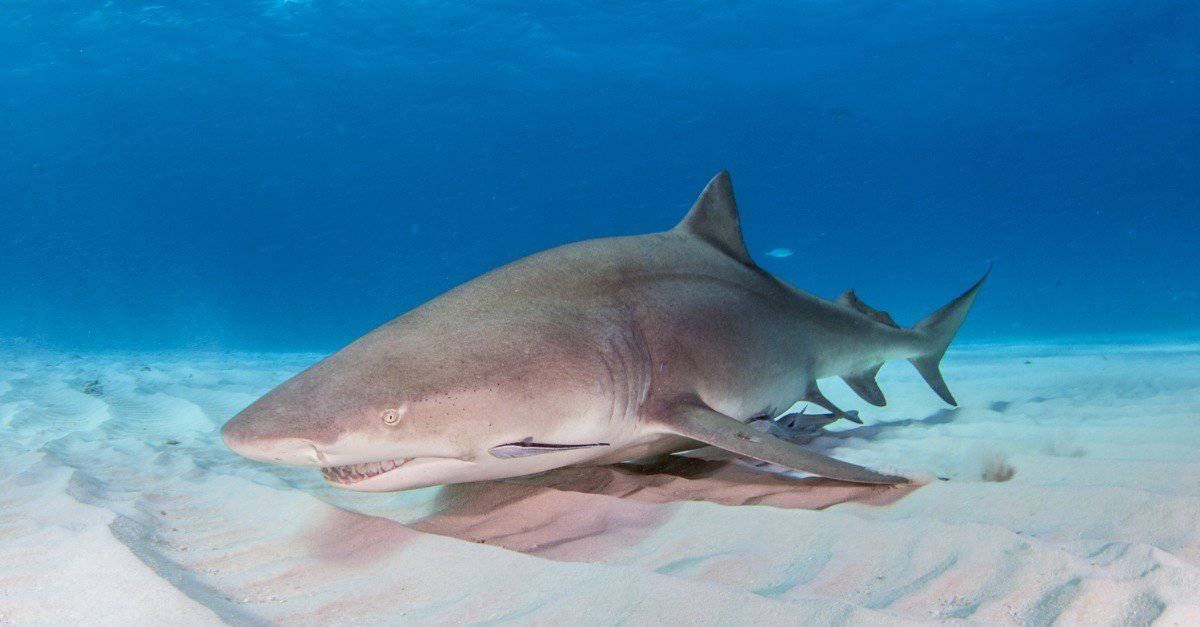
Lemon sharks inhabit shallow tropical and subtropical waters around coral reefs in the Atlantic and Pacific Oceans at depths of up to 300 feet. However, they migrate south every winter to warmer waters and then head north again in the spring. Lemon sharks have a yellowish coloration on their upper region and can reach around 10 feet in length. Their two dorsal fins are approximately the same size. Lemon sharks mainly feed on bony fish and crustaceans and are not considered to be dangerous to humans.
Hammerheads
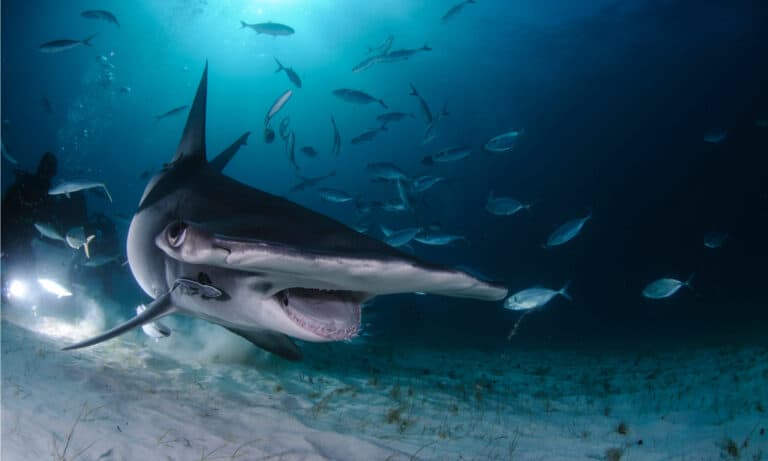
Hammerhead sharks are some of the most unusual sharks in Carcharhiniformes due to their distinctive heads. One of the newest species in the order is a hammerhead, which was described in 2024. The shark is named the shovelbill shark due to its flat, wedge-shaped head. It was discovered in the Caribbean and the Southwest Atlantic. There are ten species of hammerheads, and one of the better known is the great hammerhead, which can reach a maximum length of 20 feet. Hammerhead sharks are mainly found in coastal waters. They are highly migratory and often undertake long journeys to cooler waters every summer.
Bull Shark

Bull sharks are one of the few sharks that can survive in freshwater.
©bluehand/Shutterstock.com
Another famous species in Carcharhiniformes is the bull shark. Bull sharks are renowned for their ability to survive in both freshwater and saltwater and are sometimes found in rivers and estuaries. They are famously the species that are believed to be responsible for the 1916 Jersey Shore shark attacks that were the inspiration for Jaws. Bull sharks are one of the most dangerous species of sharks in the world due to their highly unpredictable nature and powerful bite force. They often hunt in shallow, murky water around the coasts and have a varied diet.
Silky Shark
Another shark with a widespread distribution is the silky shark, which inhabits tropical waters around the world. They can be found at depths of up to 1,600 feet. However, they are more common at depths up to 660 feet. Silky sharks are highly migratory and often travel vast distances across the open ocean, with the longest recorded migration being a female who travelled 17,190 miles in 546 days. Silky sharks reach lengths of around 8 feet 2 inches and have a relatively small first dorsal fin. They mainly prey on fish and cephalopods.
Blacktip Reef Shark
Blacktip reef sharks inhabit the coral reefs in the Indian and Pacific Oceans and can often be found in shallow water. They are easily distinguished by the black tips on their fins, including their dorsal fin. Blacktip reef sharks can reach 5 feet 3 inches in length and are fast, agile sharks. They prey mainly on small fish, but will also eat animals such as crabs and squid. Blacktip reef sharks are caught by both small-scale and commercial fisheries, both intentionally and as bycatch. Blacktip reef sharks are classified as a vulnerable species by the IUCN Red List, and their reliance on the coral reefs makes them vulnerable to habitat loss.
Blue Shark
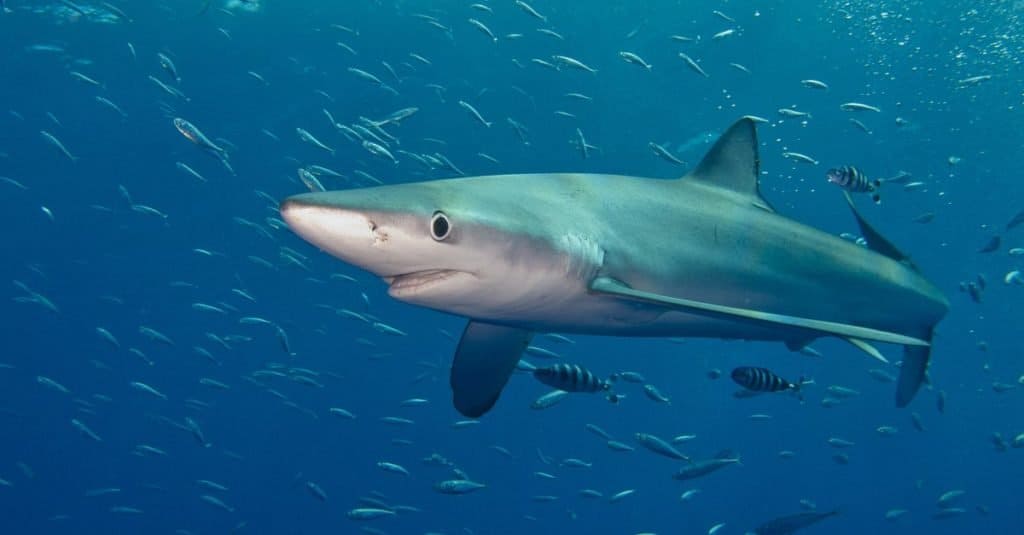
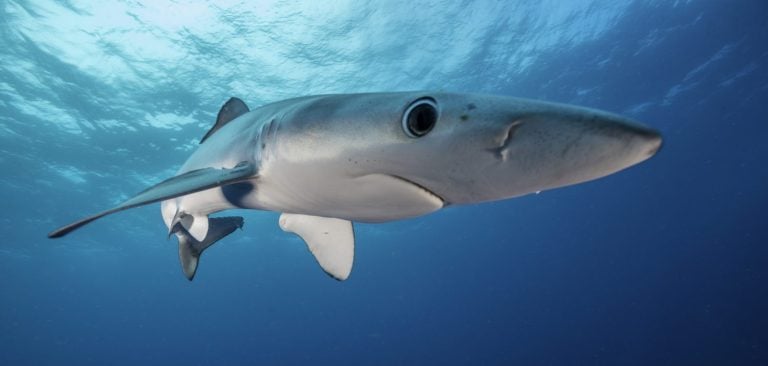
Blue sharks undertake some of the longest migrations of any shark species.
©Anna L. e Marina Durante/Shutterstock.com
One of the most migratory sharks in the world is the blue shark, which migrates vast distances every year. Blue sharks inhabit deep temperate and tropical waters at depths of up to 1,150 feet and follow a clockwise migration pattern every year. They typically follow the Gulf Stream current from the Caribbean towards Europe and the UK every summer and then return by following the Atlantic North Equatorial current, often travelling more than 5,000 miles in a year. Blue sharks are also one of the few shark species that migrate in schools, and these groups are often segregated by age, size, and gender.
Oceanic Whitetip
Oceanic whitetips inhabit open water, far from land. They are highly migratory and are always on the move in search of food. They are apex predators with an opportunistic nature, preying on fish, marine mammals, and other sharks. Oceanic whitetips are widely regarded as one of the most dangerous sharks due to their tendency to prey on survivors of shipwrecks and plane crashes. Oceanic whitetips are around 11 feet long and have distinctive white markings on their fins, hence their name.
Pyjama Shark
One of the few ground sharks with a set of barbels is the pyjama shark, which is a species of catshark. Pyjama sharks are ground-dwelling sharks that are endemic to the waters around the South African coast. They reach a little over 3.5 feet long and have distinctive dark stripes running along their body. Pyjama sharks mainly feed on crustaceans and small fish, which they search for on the seabed. They are often caught as bycatch by commercial fisheries. However, they are still classified as a species of Least Concern by the IUCN and have an increasing population.