
Quick Take
- Scientists called it a brand-new discovery, though the people who live near it already had two different names for it. Discover the local names →
- Its tiny known range is exactly what makes it one of the most conservation-vulnerable sharks. Assess the conservation risks →
- The researcher this shark was named after has a connection to it that goes far deeper than just being the first to find it. Meet the namesake scientist →
One of the world’s most biodiverse marine locations, the Coral Triangle, has yielded a new species of shark. This very special creature is a type of walking shark, meaning it can use its fins to walk on sand at low tide. It is one of only a few walking shark species on the planet, and scientists are already concerned that its population may be threatened. We introduce you to Hemiscyllium dudgeonae.
Researching Walking Sharks
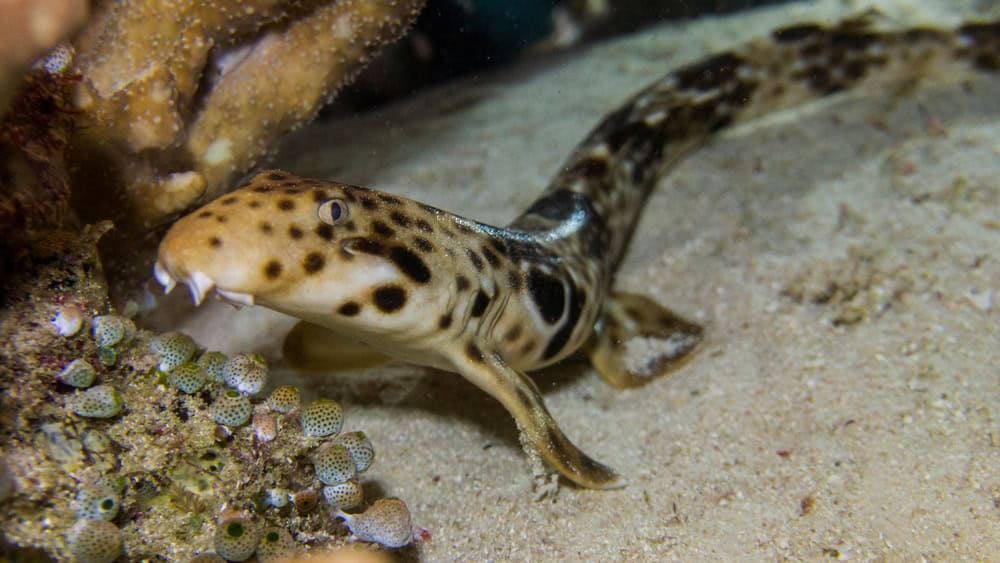
Walking sharks are incredible marine creatures. When the tide goes out, they can use two pectoral fins and two pelvic fins to propel themselves forward on the sea floor. This gives them an advantage over their competitors because they can stay in shallow tidal pools and get from one pool to another in search of prey. They are also good at withstanding low oxygen environments for several hours.
Finding a New Shark Species
The new shark species was discovered as part of a broader study of walking sharks that are endemic to Australia and Papua New Guinea. The 12 individuals recorded in the published study ranged from 15.43 to 30.75 inches long and included two females and 10 males. These types of sharks generally have a pattern of variable-sized brown spots.
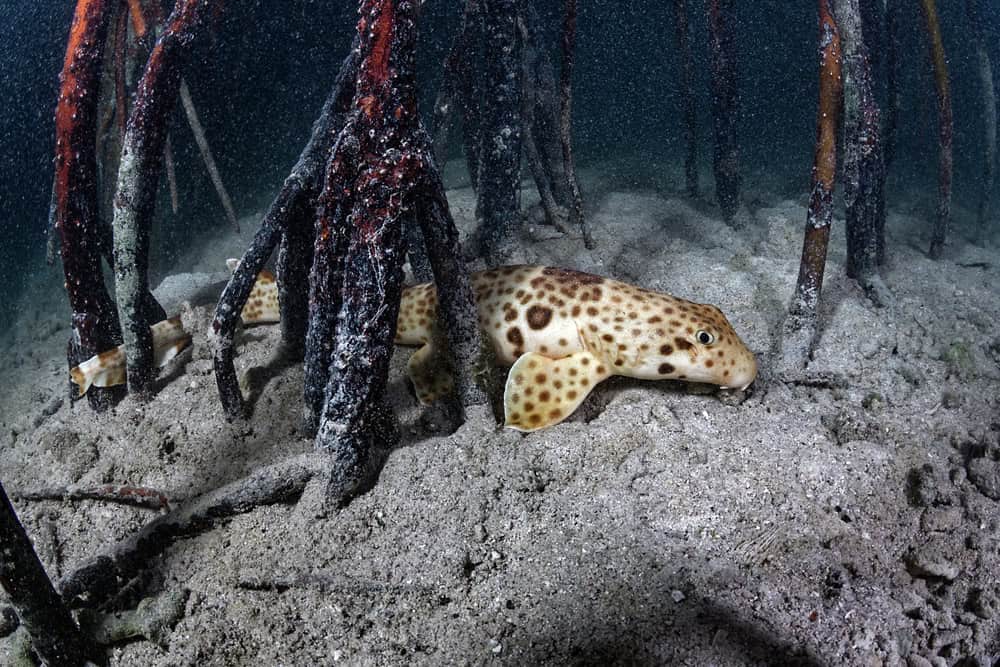
The new walking shark species has a unique pattern.
©Mekan Photography/Shutterstock.com
However, it is the well-defined white spots and dashes along the sides of their bodies that distinguish them from other walking shark species in the area. Another distinguishing feature is a pair of large dark spots: one behind the spiracle and one directly below, surrounded by a broad white area. Genetic tests confirmed that they were a distinct species.
Who is Hemiscyllium dudgeonae named after?
This new shark species is in the Hemiscyllium genus in the family Hemiscylliidae, so that is where the first part of its name comes from. The second part was chosen in honor of Christine L. Dudgeon, who is a renowned ecologist and geneticist. She has researched this family of sharks for the last 20 years and was the first researcher to collect this previously unknown species.
Where Does the New Species Live?
Currently, the only known location for Hemiscyllium dudgeonae is Milne Bay Province in eastern Papua New Guinea, specifically between the Amphlett Islands (off northern Fergusson Island, D’Entrecasteaux Islands) and the Trobriand Islands. However, the researchers suggest that it will also be found throughout the D’Entrecasteaux and Trobriand Islands, as well as around offshore islands such as Woodlark (Muyua) Island. More research surveys will be needed to confirm this.
So far, it has been found in waters less than 16 feet deep where it hangs out among seagrass and coral outcrops on coastal fringing reefs. It can also be spotted sheltering under rocky outcrops or tabular corals. Based on available data, its known depth range is approximately 1.5 to 39 feet. Also, the individuals observed so far stayed in shallow water at night and dived to greater depths during the day.
Not Such a New Species for Everyone
While there is understandable excitement about the discovery of this new shark species, the local population was already well aware of its existence. Locally, it is known as kadedekedewa. This loosely translates as ‘dog shark’ or ‘lazy shark,’ which is explained by its slow, four-limbed gait. On the Trobriand Islands, however, it is known as ‘botabota’. This highlights how much modern taxonomical research can learn from local indigenous people, who have shared these habitats with native species for thousands of years.
How Safe Is the New Shark Species?
The exact conservation status of this new species has not been formally assessed. Nevertheless, five of the other nine walking shark species are currently classed as threatened with extinction by the IUCN Red List. The fact that they have such a limited distribution and are found in an isolated location makes them more vulnerable. They tend to stay in the area where they were born and do not spread very far. This makes them especially vulnerable to localized threats.

Coastal development threatens shark habitats.
©Eugene Emau Wemin/Shutterstock.com
In Papua New Guinea, their habitat is being extensively degraded by coastal development, expansion of palm-oil plantations, and coral bleaching caused by climate change. It’s estimated that a shocking 20 percent of their habitat in Papua New Guinea has been degraded in the decade leading up to 2020. Other factors are putting further pressure on these species, including subsistence fishing, and some individuals are being collected for the aquarium trade.
Researchers consider Hemiscyllium dudgeonae to be the most concerning of the three walking shark species found in eastern Papua New Guinea. It has the smallest distribution and has only been confirmed at three sites. Additionally, there are anecdotal reports of significant subsistence fishing in these areas. It is hoped that local conservation and management practices can be put in place to protect this newly discovered species. However, the scientists stress that ongoing engagement with traditional land and sea-owners will be essential for success.