Forest fires have become a common occurrence. In some states, it is not a matter of if, but when, a forest fire will break out each year. Consequently, both local and federal agencies have been looking at alternatives to the traditional ways of preventing and fighting forest fires. One method that is being used more than ever before happens to be not only more environmentally friendly, but also pretty adorable.
Goats are being used to help prevent forest fires. These nimble farm animals are proving to be worth their weight in gold as they clear spaces with ease, preventing invasive vegetation from returning and removing plant debris known to help fire spread quickly. This is why, from urban areas to dense forests, goats are being used in more areas, from urban to dense forests, as part of wildfire prevention efforts.
Goats Eat Invasive Plant Species

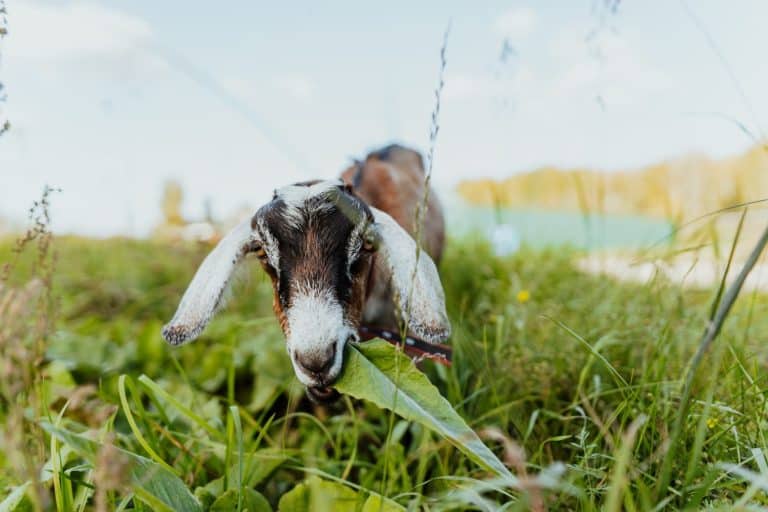
Goats prefer eating bushes, small trees, and weeds over grasses, which helps them clear fire-prone areas with ease.
©Lenar Musin/Shutterstock.com
Unlike other livestock, goats prefer to browse rather than graze. What this means is that goats will forego grasses if there are things like bushes and small trees available to eat. They enjoy leaves of plants rather than lower-lying grasses. Because of this, goats are a perfect tool to help prevent forest fires.
Goats reduce the vegetation that helps forest fires spread by consuming the entire plant, rather than just the ground-level vegetation. The “horizontal and vertical continuity of fuels” is eliminated after goats have consumed acres of invasive plants. This means that if a forest fire were to break out near an area that goats have nibbled down, firefighters could easily gain the upper hand, given the fire has very little room to expand.
A recent study published in Agroforestry Systems found that goats are highly effective at reducing “fine fuel loads.” These are things like small plants, pine needles, and leaves on forest floors that are very flammable.
Additionally, as the goats browse, they leave their droppings behind. This not only helps to fertilize the ground, but the combination of fertilization and aeration makes the ground able to hold more water for longer periods after it rains. When the ground is not dried out, fire has a harder time spreading, making goats invaluable not only for forest management but also for clearing areas around businesses and homes to slow the spread of wildfires before they can cause excessive damage.
Goats Are a Cost-Effective Way to Clear Land

Goats are a cost-effective way of clearing acreage to prevent the spread of forest fires.
©IRA_EVVA/Shutterstock.com
One of the biggest questions people have about using goats for land management is whether they are cost-effective. The answer depends on the size of the land that needs to be cleared. For small jobs, such as those under 250 square feet, it costs more to have a herd of goats come to clear the area than it would to simply mow the space. However, for larger spaces, goats can save significant amounts of money.
A 2008 pilot study by the Washington State Department of Transportation found that using goats to clear vegetation could save approximately $300 per acre compared to herbicides, in addition to being more environmentally friendly. Therefore, when large clearing jobs need to be done, not only are goats effective at quickly removing invasive plants, but they also can be more cost-effective.
Why Goats Are Better Than Other Animals at Brush Clearing

Goats are better than other farm animals at clearing acreage because they eat plants from the ground up in their entirety.
©Annabell Gsoedl/Shutterstock.com
Goats have become the go-to solution for reducing the number of weeds and invasive plant species in open fields, which are often responsible for allowing wildfires to spread quickly as they become dry and brittle after the rain dries up for the season. But other farm animals, like sheep and cows, are also capable of eating weeds, so why are they not chosen for clearing fields?
The answer has to do with goats being far more efficient than other farm animals. Goats can climb, balance themselves on uneven surfaces, and squeeze into smaller places than sheep and cows can. By doing this, goats help eliminate the fire source from the ground up, according to Lani Malmburg, owner of the goat grazing company Green Goat.
“The goats can eat the entire fire fuel ladder, and they’re the only animal that can stand on their hind feet to reach it all,” Malmburg explains to Planet Forward. “And they’re recycling it all in place and turning that unwanted foliage into pure organic fertilizer, and then they’re scattering it and trampling it in making the soils healthy, full of nutrients, and stabilizing the steep hillsides, and that’s all done in one shot.”
Additionally, unlike cows and sheep, goats grind any seeds they eat as they chew. This means that as their scat is distributed throughout the field or area, they are not scattering any seeds. As a result, there will be significantly fewer unwanted plants the following season, since invasive plants and weeds were not allowed to propagate.
Goats Need To Be Monitored While Working
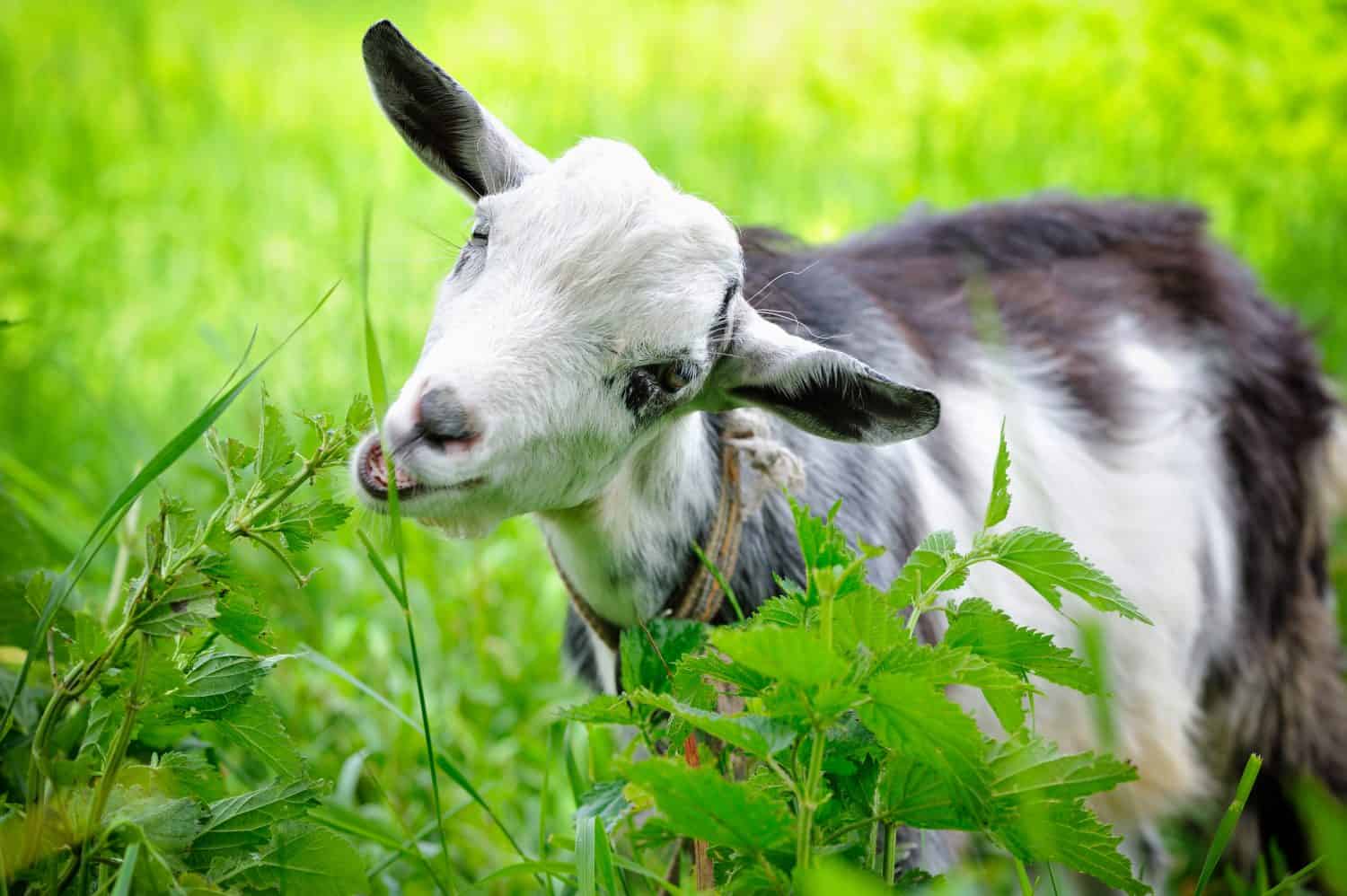
If not watched, goats will eat vegetation down too far, causing problems for future vegetation and the soil.
©Nataliia Melnychuk/Shutterstock.com
Goats are incredibly efficient at clearing fields completely if left to their own devices. They are also known to leave behind certain plants in a cleared zone if there are other plants they find more desirable. Because of this, they need to be monitored when working to ensure this does not happen. According to Denton Cook, who owns High Desert Grazers, when the goats are on the job, he and his employees are too. This ensures the goats not only do their jobs but are protected from wild animals as they graze.
“We go with the goats,” Cook explains to Thisis Reno. “We have a camp trailer. We stay with the goats on each job we work on.”
Being on the job with the goats allows goat clearing companies to monitor how much acreage is being eaten during the goats’ shift. The amount of time the goats eat is a voluntary 15 to 18 hours per day, seven days a week, according to Cook. While goats do an incredible job clearing areas to mitigate the spread of wildfires, it is important to remember that they are a tool in the fight against fires, not an ultimate solution.
Goat Browsing Is a Tool, But Not the Ultimate Solution

Goats are an incredible tool in helping to prevent the spread of forest fires, but more than goats are needed to stop the devastating fires.
©P_Lila/Shutterstock.com
As helpful as goat browsing is in slowing the spread of wildfires, it is not a solution to ending them. As climate change continues to make the weather warmer and dry out vegetation earlier, the threat of wildfires is greater than ever before. According to Gloria Montero, who owns Weed Warriors, the goats can help with the problem of weed overgrowth. However, if all the responsibility is placed on goats, wildfires will not be stopped.
“Fire abatement, it’s a tool in the toolbox of weed management. So, it’s not gonna solve the problem unless you’re just doing it to get rid of some weeds,” Montero tells Thisis Reno. “If you’re trying to control noxious weeds, then you need to have a plan after the goats come in. You still need to follow through to keep on top of the noxious weeds, ’cause one grazing’s not gonna kill them. It’s not an eradication program. It’s a tool.”
A variety of tools are needed to fight wildfires. Climate change is contributing to longer and more intense wildfire seasons, with blazes reaching areas that in the past would have been “too wet and cool to support them.” These areas are where the goats excel.
Chemicals and Controlled Burns Can Be Risky

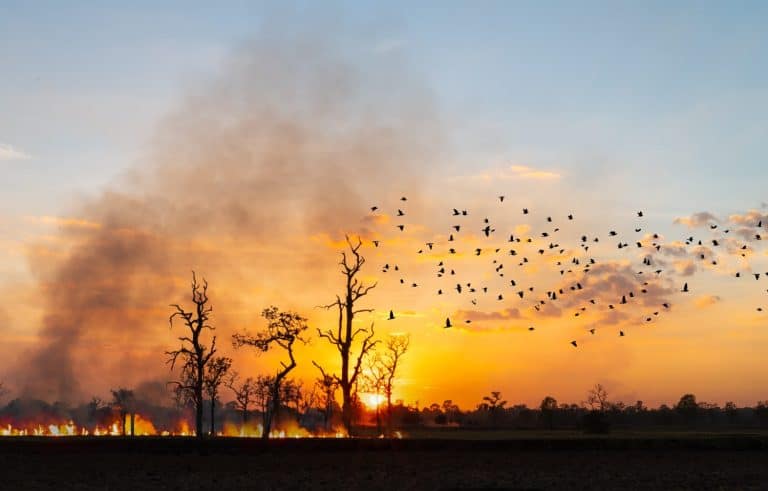
Controlled burns can quickly grow out of control.
©ChameleonsEye/Shutterstock.com
Once wildfires have started and taken hold, dead brush and grass that have not been cleared away for long periods provide fuel that helps fires spread and potentially become uncontrollable. To combat this, methods other than using goats have been used over the years. While effective, different methods of trying to keep large regions of vegetation from becoming tinder for fires can also be risky.
One way to keep the invasive species of plants from spreading is to spray them with chemicals. While this may work on small areas, chemicals are not intended for large-scale use. According to Mike Phillips, an employee of Laguna Beach who specializes in fire prevention, while chemicals can work, they can also be harmful to people and animals.
“You can’t use chemicals because they leach into the water supply, and the areas in danger are far too large,” Phillips explains to Smithsonian Magazine.
With chemicals taken out of the equation to help with fire prevention, another popular method is lighting a controlled burn. Controlled burns can be very effective, given that if an area is already burned, fire has nowhere to travel. If a wildfire can be stopped in any direction when it is burning out of control, that allows firefighters to gain the upper hand. However, as with any fire, if the conditions suddenly change, a controlled burn can quickly grow out of control. Were this to occur, the very thing that firefighters were attempting to stop is something that they instead started.
Heavy machinery and crews are effective on flat land. However, on mountainsides where goats have sure footing, bringing heavy machinery and crews can be dangerous. One wrong step by a crew member or a misstep with machinery can turn wildfire prevention work into an emergency. There is no one answer to stopping the spread of wildfires. All current methods are tools that can help firefighters gain the upper hand on these fires before they become devastating.
Resource constraints have made it challenging for some firefighting agencies to take proactive measures, increasing the risk for many communities as temperatures rise and extreme weather events become more common. But with goats working hard to clear fields and create barriers around homes and businesses without harming the environment, they may be the best option for long-term prevention, especially in states notorious for destructive wildfires year after year.