
Quick Take
- Dolphins breathe consciously, which is one quirk that forces a surprisingly clever solution to a problem you'd never think a mammal would have to solve. See how breathing works →
- A dolphin's breath-hold time changes dramatically depending on what it's doing, and one particular state pushes that limit far beyond what most people would guess. Explore the breath-hold limits →
- Dolphins have no vocal cords, yet they're among the most vocal animals on Earth, and the way they pull that off is stranger than it sounds. Discover how dolphins vocalize →
- Dolphins need 8 hours of sleep but can't stop swimming or they'll drown, and the way they solve this problem is one of the most bizarre adaptations in the animal kingdom. See how dolphins sleep →
There are currently 42 recognized species of dolphins worldwide, divided into 38 oceanic species and 4 freshwater river species. Dolphins inhabit mostly shallow areas of the world’s tropical and temperate oceans, though some species are found in deeper waters and rivers. In the coastal waters around Florida, the common bottlenose dolphin is the most abundant and frequently sighted species. In addition to bottlenose dolphins, Florida’s coastal waters are home to several other species, including the Atlantic spotted dolphin, rough-toothed dolphin, spinner dolphin, and pantropical spotted dolphin. Despite living their entire lives in the water, dolphins are mammals with lungs instead of gills, so they must surface to breathe air. Unlike humans, who breathe automatically, dolphins must consciously decide when to surface and open their blowhole. Continue reading to learn more about dolphin breathing, including how long they can stay submerged.
How Long Can Dolphins Hold Their Breath?
During normal activity, dolphins surface for air every 15 seconds to 3 minutes, averaging two to five breaths per minute. This breathing rate varies depending on their physical state and behavior.
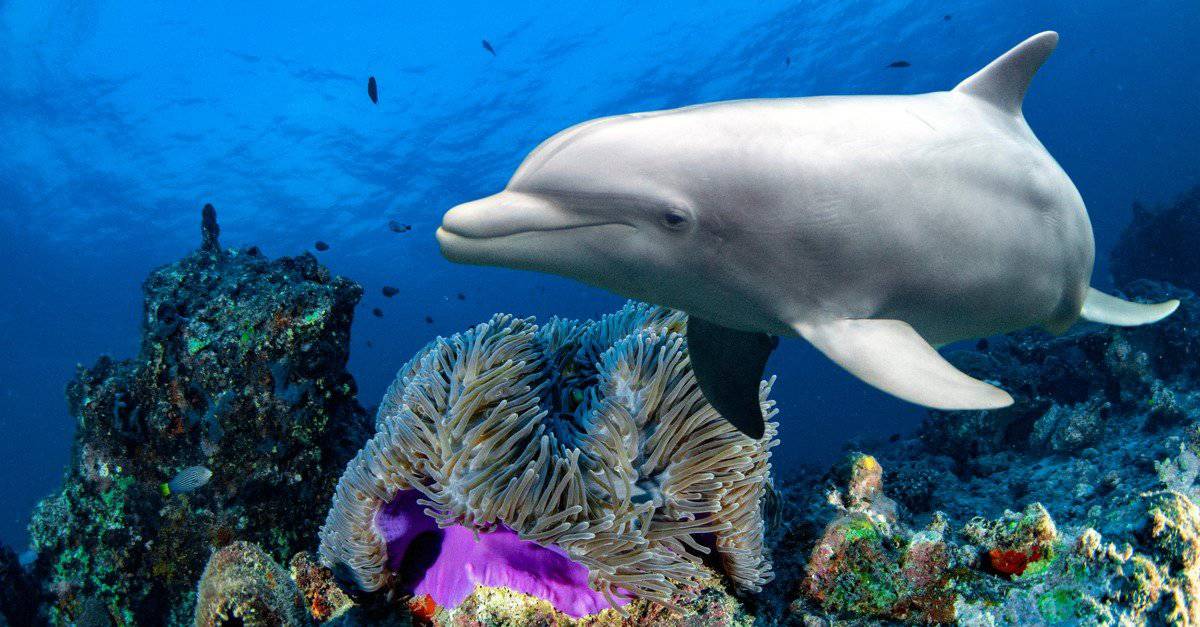
How long can dolphins hold their breath underwater? The answer may surprise you.
©Joost van Uffelen/Shutterstock.com
While actively foraging, dolphins surface more frequently, taking a quick breath every 5 to 10 seconds between shallow dives. However, during deeper dives, they may remain submerged for several minutes.
When dolphins are sleeping, their metabolic rate slows, and their breathing decreases to just 3 to 7 breaths per minute. This allows them to remain submerged longer and surface less frequently.
When diving deeply or escaping threats, coastal bottlenose dolphins can hold their breath for up to 7 to 10 minutes.
How Do Dolphins Breathe?
All dolphin species have a single external blowhole through which they breathe. Over millions of years of evolution, their nasal passages have merged into a single blowhole located on top of their head.
To breathe, a dolphin swims to the surface and contracts muscles to open the blowhole flap, forcefully exhaling stale air, often creating a visible spray or blow, as trapped water vapor condenses. The dolphin then immediately inhales fresh oxygen, a process that takes less than a second. Once the inhalation is complete, the dolphin relaxes its muscles, allowing a watertight, fibrous plug to seal the blowhole tightly shut before the dolphin submerges.
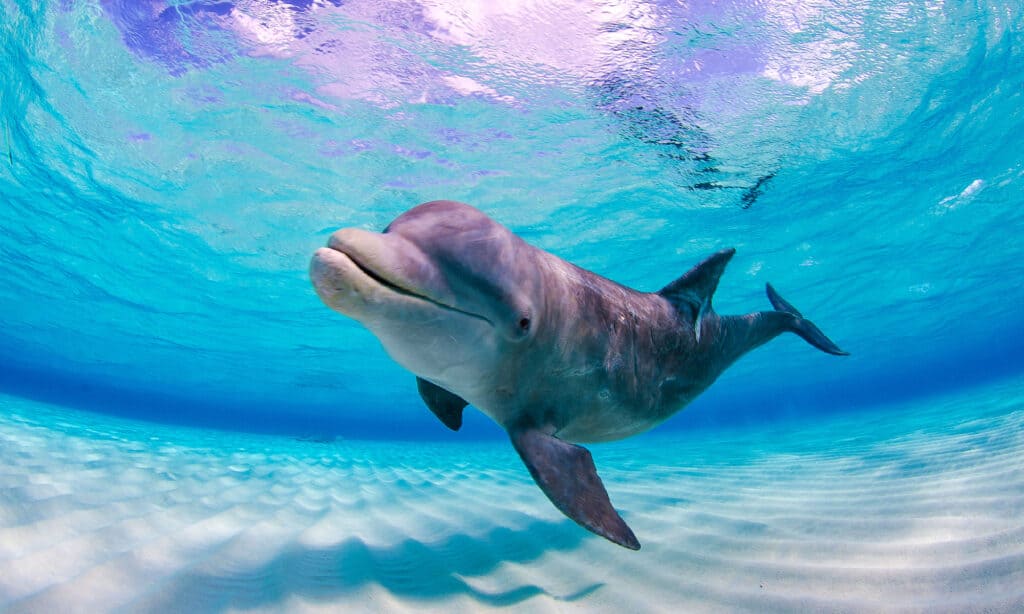
Dolphins have a blowhole at the top of their heads that opens when they surface for air.
©iStock.com/Michelle de Villiers
Because dolphins lack vocal cords, they communicate primarily using their blowhole and the complex internal nasal passages beneath it.
When a dolphin wants to vocalize underwater, it forces air from its lungs up through its nasal sacs and past specialized internal tissue structures called phonic lips. As the air flows past the phonic lips, the surrounding tissue vibrates to generate a diverse array of signals for navigation, emotional expression, and signature whistles. Dolphins have two independent sets of phonic lips, allowing them to produce whistles and clicks simultaneously.
Dolphins also use their blowholes to release trails, streams, and clouds of bubbles, which serve as important visual communication signals and social cues. Although their acoustic clicks and whistles carry over long distances, bubbles provide an immediate, visible context to their messaging.
How Do Dolphins Sleep?
Dolphins sleep using unihemispheric slow-wave sleep, an evolutionary adaptation necessary for their survival as voluntary breathers in an aquatic environment. During this state, a dolphin shuts down one hemisphere of its brain and closes the opposite eye.
The active hemisphere monitors the surroundings, controls swimming movements, and regulates the conscious decision to surface for air. This specialized sleep structure prevents the dolphin from drowning, protects it from predators like sharks, and maintains its body heat through continuous motion.
A mature dolphin typically gets about 8 hours of sleep over a 24-hour cycle. Rather than sleeping in one long block like humans, dolphins break their rest into shorter periods, ranging from a few minutes to a few hours, alternating which side of the brain rests throughout the day and night.
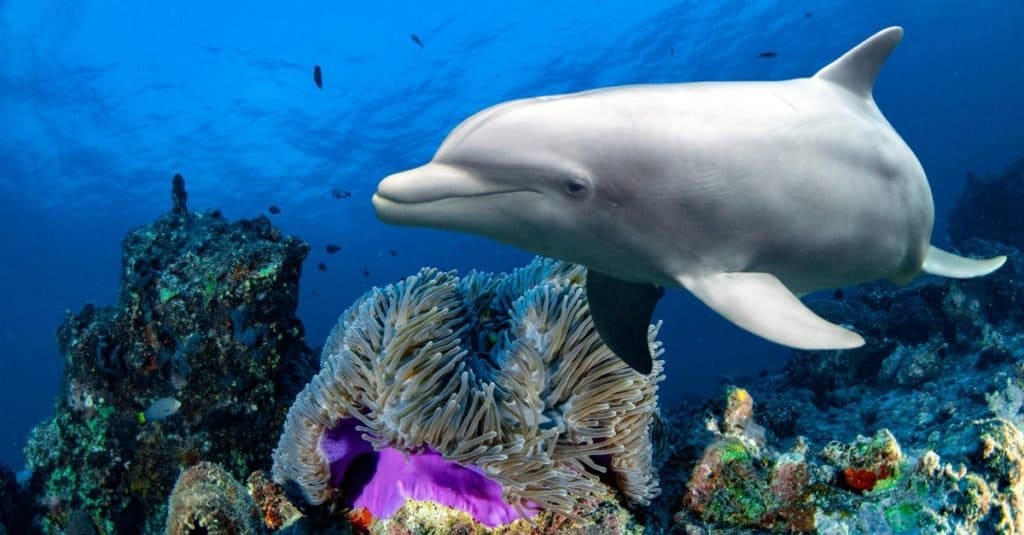
Dolphins sleep with only half of their brain.
©Andrea Izzotti/Shutterstock.com
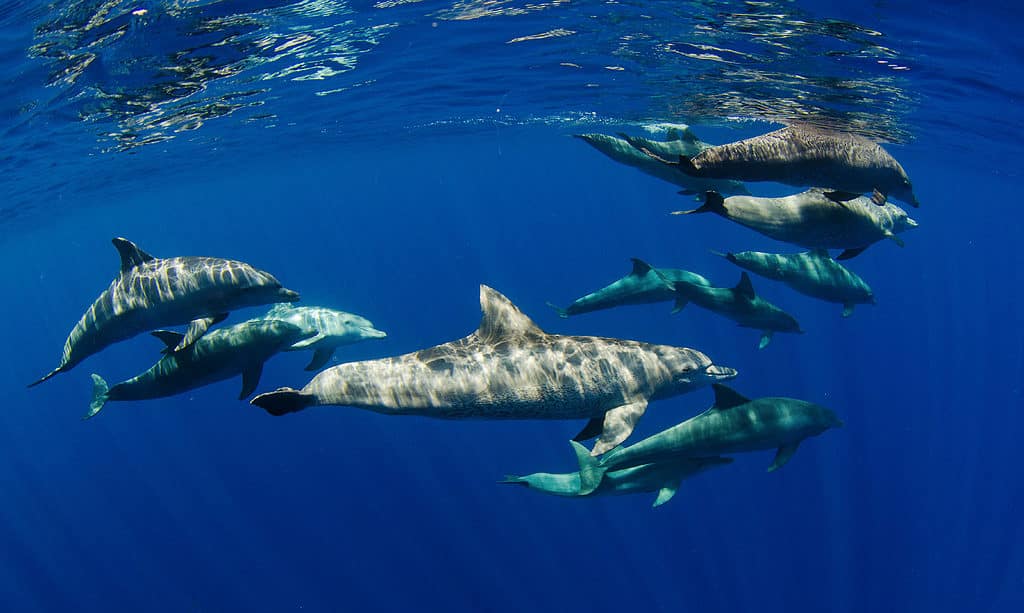
Within a pod, dolphins use staggered sleep schedules and synchronized group formations to maintain collective safety. When a pod does rest together, they often swim slowly in a tight, coordinated formation known as logging, named for their appearance as floating logs at the surface.
In this formation, the dolphins on the outer edge of the group keep their outward-facing eye open to scout for danger. By rotating positions within the logging formation and staggering their deep-sleep intervals, the pod ensures that some members remain alert, capable of detecting threats, and able to guide the group to safety.