The Great Grey Owl practices tireless hunting efforts. This has to do with the owl’s decision not to migrate, but instead to remain in the same location year-round. Consequently, during the winter, when the ground is covered in a blanket of snow, the Great Grey Owl has to work a bit harder to locate its prey than at other times of the year.
Fortunately for the Great Grey Owl, it possesses hunting prowess that other birds of prey lack. With its keen sense of hearing and virtually soundless flight, the Great Grey Owl can locate and capture prey before the prey ever knows it is being targeted. This makes the Great Grey Owl’s hunting skills successful at all times of the year, allowing the owl to live in places other birds could not survive during the harshest months of the winter.
Great Grey Owls Use Their Facial Disks For Detecting Sound
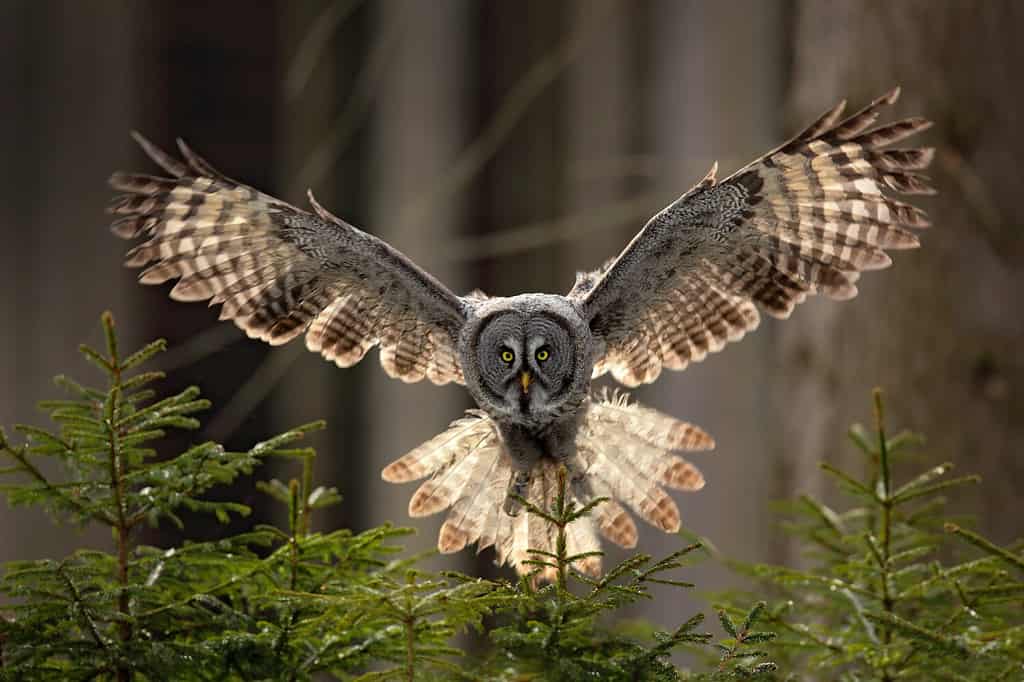
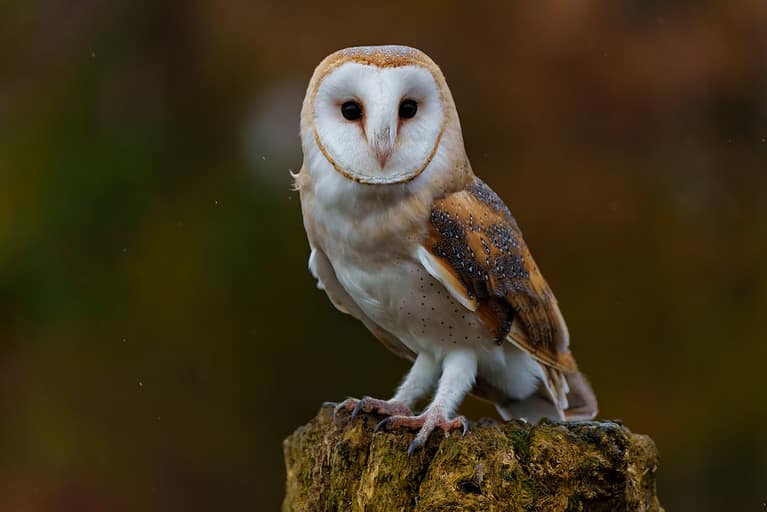
The Great Grey Owl has the largest facial disk of all owls, used for detecting sound in all directions.
©Ondrej Prosicky/Shutterstock.com
All owls have facial disks. But in the case of the Great Grey Owl, which has the largest of all facial disks, this is a powerful tool used to hunt their preferred prey, voles, even from far away.
Owls’ facial disks are used to capture sound. It is used like a “radar dish” to help owls determine exactly where their prey is located, as well as any predators lurking in the distance. In the case of the Great Grey Owl, not only does it have a large facial disk, but also ears that are at different levels on the head to “pinpoint noise” both left and right, as well as up and down.
As the Great Grey Owl cuts through the air with no noise, it can use the facial disk while in flight to hear the sounds of the voles as they move. This is done both as voles move through dense brush but in over a foot of snow.
What is interesting when it comes to the snow is that the Great Grey Owl will hover for a moment before striking. According to a 2022 study published in Proceedings of the Royal Society B, this phenomenon is attributed to the snow creating an “acoustic mirage” that can cause the sound of the voles to appear to be coming from an area where they are not. Using their facial disk, the Great Grey Owl can determine precisely where the vole is beneath the snow, simply by listening for a moment. Consequently, the owls are precise in where they strike, successfully capturing prey nearly every time they attempt to do so.
Great Grey Owls Are Large But Stealthy
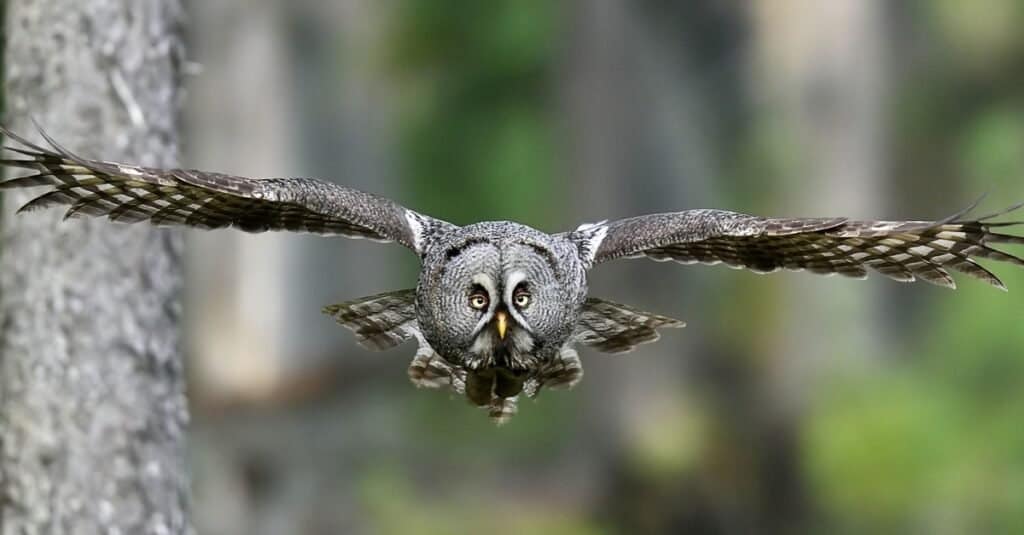
The Great Grey Owl is one of the largest owls, but it is also the most silent when it comes to hunting techniques.
©Erik Mandre/Shutterstock.com
The Great Grey Owl is one of the largest owls worldwide. Because of this, it would make sense if the owl were loud when flying, given its body mass. However, despite being large, the Great Grey Owl is one of the stealthiest owls there is.
The reason why some owls are quieter than others has been a discussion for decades. It was not until Krista Le Piane, a then-graduate student and PhD candidate at the University of California, Riverside, made it her mission to determine what causes some owls to be silent when flying.
A 2020 study published in Integrative Organismal Biology, in which Le Piane was the lead author, found that there were two hypotheses as to why owls, like the Great Grey Owl, could be silent in flight, while other owls were not.
“According to the self-masking hypothesis,” Le Piane explains in the study, “owls fly silently to avoid producing wing noises that block their own hearing, much as the sound of one’s own footsteps can mask the ability to hear another noise.”
“This self-masking hypothesis predicts that silent flight evolved in response to how reliant the owl is on sound to hunt. This hypothesis predicts that wing features promoting silent flight will be correlated with traits associated with acute hearing,” Le Paine states in the study. “It predicts that owls hunting prey that make audible noises, which allow them to be localized, will have these wing features, whereas those specializing on prey that do not make noises that allow the owl to hunt the prey acoustically will not have silencing features.”
Additionally, as Le Piane pointed out in a 2022 study published in the Biological Journal of the Linnean Society, the primary feathers also help to reduce sound, thanks to the “comb” shape they possess.
“This comb is a series of modified barbs, or serrations, which project up from the outermost primary feathers on the leading edge of the wing,” the study explains.
The study goes on to say that by having these “serrations” present, the turbulence that owls face is broken down into smaller eddies. The feathers can decrease the sound of the wind going through the wings, making the Great Grey Owl nearly silent. In addition to the comb-like feathers decreasing the sound caused by turbulence, the down feathers the Great Grey Owl possesses also help to muffle sound.
While not discussed in the study, a 2018 study by Le Piane proposed that the frequency at which turbulence is processed through the wings is higher than what owls’ prey can hear. Consequently, it is still a work in progress to determine why the Great Grey Owl and others of its size can remain as stealthy as they do in flight, despite their large body size.
Great Grey Owls Are Opportunistic Hunters
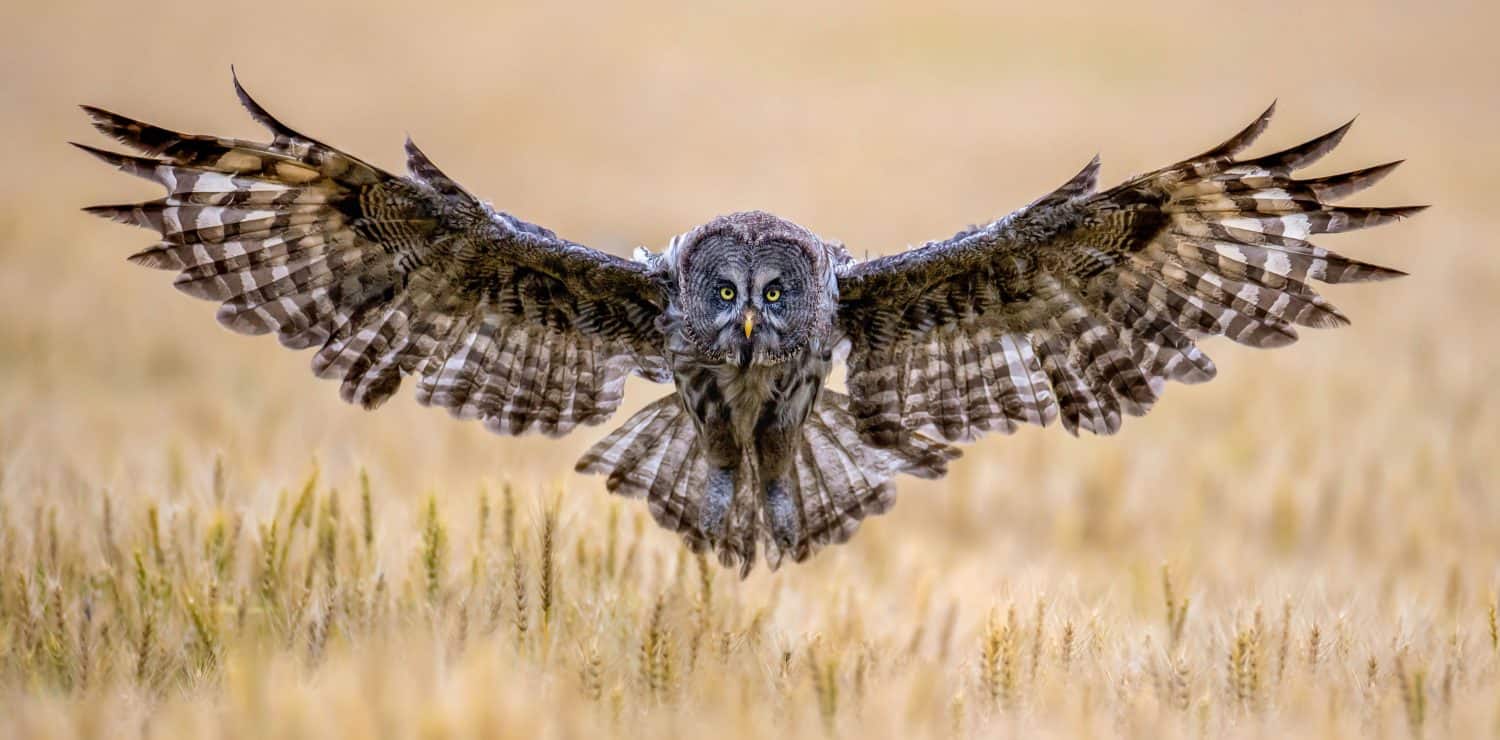
The Great Grey Owl prefers to hunt during dawn, dusk, and the evening, but if prey is present during the day, it will hunt around the clock.
©Wang LiQiang/Shutterstock.com
Owls are typically considered to be nocturnal animals. However, they are also opportunistic animals. What this means is if there is known prey that is active during the daytime, the owls will hunt during the day versus at night. Typically, a Great Grey Owl will be seen hunting during the day during breeding season. However, their typical hunting time is during dawn, dusk, and at night. Coincidentally, the times that voles are most active, which is the preferred prey for a Great Grey Owl, are during these same periods.
However, voles are always active and will move around during the day as well. This is why the Great Grey Owl is still able to hunt them during the peak of the day during the winter. Not only do these rodents remain active around the clock, but they also do not hibernate like other creatures do during the colder months.
Great Grey Owls Can Hunt Prey Under Feet Of Snow
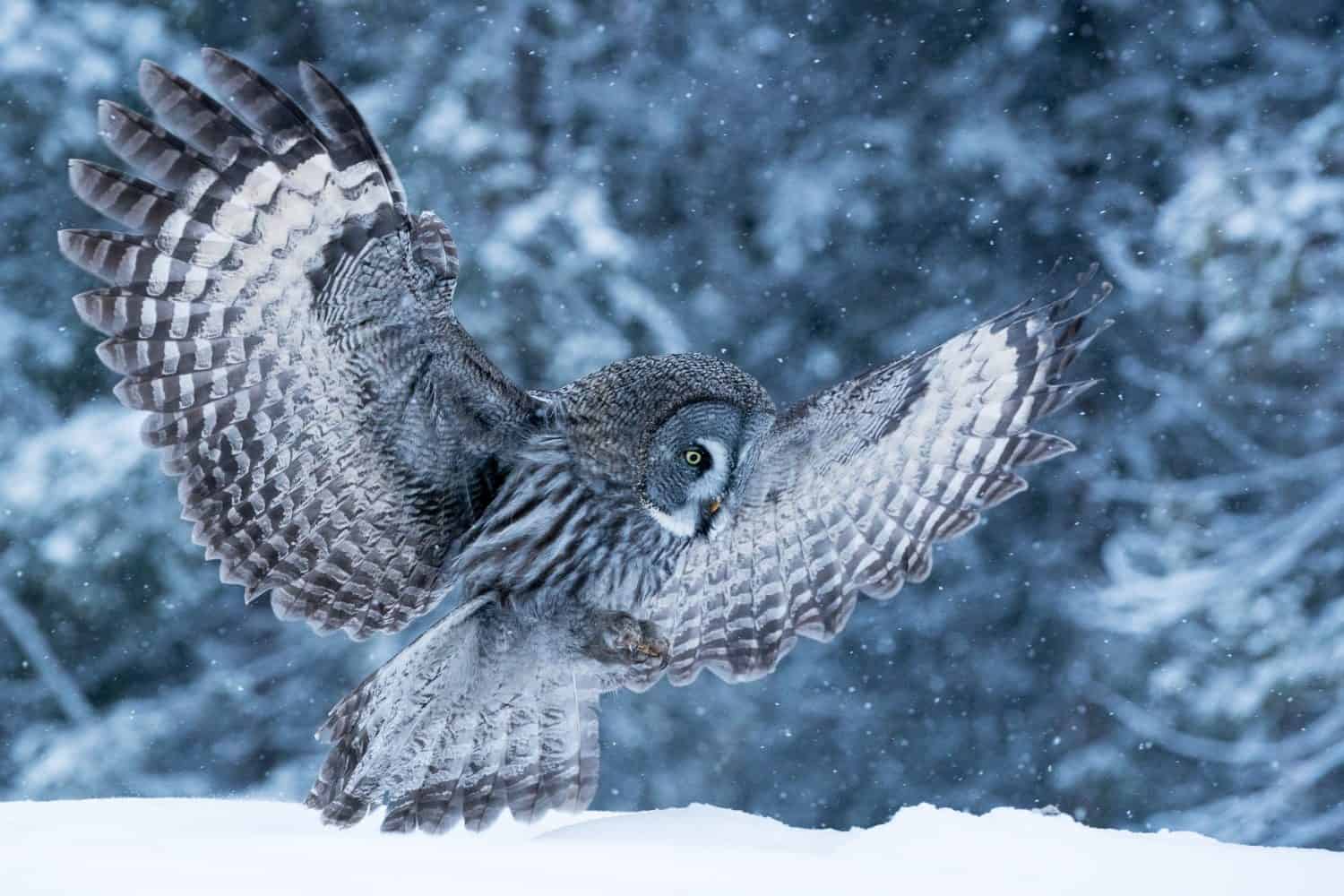
The Great Grey Owl can detect prey under a foot of snow or more.
©adamikarl/Shutterstock.com
The Great Grey Owl has the ability to hunt year-round, regardless of the conditions. What this means is that if it is the warmer months when prey can be easily seen or during the winter when prey is covered by snow, the Great Grey Owl hunts with ease. While there is always a challenge when it comes to hunting, the challenge intensifies when prey has to be detected without using sight. Fortunately, the Great Grey Owl’s ability to hear its prey under a foot or more of snow is what helps it to successfully hunt voles, even as the voles’ activity should be shielded.
The Great Grey Owl’s hearing is so sensitive that it can hear a vole’s heartbeat under the snow. This ability to hear a heartbeat and the virtually noiseless flap of the Great Grey Owl’s wings is what makes the owl so dangerous. The vole or other prey that the Great Grey Owl targets does not even know the owl is coming before it is snatched up. Consequently, prey is clueless; they are even being considered as a meal until the owl has grabbed it and consumed the prey moments after striking. This ability to hunt in such a stealthy manner would leave many to believe the Great Grey Owl is an apex predator. However, while the owl has incredible hunting skills, it still has predators, which means it is not considered an apex predator.
Great Grey Owls Are Incredible Hunters, But Do Have Natural Predators
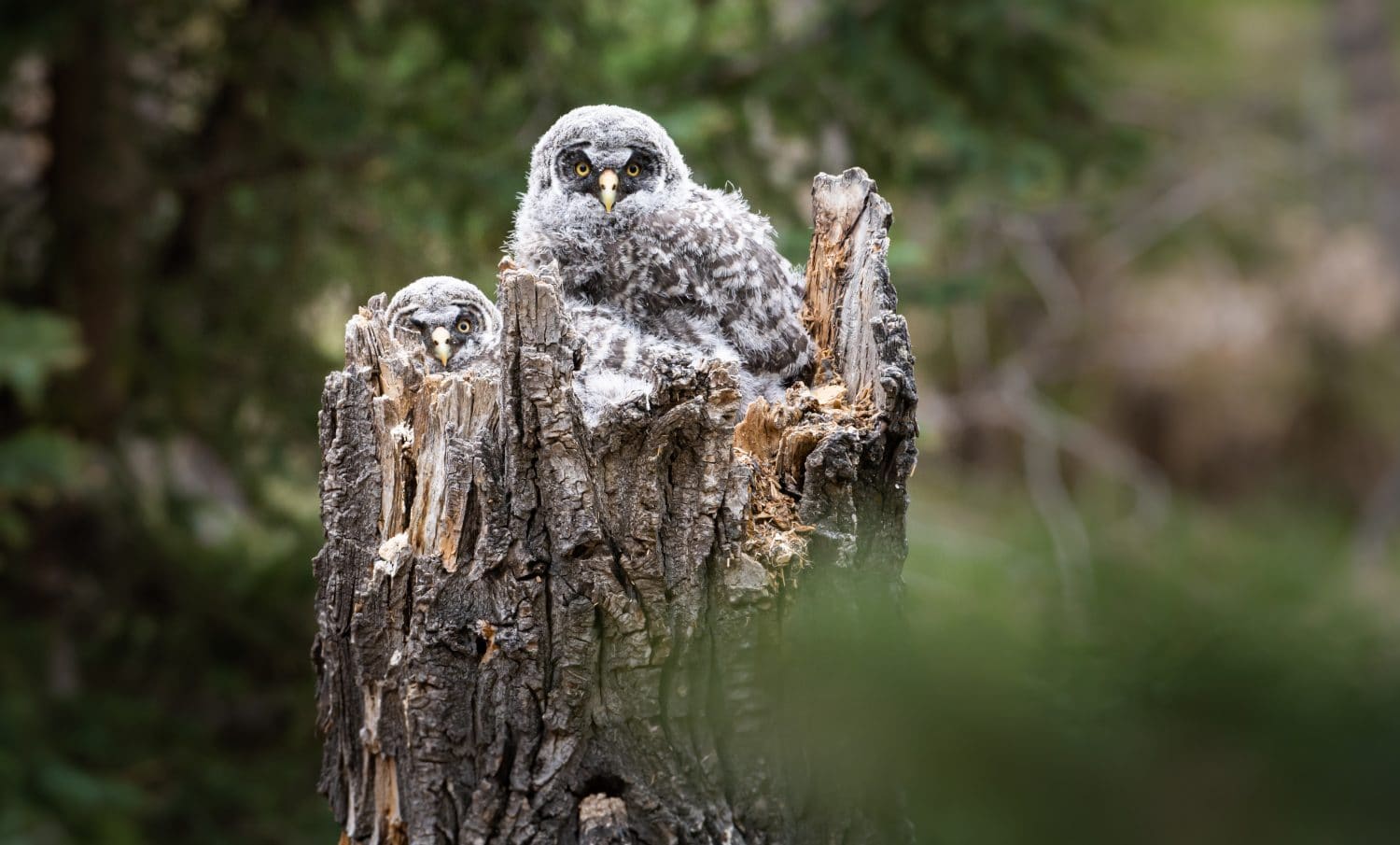
The Great Grey Owl is a top predator, but still has animals that consider it prey.
©Ghost Bear/Shutterstock.com
Despite being an incredible hunter, the Great Grey Owl is not considered an apex predator. Instead, it is a top predator, given that the owl does have natural predators. The Great Grey Owl has hunting capabilities that are second to none. Not only can it hear something as small as the heartbeat of a vole, but its wings are virtually silent when flying across the sky to strike its prey with precision.
However, the Great Grey Owl becomes a target for other animals when it lands or flies away from the safety of trees as an adult, when eggs are left unattended in a nest, or when hatchlings are not supervised. Consequently, the owl not only needs to listen for its prey, but also for predators that want to make it prey as well.
The animals that hunt the Great Grey Owl include:
- Black Bear
- Broad-Winged Hawk
- Northern Goshawk
- Common Raven
- Great-Horned Owl
- Golden Eagle
- Lynx
The Great Grey Owl is often able to defend itself and its eggs or hatchlings, given that it becomes aggressive when the two are threatened. However, because the species is not as aggressive as other predators, the Great Grey Owl can find itself on the receiving end of being hunted. This is why the owl’s exceptional hearing is so necessary, so that when danger lurks, the Great Grey Owl can fly off safely before becoming a meal for another predator.