
Quick Take
- Scientists already knew bats adjust the pitch of their calls to hunt, but that behavior turns out to have a hidden function nobody suspected. See what researchers discovered →
- Bats aren't just listening harder in noisy forests. They're doing something far more active to silence the chaos around them. Explore the silent zone effect →
- Researchers confirmed the effect by breaking it, and doing so reframed a decades-old question about bat hunting. See how they broke the effect →
- The same acoustic trick bats use in dark forests could change how engineers build sonar, radar, and ultrasound systems. Discover the engineering applications →
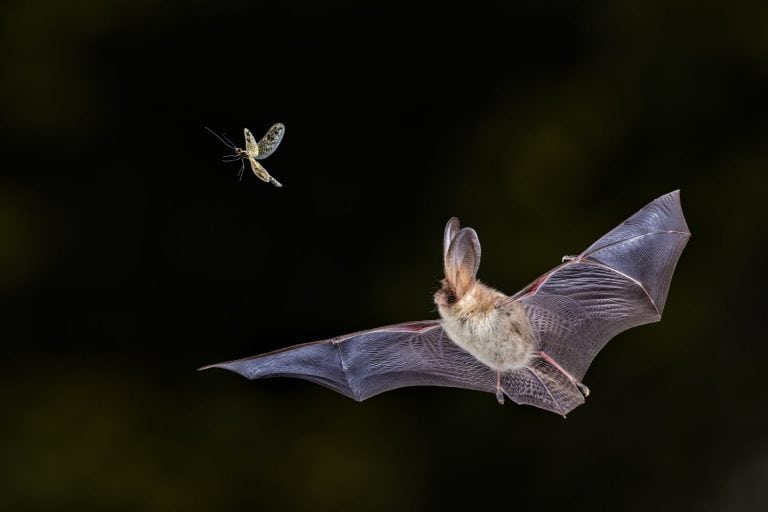
As darkness falls, a greater Japanese horseshoe bat gets ready to head out for the night’s hunt. As it takes flight, it uses its refined hearing to zero in on a target in the noisy forest. The unsuspecting prey has no idea that danger is about to swoop in until it’s too late.
For bats, hunting by sound is how they find their next meal. But how exactly do they do it? More importantly, is there more to it than scientists already understand?
How Bats Hunt
Bats are flying mammals that hunt almost exclusively by sound. They function like aerial radar dishes, emitting pulses of sound and listening for the echoes that bounce back. They use this information to determine the distance, size, and shape of objects around them. They are highly skilled at distinguishing background noise from the specific sounds made by their prey.
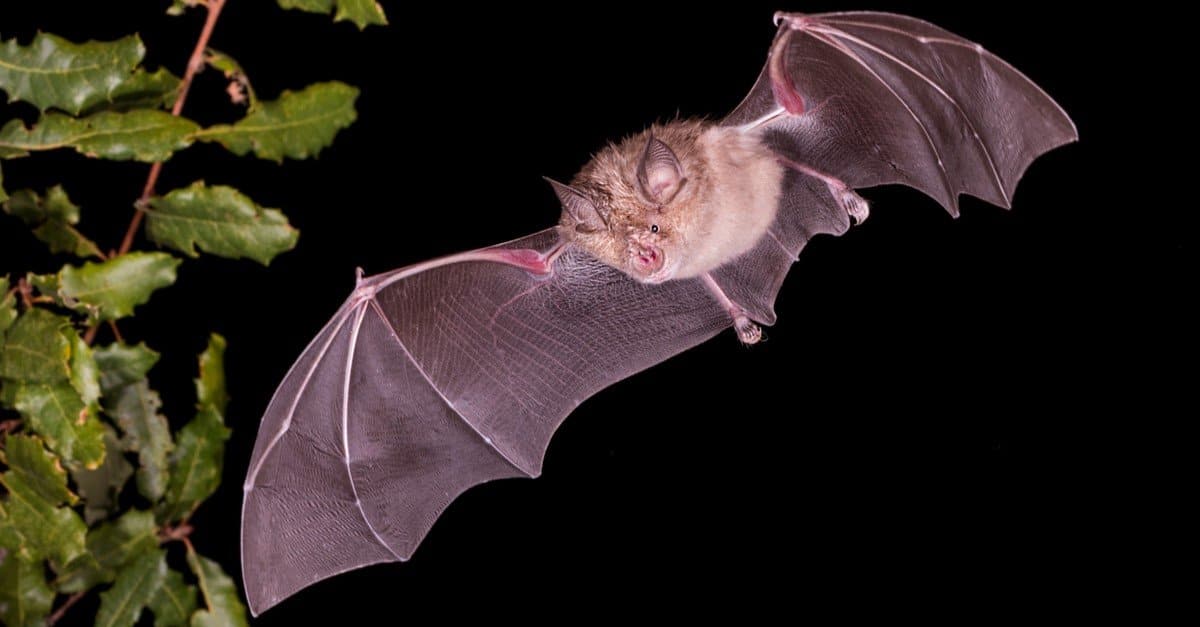
Bats hunt primarily by sound.
©Here/Shutterstock.com
Most bats go through three phases when they hunt. They start hunting by emitting slower, longer sound pulses with extended pauses between them, which helps them assess their surroundings. When a bat detects a promising sound, it increases the rate of its sound emissions as it approaches its target. Once it is within striking range, the bat emits a constant buzz that guides it precisely to its victim. This final step takes less than a second.
For the bat, it’s just another night finding its next meal in the dark. But to the casual onlooker, it is a master class in hunting by sound. Now, new research shows that for at least one bat species, there is more to that ability than was previously understood. The findings, published in the journal Communications Biology, were released May 19, 2026.
The Study That Changed Things
Researchers at Doshisha University in Japan already knew that sound plays a key role in successful hunting in bat species. The researchers were curious about how a bat is able to filter out the multitude of sounds in a forest to hone in on its prey so precisely.
They turned to the Japanese horseshoe bat to find out. They already knew that these bats use a process called Doppler shift compensation (DSC) to find their prey. DSC allows a bat to change the frequency or pitch of the sounds it emits, helping it better find and focus on potential prey in a noisy environment as sound returns to it. At its most basic, DSC helps stabilize auditory perception in bats.
However, the researchers wondered if DSC had another function.
How the Research Was Conducted
The Japanese researchers began by capturing 11 greater Japanese horseshoe bats from local forests. Back at the lab, the team played a variety of artificially created echo sounds and recorded which sounds triggered the DSC behavior in the bats. Researchers also attached microphones to the bats to record real echo sounds received during flight and hunting. The researchers used tethered moths as the prey.
Their experiments revealed that bats can control their own echolocation calls to keep the highest frequency echoes as a constant reference. When they do this, it automatically creates a “silent zone” that blocks out any echoes above that reference point. Once the clutter noise is eliminated, the bats can focus exclusively on the faint echoes from their prey.

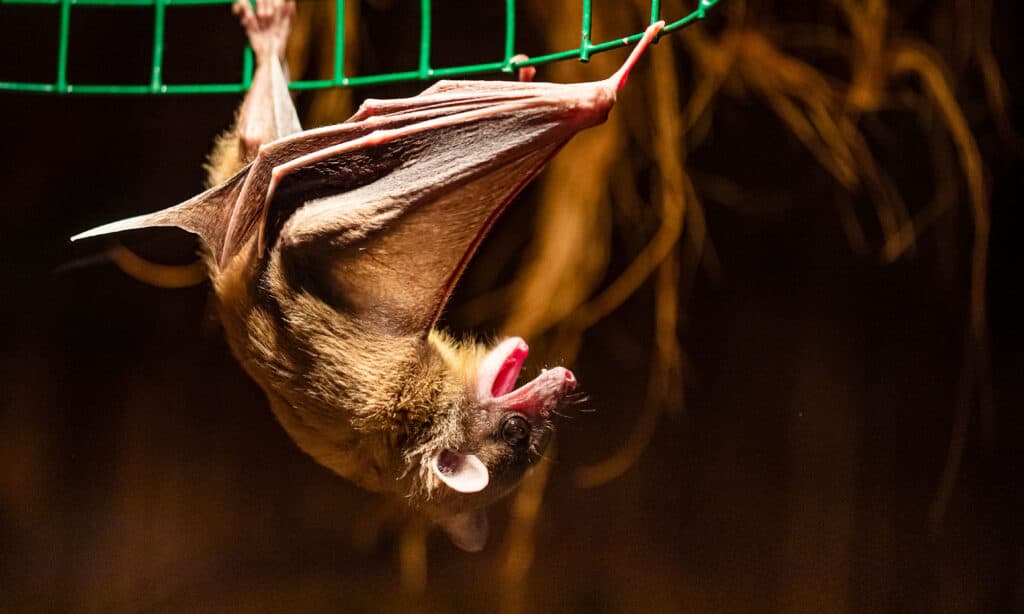
Bats use echolocation to hone in on their prey.
©Alex555x/Shutterstock.com
To test their hypothesis, researchers conducted additional experiments in which they introduced artificial noise into that silent zone. As a result, the bats’ hunting success decreased. When researchers introduced additional noise that was filtered out by the silent zone, there was no impact on the bats’ ability to hunt successfully.
They concluded that the silent zone is not just a byproduct of echolocation, but a strategy bats use to hunt more effectively in noisy environments. This offers evidence of how animals solve acoustic challenges in natural conditions, such as noisy forests.
“I am truly delighted that this study has finally clarified the fundamental role of DSC, a question that has fascinated me since my PhD student days,” Professor Shizuko Hiryu of Doshisha University and a co-author of the study said in a recent news story. “Our findings show that bats actively shape the acoustic environment to enhance perception, manipulating the physical properties of echoes rather than relying solely on neural processing. This study reminded us once again of how remarkably intelligent bats are in their use of the acoustic world.”
What the Findings Mean Beyond Bats
The ability of bats to adapt their hearing to solve acoustic challenges has implications beyond the species. Technologies that rely on waves to shape signals — such as ultrasound, sonar, radar, and imaging systems — may also benefit from these findings.
Developing new approaches to refine wave-based technologies, especially for use in noisy or complex environments, could enhance the quality of data these technologies provide.