
Quick Take
- A caterpillar trapped in a bag with only its front legs free has evolved a locomotion strategy so strange it took a lab study to figure out how it works.
- Bagworm silk outperforms what materials scientists expected, and it is already being considered for human products.
- Female bagworms undergo an extreme transformation, with their bodies serving one final purpose.
- The same slow, cumbersome design that makes bagworms easy prey is the exact reason they've thrived long enough to defoliate over 128 species of trees.
We’ve all watched caterpillars crawl, creating a ripple-effect with their multiple pairs of legs alternately making contact with the surface. Species like inchworms (larvae of the geometer moth) move by planting their front and rear legs one after the other, arching their bodies forward as they go. But one type of caterpillar, the “bagworm”, moves without ever using its back legs.
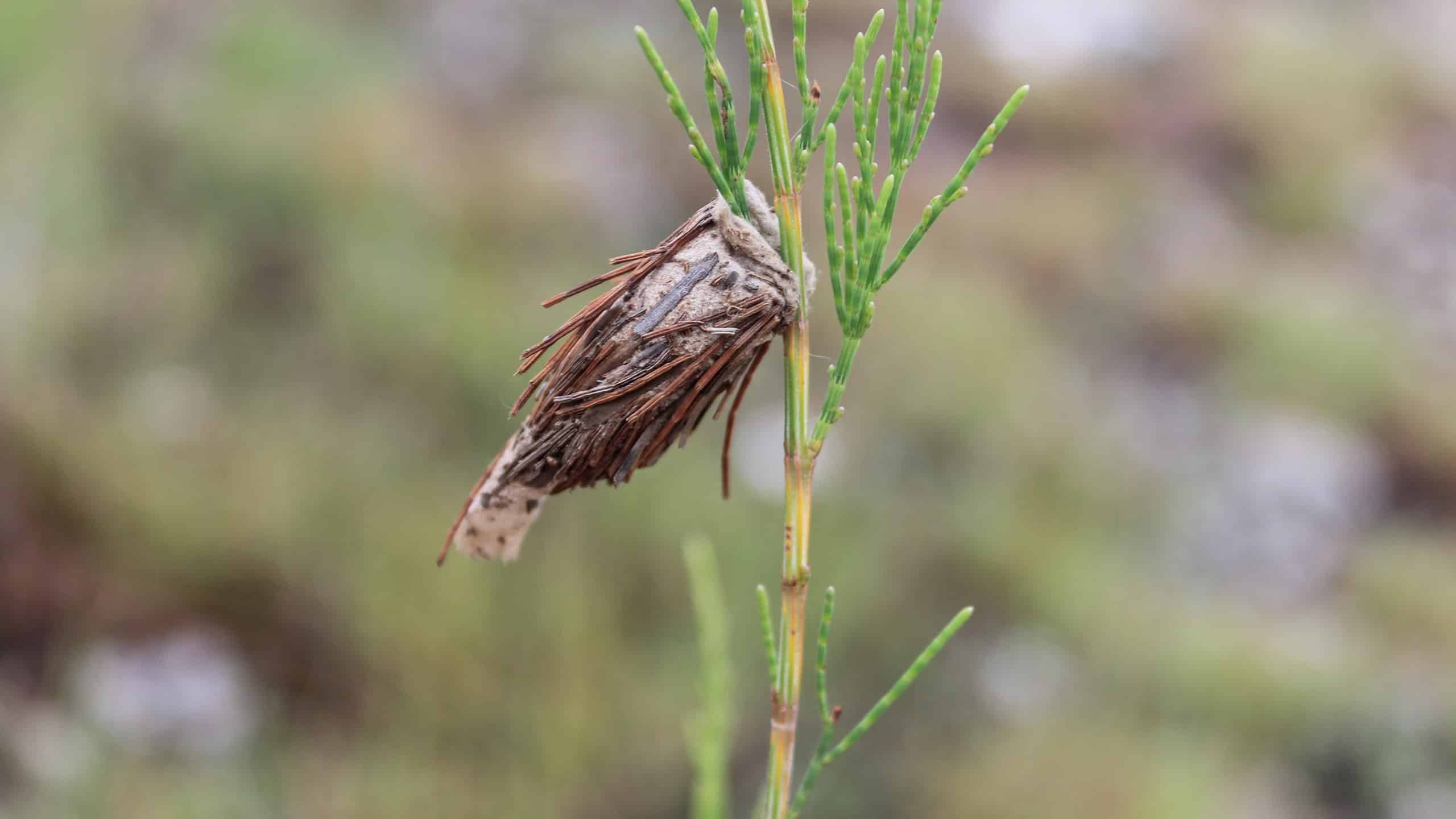
Bagworms are the larvae of moths in the family Psychidae, so named because they enclose themselves in silk structures that resemble little sacs hanging off trees. By incorporating pine needles, leaves, and twigs in their bags, the larvae camouflage as bits of tree debris. Because of their voracious appetites and tendency to defoliate at least 128 types of trees and shrubs, bagworms are considered pests in the U.S. They are found from New England to Nebraska and southward through Texas.
But how can a tiny creature confined to a bag be a pest? With only their heads and front legs (“thoracic legs”) outside the bag, they’re unable to use their back legs (“prolegs”) for locomotion like other caterpillars. In fact, their back legs are immobilized as they hold the bag in place from the inside. Yet, bagworms don’t remain in one place. They move from tree to tree, searching for their preferred food sources, which include juniper, pine, and other conifers, as well as maple, willow, and other streamside plants.
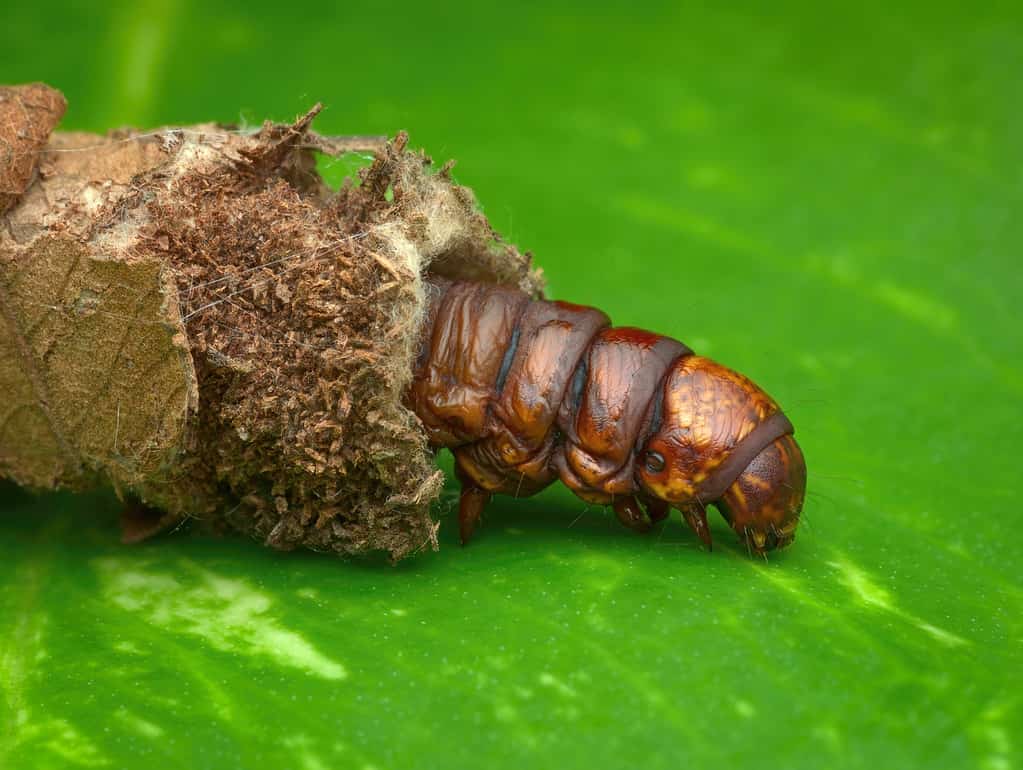
Bagworm caterpillars cover themselves with a protective case.
©iStock.com/Abdul Latif
To reach other branches or new trees, bagworms spin silk strands, using them to launch themselves like a parachute in the wind. Once on a tree, they begin munching on leaves and needles. A 2021 study published in Scientific Reports described their unusual mode of transportation using only their three pairs of front legs. By observing bagworms walking on black paper in a laboratory setting, the researchers detected a unique locomotion behavior.
The bagworm spins silk thread into a zig-zag shape, gluing the silk to the surface each time it changes direction. The rungs of silk remain suspended between the glued points in a ladder-like structure. Each rung is connected to the neighboring rungs on either side, since the entire ladder is formed from a single continuous thread. This strand can be over 100 meters long, according to the researchers. The bagworm climbs the ladder, rung by rung, by hooking onto it with sickle-shaped claws at the end of its front legs.
While the second and third pairs of front legs secure the bagworm to the ladder, the first pair of legs continuously builds the ladder from silk and adhesive material extruded from the spinneret on its chin. The ladder is strong enough to support the bagworm on vertical surfaces or even on the undersides of horizontal leaves. A 2019 study published in Nature Communications found the silk from a Japanese bagworm (Eumeta variegata) to be “extraordinarily strong and tough,” so resilient that it’s a promising candidate for human use as a structural material.
Since then, researchers and companies have explored the potential of bagworm silk for use in products such as tennis racket shafts. “Bagworm silk is made of protein, just like silkworm and spider silk,” explained Asanuma Akimune, an employee in the Corporate Strategy Division of the materials manufacturer Kowa, in an article. “When we analyzed the amino acid sequences that make up the protein, we found that it has a highly ordered hierarchical structure, which is what provides its high strength.”
However, for bagworms, this laborious method is their only form of movement. It’s limiting, forcing the larvae to move slowly. If a predator approaches, a bagworm cannot escape by running; instead, it retreats into its bag. After about four weeks of dragging their bags around, male bagworms emerge and fly off to mate with females.
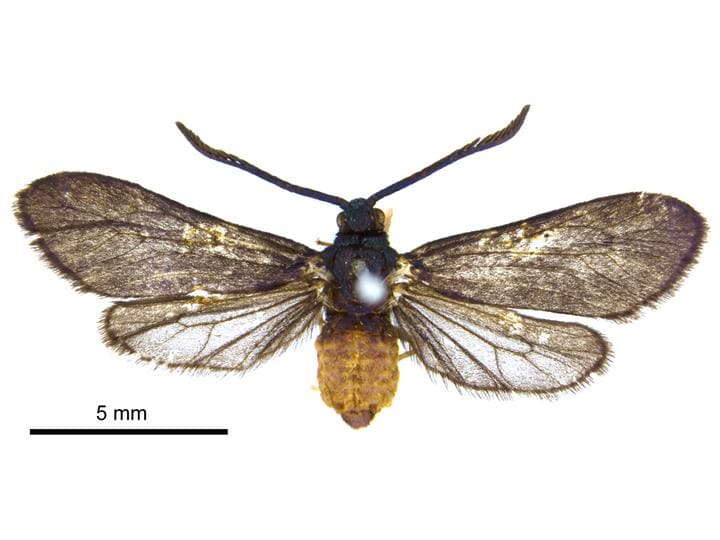
The females, however, spend their whole lives in bags, metamorphosing into yellowish, wingless, larviform moths that have highly reduced or nonworking eyes, legs, and mouthparts. Males must mate with the females through the openings in their bags. The females lay hundreds of eggs in their bags, then mummify themselves around their egg masses, offering their bodies as nutrients for the larvae.
When several hundred to over 1,000 eggs hatch in the spring, the larvae emerge and construct their own bags.