
Quick Take
- Scientists spent decades trusting a "gold standard" method to age sharks, but a crisis eventually revealed it was fundamentally wrong. See why bands misled scientists →
- Researchers set out to measure how old sharks are, but in doing so they accidentally discovered something far more revealing hidden inside their bones. Discover the hidden chemistry →
- A shark's skeleton silently records something most scientists never thought to look for, a fact that a laser finally managed to expose. See what the skeleton records →
- For one critically endangered shark species with fewer than 2,500 individuals left, this technique could change what conservation even means. Explore conservation applications →
As above, so below. There are patterns in nature that function as fractals, capable of retaining their essence no matter their magnitude. Such is the case with galaxies when compared to neurons in the brain. Such, it seems, is also the case when comparing tree rings and shark bones. By combining two advanced geochemistry techniques, Australian researchers have figured out how to read the story of a shark’s life by analyzing its vertebrae.
Counting a shark’s age by its vertebrae mineral deposits is not new. For decades, scientists knew they could count the alternating light and dark bands from a slice of a shark’s vertebrae to add up its years. However, such measurements are often unreliable. Seeking to improve the accuracy of these insights, researchers from the University of Melbourne have combined two innovative techniques to paint a more nuanced picture of a shark’s age, movements, and even specific aquatic environments it has traversed. Let’s learn more about this fascinating new study and how the intersection of science and technology can produce some startling insights.
Tree Rings
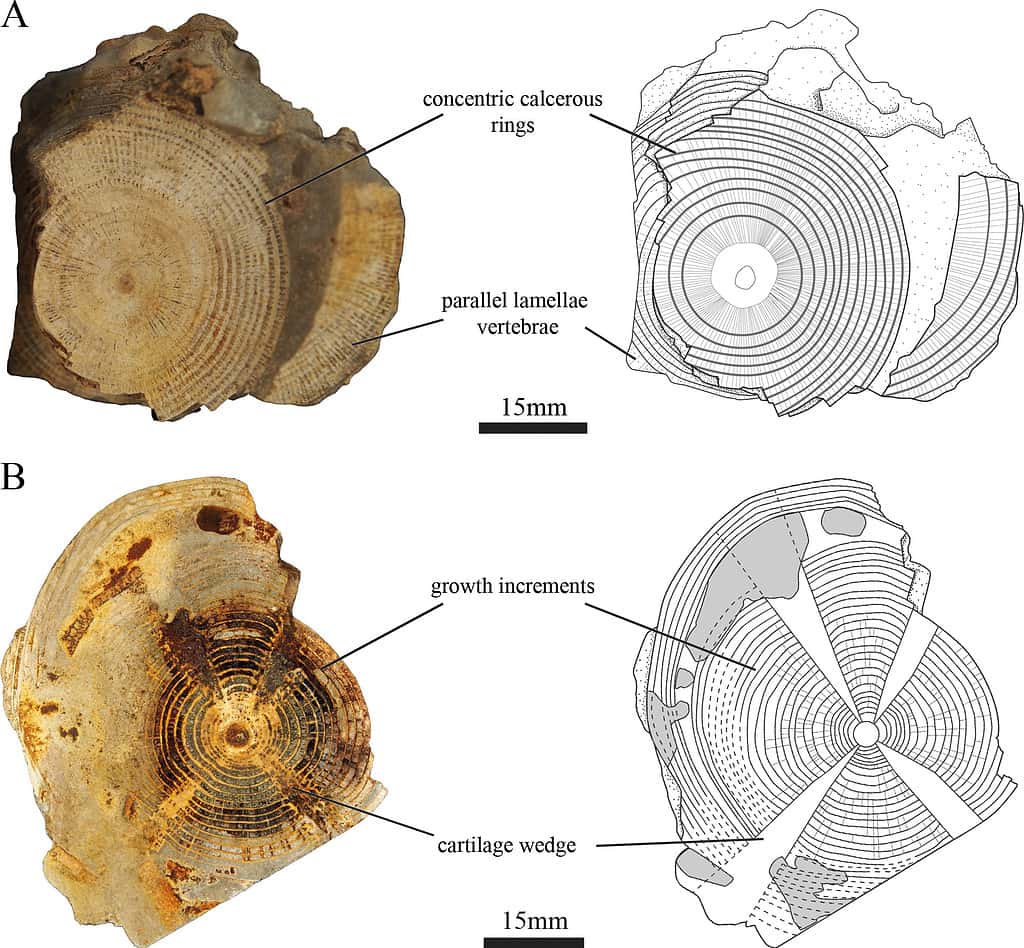
Just like tree rings, the mineralized center of shark vertebrae shows stages of metabolic growth.
Since the early 1900s, scientists have known about the unique features of shark vertebrae. Unlike other fish, sharks have cartilaginous skeletons. In the center of their vertebrae, however, sits a calcified component. Upon closer inspection, scientists realized that these calcified centers mineralized over time, leading to deposits of calcium and phosphorus layers.
Inspired by counting tree rings, researchers realized they could probably measure shark age in much the same way. This begat staining techniques, whereby marine biologists would stain shark vertebrae with silver nitrate or other chemicals to reveal patterns of growth. Opaque bands became associated with rapid growth, while more translucent bands became associated with slower growth. This technique became codified, and eventually, the gold standard for aging sharks.
For years, this technique produced seemingly surefire results for fisheries and conservationists regarding shark health. The only problem, however, was that these growth rings were not consistent. A crisis was brewing in the background, and it took until the millennium for scientists to realize their mistake. It turned out that shark rings were much more metabolic than durational. If a shark starved for a period of time or endured high stress, minerals would cease to deposit in their vertebrae. Conversely, a shark in a chaotic environment might deposit two years’ worth of minerals in a single year. This scientific realization shattered the previously accepted measurement model.
New Techniques
Science is not the finalization of facts so much as the evolution of ideas. Enter researchers from the University of Melbourne, eager to advance the metabolic measurement model for shark vertebrae. They learned that shark age may be hard to pin down definitively, but shark biographies can be read through the quantities of different isotopes. Their findings were published under the title “Challenging traditional methods of age estimation: elemental and isotopic characterisation of speartooth shark Glyphis glyphis vertebrae.”
Researchers combined X-rays with Laser Ablation Inductively Coupled Plasma Mass Spectrometry (LA-MC-ICP-MS) to study the chemistry of shark vertebrae. The laser removed material from a Speartoothed shark vertebra and ionized it in a mass spectrometer to detect elements and their isotopes. Then they compared the results with existing geochemical data from areas that the threatened Speartoothed shark species calls home.
This produced some startling findings. As the researchers put it, “our results provide the first confirmation that shark vertebrae strongly record the geochemical fingerprints of their environment, based on combined X-ray- and isotope-based analyses.”
The Body Keeps Score
It turns out that every move a Speartooth shark makes is recorded in its skeleton. By comparing historic weather and geochemistry data, the researchers were able to link a shark’s location and activity to historic patterns. Even subtle data, like wet and dry seasons, was recorded in a shark’s vertebrae. The trace element strontium, for example, appeared in the vertebrae in quantities proportional to the strontium concentrations of the surrounding environment.
Though researchers were searching for a way to more accurately measure a shark’s age, they found everything except age, including behavior, movement, and location, year after year. As the researchers explained, these findings have serious implications, “as it indicates that, at least for the shark species we investigated, visible light/dark banding in the vertebrae is not a reliable means of estimating age.”
Future Implications

Speartooth sharks are a rare river shark species with fewer than 2,500 individuals left in the wild.
Scientists may not be able to accurately measure shark age, but with these new findings, they can identify movement patterns. This could prove critically important for the protection of species like Speartooth sharks. With fewer than 2,500 mature individuals left in the wild, Speartooth sharks need all the help they can get. These new findings from the University of Melbourne (in collaboration with other organizations) can help identify integral habitats, monitor ecosystem health, and, in turn, tailor conservation management policies towards specific shark needs.
As the researchers pointed out, their findings could also help assess macro-environmental effects. They explained that “this could include using vertebral microchemistry to assess modern effects on waterways, like the accumulation of heavy metals and other contaminants, and to reconstruct past aquatic environments.”
For a vulnerable species like Speartooth sharks, age may be just a number, but environment means everything.