
Spend a night in the African bush and you can hear them calling, just out beyond the edges of your camp. Like the howls of dogs with an edge of malice and mischief, a hyena’s calls spark curiosity in the mind while sending a shiver up your spine. Whatever their intentions, hyenas are the one African animal you never want to tussle with. This article from People.com is one of many chilling depictions of the real-life danger hyenas bring to human beings.
Sure, almost every living thing in Africa comes equipped with an edge, but there’s just something about hyenas. Depending on who you talk to, they are symbols of wit and innovation, or ugly omens of greed and cowardice. Whatever the stance or symbol, however, there’s more than meets the eye when it comes to hyenas. Let’s learn about their biology, their behavior, and their danger as evidenced by this near-fatal news story.
A Terrifying Encounter

Cape Vidal is part of the iSimangaliso Wetland Park, one of South Africa’s largest protected areas.
©U. Eisenlohr/Shutterstock.com
A week or so ago, terror struck a family at Cape Vidal Nature Reserve in St. Lucia, South Africa. Twenty-seven-year-old Nicolas Hohls of Harburg arrived at the Reserve with his father for a much-anticipated bachelor party. The crew spent the day fishing in the reserve before retiring back to camp, where they cooked some food and drank a few beers. At around one in the morning, the crew—including Nicolas Hohls—called it a night. As told in a People.com story, however, the night was far from over.
Late Night Terror
Hohls had been camping at Cape Vidal Nature Reserve since he was six years old, so he didn’t think leaving a six-inch gap in his tent door would be a cause for concern. About a half hour later, as Hohls was drifting off to sleep, however, terror struck. Two hyenas attacked him in his tent, one clamping part of his head in its mouth while the other bit his ankle.
He went from gentle sleep to violent struggle; the hyenas tore at his body, but Hohls fought back. He grabbed the first hyena and ripped it off his face before doing the same with the hyena clamped on his ankle. Once free of the sharp teeth, Hohls relied on instinct fueled by adrenaline: he struck at the hyenas’ weak points, gouging their eyes and throats.
Fighting to Survive
Hohls spent about a minute fighting off the hungry hyenas before his screams alerted his father, who was in a rooftop tent above him. By the time his father came to the rescue, the hyenas were gone, but Hols was left in a pool of blood. His father quickly threw him in a car and raced him to a hospital in nearby Ballito, South Africa. Thanks to the actions of both Hohls and his father, the 27-year-old is recovering well. Despite needing 30 stitches in his head, hand, and legs, the damage was minimal and without any sign of infection. For now, Hohls is resting and allowing his body time to heal. As he puts it, he’s “very grateful to be alive.“
Types of Hyenas

There are four types of hyenas, but only the spotted hyena is commonly known to attack humans. Rare attacks by striped hyenas have also been documented, particularly outside Africa.
©Ahmed Abubasel/Shutterstock.com
Hyenas are hard to place in the grand scheme of things. They may look like mangy dogs and behave like canines, but hyenas are closely related to felines and viverrids. There are four extant species of hyena, each with different characteristics: the spotted hyena, the brown hyena, the striped hyena, and the aardwolf.
Spotted hyenas (Crocuta crocuta) are the most widespread hyena species, particularly in Southern Africa. They are also the largest. Though they have a reputation as scavengers, they are also adept hunters. Interestingly, spotted hyenas live in complicated matriarchal clans with dozens of members. Brown hyenas (Parahyaena brunnea) also live in South Africa and are known to travel long distances for scavenging opportunities. While they often forage alone, they live in clans and maintain complex social structures.
Striped hyenas (Hyaena hyaena) are smaller, live in regions ranging from North Africa to India, and function primarily as scavengers. The aardwolf (Proteles cristatus) is the smallest but most enigmatic hyena species. It lives alone and by night, subsisting entirely on insects like termites. The majority of hyena species pose almost no threat to humans. Not only are they too small in size, but species like the striped hyena, brown hyena, and aardwolf are more scavengers than hunters. They prefer already dead game to eat. The spotted hyena, however, is a different story.
The Spotted Hyena

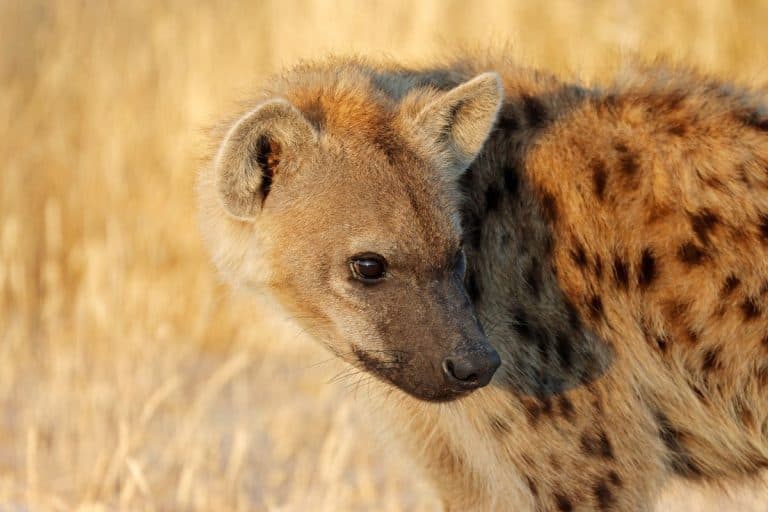
Spotted Hyenas are the largest hyena species and the most dangerous.
©Gumpanat/Shutterstock.com
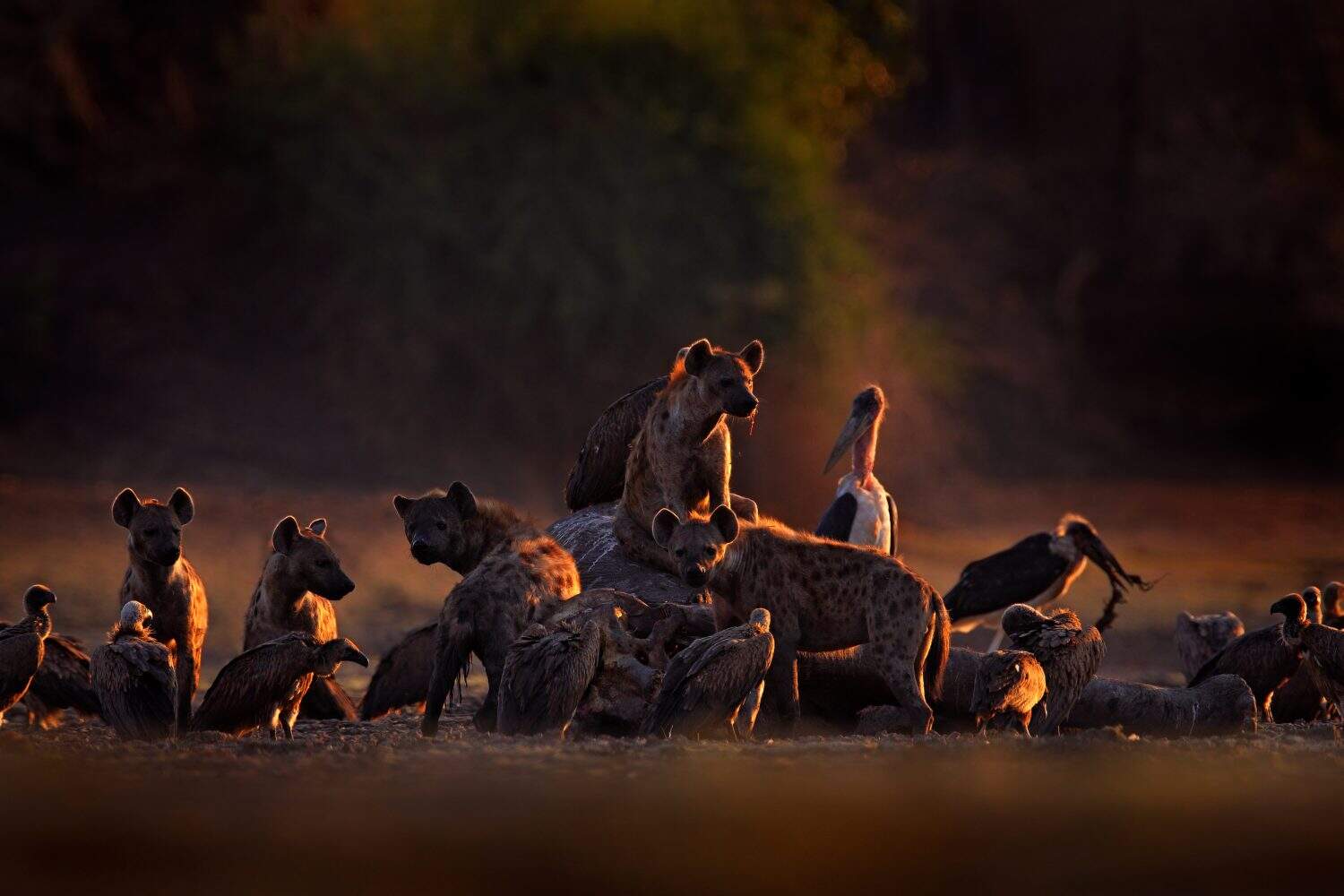
This People.com story of a hyena attack in South Africa undoubtedly involved spotted hyenas. They are the most populous type of hyena in the region and are known, in rare cases, to attack humans. Spotted hyenas, unlike brown hyenas, are capable hunters. As previously mentioned, spotted hyenas live in large matriarchal clans, often featuring up to 80 individuals. These groups function under strict hierarchies where females dominate; even the lowest-status female outranks the ‘alpha’ males.
Their large but shifting communities speak to the spotted hyena’s sociability. Those yelps, growls, and signature cackles emitted by spotted hyenas that you often hear in the South African bush play an important role in intra-clan communication. This eerie oral language helps signal rank, vocalize distress, or coordinate hunting parties. These hunting parties also make spotted hyenas incredibly effective predators when they aren’t simply scavenging food. Operating as a team, multiple hyenas will chase down prey like zebra or buffalo over long distances. Once they catch their prey, spotted hyenas use their incredibly strong jaws to eat every part of their kills. This makes them, essentially, the ‘recyclers’ of the savannah ecosystem.
While spotted hyenas can pose a threat to humans, they usually keep their distance, preferring to hunt down more conventional game. As evidenced by this People.com story and others, hyenas are opportunistic, seizing chances at human meals when said humans are exposed, vulnerable, or unaware.
These hyena-human incidents happen where both share habitats. Ironically, a hyena out in the bush is far less likely to attack a human than one habituated to people or some degree of urbanization. In the latter case, they are more likely to associate humans with food. The spotted hyena’s willingness to break boundaries with clever tactics, however, should not be underestimated. That said, they are far more dangerous to livestock than humans.
Fascinating Folklore

Hyenas have long been seen as symbols of trickery, magic, and the supernatural.
©Andrew Mohamed/Shutterstock.com
The long and contentious relationship between hyenas and humans has produced some fascinating stories, superstitions, and folklore. As far back as Aristotle, they’ve been known as clever yet ‘cowardly’ creatures. Even back then, more than one commentator remarked on the use of hyenas in magical rituals, suggesting their body parts could cure disease, invoke protection, or even increase virility. Many cultures consider hyenas as symbols of sorcery, witchcraft, and the supernatural. Whatever the time frame, ancient or modern, there’s something about hyenas that is liminal. Symbolically, they occupy a place between life and death and between hunter and scavenger.
Depending on which part of Africa you’re in, locals have different folkloric opinions about hyenas. In West Africa, they tell tales of this creature’s immorality, filthiness, and unconventional manner. East Africa, however, places hyenas in a more sacred space; Tabwa mythology, for example, treats hyenas as an animal of light, one that first brought the sun’s warmth to Earth. In the Horn of Africa, in countries like Somalia and Ethiopia, hyenas have a mixed reputation.
Some people see them as devilish, even hypnotic, while others treat them as living protection spells. Residents of the Ethiopian city of Harar, in particular, regularly feed and cohabitate with hyenas and treat them as magical barricades against evil. Whatever reputation you choose to believe, hyenas are beguiling and fascinating creatures, straddling different worlds and symbols. As this People.com story shows, however, they can be very real threats to human beings and should be treated with the utmost caution.