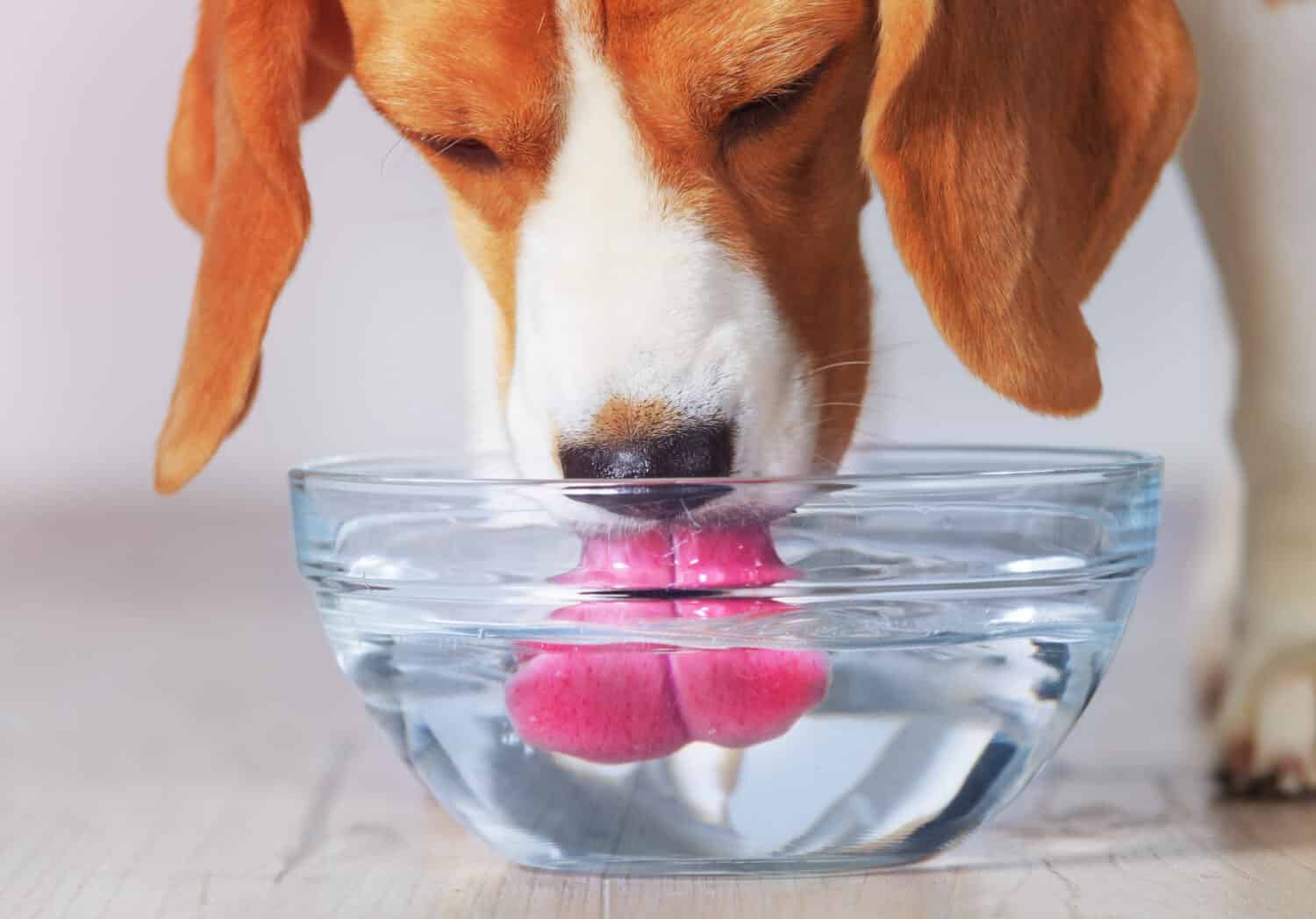

Quick Take
- Dogs snap their tongues upward, generating forces from 1 to 4 Gs and peaking at 8 Gs to lift a water column.
- The curled tongue forms a backward ladle, increasing surface area so water clings and rises as the dog retracts.
- Bigger dogs drink slower but pull more water per lick and make bigger splashes.
Can you imagine how hard it would be to catch a falling glass of water while blindfolded? What about doing it while hanging upside down at four times the force of gravity? It may sound like some impossible stunt, but for your dog, it’s just a Tuesday morning at the water bowl.
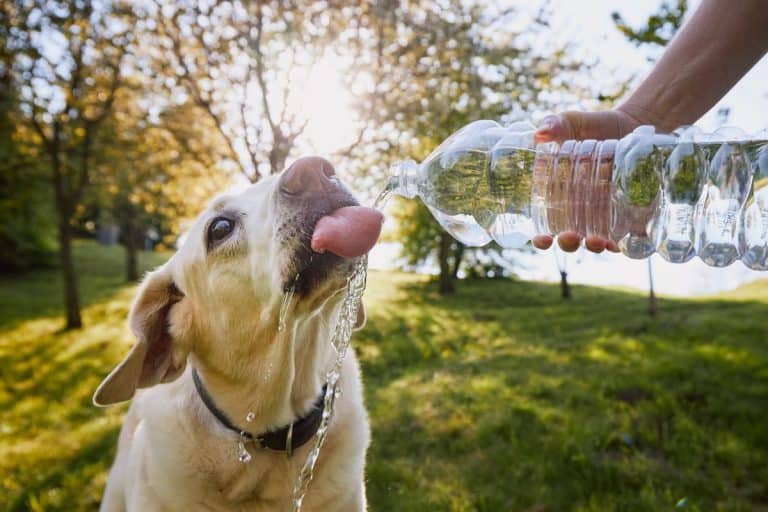
To us, a dog drinking water looks like pure, uncoordinated chaos, leaving nothing behind but messy splashes and slippery floors. But this high-speed footage on Instagram reveals a far different story. What looks like a disaster is actually a masterclass in physics. Dogs drink with surprising precision, using complex fluid dynamics to lap up every last drop.
Why Dogs Can’t Suck
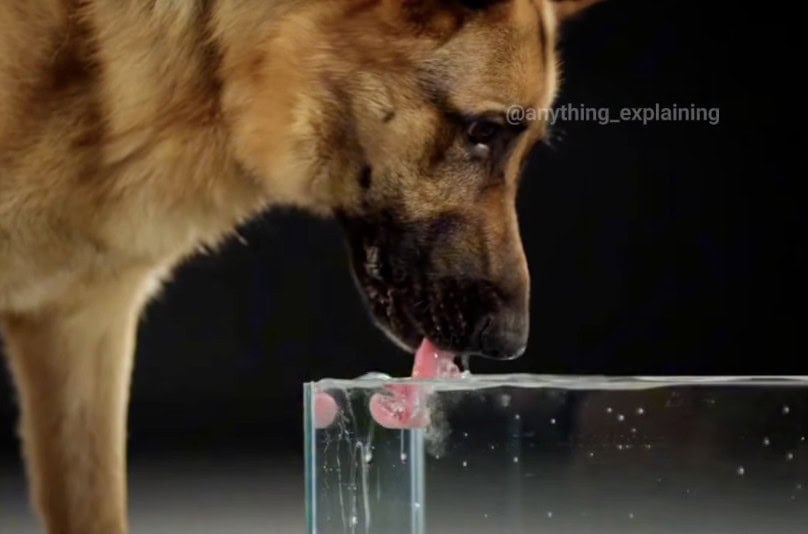
A dog can’t drink through a straw because it can’t fully seal off its mouth to create a vacuum.
©Instagram/@anything_explaining – Original
To understand how a dog drinks, you first have to understand why they can’t take in water as humans do. We have “complete cheeks,” which allows us to seal our mouths, create a vacuum, and suck liquid through a straw or from a cup.
Dogs are built differently because of an evolutionary trade-off. They have “incomplete cheeks” that allow their mouths to open incredibly wide — perfect for catching prey or panting to stay cool. The downside, however, is that they can’t create suction.
Because they can’t “suck” water up, dogs face a difficult task: they have to somehow move liquid upward against the pull of gravity using nothing but their tongues.
The Secret of the Backward Ladle
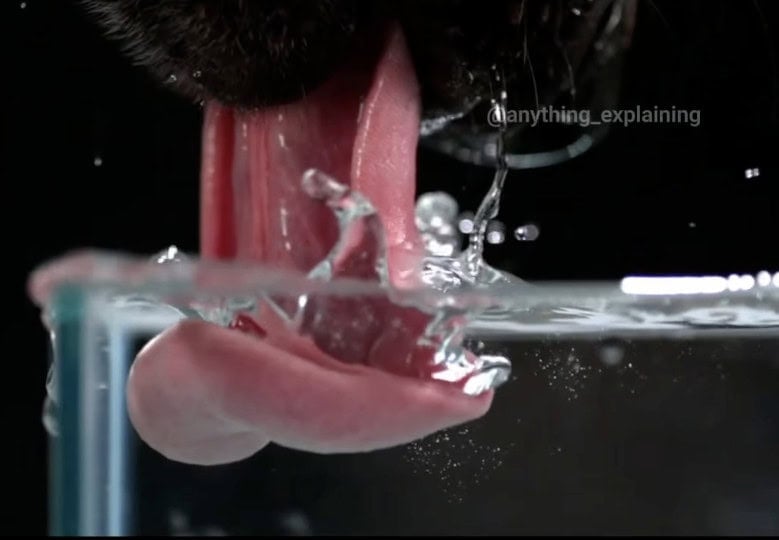
Splashing is an integral part of how a dog drinks water.
©Instagram/@anything_explaining – Original
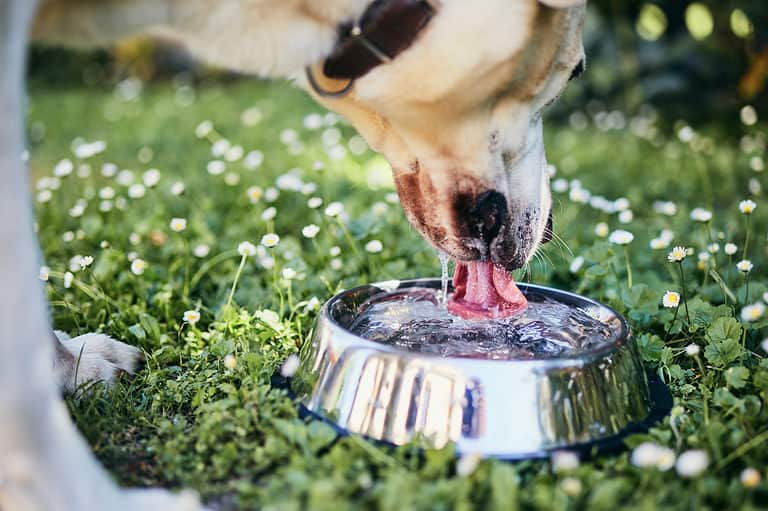
When your dog takes a drink, he isn’t just sticking his tongue in the water; he is performing a high-speed anatomical trick. The moment the tongue hits the surface, it curls backward to create a shape that looks like a deep ladle.
Most people think the dog is using this shape to “scoop” water into their mouths like a spoon, but that’s actually a myth. The “ladle” isn’t for carrying water — it increases the surface area, allowing more water to adhere to the tongue. As seen in the Instagram video, the water clings to the underside of the curled tongue, creating a bond that allows the dog to pull a liquid column upward along with the retraction of its tongue.
The Physics of the Snap
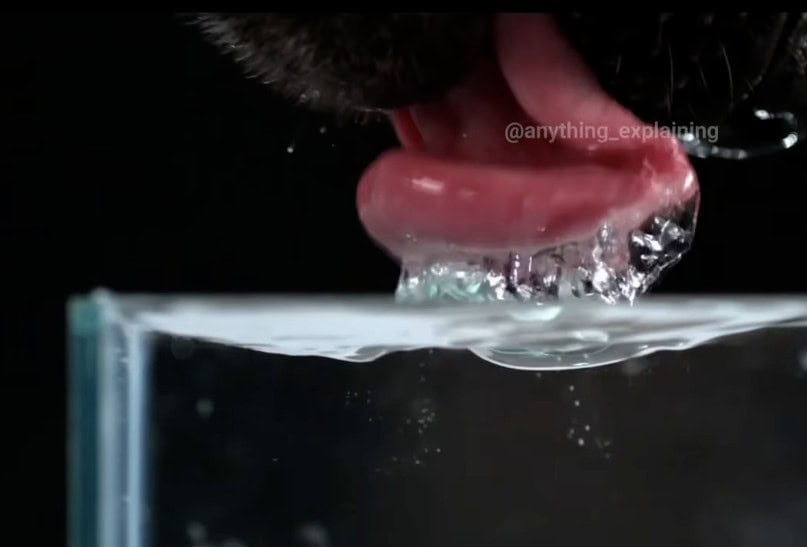
Dogs snap their tongues upward with incredible speed, generating forces typically between 1 and 4 Gs, though they can peak as high as 8 Gs.
©Instagram/@anything_explaining – Original
This is the moment your “sloppy” dog turns into a natural-born physicist. As they jerk their tongue upward, they are relying on inertia. By retracting their tongue at a blistering speed — generating forces up to 8 Gs — they pull a column of water straight up into the air.
Even after the tongue stops moving, the water’s momentum keeps rising. For a split second, your dog creates a tiny, vertical “water fountain.”
But this fountain is extremely short-lived. To actually get a drink, the dog must be quick and precise. They must snap their jaws shut at the exact microsecond the water reaches its peak, “biting” the liquid out of the air before gravity pulls it back down into the bowl.
Precision vs. Power
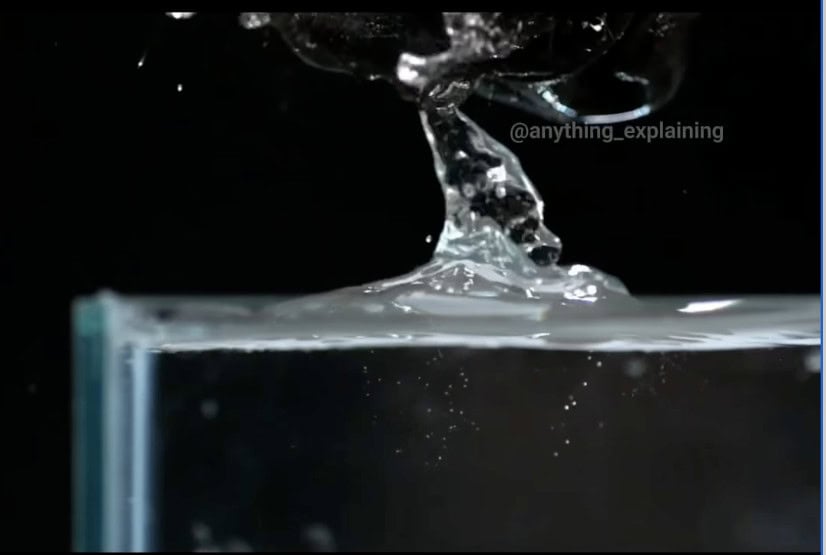
As a dog pulls back its tongue, the water follows, forming a tiny, vertical pillar of liquid.
©Instagram/@anything_explaining – Original
When it comes to staying hydrated, cats are like precision surgeons, while dogs are more like heavy-machinery operators. Cats use a more refined method, barely grazing the surface of the water with the tip of their tongue to pull up a delicate, hair-thin stream of water. It’s quiet, elegant, and typically clean. Dogs, on the other hand, use brute force. They dive deep, splashing through the water to pull up as much volume as possible.
To uncover the secrets of how dogs drink, researchers actually built “robo-tongues.” By using high-speed cameras to track several different breeds and simulating the movement with glass tubes and metal rods, scientists could measure the exact forces at play.
They discovered that the “mess” we see isn’t caused by a lack of coordination. Instead, it’s a necessary byproduct of physics. Because dogs are often much larger than cats, they have to move their tongues with incredible acceleration to pull up enough water to stay hydrated. The splashes aren’t actually mistakes — they are evidence of the high-speed power required to get the job done.
Size Changes the Rhythm, Not the Rules
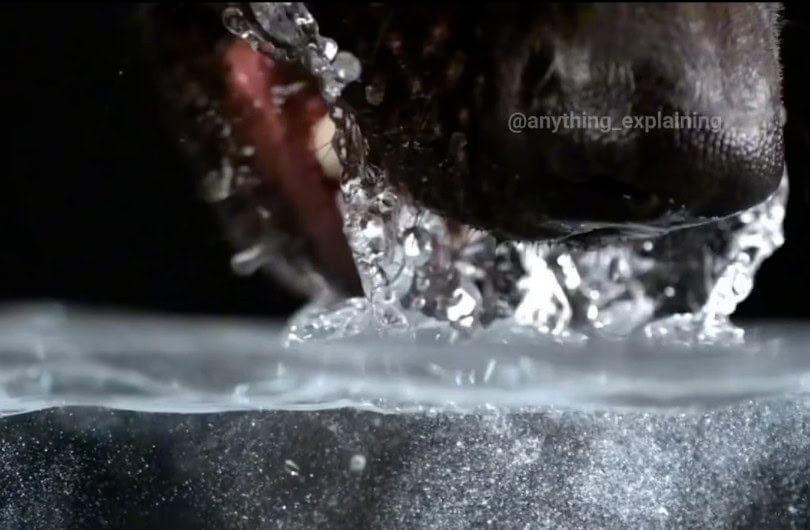
To successfully get a drink, a dog has to snap its jaws shut at the exact millisecond the water column reaches its peak.
©Instagram/@anything_explaining – Original
The physics of drinking is the same for every dog, but their size changes the speed. The bigger the dog, the slower the lap. A Chihuahua, for example, drinks in a blur of motion, lapping at high speeds to move tiny amounts of water. A Great Dane, in contrast, drinks at a slower, more rhythmic pace.
Because a large dog has so much more surface area on its tongue, it pulls up a greater amount of water with each lap. This explains why bigger dogs tend to make a bigger mess. It’s not that a Great Dane is more careless than a tiny Yorkie; its larger tongue simply creates a much bigger wake. The “mess” is just a larger version of the same high-speed physics.
So, the next time you’re mopping up around your dog’s water bowl, take a second to appreciate the feat of engineering that requires the clean-up. That “mess” is actually proof of a high-speed biological maneuver that defies gravity. Your dog isn’t just drinking; they are mastering the laws of physics, one high-speed lap at a time.