Humans have been using the remarkable olfactory abilities of dogs for as long as canines have been domesticated. Our ancestors used the ability of hunting dogs to sniff out prey to help them secure their next meal. Fast forward several thousand years, and humans are using dogs (more specifically, their noses) to detect narcotics, explosives, humans lost in the wilderness, and cadavers, to name just a few. So, why not use them to detect the one disease that affects nearly four out of 10 Americans during their lifetime – cancer. We explore the latest research into canine cancer detection and assess whether these developments could revolutionize cancer diagnostics.
Why Early Cancer Diagnosis Matters So Much
When someone has cancer, some cells in their body are growing uncontrollably. The human body is made up of trillions of cells, and cancer can start almost anywhere. It is perfectly normal for our cells to grow and multiply, and they usually receive a signal telling them when to grow and when to stop. This is how our bodies replace old and damaged tissue. With cancer, however, the cells multiply when they should not and form a tumor that invades other tissues and stops our organs from working properly. These cells ignore the signals that tell them to stop growing. Ultimately, cancer is caused by changes to the genes that control the way our cells function.
Cancer cells may also spread to other parts of the body. Cancer that has spread from the place where it first formed to another place in the body is called metastatic cancer. The later a cancer is diagnosed, the more likely it is to have spread. Medical statistics clearly show that the people who have their cancer diagnosed early stay well during their treatment, have an improved quality of life, have better experiences of care, and have better survival rates than those diagnosed later. Treating early-stage cancer is also cheaper than treating later-stage disease.
We can help ourselves by seeking advice from a medical professional if we notice any unusual symptoms. But what about the cancers that have very vague or even no symptoms in the early stages of the disease? And how can doctors tell the difference between cancer and other diseases that present with very similar symptoms? This is where screening and diagnostic tests are used. Within the last few decades, dogs have been playing a role in that.
Cancer – The History of Doggy Detection
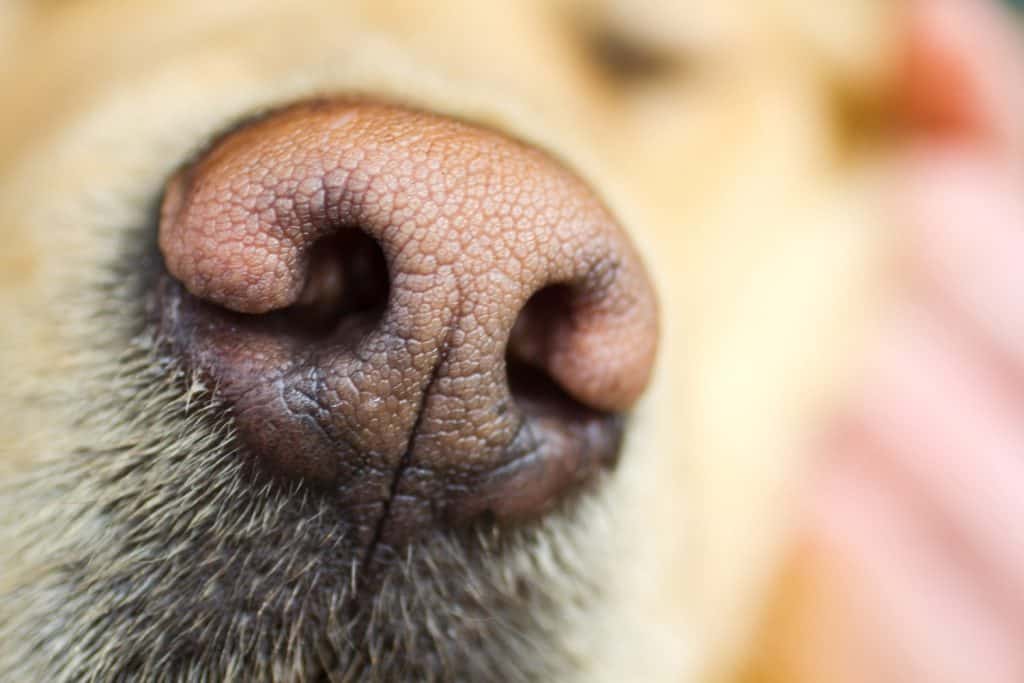
Dogs have an amazing ability to detect odors.
©Nicholas J Klein/Shutterstock.com
For many years, there have been anecdotal reports of pet dogs “detecting” cancer in their owners. The possibility of using dogs in a clinic to detect cancer was first put forward in 1989 and described dogs detecting a type of skin cancer called melanoma. Several studies followed, where canine clinicians were put through their paces in trials for the detection of breast and lung cancer. In these studies, the dogs outperformed clinical instruments. They were found to be both sensitive (they did not miss many cases) and specific (they did not have many false positives). Several types of body tissue and fluids were presented to the dogs, including skin, breath, urine, feces, and sweat.
By 2022, at least 62 studies had been published where a dog’s ability to detect cancer had been put to the test. Researchers conducting a review of the available evidence to date concluded that there were still many unanswered questions. They felt that there was currently insufficient evidence to warrant the use of medical detection dogs in clinics and that more research was needed. However, they also highlighted the potential opportunities to develop an accessible and non-invasive method for cancer detection. Since then, further studies have been published.
What Are the Dogs Smelling?
At the heart of canine cancer detection are chemicals given off by our bodies called Volatile Organic Compounds (VOCs). They are made by normal biochemical reactions, after we have eaten food, and by certain bacteria. At room temperature, they evaporate and enter the air around our bodies. More importantly, there are specific disease-related VOCs, and these can be found in our blood, breath, feces, skin, sputum, sweat, urine, and vaginal secretions. These chemical signals (markers) could be a new way of detecting disease. Some could be markers of cancer and could be detected without the use of invasive procedures such as biopsies.
There are intensive studies underway to develop machines (so-called electric noses) that can detect these chemicals using techniques such as gas chromatography-mass spectrometry (GC-MS). Dogs, on the other hand, already have a highly sensitive nose! Dogs can detect VOCs in very low concentrations – just a few parts per trillion. This makes their noses sensitive enough to detect cancers. So far, research has shown that dogs can detect VOCs associated with melanoma, colorectal cancer, lung cancer, ovarian cancer, prostate cancer, breast cancer, bladder cancer, and some blood cancers.
The Future of Dog Cancer Detection
This is an active and exciting area of research with many potential opportunities. However, there are a lot of details that need to be ironed out. There is no question that dogs can detect the chemicals given off by some cancers, but it is not yet clear how best to harness this extraordinary ability. Firstly, a lot more research is needed into which dogs should be used and how they should be trained. There needs to be a standardization of samples for both training and testing. Research into scent configuration, preservation, and optimization of VOCs is also needed.
The use of dogs in clinics will be limited by health and safety and animal welfare considerations. And training dogs to this level is not cheap! Some question the scalability of this methodology. It may, therefore, be a better approach to collect samples in clinics or homes and transport them to sniffer dogs for testing. There may also be opportunities to combine the phenomenal abilities of our four-legged friends with gas chromatography-mass spectroscopy (GC-MS), artificial neural network (ANN)-assisted examination, and microbial profiling. Ultimately, the answer may be in combining dogs with machines rather than pitting one against the other.