
Quick Take
- The Wallace Line marks a sharp biological divide between Asian and Australasian species, despite islands being just miles apart.
- Alfred Russel Wallace identified the boundary in 1859 after observing dramatic species differences across a narrow strait in Indonesia.
- Deep ocean trenches and shifting tectonic plates helped create the divide around 35 million years ago.
- Studying how past climate change shaped species migration helps scientists predict which animals may adapt, or struggle, as global warming continues.
Understanding history helps us make sense of the present and even make predictions for the future. It’s not just historians who study history, but scientists as well. As climate change shifts the environment, animals must adapt to survive. By learning how they adapted in the past, scientists can make predictions for the survival of current species. This aids conservationists in determining where it’s most effective to focus their efforts. One significant example of how different species were affected by climate change in the past is found along the Wallace Line.
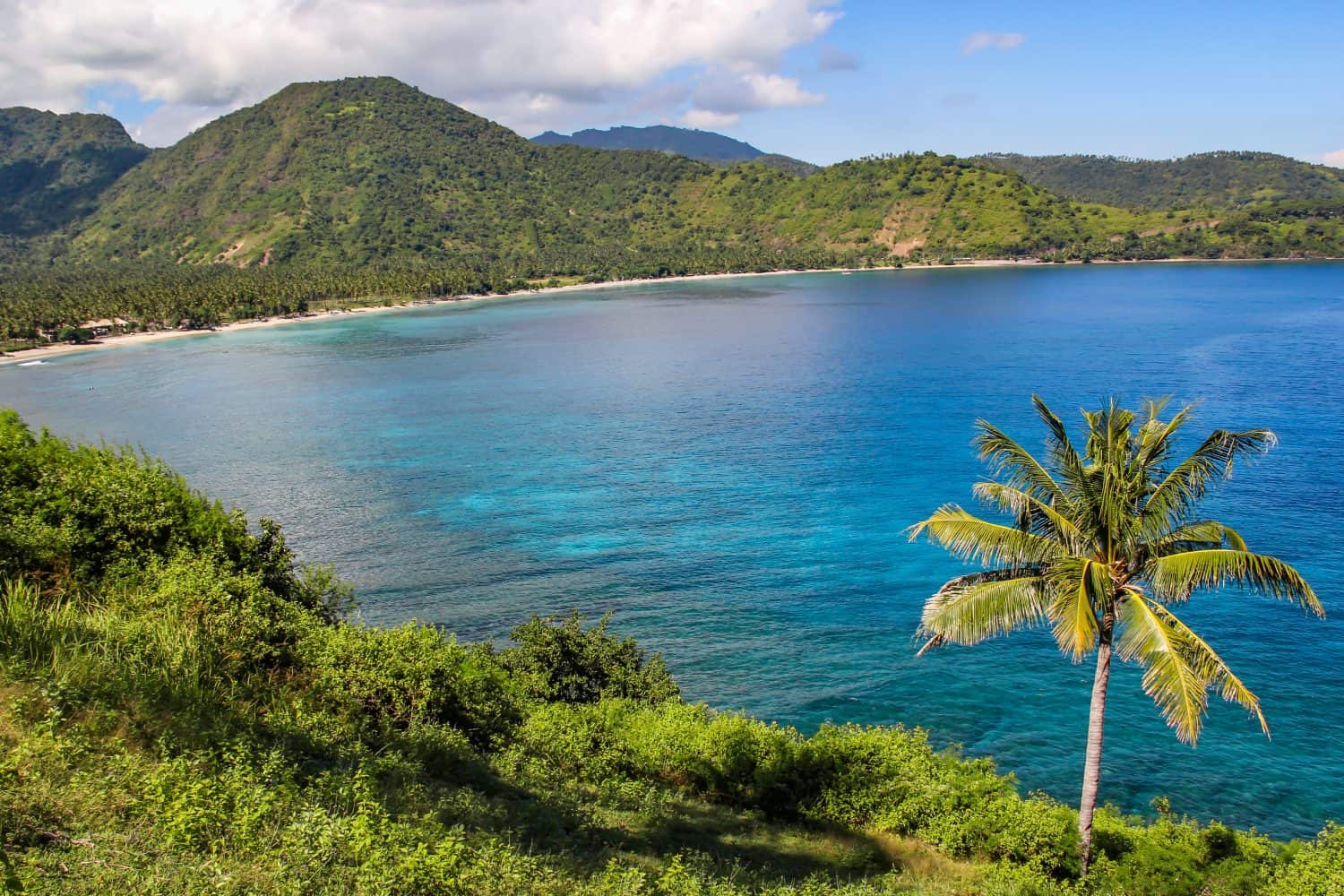
The Wallace Line is an imaginary divide separating plant life and animal species between Australasia and Asia. It runs between the islands of Bali and Lombok in the south and between Borneo and Sulawesi in the north. While an island on one side of the divide may be home to monkeys and tigers, on an island across the line, you might spot cockatoos and marsupials. New research points to climate change millions of years ago as an explanation for why the species differ so greatly east versus west of the line.
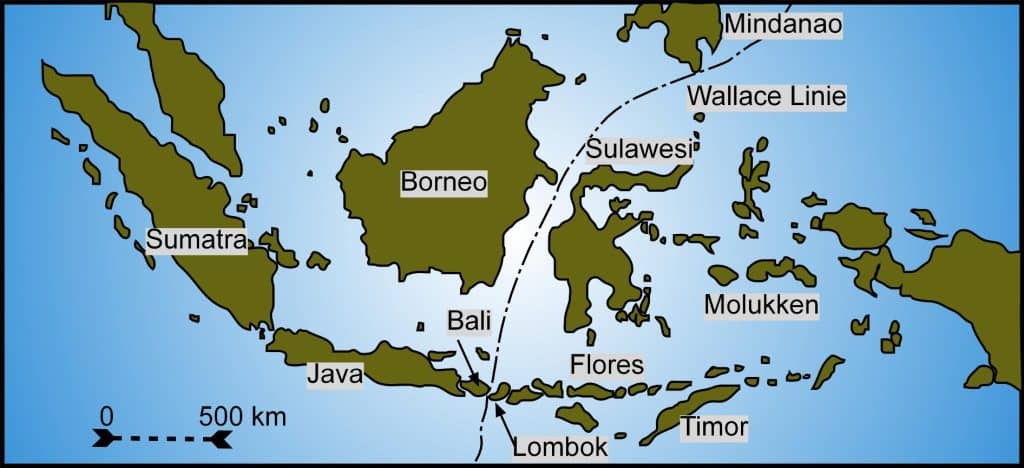
British naturalist Alfred Russel Wallace drew the Wallace Line in 1859.
©Gunnar Ries, CC BY-SA 2.5, via Wikimedia Commons – Original / License
History of the Wallace Line
British naturalist Alfred Russel Wallace noticed an interesting phenomenon while exploring the Indonesian Islands in 1856. As he crossed the Lombok Strait (a deep ocean trench separating the islands of Bali and Lombok), he realized the ecosystem changed abruptly. While Bali had woodpeckers and weaver birds, Lombok was home to cockatoos.
It was a surprise to find a complete divide in animal and plant species, with only a 15-mile narrow strait separating them. By 1859, Wallace’s observations led him to propose the concept of the Wallace Line—an invisible boundary separating the biogeographical regions of Southeast Asia and Australia. This discovery challenged the prevailing belief that plant and animal species are randomly distributed around the planet, showing instead that their distribution is closely linked to Earth’s geological history.
The Species That Live on Each Side of the Wallace Line
The Wallace Line marks a clear division between the animal species of Asia and those of Australasia. Rather than a gradual transition, there is a sharp separation. Here are some examples of animals found on each side.
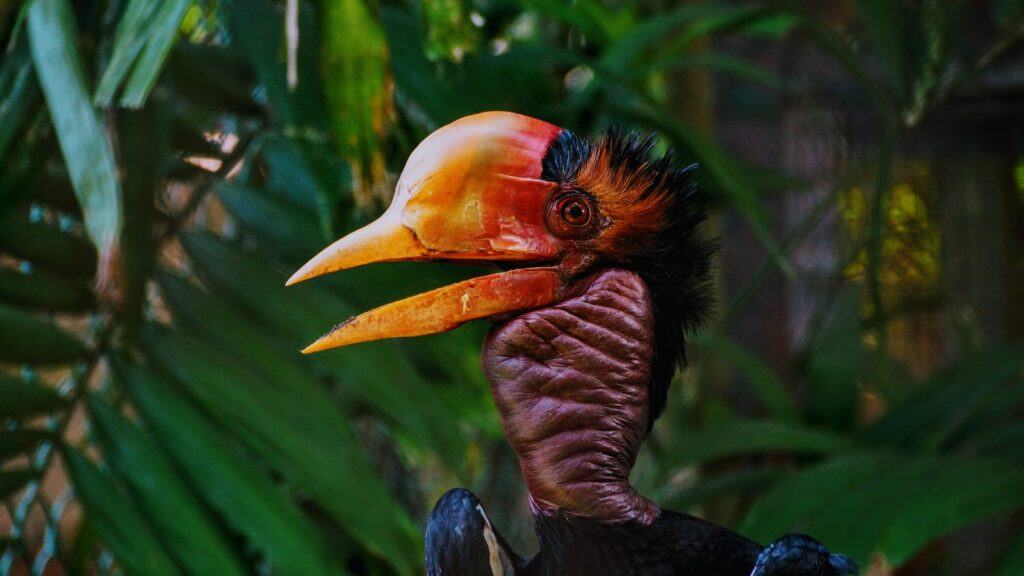
The helmeted hornbill lives on the Asian side of the Wallace Line.
©Craig Ansibin/Shutterstock.com
West of the Wallace Line (Asia)
- The countries and islands west of the line include the western islands of Indonesia, Malaysia, Brunei, Singapore, Thailand, and the Philippines.
- Animals: tigers, monkeys, orangutans, and rhinos.
- Birds: woodpeckers, thrushes, and sunbirds.
East of the Wallace Line (Australasia)
- Australia, Papua New Guinea, and the eastern islands of Indonesia.
- Animals: marsupials, monotremes, and Komodo dragons.
- Birds: cockatoos, honeyeaters, and lories.
Why Does the Wallace Line Exist? A New Theory
A 2023 study introduced a new theory to better explain the strange phenomenon of the Wallace Line. Around 35 million years ago, the continent of Australia began drifting north, away from Antarctica. Eventually, Australia crashed into the Eurasian plate. This action created the volcanic islands of the Malay archipelago. Deep ocean trenches prevented land animals from crossing the Wallace Line.
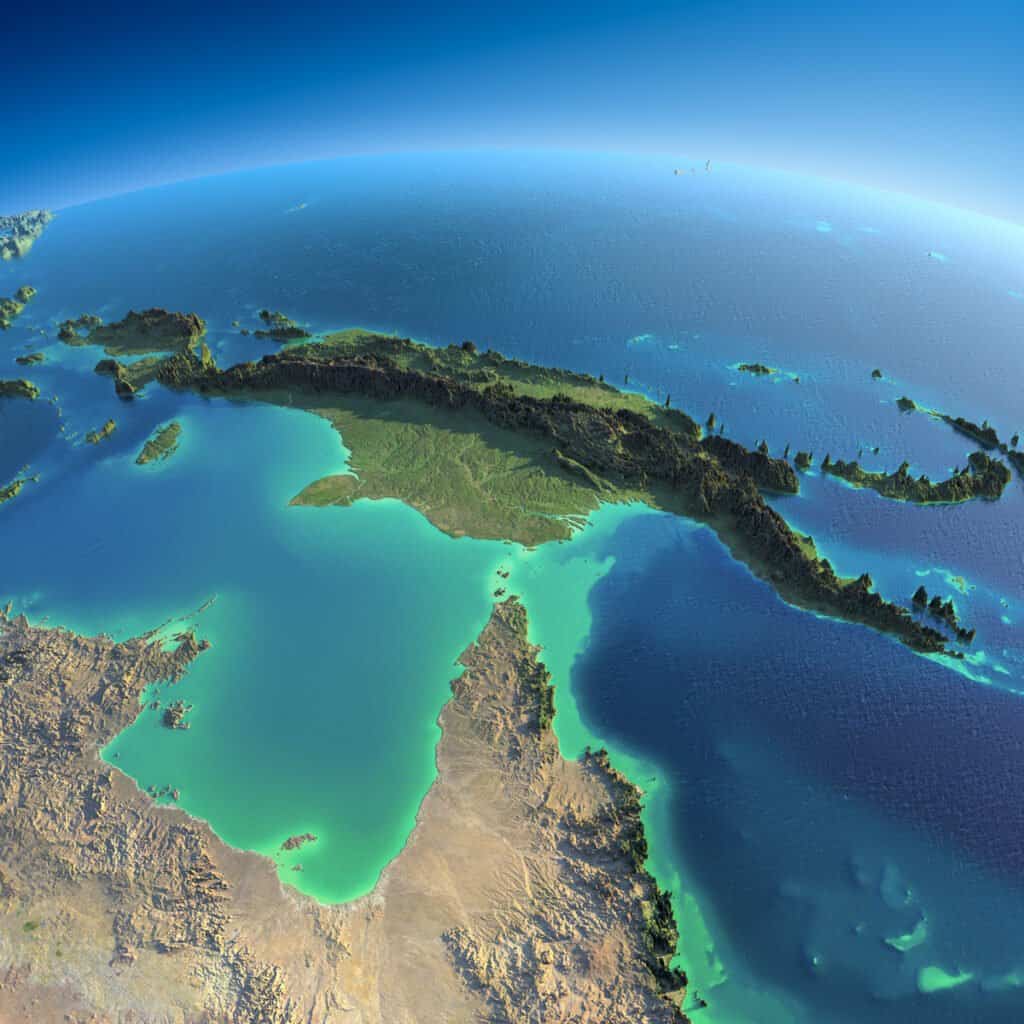
Animals that evolved in Australia were not adapted to the lush, tropical islands west of the Wallace Line.
©Anton Balazh/Shutterstock.com
Beyond the geographical changes, the convergence of plates triggered global climate change. Study lead author Alex Skeels explained in a statement:
“When Australia drifted away from Antarctica, it opened up this area of deep ocean surrounding Antarctica, which is now where the Antarctic Circumpolar Current is. This dramatically changed Earth’s climate as a whole; it made the climate much cooler.
Despite this global cooling, the climate on the Indonesian islands, which organisms used as a gateway to hop to Australia, remained relatively warm, wet, and tropical. So the Asian fauna were already well-adapted and comfortable with these conditions, which helped them settle in Australia.
This was not the case for the Australian species. They had evolved in a cooler and increasingly drier climate over time and were therefore less successful in gaining a foothold on the tropical islands compared to the creatures migrating from Asia.”
How Does Learning About the Wallace Line Impact Us Today?
Australia’s animal species evolved to thrive in dry and cooler climates. If they attempted to move west into the more humid and warm islands of Asia, the climate would prevent their success. In contrast, animals that evolved in Asia were well-adapted to the tropical islands and could more easily expand their range.
By studying how climate change affected species in the past, scientists hope to get a better understanding of the issues facing the planet today. Skeels explained, “Our findings could also inform predictions for animal migration in the future and help us predict which species may be better versed at adapting to new environments, as changes to Earth’s climate continue to impact global biodiversity patterns.”