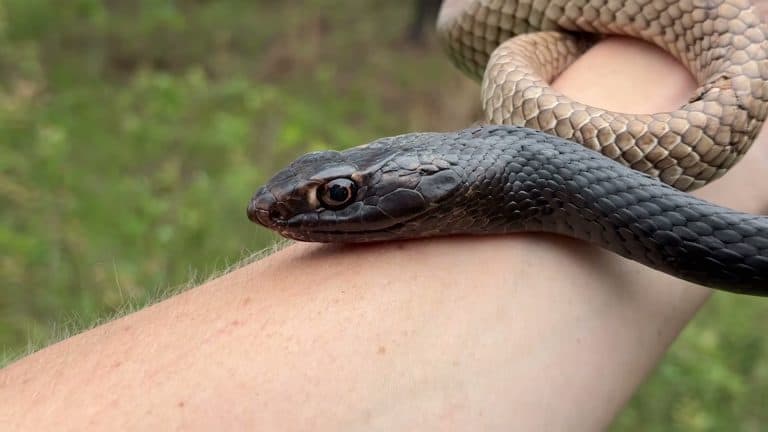

North Carolina is a state full of biodiversity, and snakes are no exception. Its diverse environments, from the mountains in the west to the coastal plains in the east, provide abundant habitat for 38 species of snakes that call North Carolina home.
If you live in or are visiting North Carolina, you may want to learn about these six specific species. These snakes are venomous, meaning they use toxin to hunt prey such as mice, toads, and other small animals. Venomous snakes get a bad rap because they have the potential to harm people; however, they only do so if they feel their life is at risk and attempt to protect themselves.
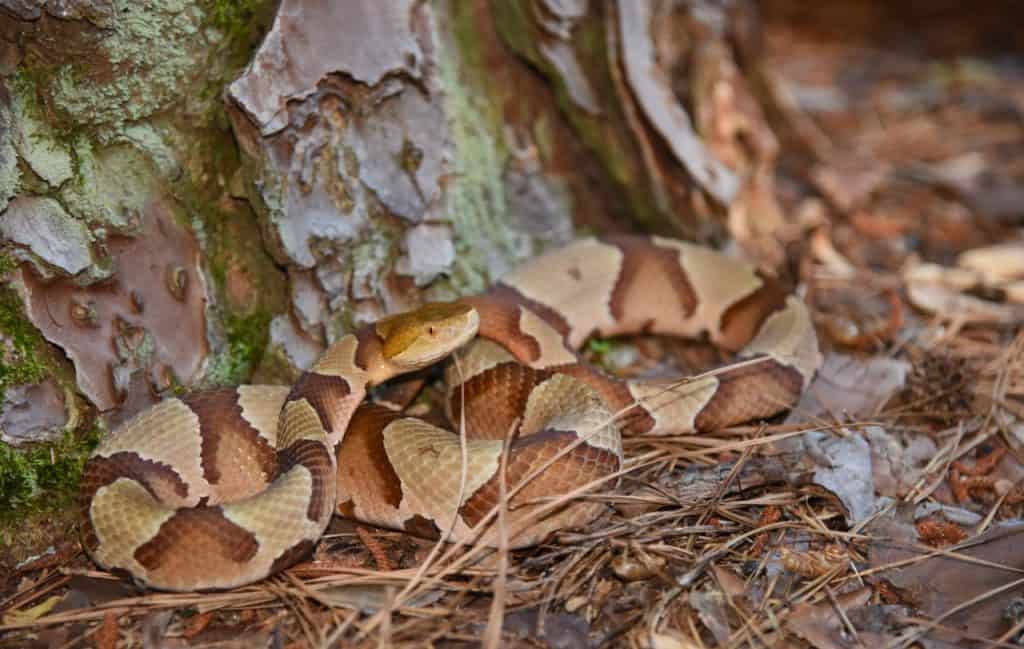
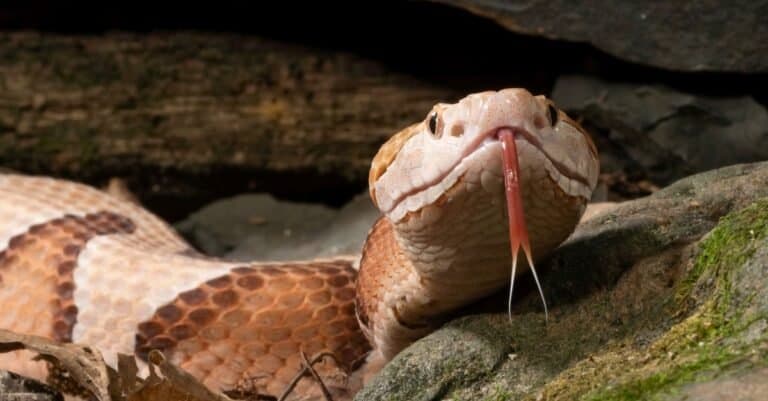
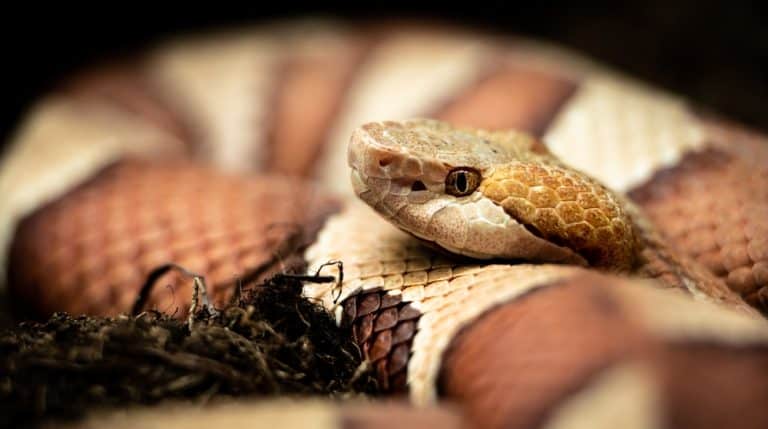
Copperheads are the venomous snake you are most likely to come across in North Carolina. Photo by Thomas Reed.
©Thomas Reed
These snakes are remarkable for more than their venom production. While it’s important to learn about these species to best protect yourself, you’ll likely find these venomous snakes are worth getting to know as fascinating wild animals.
“A lot of times people want to know if a snake is venomous or not venomous, and that’s valuable and it’s good to learn your snake species, but it can be just as interesting to observe venomous snakes as it can be for any other snakes,” says Jeff Hall, the Statewide Herpetologist at the North Carolina Wildlife Resources Commission. “Certain species certainly have really interesting behaviors.”
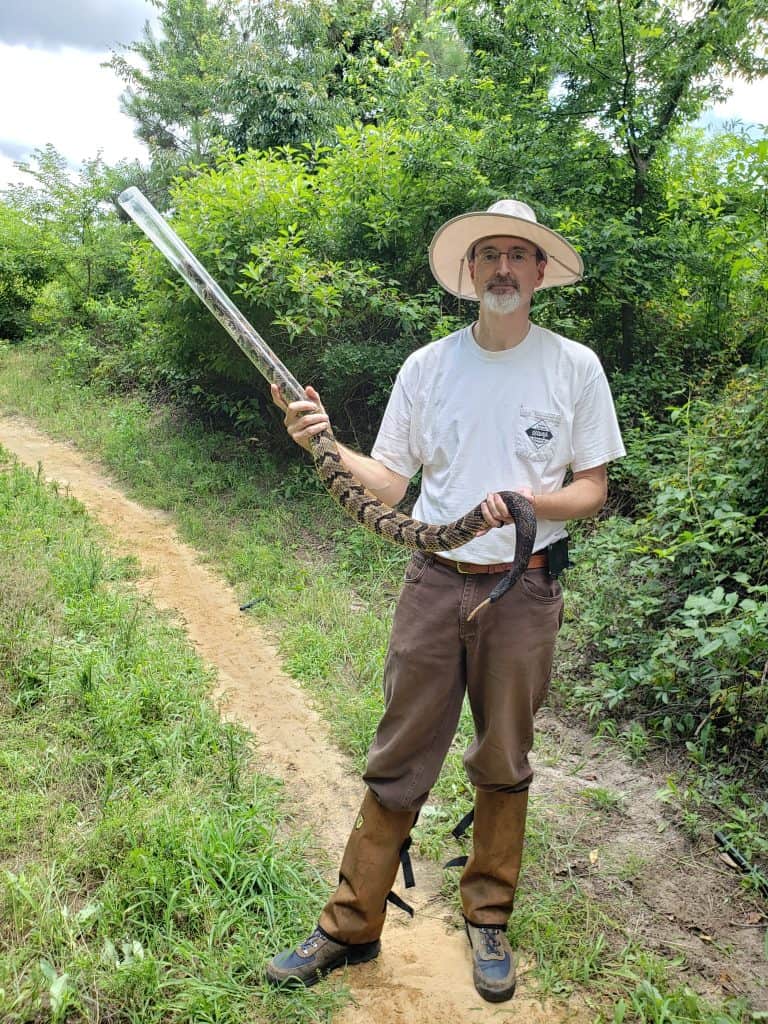
As the Statewide Herpetologist at the North Carolina Wildlife Resources Commission, Jeff Hall handles venomous snakes frequently and has never been bitten. Here, he is pictured with a timber rattlesnake.
©Jeffrey Hall
Copperhead
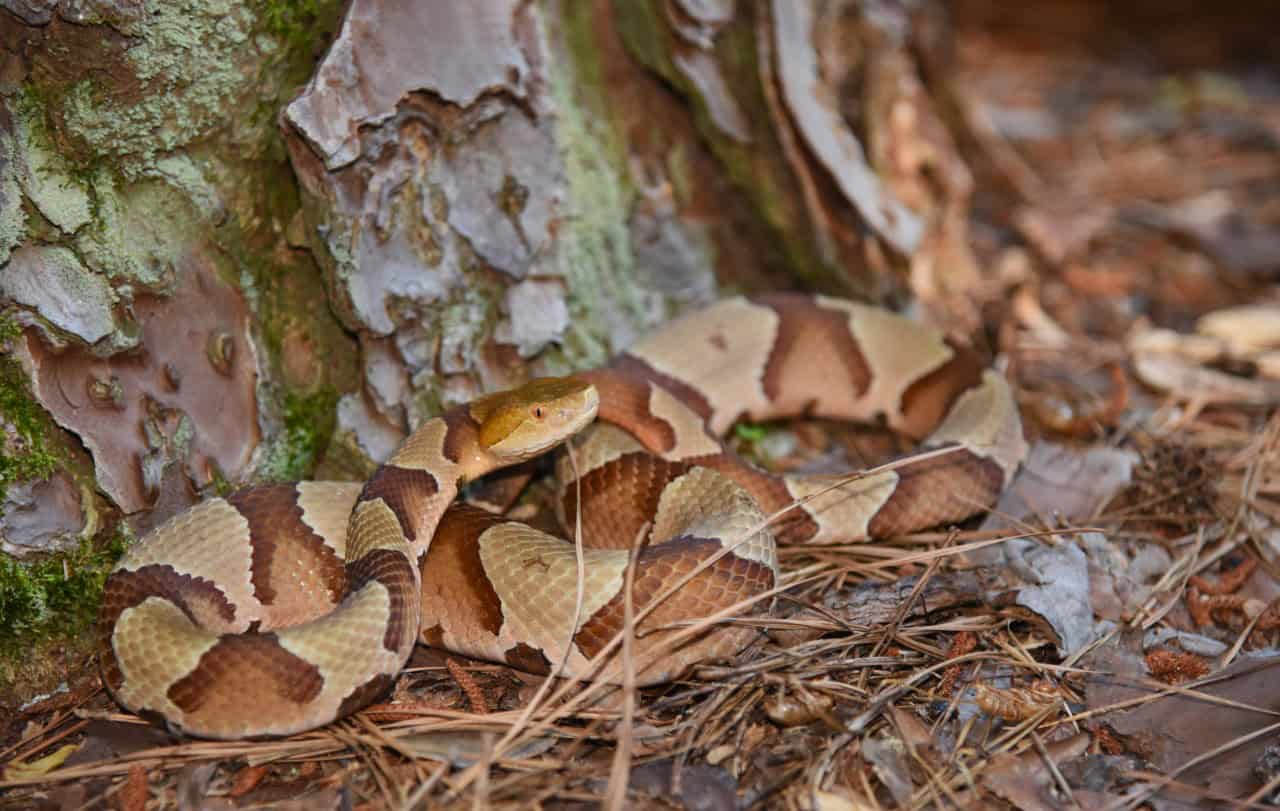
The copperhead (Agkistrodon contortrix) is the most likely venomous snake that you’ll come across in North Carolina. Adult copperheads are between 60-90 cm (2-3 feet) in length. They often look “short” and a little chunky due to their heavier body size and triangular head. Their scales are light brown with some individuals being grayish or pinkish, and they have darker brown bands that are narrow in the center and wider at the edges. These bands resemble hourglasses or dumbbells, and many people say they look like Hershey’s Kisses. “If you look at a copperhead just by itself, they’re one of the most beautiful species that we have,” Hall says.
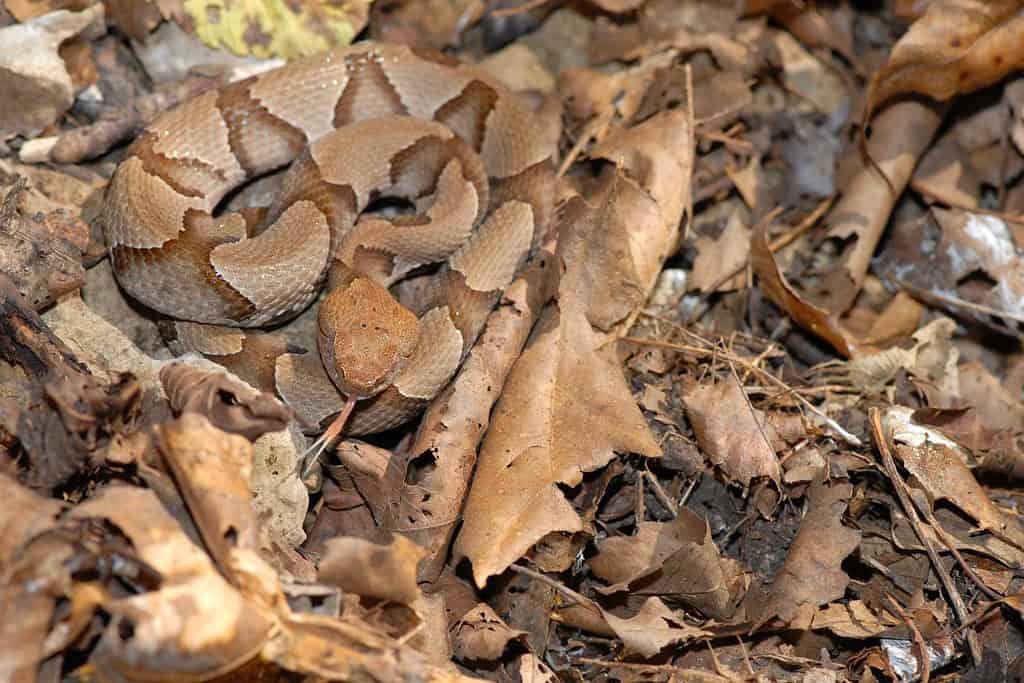
Copperheads have excellent camouflage, which has helped them adapt and survive in suburban environments alongside people.
©Rusty Dodson/Shutterstock.com
Copperheads are common and widespread throughout North Carolina, having adapted to a variety of habitats ranging from very rural to nearly urban areas.
“Copperheads are probably found in all 100 counties, even though we don’t have records in every county. They do relatively well in suburban habitats, just as much as they do in rural areas,” Hall says. They seem to be very adaptable and are the most commonly seen venomous snake across the state by the public.”
Copperheads can persist in a variety of landscapes for a couple of reasons. “Number one,” Hall says, “Their diet. They eat everything from invertebrates to amphibians, to other reptiles, to mammals, to birds.” He goes on to say, “If they can fit it in their mouths, they’re probably gonna try to eat it,” Thomas Reed, a herpetologist and Open Space Manager for Wake County, says. “Young copperheads often have a yellow or green tail, called a caudal lure, that they can wiggle to attract potential prey items such as frogs and lizards.”

Thomas Reed is a herpetologist and Open Space Manager for Wake County in North Carolina.
©Thomas Reed
Hall mentions that copperheads seem to especially like cicada larvae. He goes on to say, “When the 13 or 17-year cicadas emerge, you’ll see convergences of copperheads. On big oak trees that tend to get lots of cicada larvae crawling, copperheads will congregate, maybe two or three at a time. I’ve heard of a couple of sites in the coastal plain where as many as ten or eleven snakes are all sort of just coiling around a tree waiting for these cicadas to show up.”
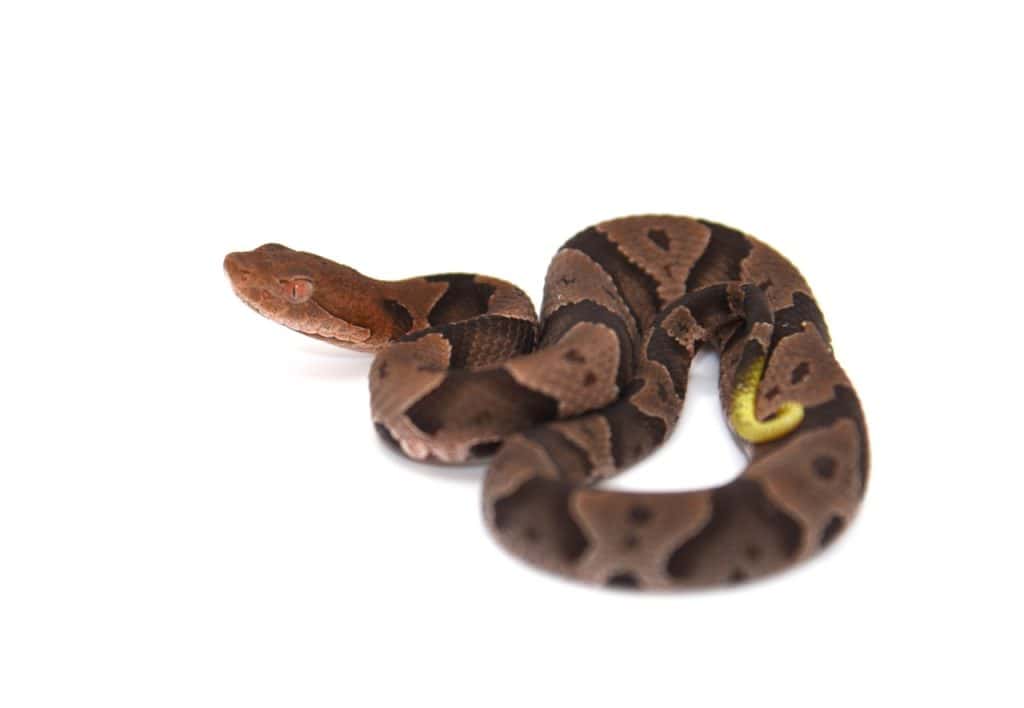
Many young venomous snakes like this copperhead often have a yellow or green tail that they use to attract potential prey like frogs and lizards. Photo by Thomas Reed.
©Thomas Reed
Copperheads are also likely abundant in North Carolina because of their appearance. “They’re just so good at camouflage. They tend to be able to live alongside humans that never see them,” Hall explains. “As long as there’s a little bit of a natural patch of habitat there, whether it be a tree line in between a series of houses or a little creek that flows down and around, they seem to be able to persist.”
Due to their prevalence, copperheads account for over 90 percent of snake bites in North Carolina. While every venomous snake bite necessitates medical attention, the good news about copperhead bites is that they are rarely fatal to humans. Hall says, “Their venom is at the lower end of the toxicity. Bites are generally non-life-threatening unless the person has some sort of allergic reaction. Most of the time, it’s also not fatal for most dogs.” However, he stresses the importance of seeking professional medical attention for any venomous snake bite. “If you’re bitten by a venomous snake, you need to go see the doctor, period.”
If they can fit it in their mouths, they’re probably gonna try to eat it.
Jeff Hall, Statewide Herpetologist at the North Carolina Wildlife Resources Commission
Cottonmouth
The cottonmouth or water moccasin (Agkistrodon piscivorus) is a member of the viper family, brown in color with a bright white mouth. This cotton-colored mouth is displayed when the snake coils up in a defensive posture with its jaws open.
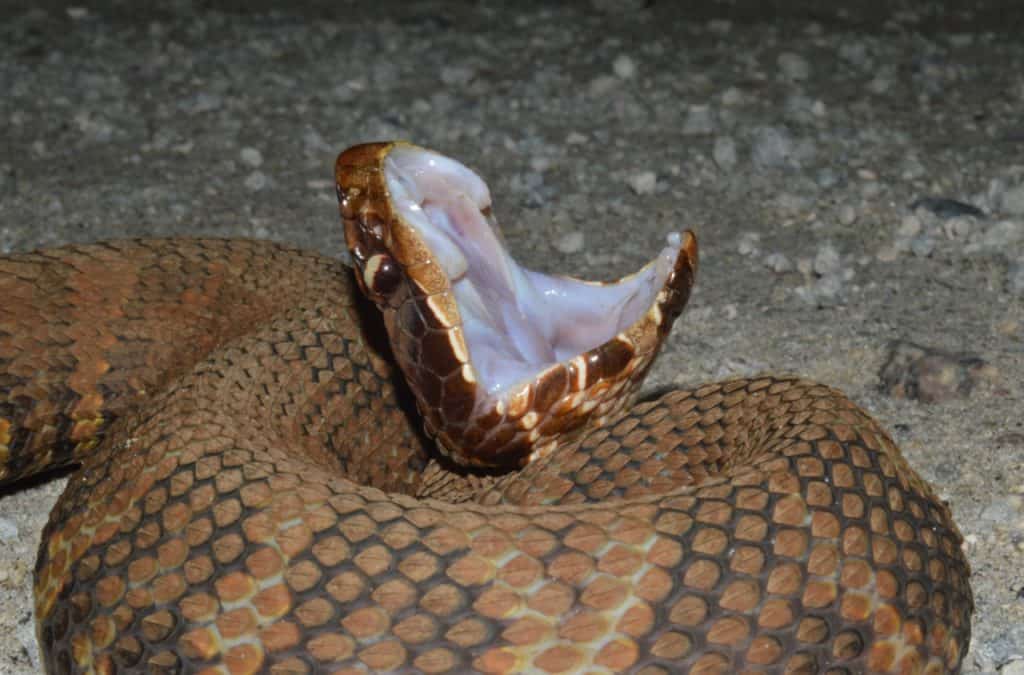
A cottonmouth snake is in a defensive posture with its mouth open. Its white mouth gives the cottonmouth its name. Photo by Thomas Reed.
©Thomas Reed
Cottonmouths have dark bands across their scales, which fade as they age. Older individuals appear more uniformly brown, while juveniles are more distinctly striped. Like copperheads, young cottonmouths also have a bright yellow or green tail tip used to lure prey, though the color fades as they age. These snakes typically grow to approximately 90-120 cm in length (3-4 feet), with the largest individuals measuring over 180 cm (6 feet) long. Unlike most reptiles, but like most pit vipers, cottonmouths give birth to live young rather than lay eggs.
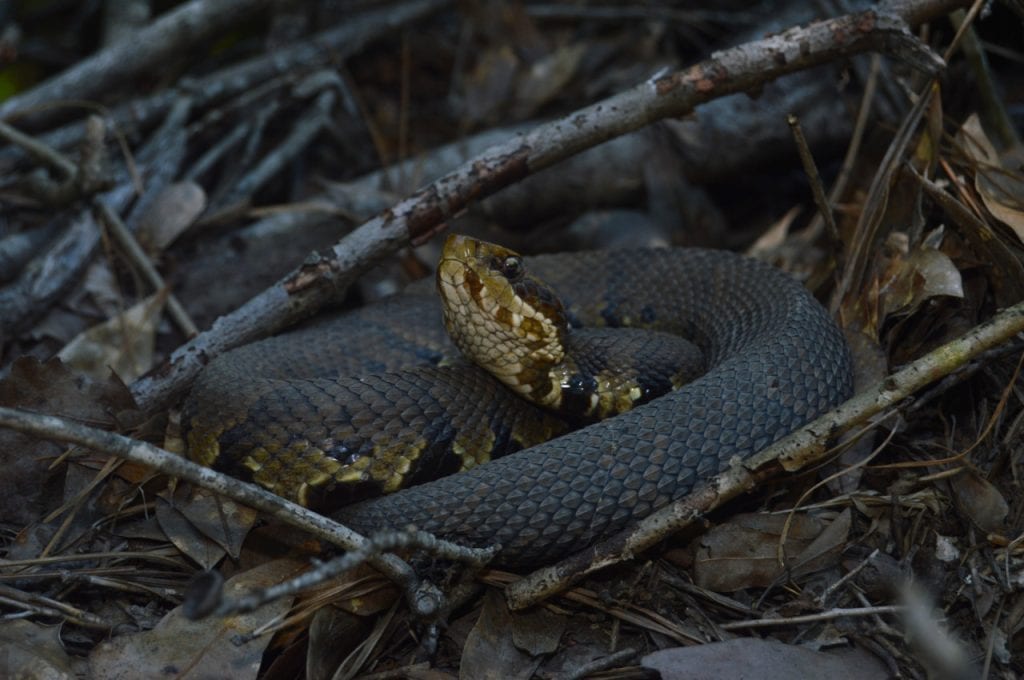
Adult cottonmouth snakes are often dark, making them appear uniformly black or brown in appearance. Photo by Thomas Reed.
©Thomas Reed
Cottonmouths are one of our most misunderstood species of snakes in North Carolina and often have a wide number of myths surrounding them.
Thomas Reed, herpetologist and Open Space Manager for Wake County
Cottonmouths are found in the eastern half of the state. Hall remarks, “In the coastal plain, plenty of folks also come into contact or see the cottonmouth. They can be pretty obvious in habitats where they live,” as you can often see them swimming in the water.
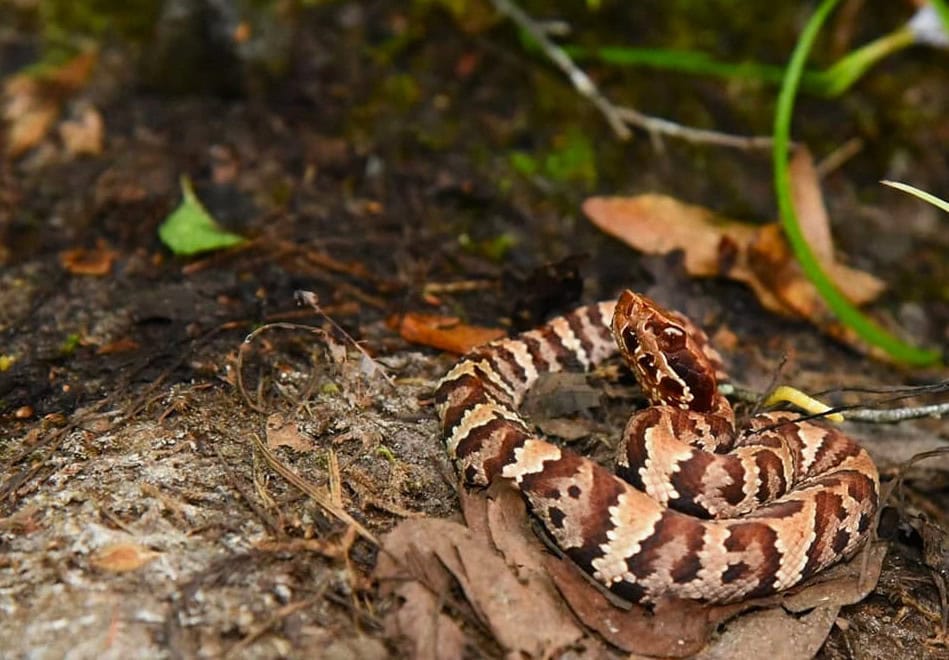
In young cottonmouth snakes, the banding is more distinct and contrasting. Photo by Thomas Reed.
©Thomas Reed
Reed states, “Cottonmouths are one of our most misunderstood species of snakes in North Carolina and often have a wide number of myths surrounding them.” Cottonmouths are associated with aquatic habitats and can be found swimming, but Reed says, “One example (of a myth) is that they can only swim on top of the water’s surface. However, this is simply not true. They feed primarily on fish and must be able to swim lower in the water column to hunt.”
Timber Rattlesnake
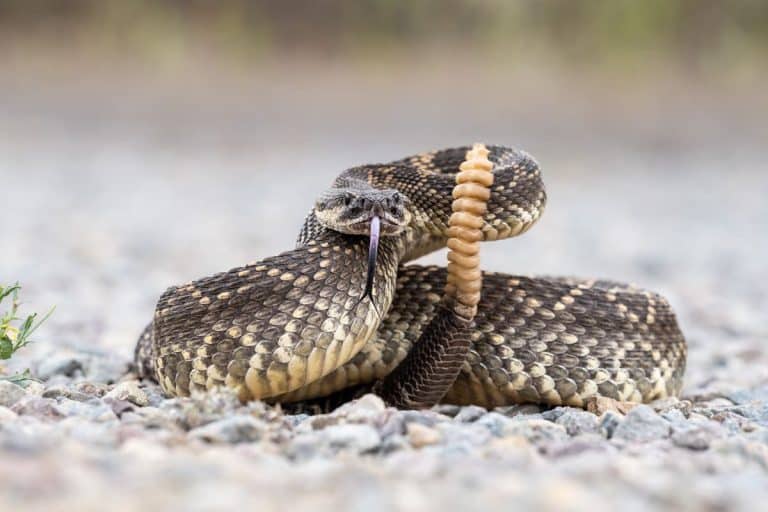
Timber rattlesnakes (Crotalus horridus) are a thicker snake on average of about 120 cm in length (4 feet), but can be over 180 cm (6 feet). They are various shades of brown, with some individuals being more black, pink, or even yellow in color, and are characterized by darker chevron bands. Most individuals have a black tail, but rattlers can also be yellow or grey. Timber rattlesnakes in central and eastern North Carolina may have a brown or orange stripe along their back.
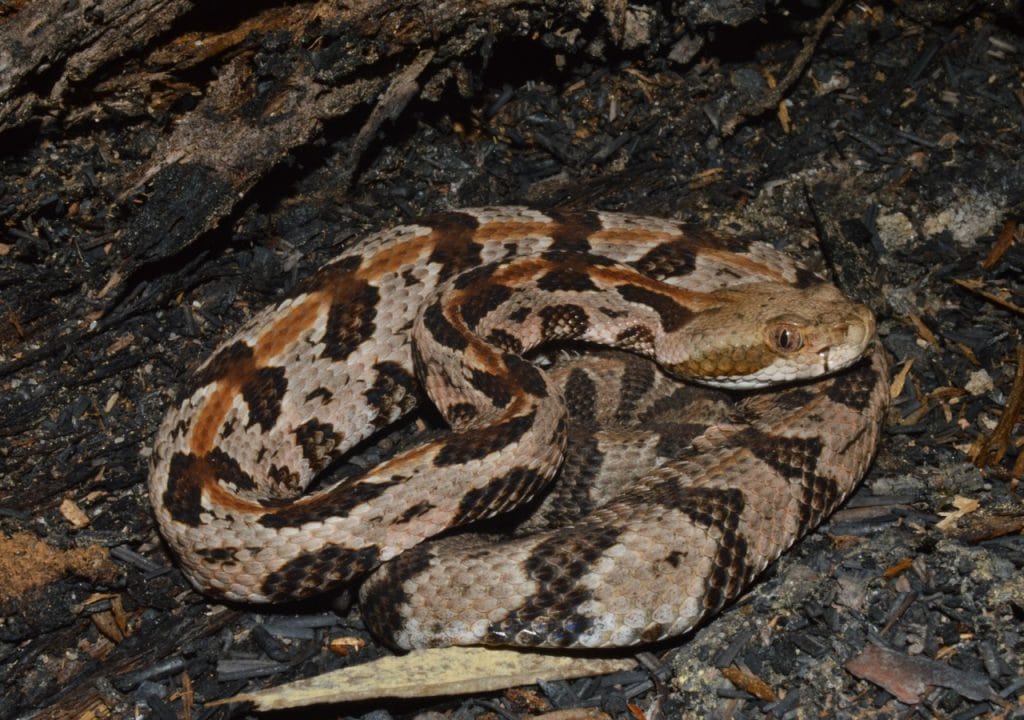
Some timber rattlesnakes have a brown or orange stripe down their back like this one. Photo by Thomas Reed.
©Thomas Reed
“Timber Rattlesnakes can be found in populations scattered across the state, but are primarily in the mountains and coastal regions,” Reed says. “They were likely more widespread in the piedmont region historically, but have disappeared due to agricultural and urbanization impacts on the habitat that they require.”
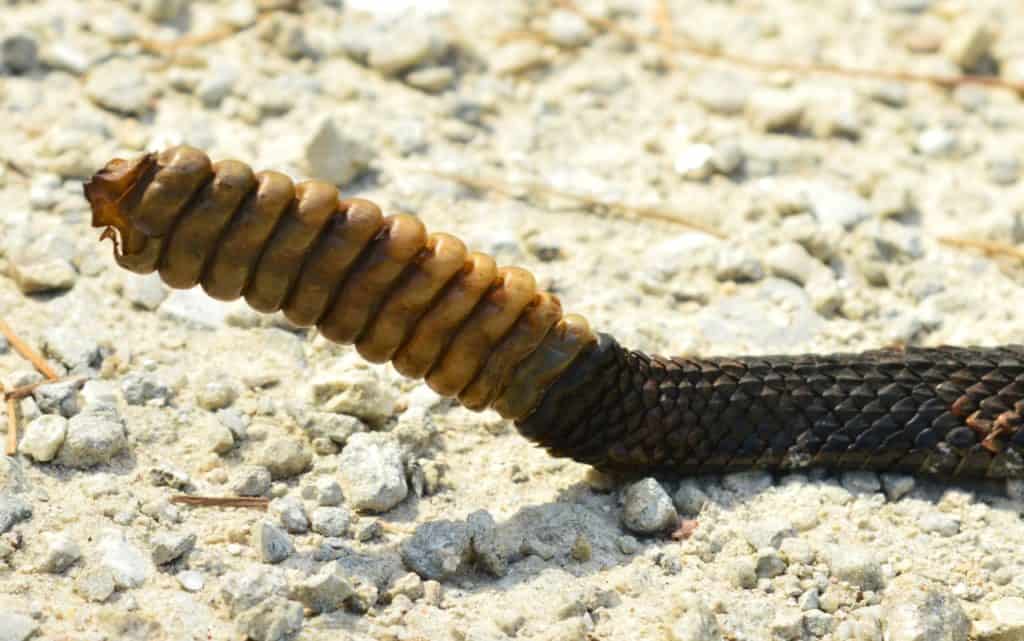
Close-up of a rattle on a timber rattlesnake.
©Thomas Reed
There are three species of rattlesnake in North Carolina, and all of them have some level of maternal care. Timber rattlesnakes also give birth to live young, or the young hatch from eggs immediately upon birth, and they stay with the mother for approximately six to ten days. Hall explains that this is an interesting characteristic of reptiles, saying, “Maternal care is not a common thing in the reptile world.”
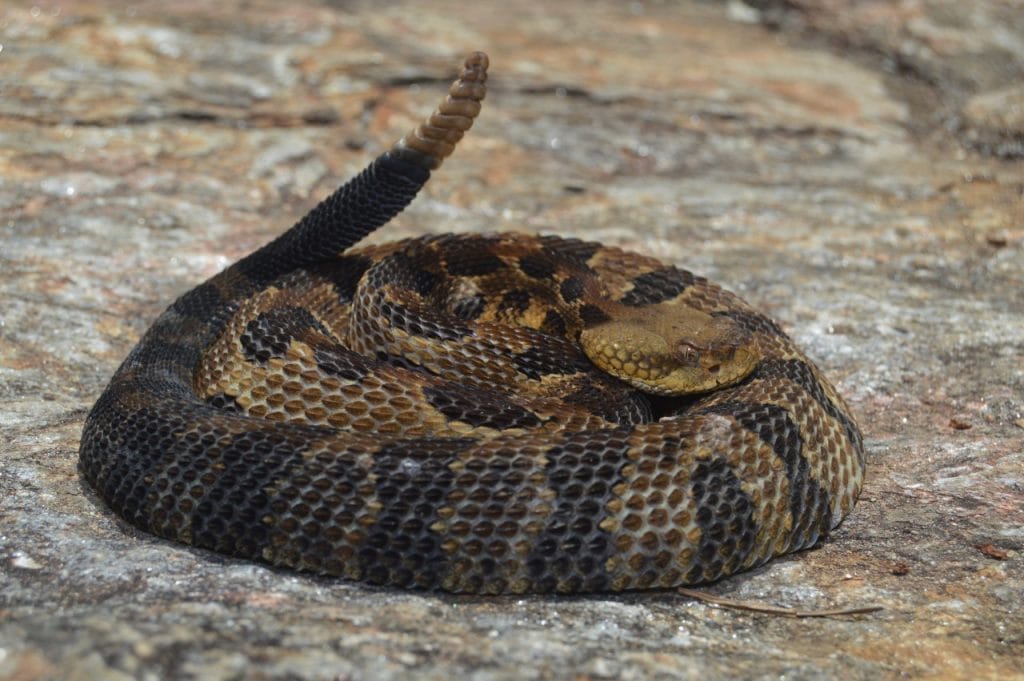
Many timber rattlesnakes tend to have darker tails. Photo by Thomas Reed.
©Thomas Reed
Timber rattlesnakes are listed as a species of special concern, meaning that they have conservation protection in the state.
Eastern Diamondback Rattlesnake
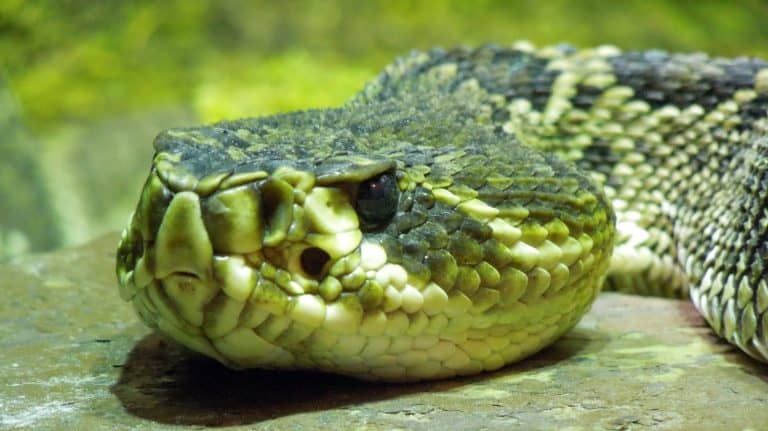
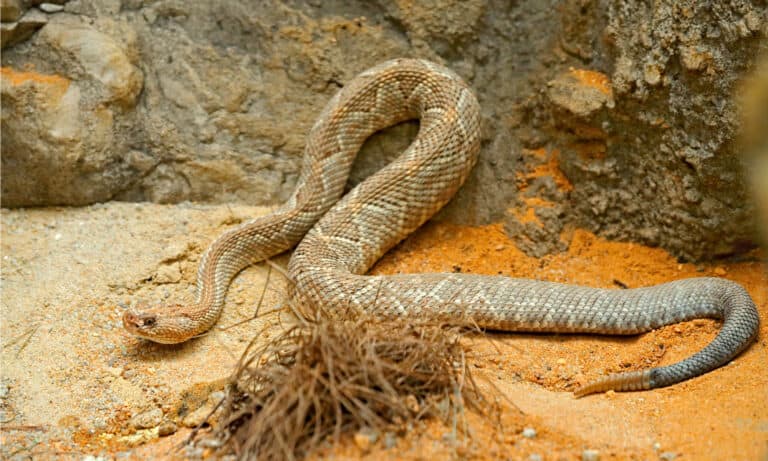
Eastern diamondback rattlesnakes (Crotalus adamanteus) are the largest species of venomous snake not only in North Carolina, but in the world, with adults measuring approximately 120 cm (4 feet) in length and up to 244 cm (8 feet) for the largest individuals. Their name comes from the dark brown to black diamond-shaped blotches running down their backs. Their bodies are thick and brown in color with hues of grey or yellow. Their large size means they can eat large prey like rabbits and squirrels.
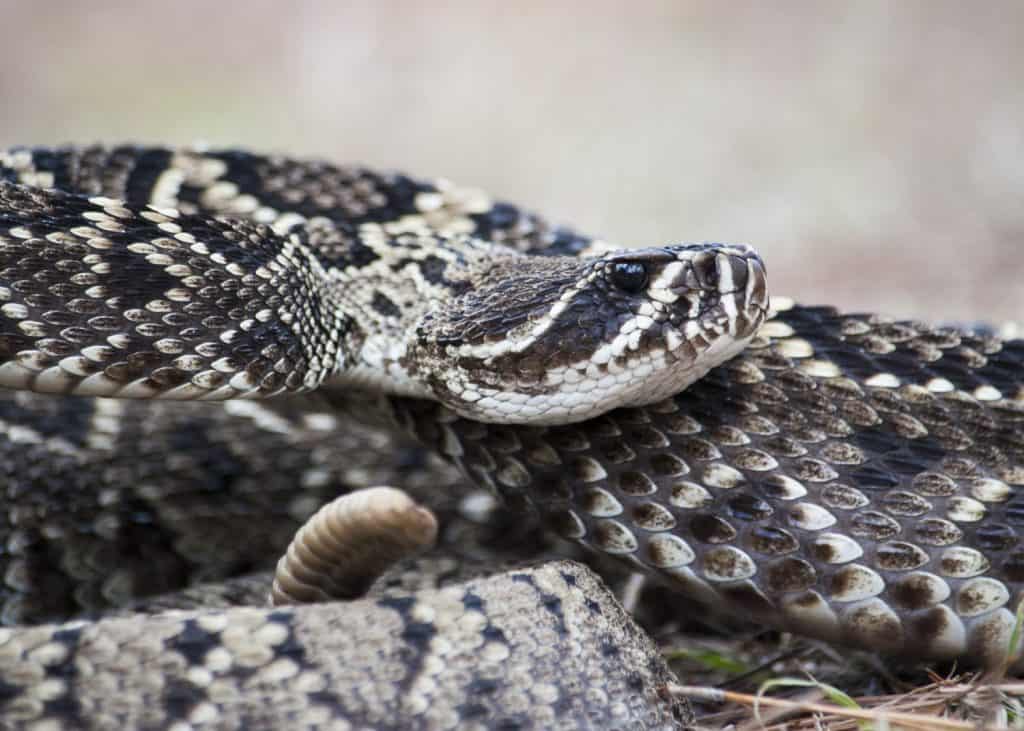
Eastern diamondback rattlesnakes are the largest and heaviest venomous snakes in the world. Jeff Hall calls them majestic.
©Brittany Mason/Shutterstock.com
“I have a particularly special soft spot in my heart for the Eastern diamondback rattlesnake. If you see one, which is very rare in North Carolina, it is just a really amazing encounter. ‘Majestic’ comes to mind,” Hall says. “People think of animals like moose and bears as being these majestic, large, charismatic megafauna, and I think the Eastern diamondback is kind of that in the snake world.”
Eastern diamondback rattlesnakes are considered endangered in North Carolina. Reed explains, “Due to a variety of factors such as urbanization and habitat destruction, their range has disappeared over time, and they are restricted to only small sections of where they used to inhabit.” Hall adds, “They historically were found in 13 counties, but currently are only found in one.” They only live in southeastern North Carolina in the sandy pine flatwoods of the coastal plain.
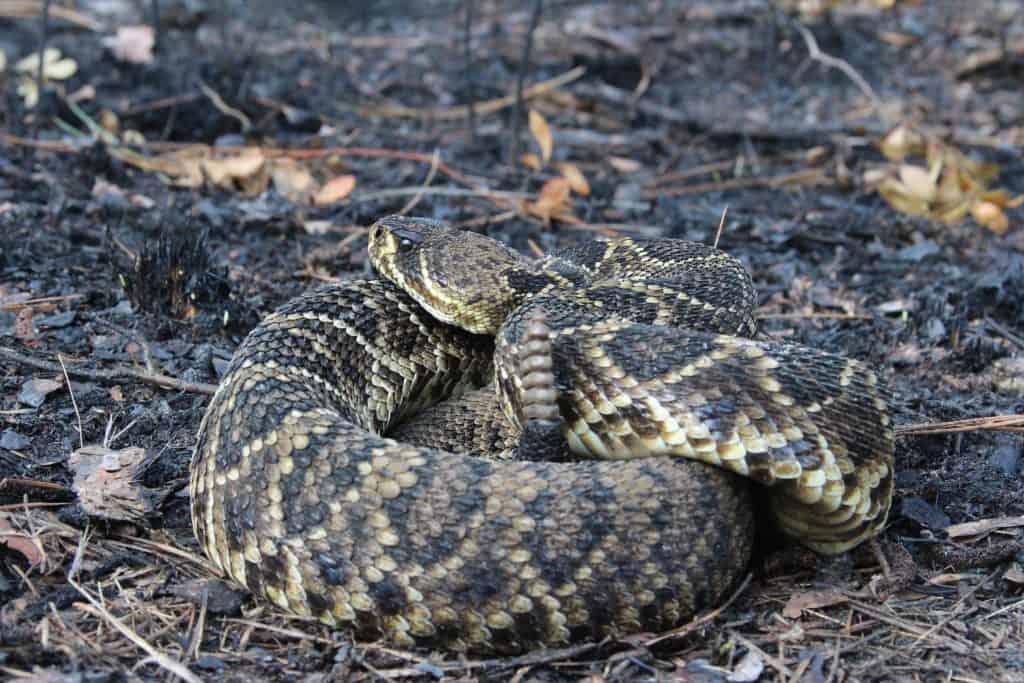
Seeing an Eastern diamondback rattlesnake in North Carolina is very rare. Photo by Jeff Hall.
©Jeff Hall
Pigmy Rattlesnake
Pigmy rattlesnakes (Sistrurus miliarus) are named so because they are the smallest rattlesnake species, typically being 45 cm (1.5 feet) long, but can be over 80 cm (2.75 feet). They tend to be more grey than brown, but can vary in color, with those in the coastal areas having more of a pinkish or even red hue, while others may be more tan. Reed explains further, “They vary based on region. The sandhills tend to have more individuals with grey and lavender colors, while the coastal individuals are more red. The red coastal snakes face more risk of poaching due to their desired colors in the pet trade.”
They are spotted with rows of dark blotches, and some have an orange stripe that runs down their back. Young pigmy rattlesnakes also have yellow-tipped tails used for luring prey.

Pigmy rattlesnakes are the smallest of the rattlesnake species.
©Breck P. Kent/Shutterstock.com
Like all rattlesnakes, pigmy rattlesnakes have a rattle, but it is smaller, making it higher-pitched than other species. “The rattle is so small that its ‘buzz’ sounds like a small insect, oftentimes barely heard,” Reed explains.
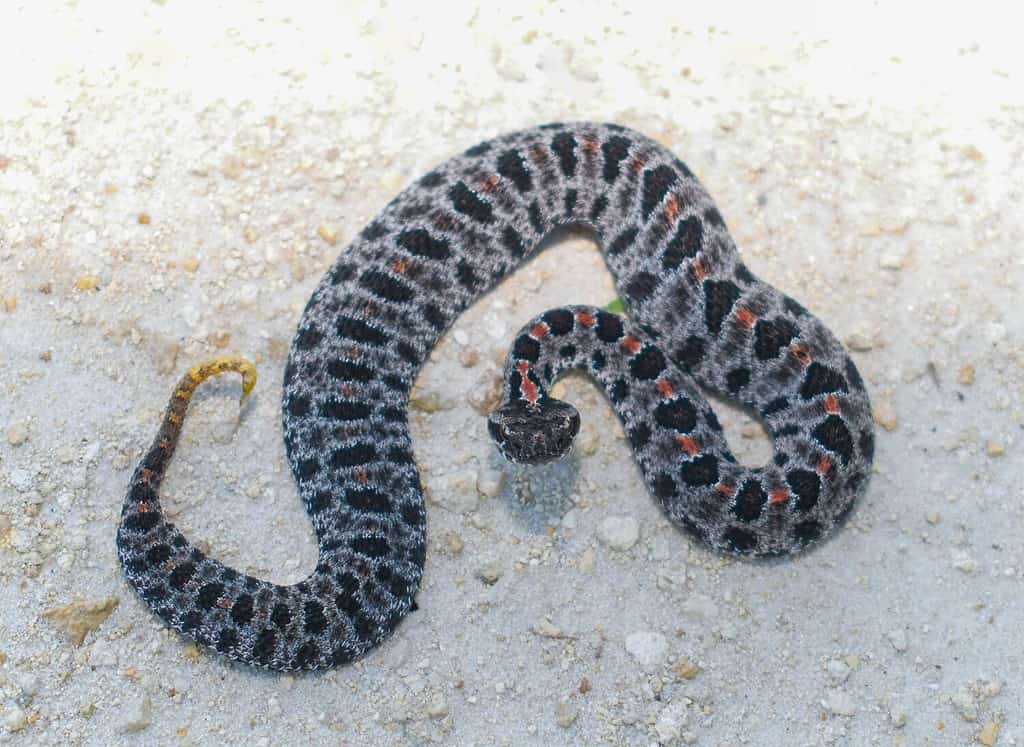
Pigmy rattlesnakes are so small that their rattle sounds more like an insect’s buzz if you can hear it at all.
©Chase D'animulls/Shutterstock.com
Like timber rattlesnakes, pigmy rattlesnakes are a species of special concern in North Carolina and are rare. Reed says, “They are found in the coastal plains and sandhills regions of the state, and they face many threats such as habitat destruction, saltwater inundation, and even illegal poaching.” Their small size and excellent camouflage make these snakes rarely seen by most people.
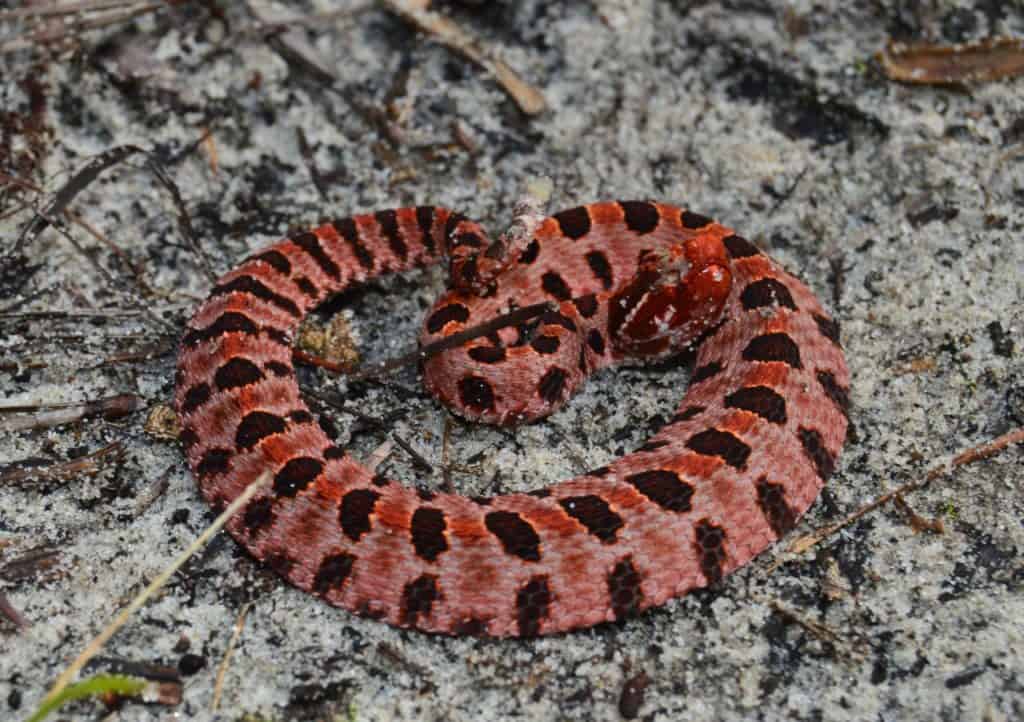
Some pigmy rattlesnakes, especially those in the coastal areas, are red in color. These snakes are more susceptible to poaching due to their desired coloration in the pet trade. Photo by Thomas Reed.
©Thomas Reed
Eastern Coral Snake
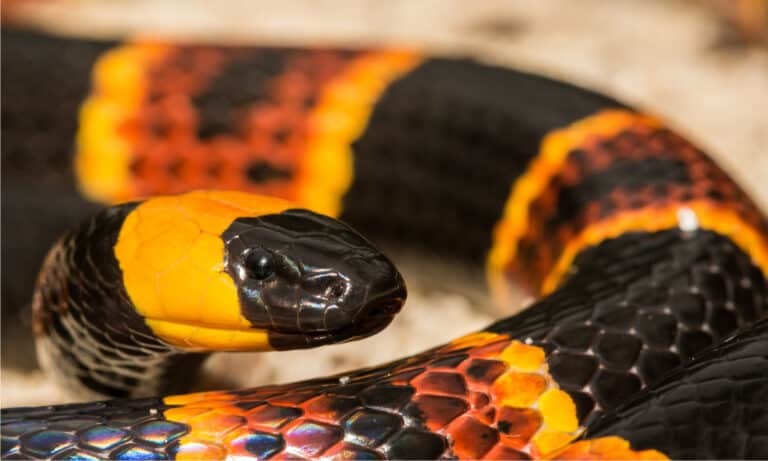
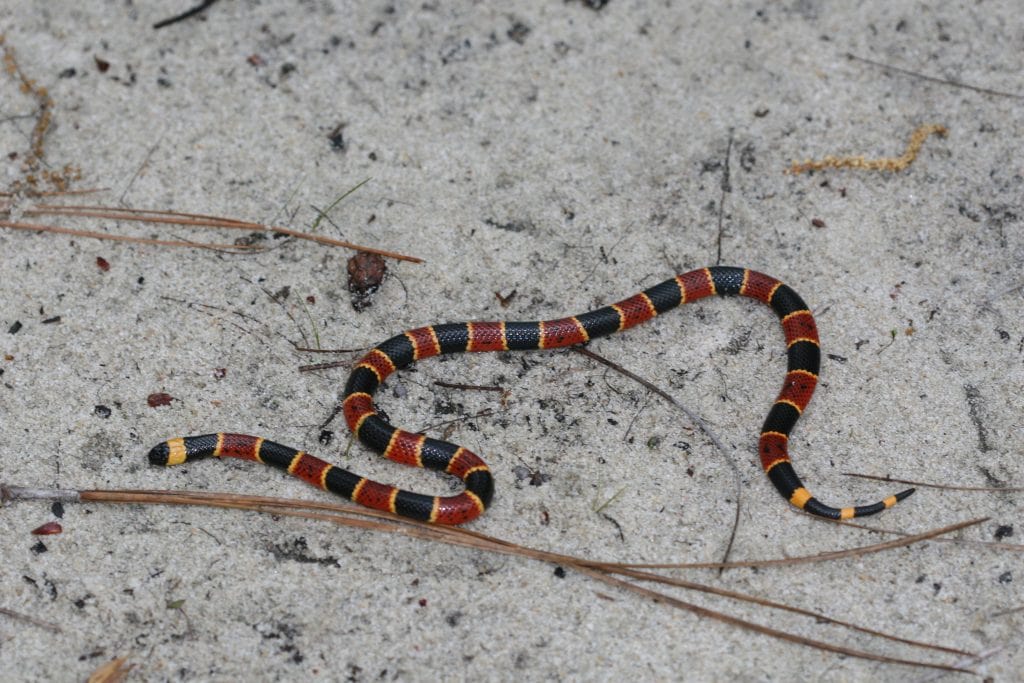
Coral snakes (Micrurus fulvius) are cylindrically shaped snakes with small heads from the cobra family. These colorful snakes are often shiny in appearance, with large black and red bands, with smaller yellow ones in between. Their snout is always black, and they can be up to 89 cm or 35 inches in length.
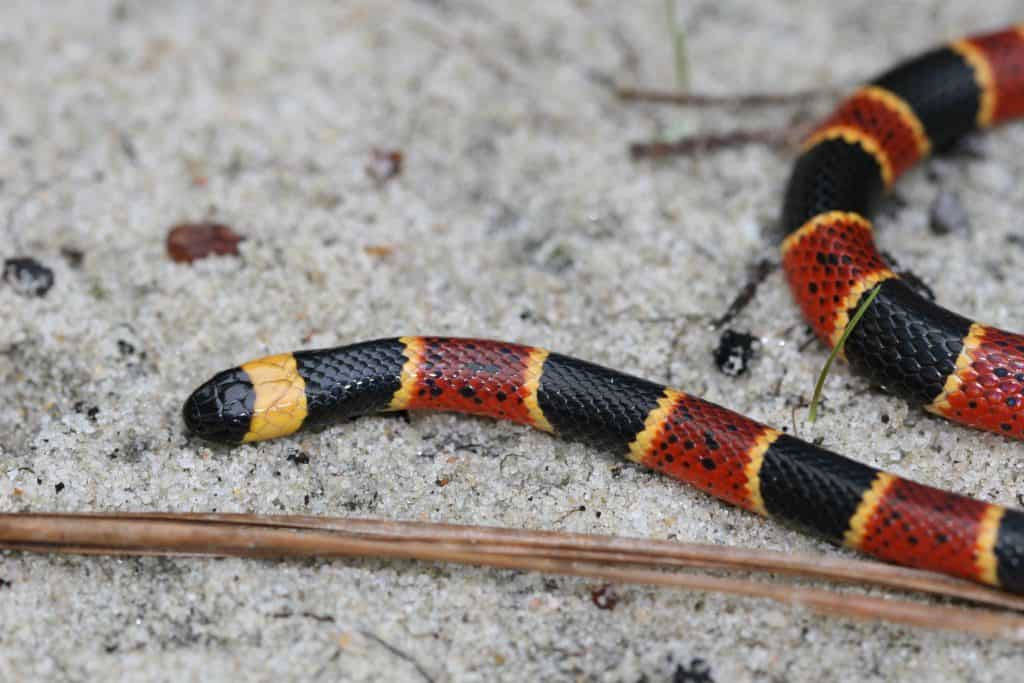
Coral snakes have small heads with black snouts.
©Jeff Hall
It is highly unlikely to see a coral snake in North Carolina, as they are one of the most rarely encountered terrestrial vertebrates in the state. Reed describes them as “a fossorial species that lives most of their life underground in areas with sandy and loose soils.” Located only in the southeastern section of North Carolina, they are mostly active at dusk and dawn, and often underground. They are also a state-listed endangered species.
The coral snake is the only snake in North Carolina with neurotoxic venom, meaning the venom acts on the nervous system, with the potential to cause respiratory failure, paralysis, and possibly death. They are elusive and non-aggressive; they have only been known to bite if restrained. There are no records of a coral snake biting a person in North Carolina’s documented history.
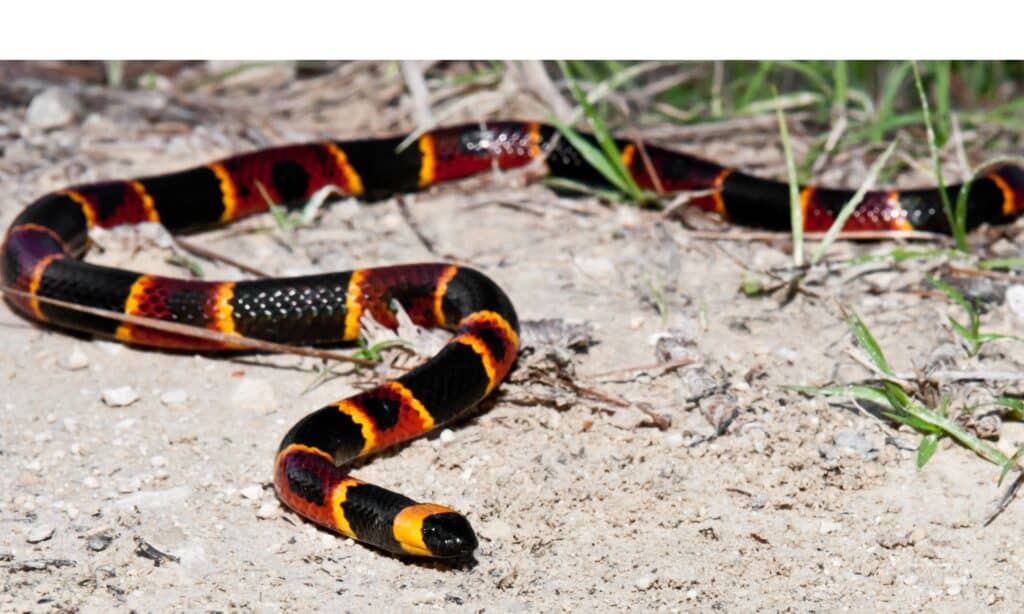
Coral snakes are rare and endangered in North Carolina. They also spend most of their lives underground, making them difficult to see.
©iStock.com/JasonOndreicka
A unique feature of the Eastern coral snake, compared to most venomous snakes, is that it lays eggs. Reed states, “They are also our only species of venomous snake in North Carolina that lays eggs; the others are all live bearers.”
Preventing venomous snake bites
Venomous snake bites can occur accidentally, such as by stepping on or near a venomous snake in the wild. However, many bites in the United States result from intentional interactions, such as keeping venomous snakes as pets, involvement in religious ceremonies, professional snake handling, or attempts to catch or kill wild snakes. Despite thousands of people owning venomous snakes in the United States and millions of wild venomous snakes nationwide, bites are rare—only 7,000-8,000 people are bitten each year in the U.S., compared to 4.5 million dog bites annually. Only about five people die from snakebites each year.
Hall explains why snakes bite in the first place and that they only do so in extreme cases of self-defense. “Snakes are maybe one inch tall off the ground. We think about how long they are, but we don’t necessarily think about how tall they are. I’m over six feet tall, so it’s 70 plus times the size of the height of a snake, so of course, it’s going to be fearful of me, and it’s gonna become defensive. They don’t want to hurt us,” he says.
Venomous snakes are one to several inches off the ground. Most people in North Carolina are sixty inches or more in height, making us appear big and scary to these small snakes. Photo by Jeff Hall.
©Jeff Hall
There are many things you can do to protect yourself from a potential snake bite. Hall says, “For most people, it’s either one that they never saw and they stepped on or grabbed, or one that they did see and they were manipulating it. They were messing with it.”
Despite working with venomous species all the time, Hall says he has never been bitten by one.
“I’m always counseling people, don’t walk around outside at night in flip-flops,” Hall says. “If you go out at night, put on shoes and take a flashlight. Don’t put your hands or feet in places that you can’t see.” These are things he taught his children when they were young, in addition to making sure they didn’t pick up any wildlife without asking permission first.
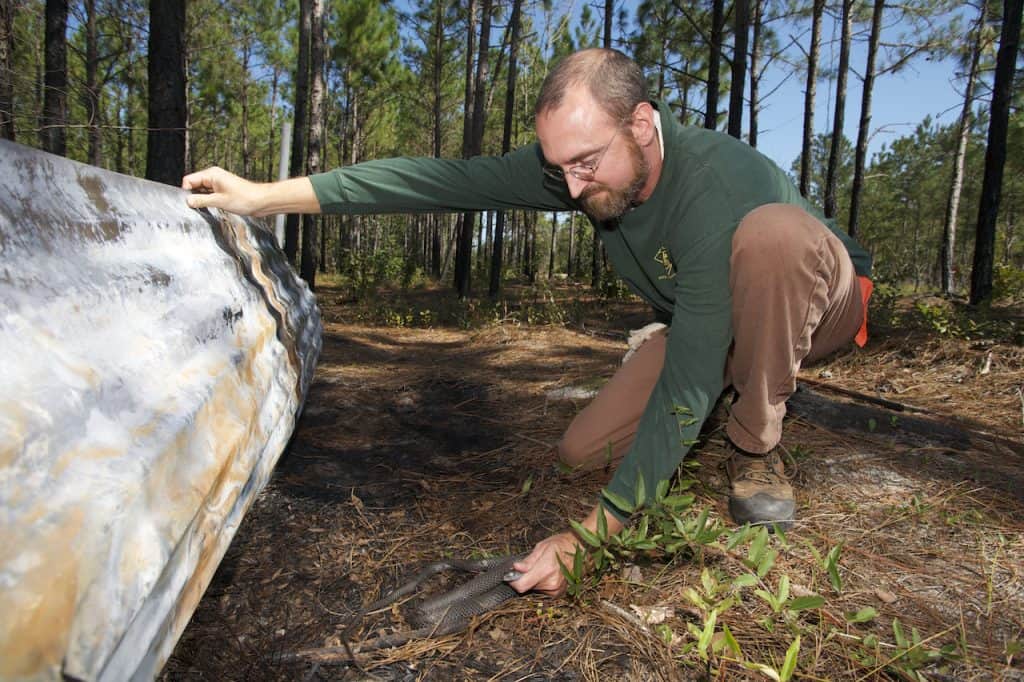
Jeff Hall, a professional herpetologist, tells people to wear closed-toed shoes at night and not to put their hands into places where they can’t see to avoid snake bites.
©
Killing venomous snakes may seem like a way to reduce the risk of being bitten, but it actually increases the danger, as snakes become highly defensive and can still bite even after death. All snakes, including venomous ones, are important to the ecosystem, and in the end, it would be impossible to eliminate every venomous snake. If the habitat is suitable for one snake, killing it will likely result in another moving in.
”There are still going to be snakes out there. The smarter thing is to educate anyone who is involved in your yard,” Hall says. ”Teach the people around you what those snakes are and to be observant when they’re in the outdoors.”
The reality is that four out of the six species in North Carolina require conservation protection, and killing more of these individuals is bringing those species one step closer to extinction.
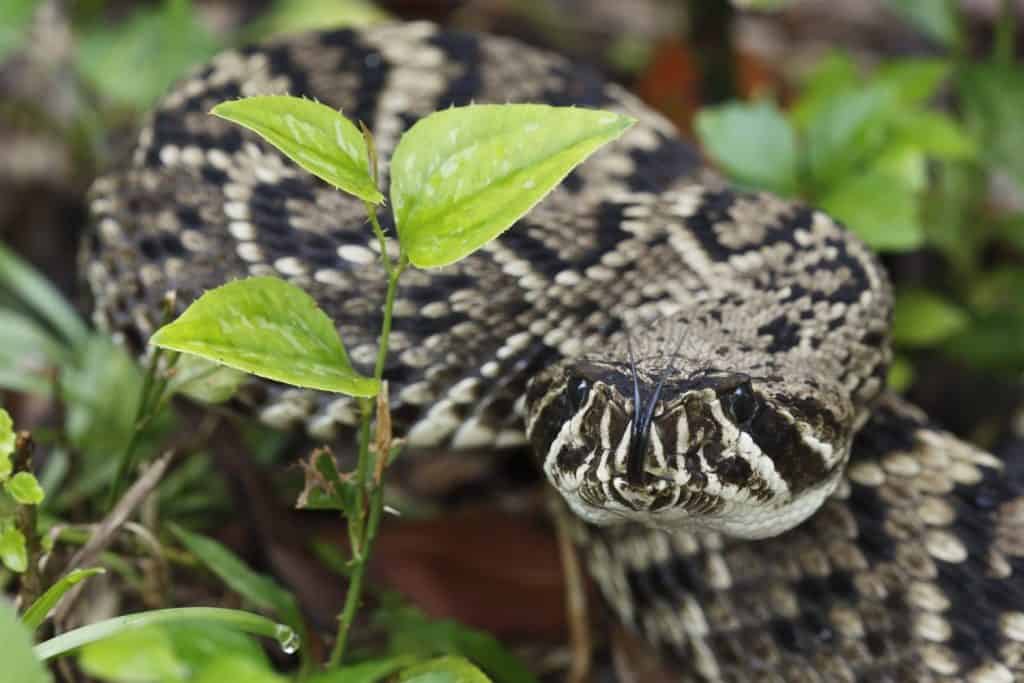
Eastern diamondback rattlesnakes are an endangered species in North Carolina that requires protection for populations to recover.
©Kevin Barry Photography/Shutterstock.com