
Quick Take
- There's a glaring blind spot that is quietly threatening some of the most critical animals on Earth. See the blind spot →
- Up to 90% of a tropical forest's survival depends on animals most wildlife AI has never even tried to track. Discover canopy dependence →
- When TropiCam isn't sure what species it's looking at, it does something counterintuitive. This may be the smartest design decision in the whole system. See how uncertainty is handled →
- Training an AI to look up into tropical canopies meant turning to a data source most research teams would never consider. Explore the training data →
Wildlife cameras are nothing new. Each year, they capture millions of pictures of ground-dwelling animals roaming in their natural habitats. Thanks to AI, all that data can be gathered and studied in mere minutes.
But what about species that inhabit the treetops of tropical forests? These arboreal animals are among the most ecologically important—and threatened—in the world. Until now, little has been done to use AI to capture and study images of these flying and climbing species.
But now there is a solution. Meet TropiCam, the AI-powered tool built to look up.
Why Forest Canopies Need to Be Studied
Traditional AI-powered camera data has focused exclusively on ground-dwelling species. Those animals are easier to photograph. They can easily be captured in photos as they wander past hidden cameras set up at ground level.
However, arboreal species—those that spend most or all of their time among the branches of tall trees—are much harder to photograph. They do not always follow predictable paths, making it nearly impossible to position cameras effectively and collect substantial data.
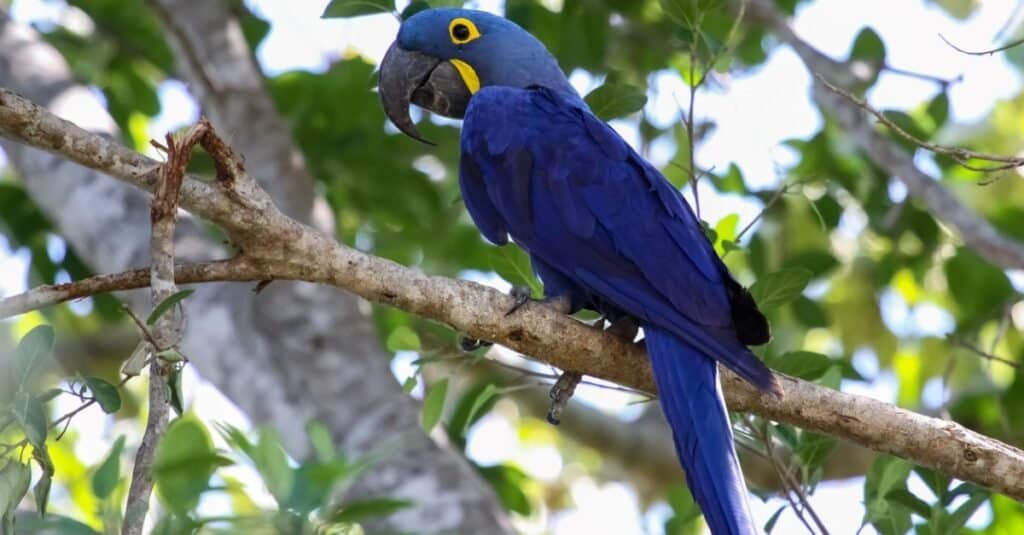
The hyacinth macaw is just one arboreal dweller in South America’s tropical rainforests.
©iStock.com/Uwe-Bergwitz
But studying these canopy-dwellers is important. The mammals and birds that choose trees instead of the ground are a key link in seed dispersal. Most of the plants in tropical rainforests rely on animals to keep the next generation of plants going. Research shows that up to 90 percent of tropical plants rely on mammals and birds to eat the fruit, then disperse seeds far away from the parent plant. That dispersal keeps the plant populations healthy and widespread.
TropiCam was developed to address this data gap. It is a collaborative project between researcher Andrea Zampetti at Sapienza University in Rome and the TROPECOLNET project at Spain’s National Museum of Natural Sciences. The aim was to create an AI-powered camera network focused on the forest canopy, enabling better study of at-risk species critical to tropical ecosystems.
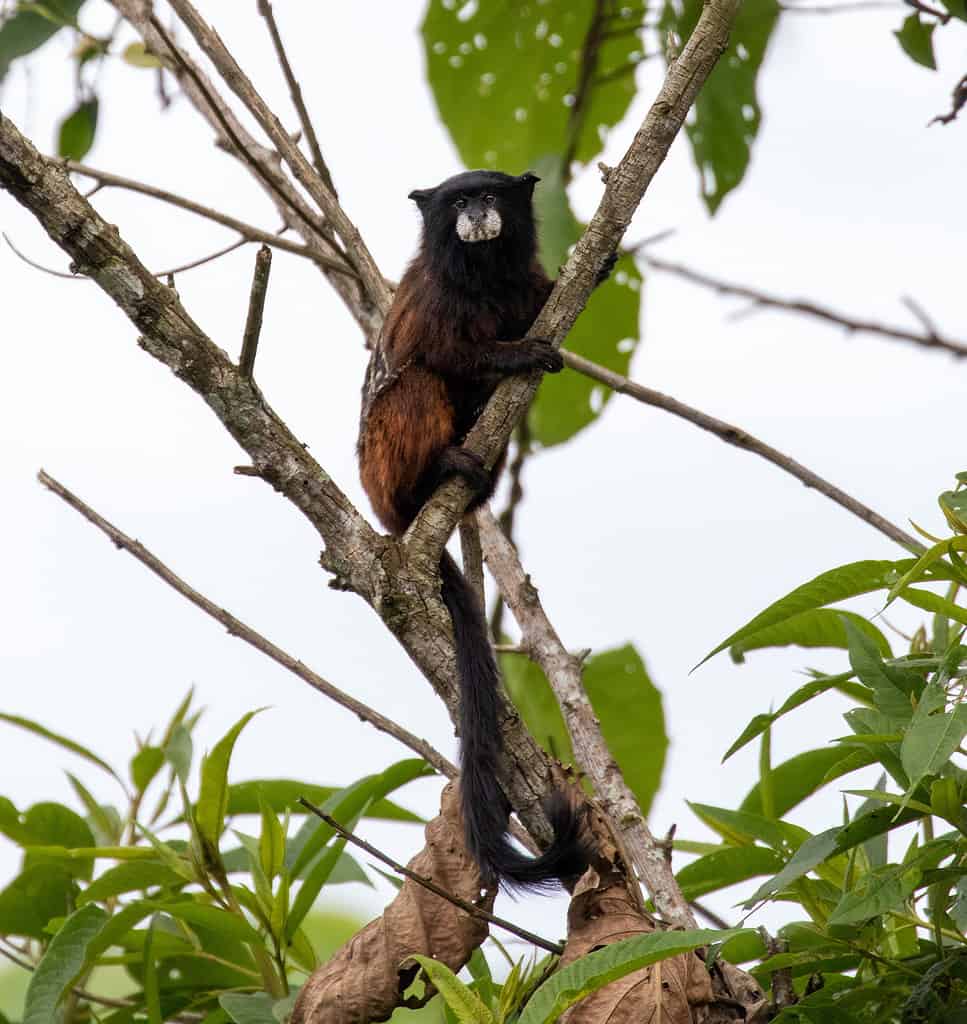
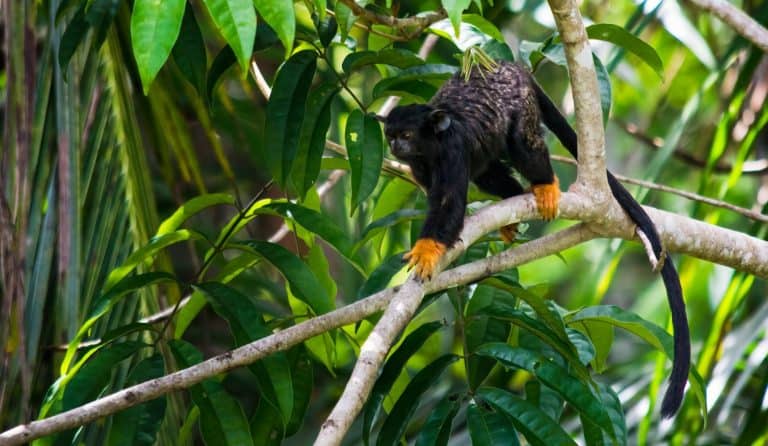
Many mammals, like the Andean saddle tamarin, spend most of their time in trees.
“It’s critical we speed up the pace at which we can gather and analyze data and transform it into useful information,” Zampetti told Mongabay. “And this tool was built to help ecologists and practitioners to expedite the analysis of camera-trap data and automatically process millions of images and videos.”
How TropiCam Was Built
To gather the data required to build out the arboreal AI tool, Zampetti headed to Brazil’s rainforests for a three-month field expedition. They worked with the NGO Instituto Juruá and local communities to gather the treetop training data needed.
After collecting data in Brazil, the research team returned to Europe and expanded the dataset to include images from Peru, Costa Rica, and French Guiana. To further strengthen the dataset, they also incorporated images contributed by citizen scientists via the iNaturalist image library.
Once the data was collected, researchers manually annotated each image to teach the AI algorithm exactly what to look for. The team focused exclusively on neotropical arboreal birds and mammals.
What Does TropiCam Do?
Today, according to the study, TropiCam can recognize 84 taxa that include 63 species. The system consistently shows 95 percent overall accuracy and more than 90 percent precision and recall for 50 of the 84 taxa.
Scientists can upload camera images to the model, and the AI will identify any species present in those images.
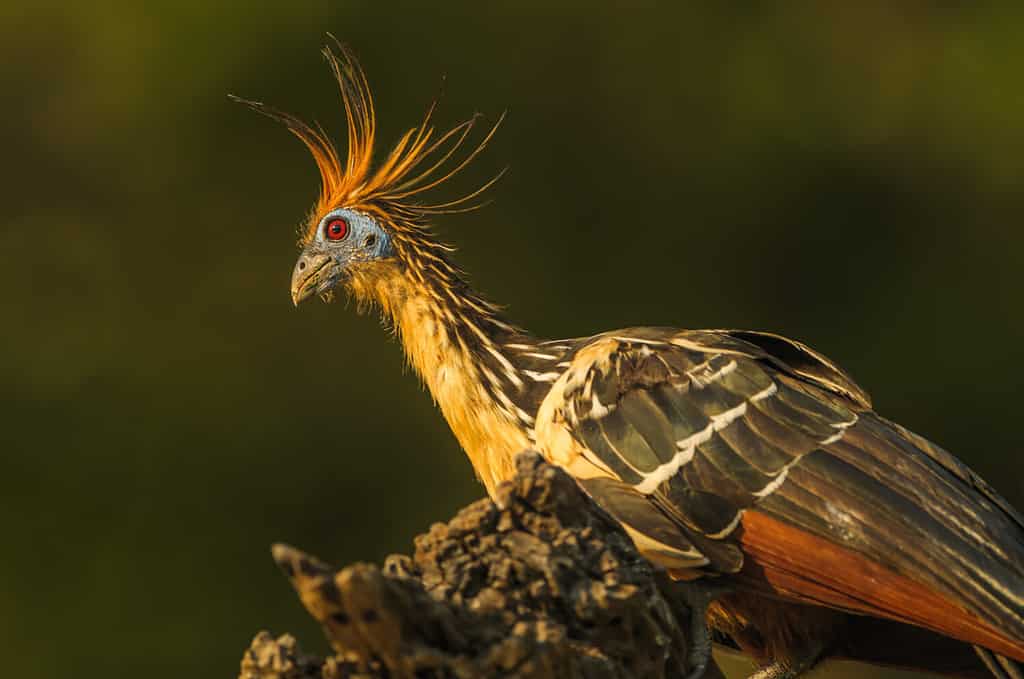
The hoatzin is a native bird of Brazil’s Amazon basin.
©Marcos Amend/Shutterstock.com
When the AI is uncertain about a species identification, it doesn’t guess. “Instead of forcing a prediction that may be wrong, it automatically moves up the taxonomic hierarchy and says that the species might be from a particular genus,” Zampetti told Mongabay.
With TropiCam, millions of upward-pointing camera-trap images can be processed automatically and in a fraction of the time it would take researchers to do even a small portion of that processing manually.
What’s Next?
The success of TropiCam is the foundation for expanded species coverage. The TropiCam team aims to collaborate with others to expand the training database with imagery from additional regions worldwide. As the database grows, the AI model is designed to improve itself, which will enhance its accuracy and applicability in various locations.
Ultimately, the widespread use of the TropiCam AI technology can broaden forest canopy monitoring, giving conservationists a better idea of forest health, species biodiversity, and the impact of deforestation in these fragile ecosystems.
Zampetti also believes that TropiCam technology can be used beyond arboreal species identification. “Going forward, we can start to increase the sample size and tweak it for improvements to make it more fine-tuned for any kind of applications,” he told Mongabay.