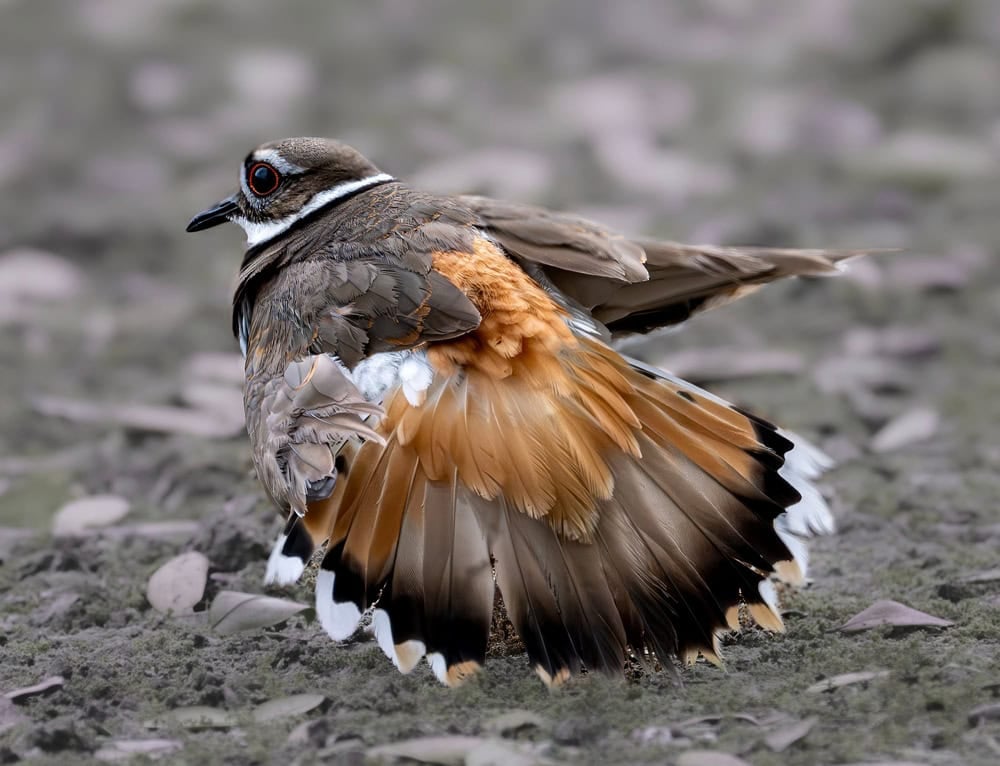

For most birds, suffering a wing injury is a total disaster. It makes them extremely vulnerable to predators and is very likely to lead to an early death. So, why would the bird in this extraordinary YouTube clip fake an injury like that? We explain the impressive acting skills of the killdeer bird.
All About Kildeers
Killdeers (Charadrius vociferus) belong to a group of birds called ringed plovers. They are a native species of the Nearctic and Neotropical regions. You will be able to spot them across most of North America and in parts of South America. Their range extends from the Gulf of Alaska coastline, extending southward throughout the United States and reaching the Atlantic and Pacific coasts. They live in savannas, taiga, and deciduous forest regions, and have a preference for open areas. This species is also very good at adapting to changing conditions and has adjusted to living close to human settlements. This is why you will often see them in parks and agricultural areas too.
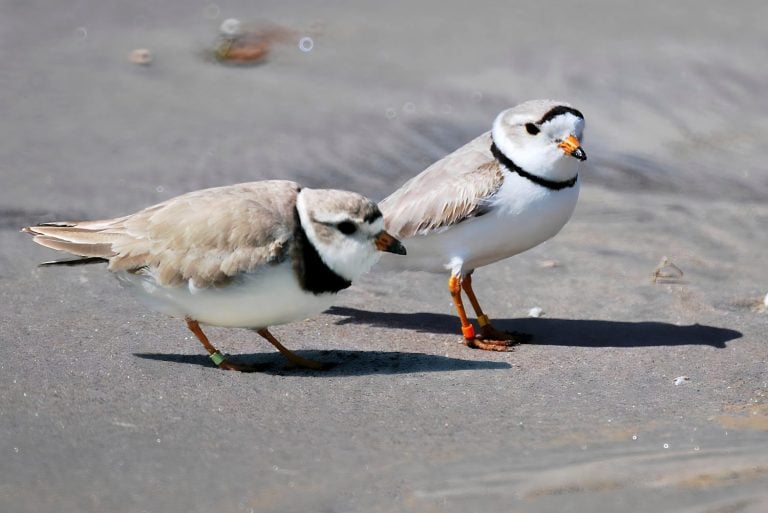
The males and females look very similar. Killdeer are between 9 and 10.5 inches long and have a wingspan of about 17 to 18 inches. They have a dark, double-banded breast, with the top band completely encircling the upper body/breast. There is another band on their head that looks like a mask. They have a pointed and extended bill with which they forage for various aquatic and terrestrial invertebrates, insects, and crustaceans. These birds play a crucial role in their ecosystems and also host several types of parasites. While killdeer are protected under the U.S. Migratory Bird Treaty Act, they are currently assessed as Near Threatened by the IUCN due to observed population declines.
Why Fake an Injury?
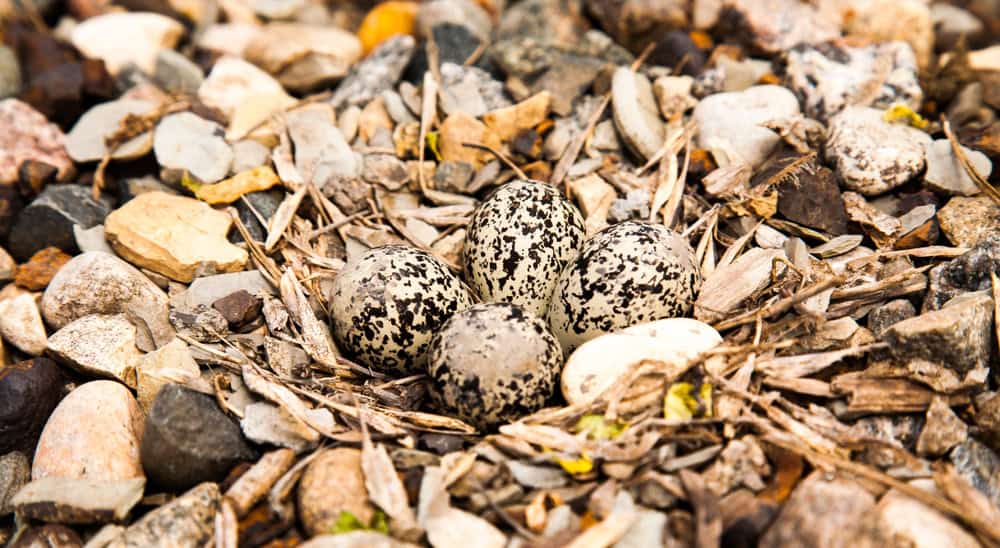
Kildeer nests are very vulnerable.
©Bob Pool/Shutterstock.com
Kildeers form monogamous breeding pairs in the spring. It is the male that first claims a territory in which to nest. These are ground-nesting birds. Calling what they build a ‘nest’ is a bit of an overstatement; it is actually just a shallow depression in the ground. These depressions are typically located in open areas, including farm fields, roadsides, and parking lots. As a result, their offspring are very vulnerable. The female lays around four eggs, and both parents incubate them for between 24 and 28 days. The eggs and chicks are a very attractive potential meal for gulls, snakes, foxes, coyotes, raccoons, and skunks, to name just a few! The adult birds cannot physically take on these predators, so they have devised a clever strategy.
If a predator approaches, one of the parent birds will launch into their ‘broken wing’ routine. As you can see in the clip, the adult bird leaves the nest and hobbles away, dragging its ‘injured’ wing, and giving a performance that is deserving of an Oscar. Every time the predator gets too close, however, the bird miraculously summons the strength to scramble just out of their reach. As the predator becomes more and more confused, it does not realize it is being drawn far away from the nest. Eventually, when the predator has been led far enough away, the killdeer simply flies off, leaving a very confused and hungry predator behind.
Do Any Other Animals Fake Injuries?
The scientific term for faking an injury is called ‘distraction display.’ It has been studied most extensively in birds and is seen in several passerines (perching birds) and in charadriiform birds. In particular, the broken wing act is seen in nesting waders and plovers. However, it has also been reported in the mourning dove, the alpine accentor, and the snowy owl.
This behavior is not without its risks. If a second predator gets involved, the stakes are higher! Also, it is thought that some predators have learned to spot a distraction display when they see one and are not at all fooled by the performance. There are a number of factors that can influence whether the bird decides to use a distraction display. On the whole, they are more likely to use one if the predator is a ground-dwelling carnivore (such as a fox) and if it is closer to the nest. This behavior is also more likely if there are two parents present or even another set of parents protecting a nearby nest. Conversely, you are less likely to see a bird use this behavior if the threat is a human or a flying predator such as a bird of prey. It is also less likely if only one parent is present to protect the nest and if the predator is further away. Sometimes, the bird decides that using this defense mechanism is too risky. In the clip linked above, however, the bird clearly thought it was worth trying!