
Quick Take
- Osprey parents have a counterintuitive strategy for pushing chicks out of the nest, and it has nothing to do with encouragement. See the tough-love tactics →
- Before an osprey chick ever attempts flight, it practices a move that has its own name, and watching it explains a lot about how birds learn to fly. Watch helicoptering explained →
- A chick's first flight is far from the finish line. The real pressure begins in the weeks after fledging. See the post-fledging pressure →
- Osprey chicks go from helpless hatchlings to nearly full-grown in a timeline that seems biologically impossible. See the rapid growth timeline →
Throughout the month of July, in osprey nests across the country, something nerve-wracking is happening for parents and chicks alike. The chicks are learning to fly.
It doesn’t happen all at once. Instead, the art of flying is learned over a series of days. During that time, chicks hop and flap their wings, seeming to test their future skills within the security of the only home they’ve ever known.
But eventually they make the leap with watchful parents looking on. By August, most chicks have fledged, off to live their own lives as independent birds of prey.
From Newborn to Fledgling In Less Than Two Months
When osprey chicks hatch, there’s no real indication they’ll grow into mighty hunters in the sky. They’re born small and weak with downy white baby feathers. But they don’t stay that way for long.
Within 30 days, the chick has already achieved up to 75 percent of its adult weight. Less than one month later, usually between 50 and 55 days old, most chicks are ready to fly for the first time.
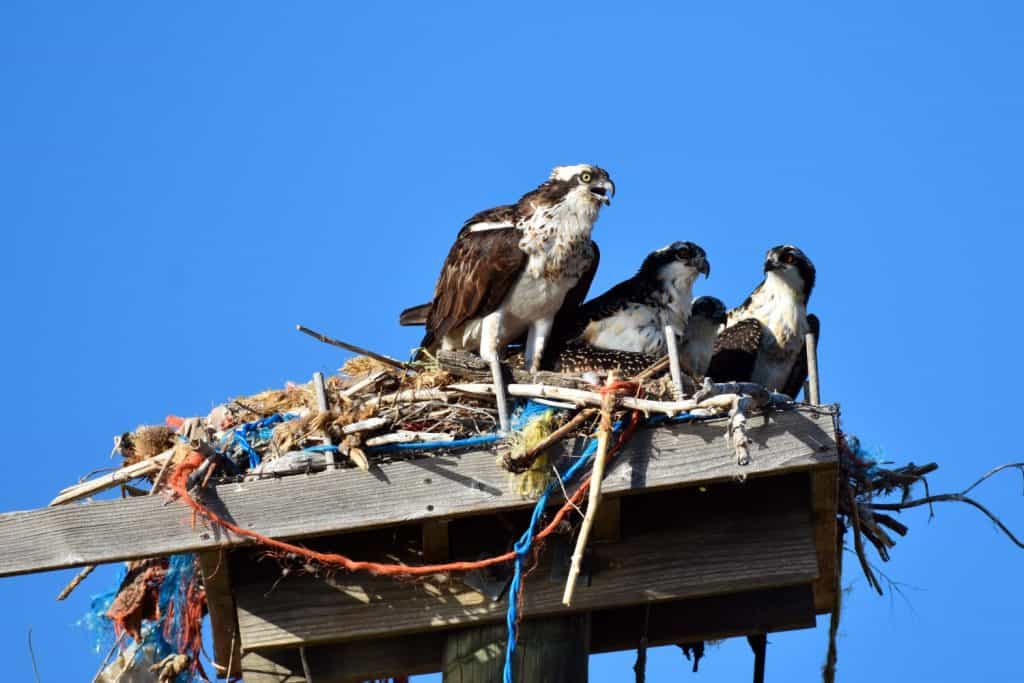
Osprey will nest and raise their chicks in treetops or manmade structures, like this one atop a pole.
©Jed Packer/Shutterstock.com
Since most osprey eggs hatch in late May or early June, July is prime time for watching the chicks fledge from their nests high in treetops or on power line poles.
But putting chicks on the path to independent flight takes a team. In this case, osprey parents and the chicks themselves have important roles to play.
The Chick Is the Star of the Show
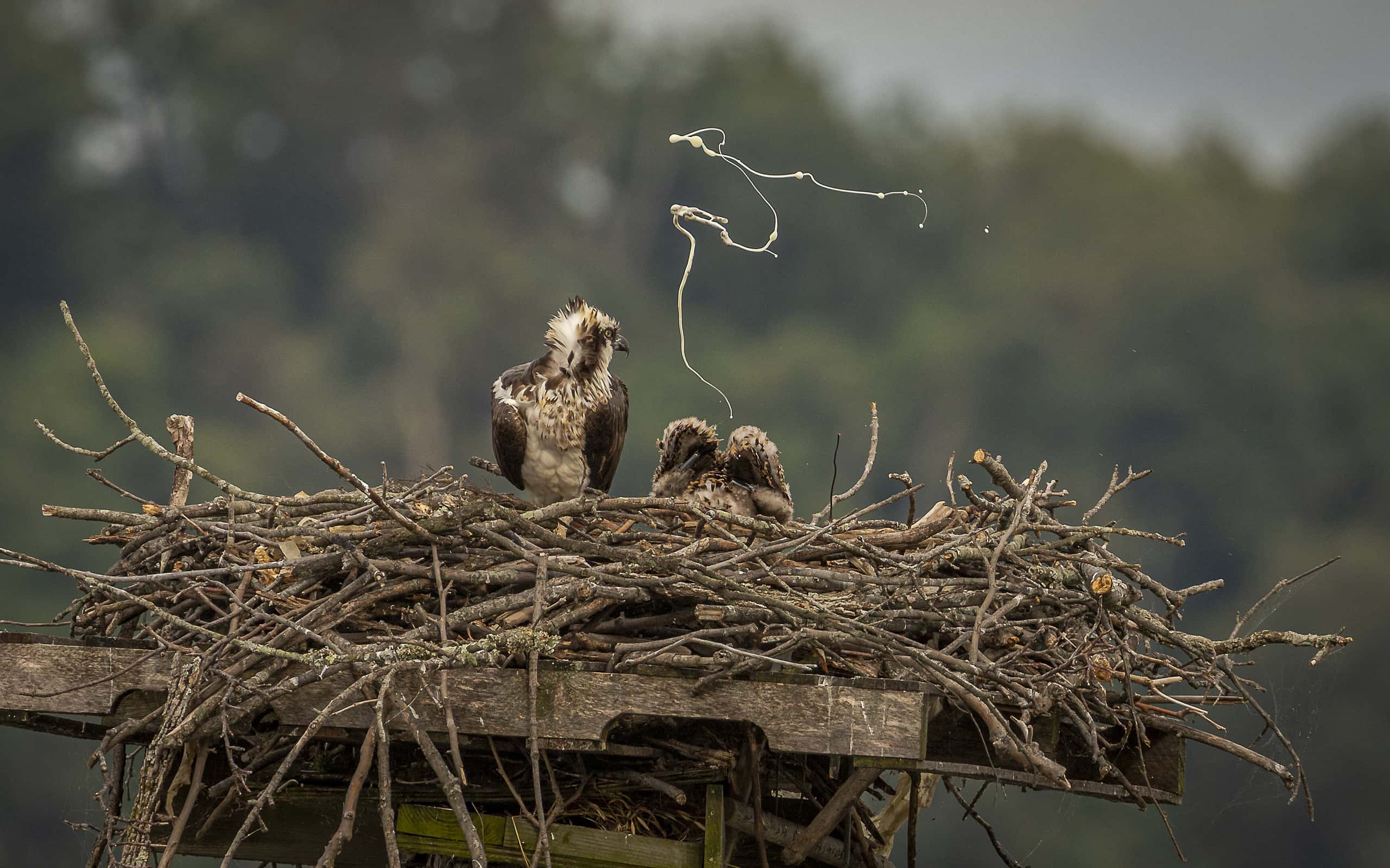
In the weeks leading up to their first flight, osprey chicks start doing wing exercises. They stand up, spread their wings, and flap vigorously while standing in place. If they flap hard enough, they might even lift themselves a few inches off the nest floor. The phenomenon is called helicoptering, since it looks like the chick is trying a vertical take-off, just like real helicopters do.
All the flapping helps the chicks build the wing muscle strength they’ll need to successfully soar through the skies. But helicoptering practice doesn’t produce instant results. In one nest in England, witnesses watched osprey chicks helicopter for days before attempting to fly any distance at all.
What Are Mom and Dad Doing?
Osprey parents closely watch their chicks as they grow, but they’re not there to lend moral support. Instead, they take a tough-love approach, actively encouraging the chicks to leave the nest when they believe the chicks are ready.
As the chicks approach fledging, their parents gradually reduce how often they feed them. The growing hunger encourages the young birds to begin seeking food on their own.
Mom and Dad are likely looking forward to a little rest. Until the chicks fledge, Dad is primarily responsible for bringing dinner back to the nest for everyone. Since ospreys are successful in at least one in every four fishing attempts, and sometimes as high as seven in ten, Dad works hard to provide for his family. With often two to three chicks in the nest, that’s a lot of hungry mouths to feed. Meanwhile, mom guards the nest and feeds the chicks once the food arrives.
Do Osprey Chicks Leave the Nest After Their First Flight?
Osprey chicks learning to fly need a few test flights under their belts before they are ready to leave the nest for good. Often, the initial flight will simply be a few wing flaps to a nearby branch, then back to the nest. Some chicks, however, are a bit bolder. In one nest at the Ferguson Museum, observers watched a chick fly a distance, land on a nearby pole, then take off again for more than four hours before returning to the nest.
Even if a chick seems to leave the nest for an extended period, it will keep returning to the nest for weeks, looking for a meal. The parents take this opportunity to teach their offspring their next invaluable lesson: learning to hunt.
Learning to Fish, Then Leaving for Good
Osprey parents begin training their young to hunt by first dropping a fish near the chick, then allowing it to practice grabbing the prey. Eventually, the training is held over the water, but only after the chicks have mastered flying. Next, the parents demonstrate hunting techniques while the chicks observe from the air.
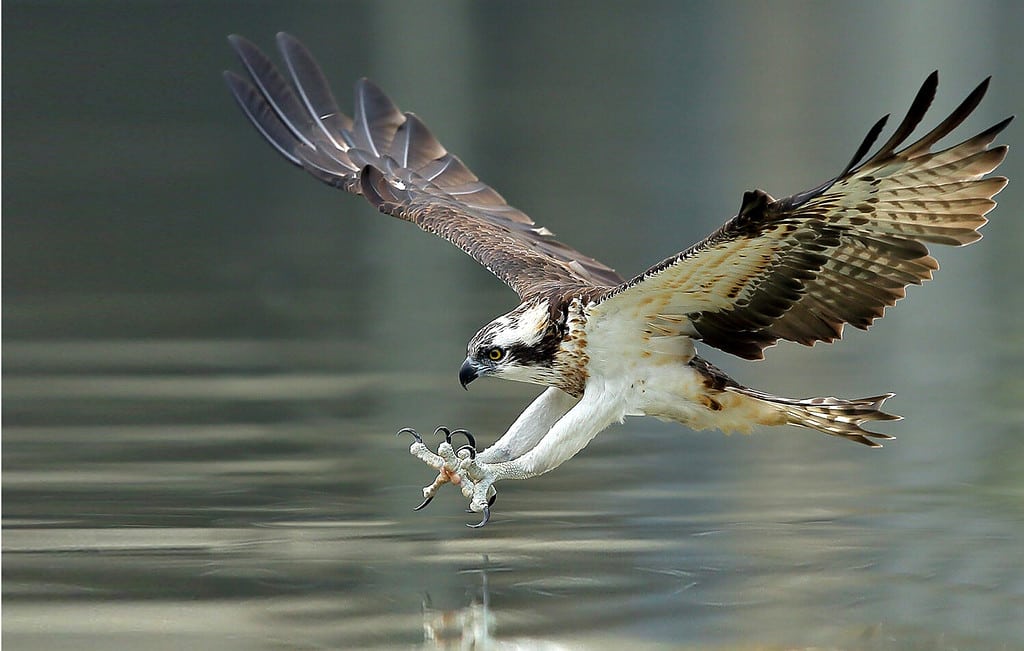
Adult ospreys teach their chicks the fine art of hunting for fish by demonstrating the techniques while the chicks observe.
©Wang LiQiang/Shutterstock.com
But the chicks have to become proficient quickly. By late summer, the ospreys begin an epic migration to warmer climates in Africa, Central America, and South America. They’ll spend the winter there, then return to their more northern summer homes the following spring.
For the chicks, this is the first true test of their flying abilities. They must go it alone, without parental guidance. These migrations can cover thousands of miles one way.