
Did you know crocodiles and alligators can be born without tails? The crocodile in this incredible Instagram video has a congenital anomaly called “amelia,” which refers to the absence of a limb or limbs. As the croc waddles across the enclosure, it appears to be roughly the size of a dog, which prompted the poster to joke that it looks like a “crocodog.” Similar to dogs and cats, crocodilians without tails are sometimes referred to as “bobbed” or “bobtailed.” While a crocodile with no tail is certainly an odd sight, it’s not as rare as one might think. So, what happened to this crocodile’s tail, and can a croc survive without one?
Genetic Defects in Crocodiles
Although malformations have occasionally been observed in young crocodiles in the wild, most defects have been studied in captive crocodilians. In a recent study of 550 crocodile embryos, 61 embryos had malformations. Limb and tail malformations were the most common at 29%. While some believe the defect is genetic, researchers have determined several other possible causes. One is the age of the mother. Scientists found that alligator females older than age 30 and younger than age 15 had higher percentages of malformations. Poor nutrition has also been found to result in malformed embryos.
Others believe that deformities in captive hatchlings, specifically the loss of a tail, could result from incorrect incubation temperatures. Other anomalies during incubation that could increase the likelihood of malformations include inappropriate humidity, improper gas levels in the incubators, and unsuitable egg orientation. Scientists also believe environmental stressors such as pollution, habitat destruction, and climate change could contribute to higher percentages of malformations in wild crocodilians.
The Tale of the Crocodile’s Tail

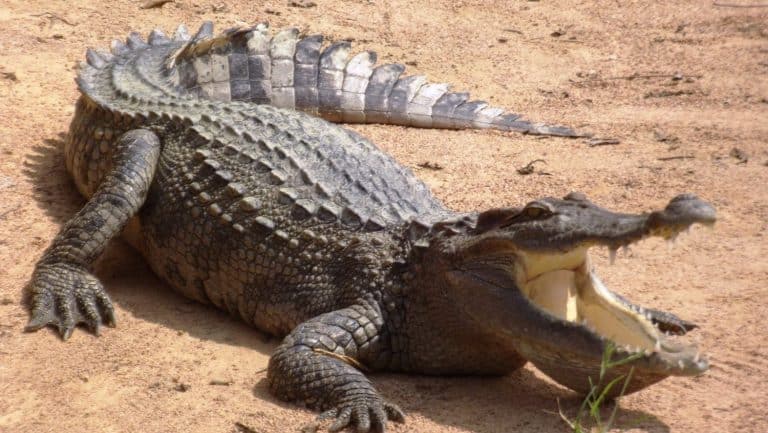
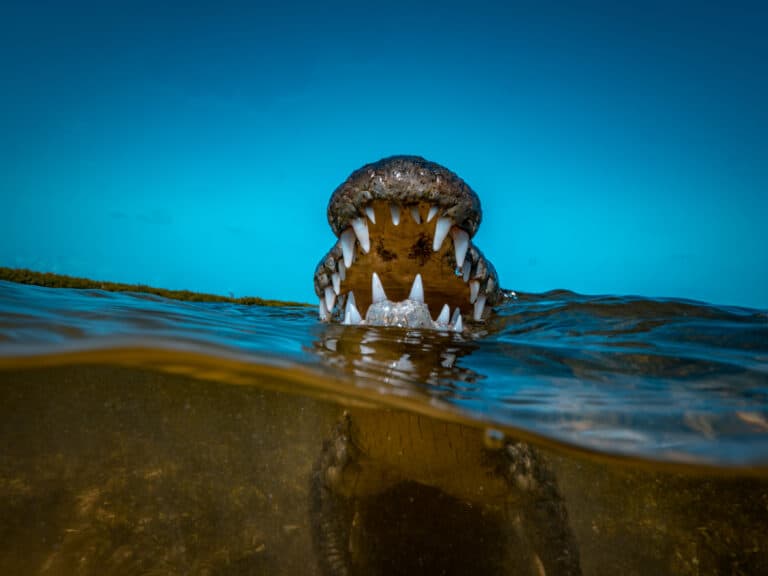
A crocodile without a tail can live in captivity, but its ability to swim is affected.
©Shamleen/Shutterstock.com
Researchers estimate that crocodilian tails make up around half of their body length and 28% of their total body weight. Considering that some saltwater crocodiles can grow to 23 feet in length and weigh upwards of 2,200 pounds, not having a tail could be a substantial loss. Their tails serve as crucial fat reserves, allowing them to go months without eating. Some large individuals can go as long as two years without a meal if necessary.
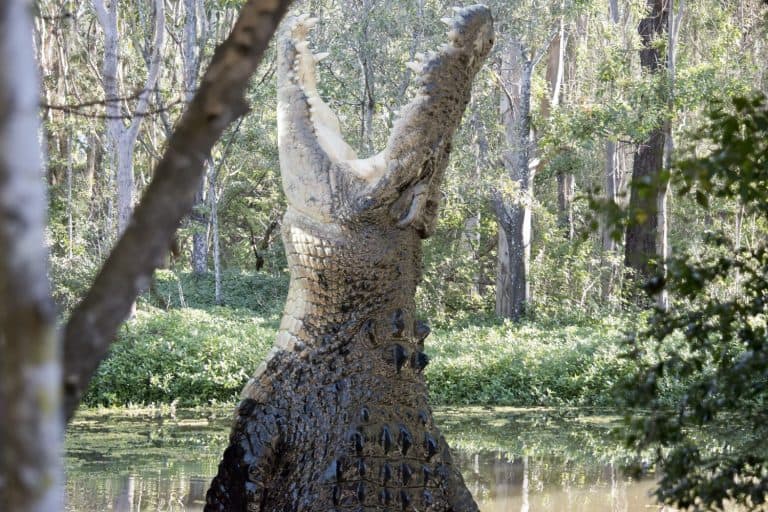
Crocodilians rely on their muscular tails for propulsion while swimming. They hold their limbs against their sides and undulate their bodies in a wave motion. Their tails generate thrust and act as a rudder to help them change direction. They also use their tails to lunge out of the water to ambush prey. Crocodiles bring their hind legs forward and spread their toes to open the webbing. Next, they bend their tails so that the tail forms a right angle with the body. Then, they push their hind limbs and tail backward to thrust themselves upward.
On land, crocodiles often “high walk,” using a side-to-side gait in which the front leg moves in tandem with the opposite hind leg. The front part of the tail is partially lifted to provide balance and stability. As shown in the video, when moving rapidly, the front and hind legs on one side touch when the crocodile’s body curves toward that side. Then, the legs move apart when the body curves toward the opposite side. The tail thrashes back and forth to help propel the crocodile forward, especially when moving downhill.
The Dangers of Life Without a Tail

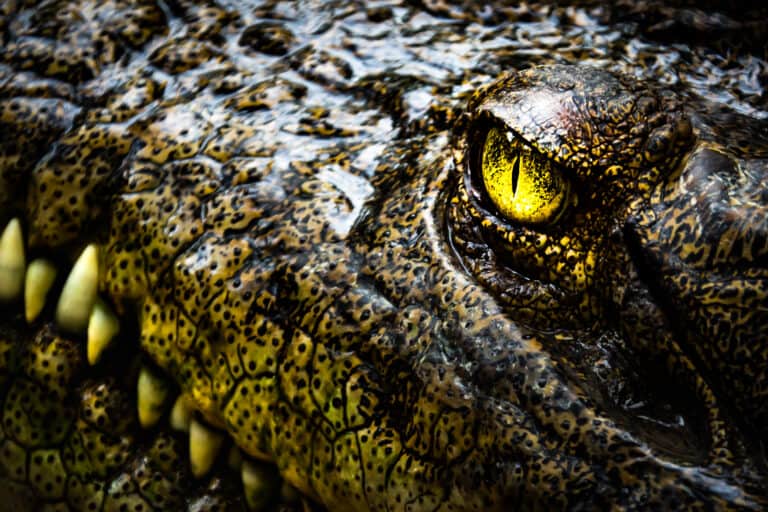
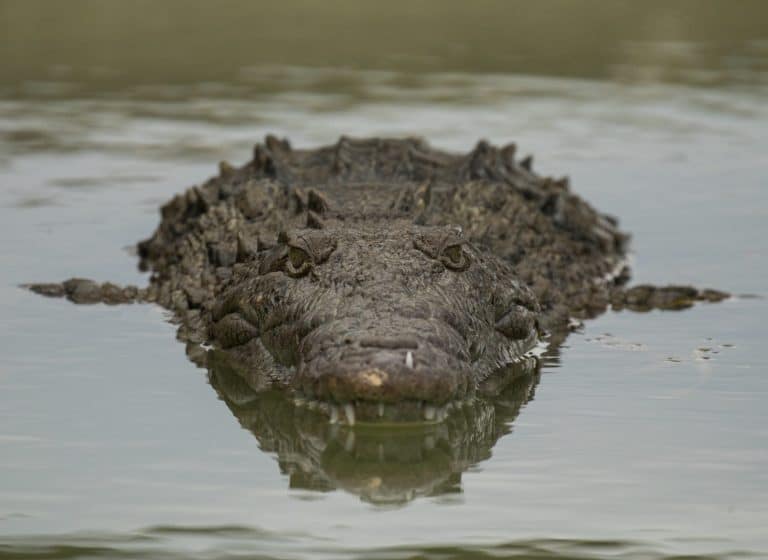
A crocodile with no tail may not be able to store enough fat to survive when food is scarce.
©SERASOOT/Shutterstock.com
Having no tail means that a crocodile has nowhere to store fat reserves. As ectotherms, they rely on external sources rather than internal metabolic processes to maintain their core temperatures. They are ambush predators, so they conserve energy for a quick burst when lunging at prey. They are ambush predators, so they conserve energy for quick bursts when lunging at prey. Approximately 60% of their food energy is stored as fat in their tails. In the wild, a croc without a tail may not be able to store enough energy to survive periods without food.
The lack of a tail also compromises a crocodile’s ability to swim. As the tail is the primary method of propulsion, a crocodile without a tail would struggle to propel itself or launch out of the water. This hinders the croc’s ability to hunt and ambush prey. They also run the risk of drowning in deep water. Crocodiles are opportunistic predators, and when food is scarce, they resort to cannibalism of smaller and weaker crocodiles. So, a crocodile without a tail would have trouble escaping predators. Tails can also be used for defense, which leaves a tailless croc even more vulnerable.
The Benefits of Being Tailless
On land, a tail can actually be a significant impediment to movement. Researchers found that tail dragging during high walking requires the crocodile’s hind legs to support its substantial mass. The constant drag of a crocodile’s tail is so considerable that the front and back legs must work harder to counteract the tail’s braking effects. As a result, the crocodile must expend more energy on land. This causes it to become easily exhausted and require frequent stops to rest. Although there is some loss of stability and power, a crocodile without a tail can move faster and use less energy while on land.
Despite the benefits of moving more quickly on land, crocodiles spend most of their time in the water, where a tailless croc is at a disadvantage. Fortunately, these animals can thrive in captivity with proper care. There is no need to hunt or compete for resources, and caretakers ensure they are not vulnerable to predation. Researchers note that tailless hatchlings can grow well in captivity, although their ability to swim is affected. There are no definitive records of their lifespans in captivity. However, a tailless female alligator named “Bob” was born in 1997 and is currently thriving as the star of an alligator park.