
Quick Take
- Scientists spotted this crab repeatedly in the wild, and they kept getting it wrong every single time. See the mix-up explained →
- One microscopic detail, too small to see in the field, is what finally separated a known species from a brand-new one. See the microscopic differences →
- DNA confirmed the split, but the genetic gap was bigger than scientists expected. It was larger than the divide between two already famous ocean species. See the genetic gap →
- Finding this crab didn't just add a new species. It quietly rewrote what we thought we knew about a different crab's range. See what changed →
Tucked away under rocks in the South China Sea, one tiny crab species thrived. Often seen by researchers, the crab was repeatedly mistaken for a similar-looking species. But when a few of the miniscule crabs were collected by scientists and later examined in the lab, it became clear they were looking at an entirely new species.
The scientists behind the discovery recently published their findings in the journal ZooKeys.
Meet the New Tiny Crab
Eucrate liui is the newest member of the family Euryplacidae, a group of burrowing crabs that are spread across the waters of the Indo-West Pacific. Until this discovery, Eucrate consisted of eight known species.
The new species was found under coral rubble in shallow coastal waters off the coasts of two areas – Beihai, Guangxi and Hainan, China. Researchers collected the new species along with other specimens from the South China Sea in various locations, then preserved them in a 70 percent ethanol mixture and stored them at the Marine Biological Museum, Chinese Academy of Sciences in Qingdao, China. That is where the research was conducted.
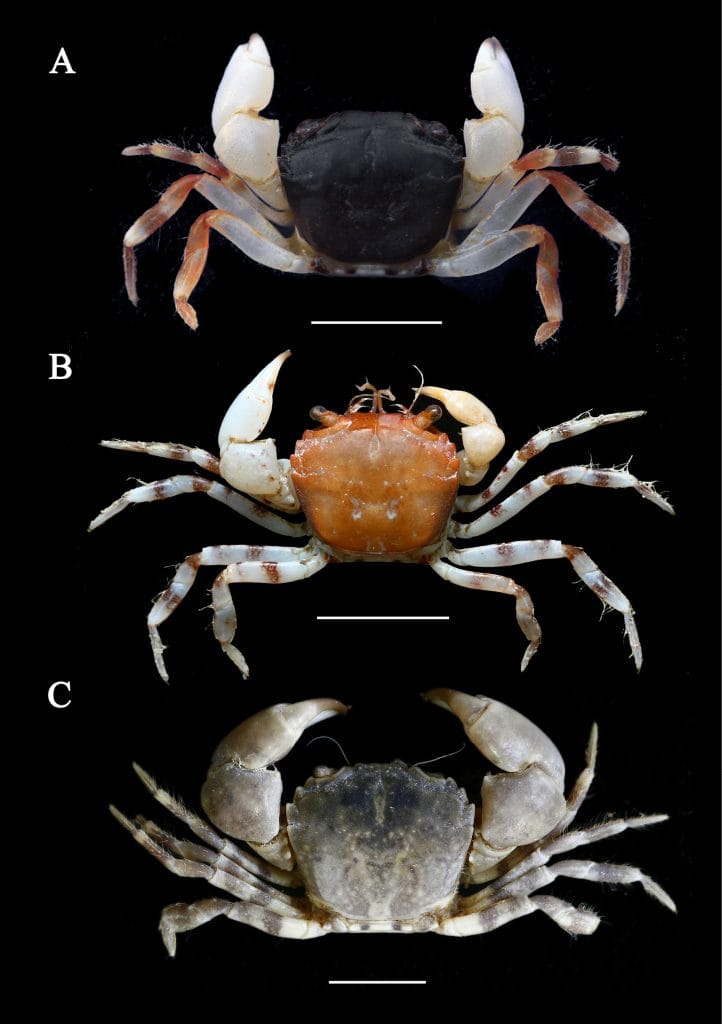
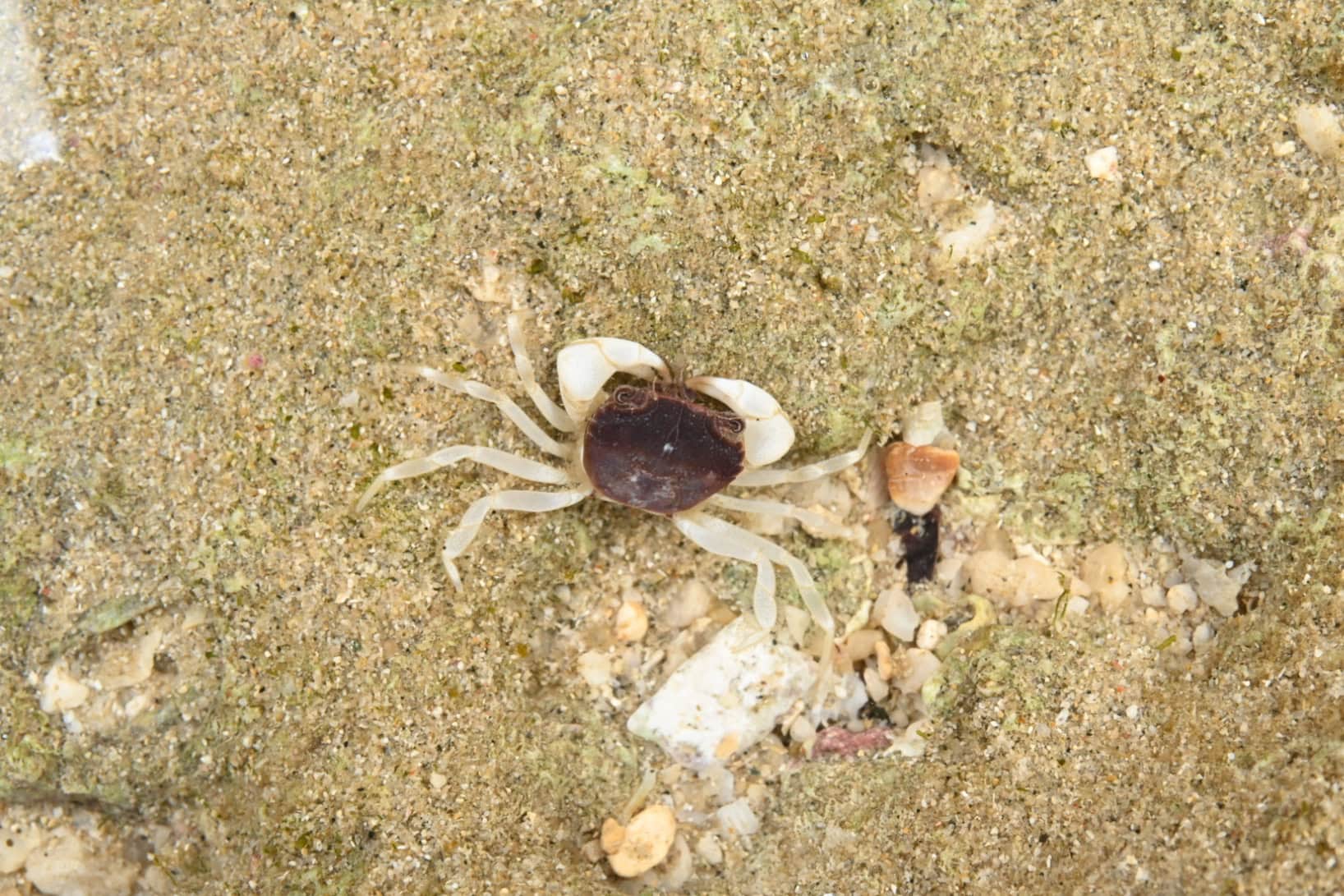
Of the specimens collected so far, the largest is smaller than a U.S. quarter, between .63 and .75 inches long. They sport several different shell colors, including an orange-red to nearly black variation and a grey-brown marbled pattern.
The new species was named after the late Professor Liu Ruiyu, a major figure in Chinese marine science. His work included national research efforts like the National General Oceanographic Survey, the Sino-Vietnam Joint Comprehensive Oceanographic Survey of Beibu Gulf, and the National Coastal Zone and Beach Resources Investigation.
Professor Liu Ruiyu, also known as J.Y. Liu, passed away on July 16, 2012, less than four months short of his 90th birthday. The new crab is one of several new species that have been named in honor of the professor after his death.
How Can Scientists Distinguish One Crab Species from Another?
In their natural habitat, small crab species are often difficult to distinguish from one another. Many look nearly the same at first glance. Telling them apart – and figuring out if a new species has been discovered – requires close scrutiny in the lab.
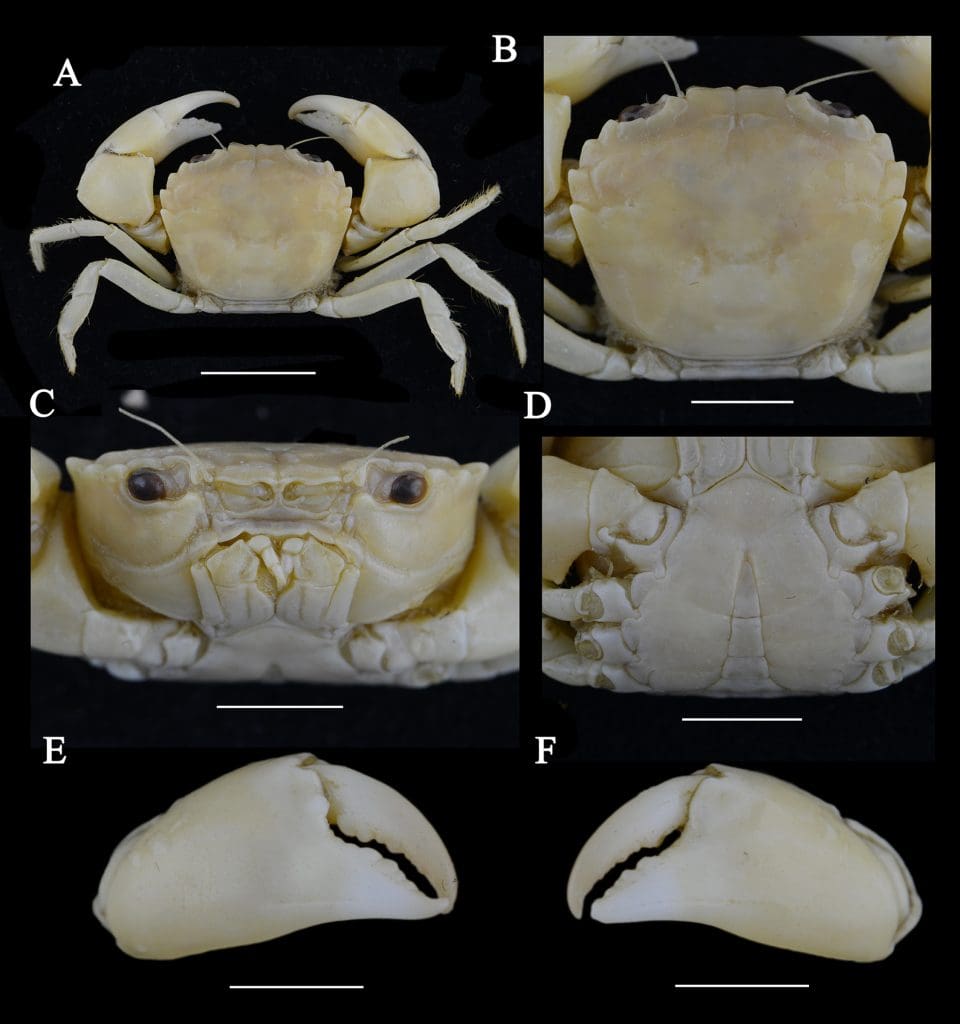
The newly discovered species, as seen under a microscope. A. Overall body; B. Carapace; C. Frontal view; D. Thoracic sternites and abdomen; E. Right cheliped; F. Left cheliped. Scale bars: 10 mm (A); 5 mm (B–F).
Scientists typically look at three different physical characteristics to tell the different species apart, including the shell (carapace), the small bumps along the front side of the shell (front edge teeth), and male reproductive parts. Looking at the reproductive parts requires specimen dissection and study under a powerful microscope.
Scientists can also use DNA to tell different crab species apart.
Is It a New Crab or A Lookalike Relative?
Initially, scientists thought the new species was actually a different crab known as Eucrate tripunctata, a similar-looking species previously only known to exist in Australia and Southeast Asia. But once researchers got the specimen back to the lab, the differences became apparent.
The new species has a flat shell compared to E. tripunctata’s more arched and raised shell. There were front teeth differences, too. E. liui’s teeth are sharp and pointy, like a triangle, compared to E. tripunctata’s more rounded teeth. The new species also has a distinctive notch and groove on its forehead and clear, raised ridges on its shell, features absent in the previously known species.
But the most telling distinctions became clear under the microscope. E. liui‘s reproductive organs are shorter with a larger opening at the tip than its lookalike cousin.
What DNA Testing Showed
While scientists suspected a new species, they confirmed it with a DNA analysis. Using a DNA marker called COI from three related crab species, the researchers determined that the genetic difference between E. liui and E. tripunctata was about 8.7 percent. That percentage was higher than the percentage that separates other well-studied marine species like snapping shrimp and mantis shrimp.
After looking at the DNA evidence along with other visual observations, the scientists were confident they had discovered a new species.
The Importance of the Discovery
The biggest outcome was that the crab genus Eucrate added a new species to its family. There are now nine known species within the genus.
An equally important finding is that E. tripunctata is confirmed to exist beyond its previously known habitat. The specimens used in this study were collected at the same time as the E. liui specimen, meaning E. tripunctata also inhabits the waters of the South China Sea.
Finally, while E. liui may be just a tiny crab, its discovery reminds us that the ocean is vast and filled with countless yet-to-be-discovered species. Some may be hiding just a few feet from shore.