
Quick Take
- A loose ligament lets the tear gland prolapse under the third eyelid, causing cherry eye, and it is not contagious.
- Most cases occur in younger dogs and in breeds prone to cherry eye, with symptoms often appearing by age one.
- Vets usually treat cherry eye with surgery; recovery requires a cone and eye drops, and recurrence occurs in 5% to 20% of cases.
Like people, dogs can get red eyes. This can be due to allergies, debris in the eye, or a condition such as “cherry eye.” The condition not only looks painful, but those with multiple dogs may be concerned that it is contagious. Fear not, pet parents. Cherry eye often looks worse than it is, and it is not something that is spread from one dog to another. So, what exactly is “cherry eye” in dogs?
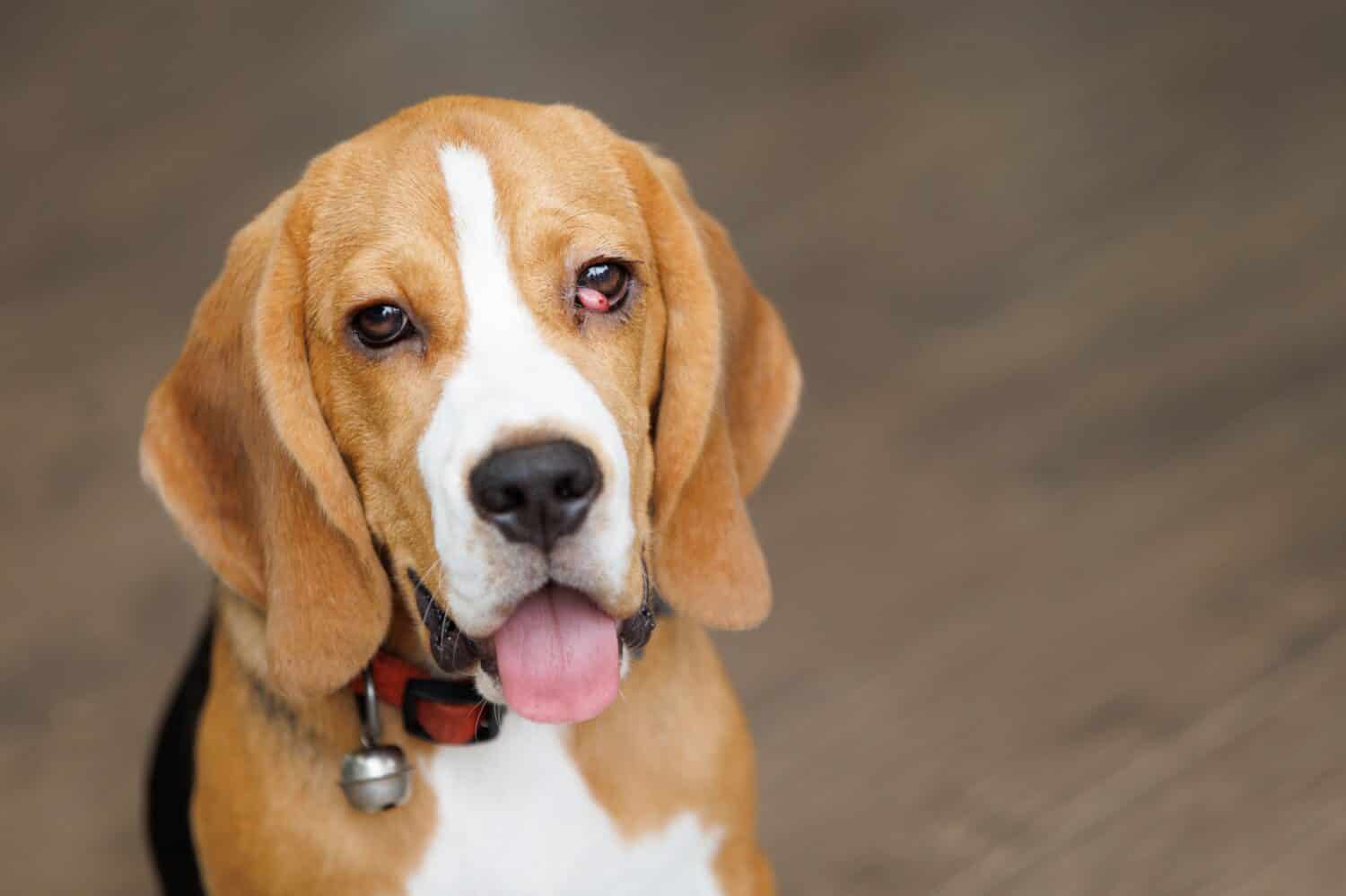
Dogs are prone to a whole host of eye conditions. From eye inflammation to dry eye, cataracts, ulcers, or glaucoma, many of the same eye health issues people face are also common in their furry friends. One of the most painful-looking is the cherry eye. Surprisingly, the condition is relatively painless, meaning that despite the eye’s angry appearance, dogs may not even notice there is a problem. According to Cameron Broach, DVM, dogs have a third eyelid. Cherry eye occurs when the tear gland of the third eyelid falls out of place and becomes visible.
“Cherry eye is caused by a loose or incomplete ligament holding a tear gland in place under the third eyelid,” Dr. Broach explains to A-Z Animals.
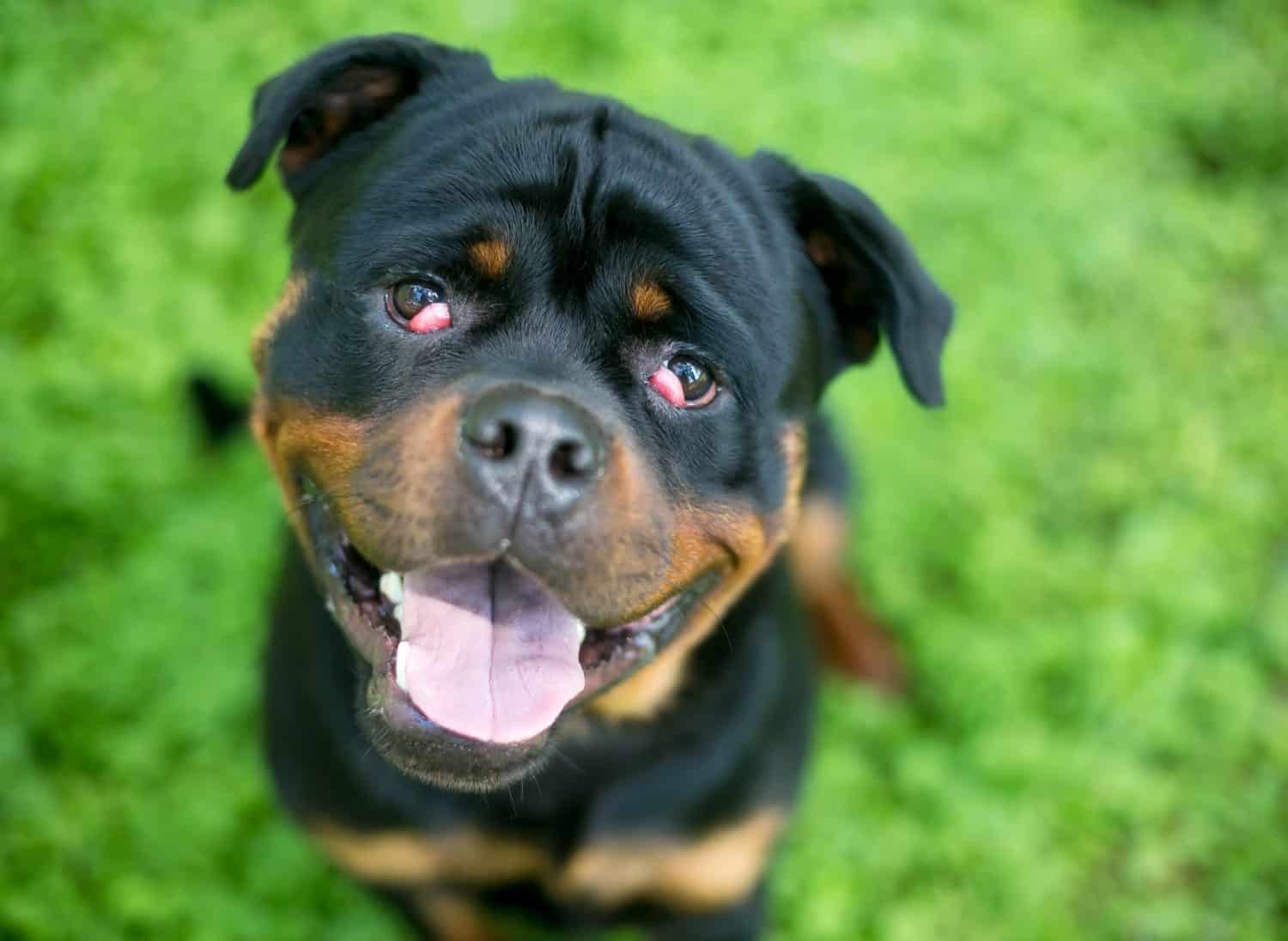
Cherry eye occurs when the third eyelid’s tear gland falls out of place.
©Mary Swift/Shutterstock.com
It is when the tear duct gland becomes irritated or inflamed that the round red mass appears. It will start off small and be a light pink color. As the condition remains untreated, the mass will grow in size and become redder. This is what most people know as a cherry eye.
The majority of dogs will have swelling of the third eyelid due to the tear duct in the inner corner of their eye. However, this is not the only spot where the third eyelid can become irritated. A cherry eye can form anywhere along the eye.
A cherry eye will generally form in one eye as the third eyelid’s tear duct moves out of place. This can be seen in the inner, outer, or even middle of the eye. However, it is not out of the question for it to occur in both eyes at once, as it is a weakness of the eye’s ligament. Does this mean that cherry eye is a congenital condition? It can be, given that some breeds are more prone to cherry eye than others. It can also suddenly appear in a dog whose parents and grandparents were never afflicted.
Do all dog owners need to worry about their dog getting a cherry eye? The answer is no. Not all dogs are as prone to cherry eyes as others. According to Dr. Broach, a practicing vet for 25 years, some breeds are more likely to develop cherry eye than others. The dogs that are most likely to come to a veterinary clinic with cherry eye include:
- English bulldog
- Cocker spaniel
- Puggle
- Beagle
- Boston terrier
While toy breeds and those with flatter faces are most commonly affected by cherry eye, larger breeds like the Mastiff and Great Dane can also develop the condition. Any dog with a weakness in the third eyelid ligament has a high likelihood of developing cherry eye. Recognizing the symptoms early is essential to prevent the condition from worsening or causing further damage to the eye.
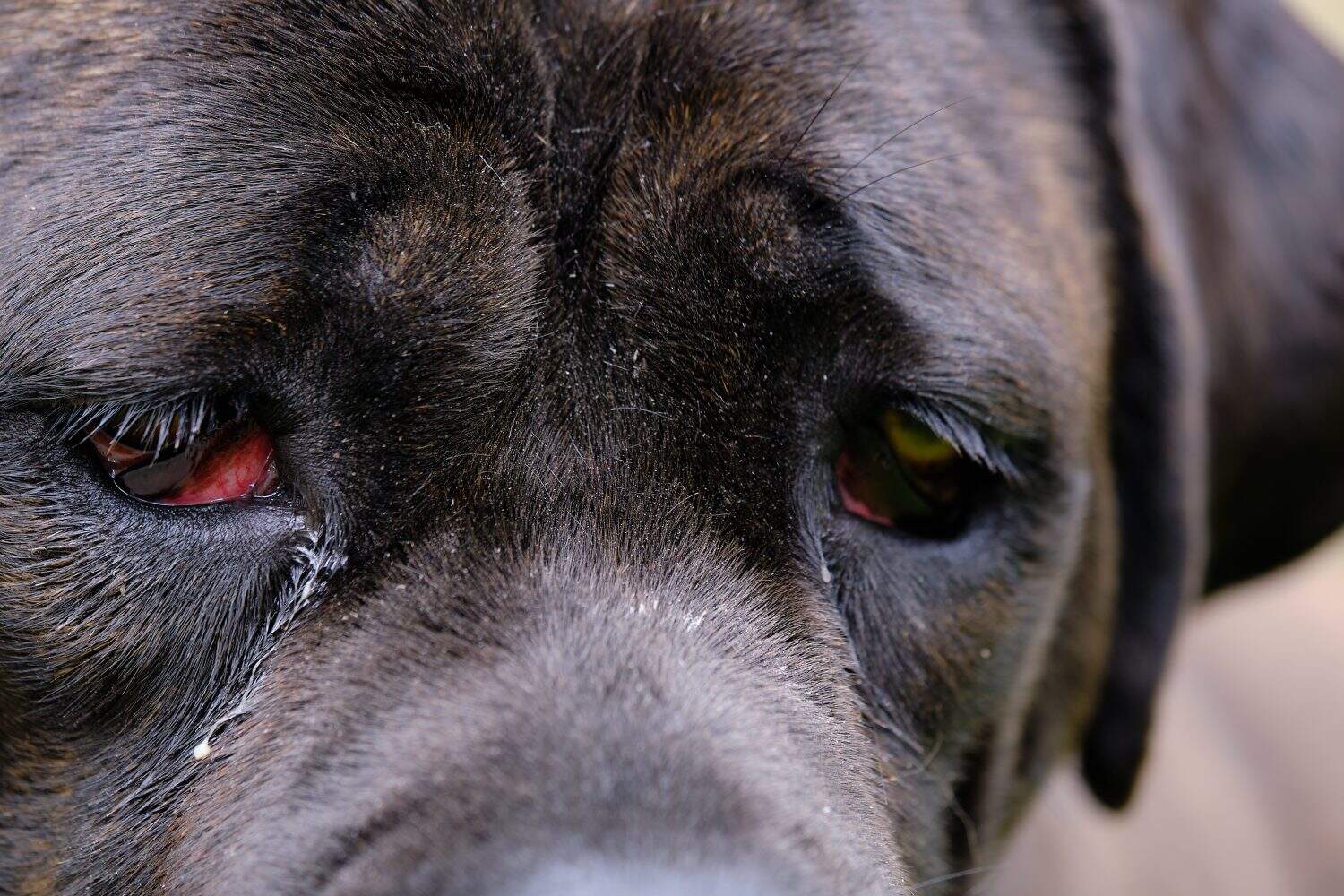
Red, irritated, and watery eyes are symptoms of cherry eye in dogs.
©Cenk_OZER/Shutterstock.com
For most, the first sign that a cherry eye is forming is bright red irritation of the eye, which appears as a round bulge in either the corners or the middle of the eye. However, there are other symptoms to watch for as well.
“Obvious pink swelling and yellow discharge are signs of cherry eye,” Dr. Broach tells A-Z Animals.
However, these are not the only symptoms to watch for. Other symptoms that could point to a cherry eye forming include:
- Incessant pawing at the irritated eye
- Abnormal blinking
- Watery eyes
It should also be noted that dogs who develop cherry eye are typically younger. A 2022 study published in PLOS One found that of the 900,000 dogs surveyed, the majority had their first cherry eye by the time they turned one. Does this mean that once a dog gets older, they are no longer at risk for cherry eye? No. However, the chances do decrease as dogs move past their second birthday.
The treatment for cherry eye depends largely on the severity of the case. For dogs in the early stages, some vets may recommend a more conservative approach to see if the condition resolves on its own with drops and massage. However, according to Dr. Broach, who practices in South Carolina, the most common treatment for cherry eye is surgery.
“Surgery is generally the only treatment,” Dr. Broach explains to A-Z Animals. “From there, the recovery process is easy. One week in a cone and eye drops.”
While cherry eye can resolve on its own with less invasive treatment, such cases are the exception rather than the rule. Those who take a wait-and-see approach are doing a dog a disservice, according to Dr. Broach, as when left untreated, “the eye will become irritated with corneal changes, and there is an increased risk of dry eye.”
For those concerned about their dog undergoing cherry eye surgery, all surgeries come with the risk of complications. As surgical techniques have advanced, though, the procedure to place the third eyelid back in its proper position has gone from an invasive procedure to one that allows dogs to go home after monitoring for anesthesia side effects has ended. Once a dog has come home, as long as post-operative care is followed, the majority of dogs will make a full recovery and, hopefully, will not develop cherry eye again.
Cherry eye is caused by a loose or incomplete ligament holding a tear gland in place under the third eyelid.
Dr. Cameron Broach, DVM
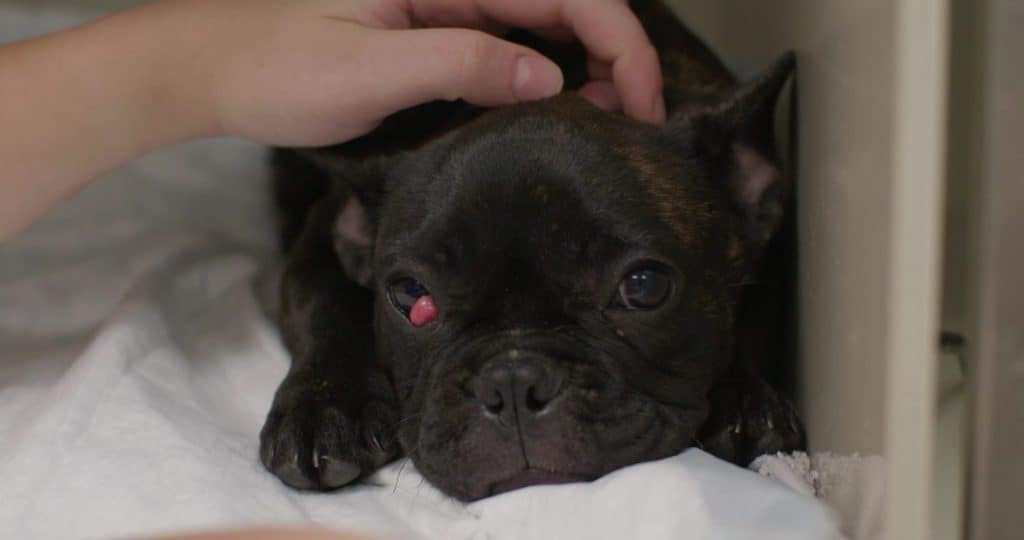
Dogs who have already been treated for cherry eye have a higher chance of developing it again.
©Lebedko Inna/Shutterstock.com
Unfortunately, according to Dr. Broach, dogs who have had cherry eye are more likely to have it return than those who have never had it. This is why knowing the early symptoms and signs of cherry eye is necessary, so that the eye itself is not compromised and the tear ducts are not damaged.
Dogs that have previously undergone surgery to repair a prolapsed third eyelid have a 5% to 20% chance of the prolapse recurring. It is also not uncommon for dogs who have had cherry eye in one eye to develop it in the other eye over time.
The good news is that, while cherry eye cannot be prevented, it is treatable. The sooner symptoms of cherry eye are detected, the better the outcome for dogs, their vision, and the development of any chronic eye conditions, like dry eye. Therefore, if pet parents have a furry friend at home that is known to develop cherry eye, the best course of action is to monitor them and seek veterinary assistance if any changes occur.