
Quick Take
- Prosauropod footprints in Stelvio National Park date to about 210 million years ago and form one of the Alps’ largest track concentrations.
- Tracks show early sauropodomorphs moved in groups, with long parallel lines indicating coordinated travel rather than solitary wandering.
- The site formed on tropical tidal flats near the Tethys Ocean about 210 million years ago and was raised to 2,000 meters by mountain building.
High above the tree line in northern Italy, a wildlife photographer scanning a steep rock face for ibex noticed something unexpected. Hundreds, then thousands, of oval impressions marked the stone. Paleontologists now believe this site preserves one of the largest known dinosaur track concentrations in the Alps. The impressions were made roughly 210 million years ago by herds of long-necked dinosaurs known as prosauropods. This discovery connects ancient life, modern exploration, and the approaching 2026 Winter Olympics in a single mountain setting.
The discovery began with Elio Della Ferrera, a wildlife photographer hiking in the Fraele Valley near Bormio. In September 2025, he was searching for animals such as ibex and eagles when his camera lens caught an unusual pattern on a cliff face. Curious, he moved closer and realized the rock was covered with clear footprint impressions, some as wide as a dinner plate. The scale of the site quickly became apparent as he scanned the surface. Suspecting scientific importance, Della Ferrera contacted local officials and the Natural History Museum in Milan. Specialists soon arrived to examine the site. For the photographer, the find showed how careful observation can reveal unexpected layers of history, even in landscapes he had explored for years.
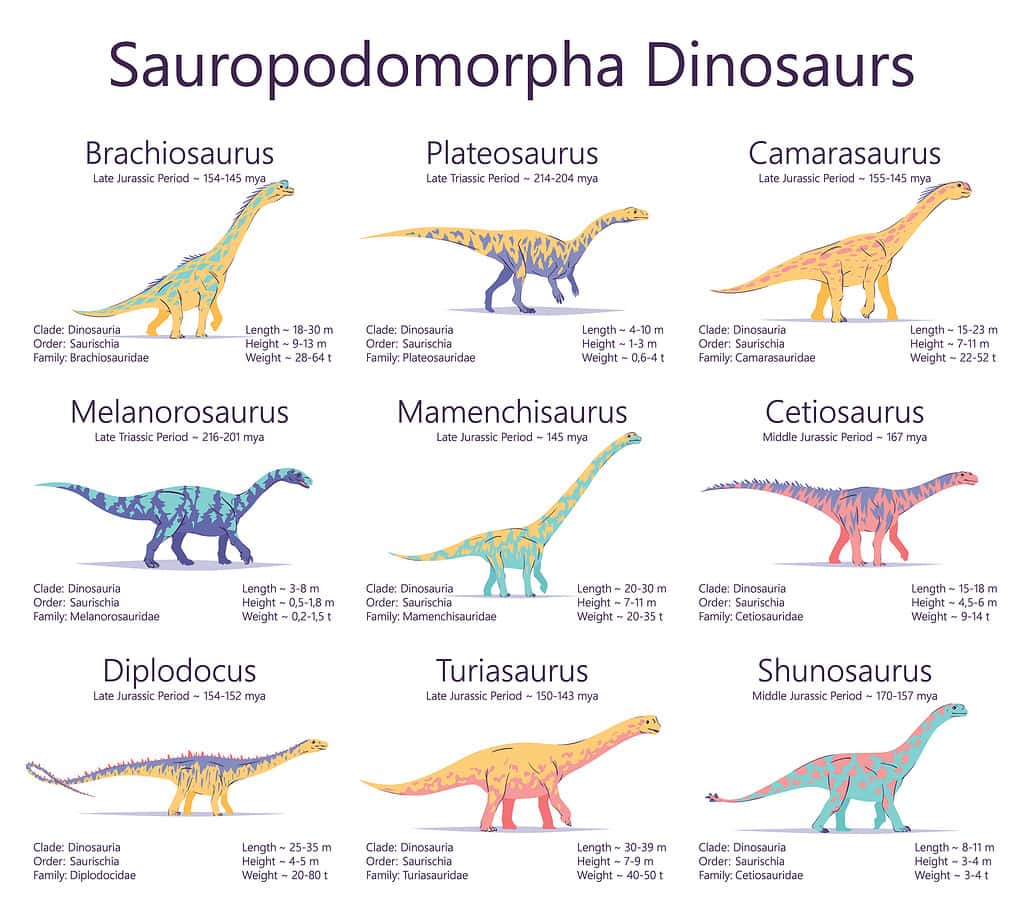
These are some of the descendant species of the prosauropods.
©Tinkivinki/iStock via Getty Images
The footprints found in the Italian Alps are linked to prosauropods, early members of the sauropodomorph lineage that later produced enormous dinosaurs such as Brontosaurus. Prosauropods had long necks, small heads, and strong hind limbs, and, surprisingly, many species moved primarily on two legs. Their forelimbs were shorter and were likely used to pull vegetation closer to the mouth.
These dinosaurs lived during the late Triassic Period, when much of what is now Europe lay near the equator. Fossils discovered across Europe, Africa, and South America suggest some species reached lengths of up to 10 meters. Their narrow skulls and simple teeth indicate they fed on soft plants such as ferns and early conifers. These animals represent an important stage in dinosaur evolution, showing how later sauropods developed their massive size and body shape.
Prosauropods hold a key position in dinosaur history because they link smaller early dinosaurs to later giants. Over time, sauropodomorphs shifted toward four-legged movement, developed longer necks, and increased greatly in mass. Later sauropods, including Brachiosaurus, exhibit skeletal features adapted for supporting immense weight and feeding high above the ground. The Italian tracks represent a stage before these changes were complete. The animals that made them were lighter, more flexible, and still capable of bipedal movement. Their claws and limb structure suggest a mix of feeding strategies suited to coastal vegetation. Studying these footprints helps researchers trace how gradual changes in posture and body design led to the largest known land animals.
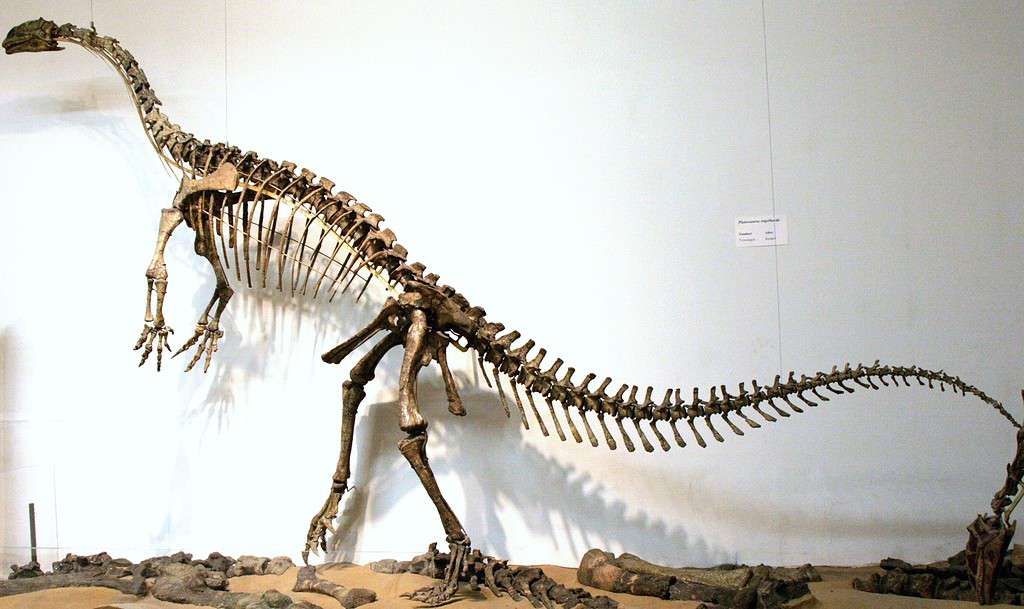
Plateosaurus, one of the sauropodomorphs that traveled on two legs.
©FunkMonk, CC BY-SA 3.0 , via Wikimedia Commons – Original / License
At first glance, the Alpine track surface looks like a scatter of shallow pits. To paleontologists, however, the repeated spacing and alignment tell a clear story. Many of the footprints form long, parallel lines that run in the same direction. This pattern suggests multiple animals moved together at similar speeds rather than wandering alone. Such arrangements support evidence from other sites that early sauropodomorphs often traveled in groups. Some tracks show detailed impressions of toes and claws, which allow scientists to estimate body size and walking speed. Most of the prints match a bipedal stance. The sheer number of impressions, reported to be as many as 20,000 across several rock faces, suggests repeated crossings over time. Like modern animal paths near water sources, the site records everyday movement rather than a single event.
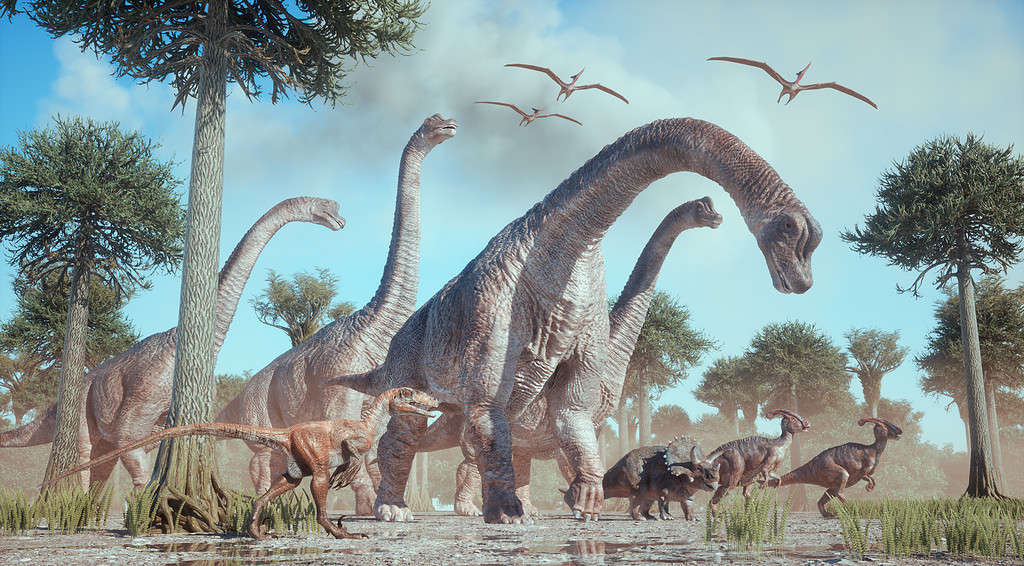
The pattern of footprints shows the animals were moving in groups of mixed ages rather than alone.
©Orla/iStock via Getty Images
The Italian footprints add to a growing body of evidence that sauropodomorphs showed social behavior. Similar trackways in North America, Africa, and Asia display long lines of footprints with consistent spacing. These features suggest animals of a similar size moved together at the same pace in family groups or herds. At Stelvio, the parallel tracks and their density fit this picture of group movement across coastal flats. By measuring stride length and track size, researchers can estimate speed and body proportions. Such details offer insight into daily behavior, rather than rare or catastrophic events.
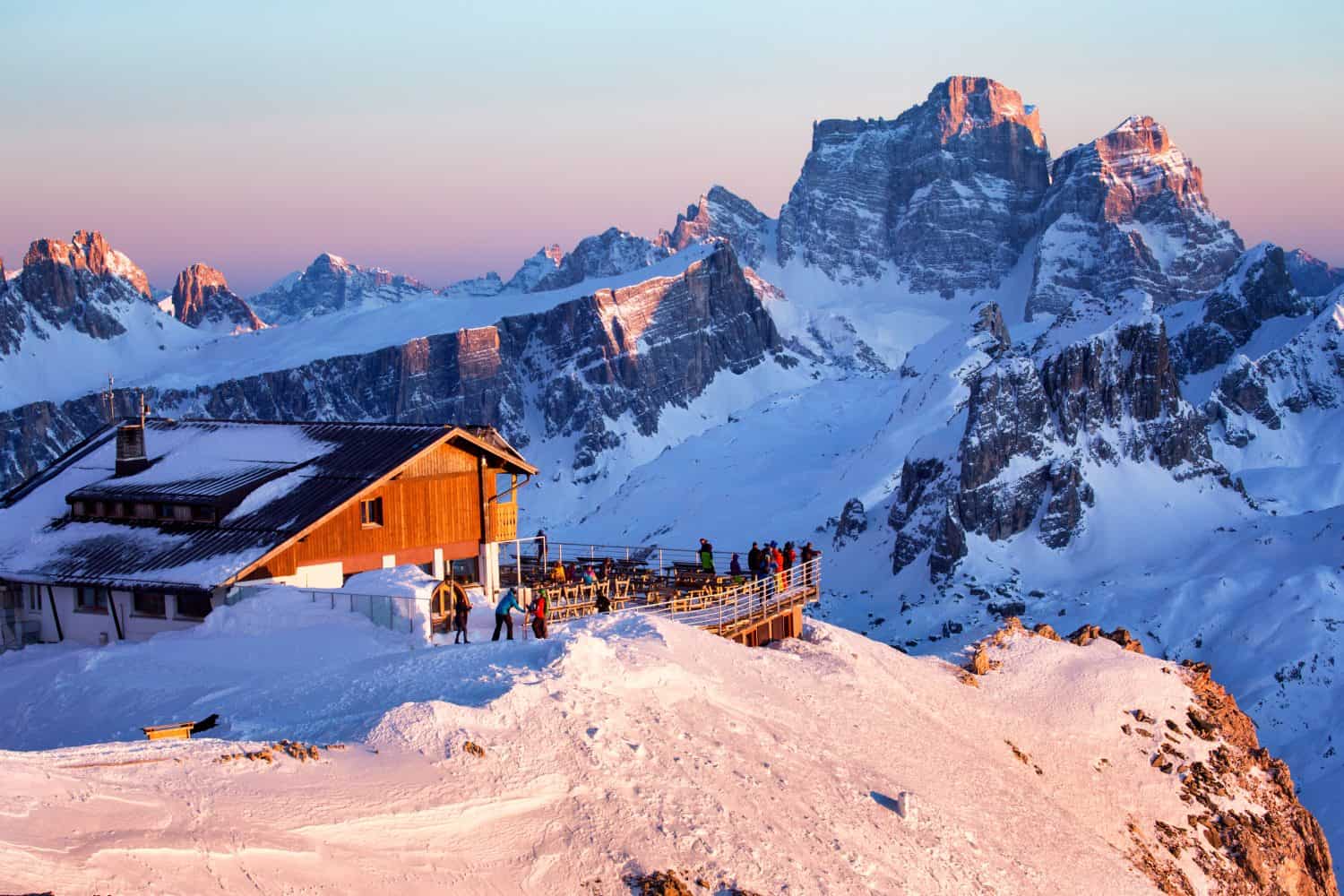
The setting of these tracks is striking, given their origin. Around 210 million years ago, the region that now forms part of northern Italy lay near a tropical shoreline along the Tethys Ocean. Broad tidal flats spread across the area, covered in wet sediment ideal for preserving footprints. Alpine track and other reptiles walked across these surfaces, leaving deep marks that later filled with sediment and hardened into rock. Over millions of years, tectonic forces pushed these layers upward as the Alps formed. The once-flat mudflats tilted and fractured, eventually standing almost vertical. Today, the track-bearing rock lies at elevations above 2,400 meters within Stelvio National Park. Erosion and seasonal snowmelt exposed the surface, explaining why the tracks remained unnoticed for so long despite nearby human activity.
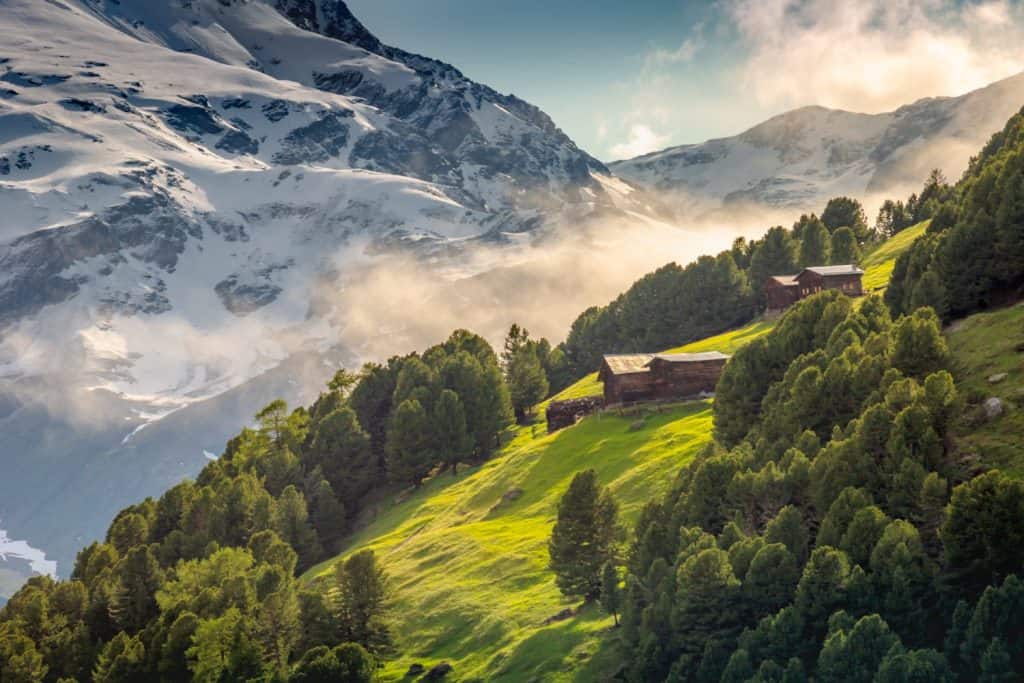
Stelvio National Park has bare snowy peaks and foothills with green forests and meadows.
©PositiveTravelArt/Shutterstock.com
An added layer of interest comes from the site’s location near areas planned for the Milan-Cortina 2026 Winter Olympics. The track surfaces lie within Stelvio National Park, between Livigno and Bormio, where alpine skiing and other snow sports are scheduled. As athletes compete on modern courses below, fossilized tracks from the Triassic Period remain fixed high on surrounding cliffs. Local officials and scientists have pointed to this contrast as a reminder of the region’s long natural history.
Discussions are underway about how to protect the site while also using it as an educational example. The Stelvio track site is difficult to reach. The footprints lie on steep, near-vertical rock faces at high elevation, often covered by snow for much of the year. Access currently requires technical climbing skills and safety equipment. Although the site is inaccessible to most people, some individuals possess (or believe they possess) the skills to reach it. This creates a risk not only of damage to the site but also of attracting thrill-seekers who could be injured or require rescue.
Efforts may focus on remote documentation, museum displays, and digital reconstructions. Visitors to Stelvio National Park can still explore nearby trails, lakes, and viewpoints that overlook the same valleys. These surrounding areas provide context for understanding how ancient animals once crossed a landscape that later became a high mountain environment.
The fossilized footprints in the Italian Alps link distant moments in time. They capture herds of dinosaurs crossing tidal flats long before mountains rose or humans appeared. Today, photographers, scientists, and athletes pass through the same landscape, leaving brief marks in snow and soil. The discovery opens a window onto the past and the future at once. It looks back to the early ancestors of dinosaurs and forward to their descendants. At the same time, it reminds us that we, too, are leaving traces on the planet, and that how we do so will determine whether there are future archaeologists left to uncover them.