
Quick Take
- A California houseboat community suspected secret government activity, but the real culprit turned out to be far stranger. The Sausalito mystery explained →
- Male plainfin midshipman 'sing' using a mechanism that operates at over 5,000 beats per minute. How the singing works →
- Some male plainfin midshipman can't sing at all, but they've evolved a surprisingly cunning workaround to still win the mating game. Meet the sneaker males →
- The plainfin midshipman isn't the only fish keeping neighborhoods awake at night. In Florida, the same thing is happening all over again. Other fish keeping people awake →
If you’ve ever gone scuba diving, you’ve probably felt an overwhelming sense of peace. There’s a physiological reason for that. Underwater, our heart rate slows. When we’re pulling air through our masks, we control our breathing, which calms us. As a result, being underwater feels quiet and tranquil. But our oceans, bays, rivers, and lakes are actually exceptionally loud. As the Marine Science Institute at the University of Texas-Austin shared, sound travels nearly five times faster underwater than it does in the air. Recently, while reading Amorina Kingdon’s book Sing Like Fish: How Sound Rules Life Under Water, I was surprised to learn about the soundscapes of our oceans. Boats vibrate, whales‘ low-frequency sounds can travel hundreds of miles, and fish are surprisingly vocal. My curiosity led me to look into the different noises fish make, which is when I discovered the plainfin midshipman.
For a long time, the plainfin midshipman’s song completely stumped residents of a houseboat community in Sausalito, California in the 1980s. According to an article published in Fisheries, the residents couldn’t understand what was making the loud, repetitive, low-frequency hum that kept them awake at night. It turns out that a group of male plainfin midshipman, all humming together, can create a noise reminiscent of an electrical generator or an airplane engine. Eventually, this fish’s song captured the hearts of Sausalito residents and gave scientists a greater understanding of plainfin midshipman courtship.
What Are Plainfin Midshipman?
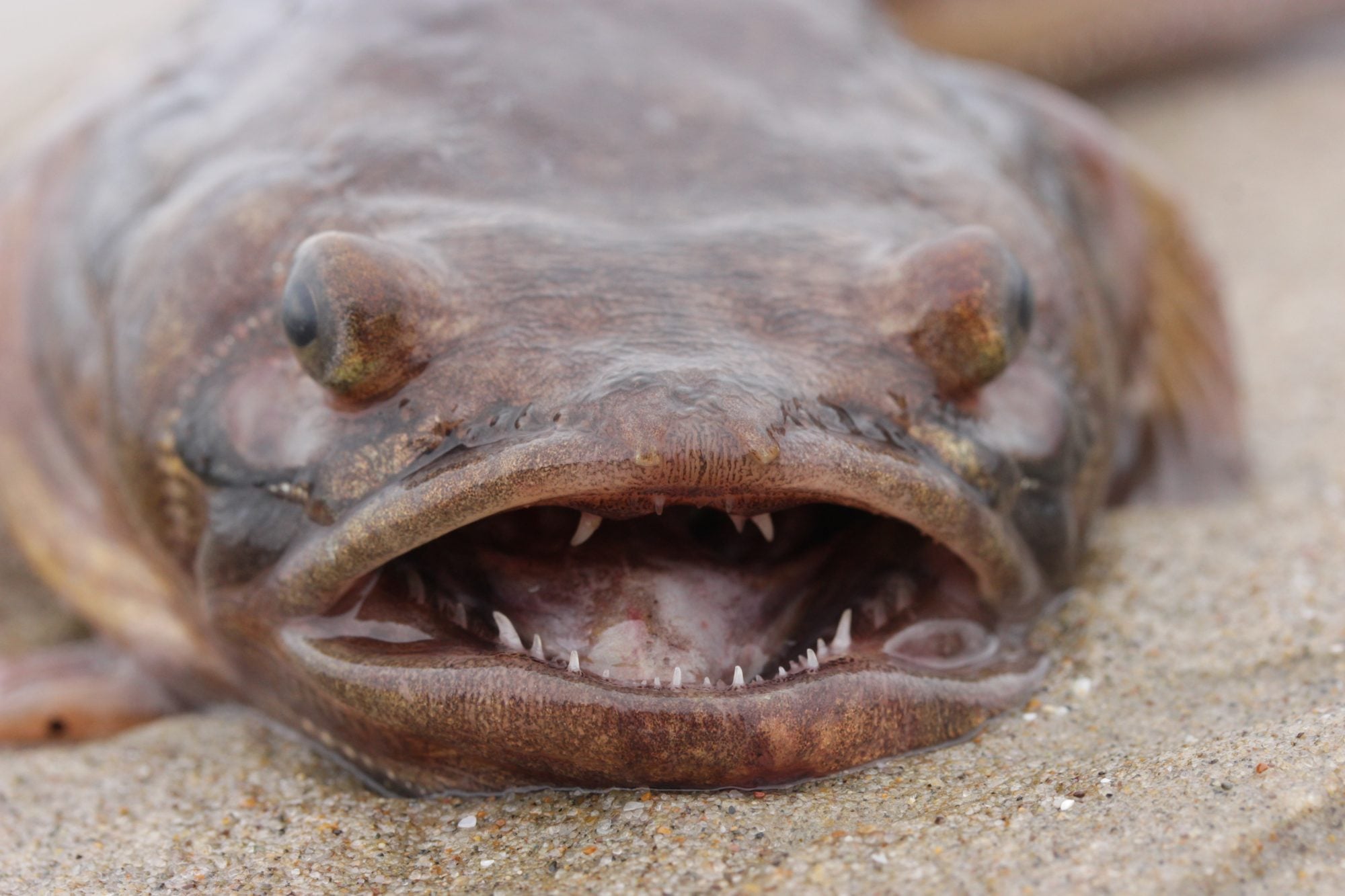
Plainfin midshipman (Porichthys notatus) are a type of toadfish. These bottom-dwelling fish are native to the Pacific Coast of North America. Typically, they’re found as far north as Alaska or as far south as Baja California. Plainfin midshipman are not the most beautiful fish you’ll ever see. At around 15 inches long, these fish are olive or brown in color with a golden stomach. Iridescent purple flecks dot their backs. Their mouths are full of extremely sharp teeth that help them feed on crustaceans, mollusks, and smaller fish. Despite their somewhat strange appearance, plainfin midshipman have a unique physical feature: sets of little dots running along different areas of their body. In fact, it’s what they’re named for!
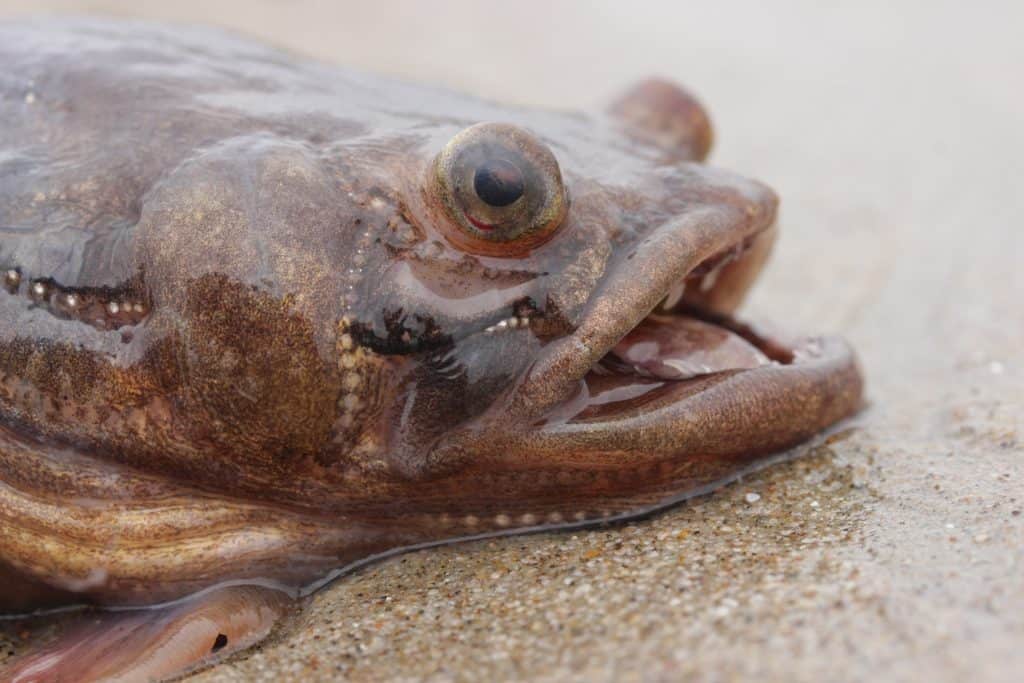
The circular photophores, or light-emitting organs, help plainfin midshipman with hunting and mating.
These dots are known as photophores. Plainfin midshipman have these bioluminescent organs on their stomach, head, and flank. The “midshipman” part of the fish’s name comes from the photophores’ resemblance to buttons on a naval officer’s uniform.
Throughout the year, plainfin midshipman live in different ocean depths: deeper during the fall and winter months, and closer to the shoreline for breeding season in spring and summer. It’s during the breeding season that type I male plainfin midshipman begin making their call for females.
The Sausalito Humming Toadfish Festival
When plainfin midshipman songs were first heard, the Sausalito houseboat community was stumped and even a little frightened. After all, Cold War tensions were running high in the 1980s. According to the Sausalito Historical Society, residents wondered whether the loud noises they heard had to do with secret, or potentially dangerous, government projects. The fishes’ songs sounded different in different boats, too, largely affecting those whose homes had steel-reinforced concrete hulls. Residents couldn’t even sleep at night.
But once ichthyologist John McCosker realized it was fish, and plainfin midshipman in particular, Sausalito houseboat residents decided to work with what they had. Rather than try to eradicate the fish, they created a festival called the Sausalito Humming Toadfish Festival. People advocated for the environment, dressed like sea creatures, learned more about the toadfish causing chaos in their community, and even played kazoos to mirror the plainfin midshipman’s calls (although clearly not as loud).
The festival ended in the 1990s as plainfin midshipman gradually began finding other places to nest during breeding season. But their songs have certainly not stopped.
This Fish Can Sing
Only type I (parental) male plainfin midshipman can vocalize to attract females. They do this by contracting muscles around their swim bladder, an organ that helps them float, up to 360,000 times an hour. That’s around 6,000 times per minute. While male plainfin midshipman can tune out their own humming, females and non-reproductive males, known as type II males or “sneakers,” have specialized hair cells that allow them to hear the low-frequency hums at or below 105 hz.
When a female hears and is attracted to a male’s singing, she travels to his intertidal nest, which he has created in sediment under rocks. Then, she lays her eggs. The plainfin midshipman is oviparous, which means the eggs are laid outside of the female’s body. This is different from fish like tiger sharks that are ovoviviparous, meaning their eggs hatch inside the body before the mother gives birth to live young. Once the eggs are laid, the female vacates the nest. The male then watches over and fans the eggs, once again humming to attract more females. Several females might lay their eggs, leaving behind hundreds or even thousands of eggs.
Type II Males Without a Song
Sneakers can’t attract females since they cannot sing. Both females and sneakers can make vocalizations like grunting, but these are usually only done in situations involving posturing or fighting, aggression, or escape. But the fact that females are oviparous benefits sneakers. They hang around type I male nests and dart inside after a female, fertilizing the eggs before the type I male can get to them. Regardless of who fertilizes them, the eggs usually hatch within one month.
Are Plainfin Midshipman the Only Fish Who Sing?
No! In fact, plenty of fish use songs or vocalizations to attract potential mates or during the courtship process. The sand goby produces rhythmic pulsing or drumming once a female enters the nest. Ambon damselfish have a higher-pitched song reminiscent of a windshield wiper on dry glass.
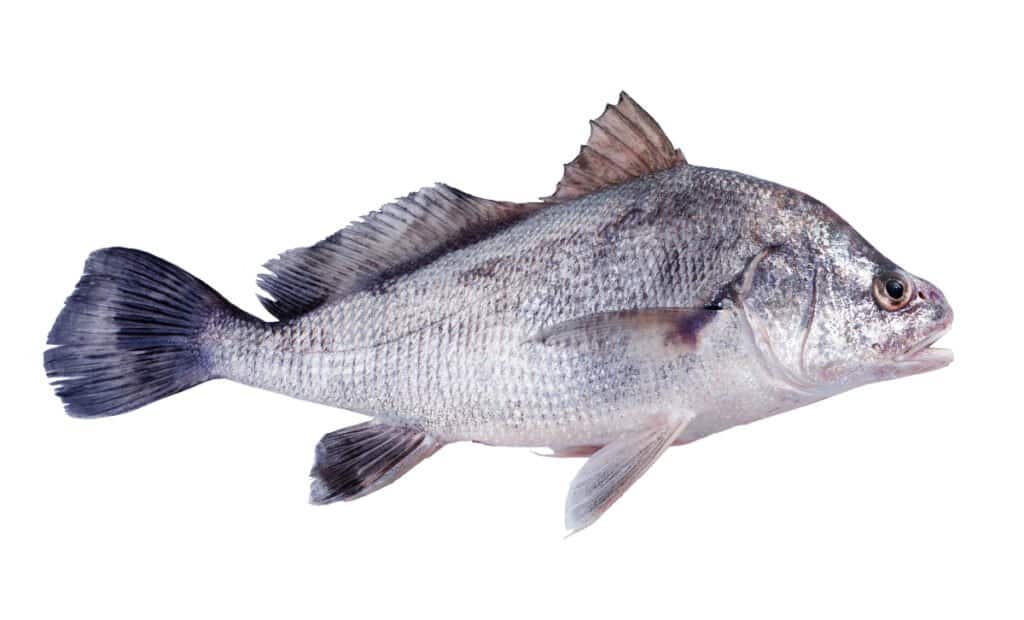
Because black drum hum at such a low frequency, their noise can easily travel through water and drains.
©IrinaK/Shutterstock.com
Black drums, similarly to plainfin midshipman, flex their muscles against their swim bladders to create a throbbing hum up to 140 to 165 decibels. In fact, they’ve been keeping Florida residents awake at night. Perhaps a Florida Black Drum Festival is on the horizon.