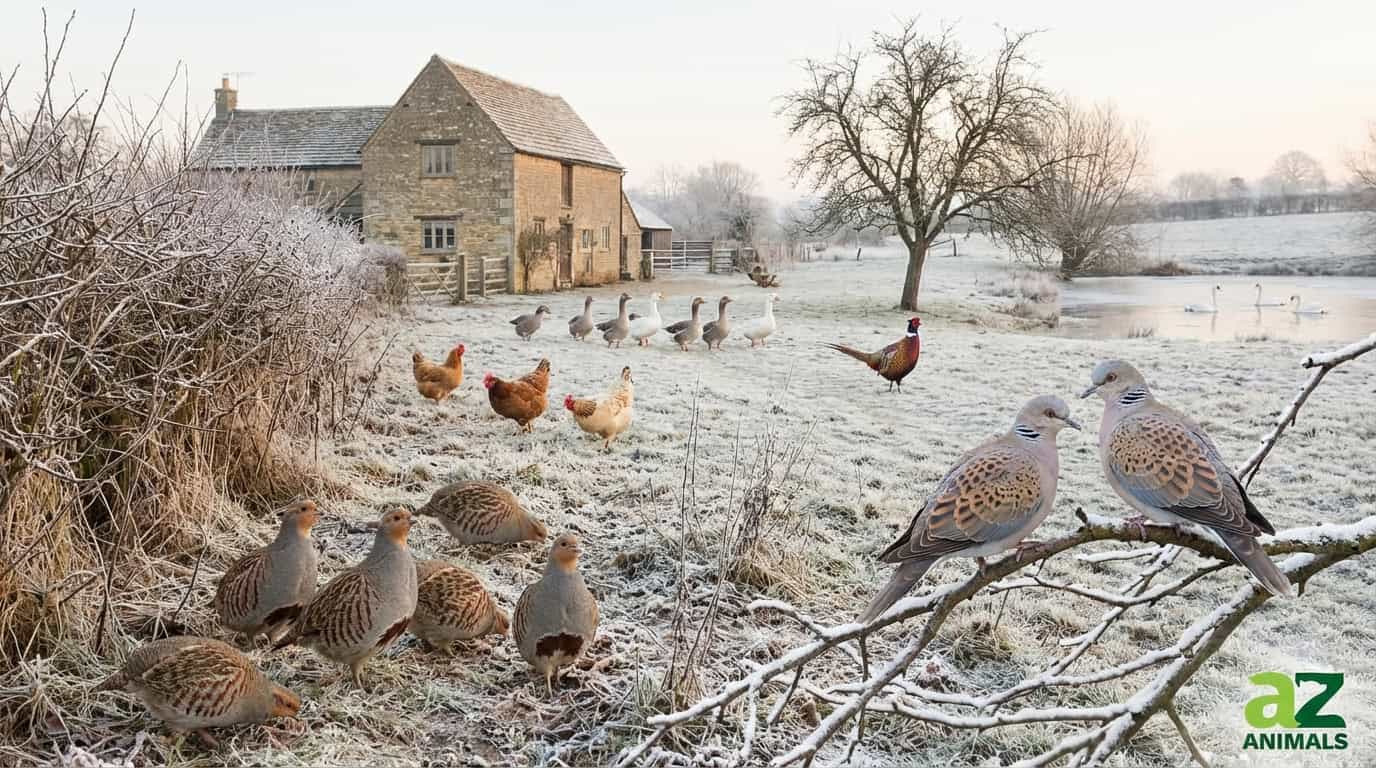

Quick Take
- The 12 Days of Christmas presents a real winter ecosystem of birds, farm animals, and people, tied to farming cycles and midwinter celebrations.
- The partridge in a pear tree is symbolic; real partridges live on the ground and would not perch in bare European pear trees in winter.
- In real life, the animals in the song would have serious conflicts with each other and burden the receiver with huge wildlife management problems.
The classic Christmas carol “The 12 Days of Christmas” sounds like a love song with a playful edge, but when read closely, it resembles a surprisingly busy inventory of animals and people. Over twelve verses, the singer’s “true love” delivers a growing assortment of birds, farm animals, and performers. Taken literally, these gifts would quickly overwhelm any household with feathers, hooves, noise, and movement.
Examining each gift as a real animal or working figure offers insight into historical European wildlife, rural life, and seasonal traditions tied to midwinter celebrations. Rather than fantasy alone, the song reflects a world shaped by farming cycles, migration patterns, and the social importance of food and music during the darkest time of the year.
Where Did The Song Originate?
“The Twelve Days of Christmas” is a traditional English holiday song first printed in 1780 in a children’s book called Mirth Without Mischief, though it likely existed earlier. It started as a party game where each singer had to remember all the previous verses, and if they forgot a line, they had to pay a forfeit, meaning a small, usually silly penalty like singing, telling a joke, or giving up a treat, which made the game loud, competitive, and fun. That memory-game setup explains why the gifts accumulate in such an exaggerated way, ranging from birds and rings to drummers and pipers. Over time, the game turned into a Christmas carol, with the familiar tune becoming standard in the early 1900s. The reason it has lasted so long is simple: it’s catchy, playful, and just ridiculous enough to match the joy and excesses of the Christmas season.
Partridge in a Pear Tree
The “partridge in a pear tree” is the song’s best-known image, though it stretches biological reality. European partridges such as the gray partridge (Perdix perdix) and the red-legged partridge (Alectoris rufa) are ground-dwelling gamebirds that spend most of their time walking through open fields and hedgerows. They nest on the ground and forage for seeds and insects rather than perching in trees.
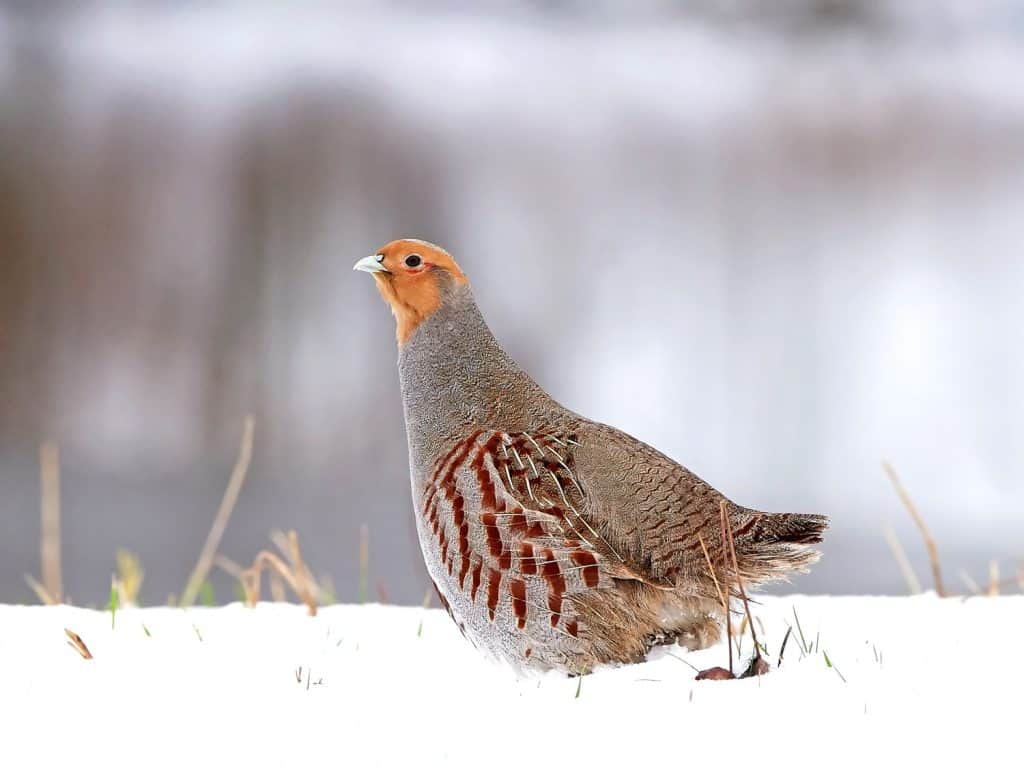
A partridge would likely not be found in a tree in winter, but rather on the ground.
©Dennis Jacobsen/Shutterstock.com
During winter, partridges gather in family groups called coveys that help them stay alert to predators and conserve warmth. While these birds can fly into low branches briefly if disturbed, a pear tree is not a natural resting place. In winter, pear trees in Europe would be bare, lacking leaves or fruit. The image works symbolically, pairing a familiar game bird with a cultivated tree associated with food security and comfort rather than depicting an accurate scene from nature.
Two Turtle Doves
Turtle doves are real birds, not a whimsical invention, and the species most often associated with the song is the European turtle dove (Streptopelia turtur). These slim, soft-colored birds breed across Europe and western Asia during warmer months. When winter approaches, they migrate long distances to the Mediterranean and Africa, meaning they would not be present in Britain during the Christmas season.
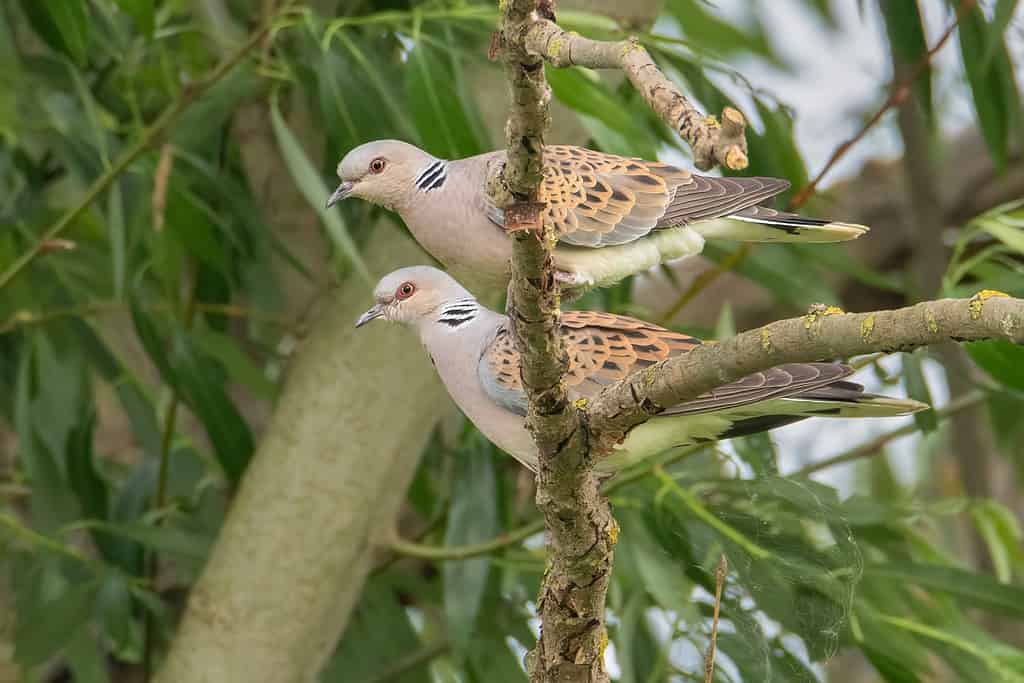
European turtle doves (Streptopelia turtur) typically migrate to the Mediterranean and Africa during the winter months.
©Catleesi/Shutterstock.com
Turtle doves favor open woodland edges, farmland, and hedgerows, where they feed mainly on seeds gathered from the ground. Their gentle vocalizations and tendency to form strong pair bonds have long made them symbols of devoted affection. Even though their seasonal movements make the timing unrealistic, a matched pair of turtle doves fits the song’s theme of loyalty and love better than almost any other animal mentioned.
Three French Hens
The line “three French hens” refers to domestic chickens rather than wild birds. Chickens descend from jungle fowl of Southeast Asia, but were widespread across Europe by the time the carol developed. People at that time especially valued French chicken breeds for egg production and meat quality, making them practical and valued farm animals. A healthy laying hen could produce a large number of eggs each year, providing a steady food source for rural households. During winter, people kept chickens close in barns or simple coops and fed them stored grain and kitchen scraps. Unlike the wild birds earlier in the song, hens are comfortable living near people and are central to everyday survival. As gifts, French hens represent reliability and nourishment rather than decoration or entertainment.
Four Calling Birds
The phrase “four calling birds” likely evolved from “four colly birds,” with colly meaning “black” in Old English. This would have referred to Eurasian blackbirds, a common species in Britain. Over time, the lyric shifted, allowing modern listeners to imagine calling birds more generally as songbirds.
In winter, many small birds gather in shrubs, orchards, and hedgerows. There, they feed on berries and seeds while vocalizing to maintain contact. Historically, blackbirds and thrushes were sometimes trapped for food as well as enjoyed for their songs. Unlike livestock, songbirds serve no direct agricultural function, but they contribute sound and movement to quiet winter landscapes.
Five Golden Rings
“Five golden rings” stands out as the only gift in the list that is not alive, if we understand them literally as jewelry. It’s more likely that, like the other gifts in the first seven days, these were inspired by birds as well. The Romans brought ring-necked pheasants to Britain and, after an interlude, they were reintroduced in the 1500s. By the 17th century, pheasants were common on estates and widely associated with hunting, feasting, and upper-class country life. Laws connected with land ownership and social class restricted who could hunt. Ordinary people usually could not legally obtain pheasant. This made it a symbol of wealth, status, and formal dining rather than everyday food.
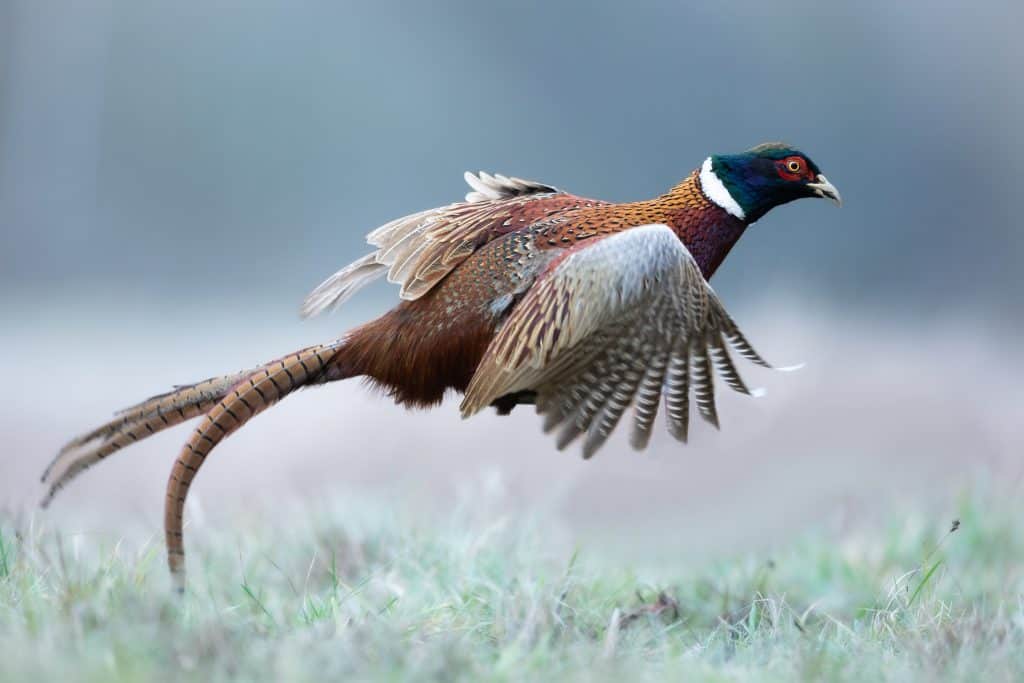
Might the ring-necked pheasant be the inspiration for the five golden rings in the song?
©Marcin Perkowski/Shutterstock.com
The bird’s ring-neck color is actually white. If real birds were intended, the idea of ‘golden rings’ is a fanciful twist, making the gift sound more special and more pleasing lyrically each time the fifth day comes around in the song. Most people today just think of literal golden rings, though, as all that historical context is a lot to weigh down a fun Christmas song.
Six Geese a-Laying
By the sixth day, “six geese a-laying” almost certainly describes domesticated geese descended from the wild greylag goose (Anser anser). Geese were common on European farms and valued for their meat, eggs, feathers, and alert behavior. Their loud calls made them useful for warning of intruders. Geese can live for many years and often form strong bonds within their flocks. Egg production usually slows in winter, so the emphasis on “a-laying” suggests an abundance beyond the norm. For a rural household, six productive geese would be an asset that provided food and usefulness well into the future. Among all the gifts in the song, these geese were probably the most practical and valuable gifts.
Seven Swans a-Swimming
“Seven swans a-swimming” evokes an image of wealth and control over nature. The mute swan (Cygnus olor) is the species most associated with this verse. These large white birds inhabit rivers, lakes, and wetlands across Europe. They form lifelong bonded pairs and defend their territory aggressively. So if someone owned seven of them, they would need access to six to eight acres of pond or slow-moving water. And it would need bends and coves so that they wouldn’t stress out seeing rivals all the time. That much water is the equivalent of a small lake the size of four to six football fields.
In the 17th century, swans were valuable, but not mainly as everyday food. In England, they were closely tied to wealth, status, and law. Swans were legally protected birds. Ownership was restricted to the Crown and certain nobles, colleges, and city guilds that were granted “swan rights.” While swan could be eaten at grand feasts, its bigger value was symbolic. Swans signaled prestige, authority, and control of land and waterways. So when swans show up in a song about piling gifts, they are less about dinner and more about displaying social power in bird form.
Human Figures in the Final Verses
After the seventh day, animals disappear from the song and are replaced by people performing specific roles. Milkmaids represent dairy work, which was essential for producing butter and cheese during winter. Ladies dancing and lords leaping point to formal aristocratic movement and social display. Pipers piping — likely meaning bagpipers in an early modern British context — and drummers drumming suggest loud, outdoor-style music brought indoors into a banqueting hall spacious and abundant enough to host them. In historical European winter festivals, labor and entertainment existed side by side. Food production supported survival, while music and dance sustained morale and social bonds. Together, these figures turn the household into a place of non-stop activity.
Would These Animals Thrive Together?
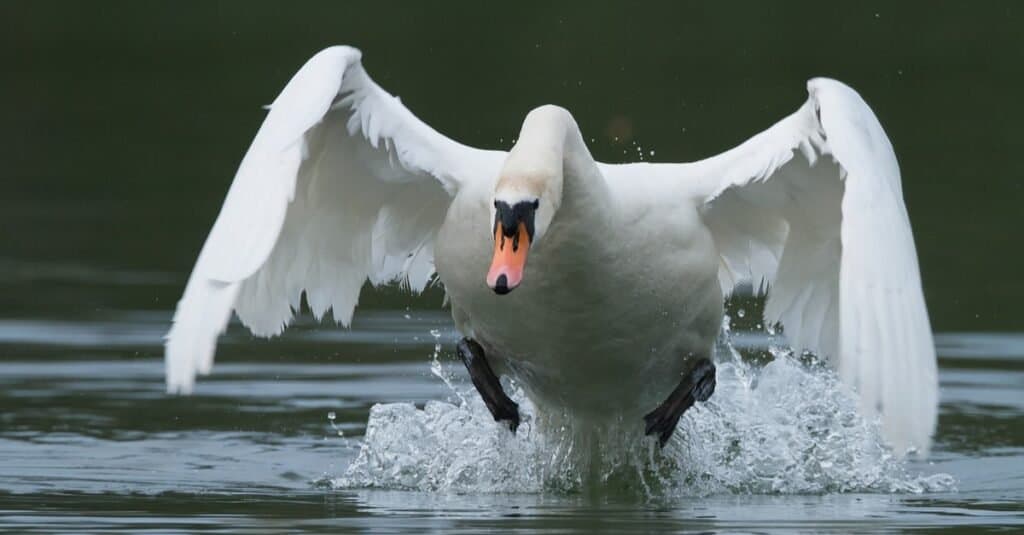
Swans can be dangerous birds if they feel threatened.
©Tone Trebar/Shutterstock.com
Taken at face value, the carol’s gifts would create serious animal management challenges. Partridges, turtle doves, blackbirds, and pheasants would all much prefer open landscapes and would suffer if kept in cages. Most of them would likely be eaten over the coming months to avoid the maintenance needs. Chickens and geese are the most practical gifts and could stay together in a chicken lot, but they would require feeding.
The swans would be a true “white elephant” gift, as there are seven of them — three pairs and one extra, which would likely be bullied by the others — and all would require a large body of water. They would not bring any real benefit besides status and decoration. At least, in the song, the gifts are spread over 12 days, so the disaster can be managed a little at a time. Maybe best solution is a bit of “regifting” to friends… or enemies!