
Quick Take
- 90% of humans are right-handed, yet our closest primate relatives show much less bias.
- Removing just two characteristics makes humans fit in with other primates, a finding that speaks to the origins of handedness.
- Ancient human ancestors weren't as right-handed as we are, but the fossil record pinpoints a turning point when that changed.
- Your dominant hand and your walking gait are connected in a way that only becomes clear when you look in the context of other primates.
If you’re a lefty and have ever felt excluded from the right-handed club as you write a letter, throw a ball, or wield a hammer, you’re not imagining it. About 90 percent of people worldwide favor their right hands, a trend that science has been hard-pressed to explain. Other primates are ambidextrous or, at most, mildly right-handed. Now, a study published in PLOS Biology finds that our handedness may reflect two major evolutionary shifts: walking upright on two legs and acquiring bigger brains.
“Compared with other primates, humans are exceptional in showing both strong individual hand preferences and a striking bias towards the same [right] side across individuals,” says lead study author Thomas Püschel, evolutionary anthropologist at the University of Oxford, in an email interview. “Our results suggest that this pattern is linked to the evolution of bipedalism and brain expansion, and likely due to the increasing importance of hemispheric specialisation in the human brain.”
Püschel and colleagues from Oxford University and the University of Reading tested several hypotheses that have attempted to explain the origins of our predominant right-handedness. They collated data on 2,025 individuals across 41 primate species, including humans, other great apes, and monkeys. They modeled trends in features that might relate to handedness, such as diet, habitat, tool use, social organization, locomotion, body mass, and brain size, and plotted them against evolutionary relatedness.
Why Humans Became Right-Handed
At first, humans stuck out as evolutionary outliers. But, after two features—brain size and upright walking (gauged by relative arm and leg length)—were removed from the models, humans fit in better with other primates. “By looking across many primate species, we can begin to understand which aspects of handedness are ancient and shared, and which are uniquely human,” explained Püschel in a press release.
In using their models to examine our extinct human ancestors, the researchers found that earlier ones like Australopithecus likely had a mild preference for their right hands, like great apes today. Once the genus Homo evolved, the right-hand preference strengthened in species like Homo ergaster, Homo erectus, and Neanderthal sp. Homo sapiens is the most right-hand-biased species known. Some other primates also show a lateral bias, but not as extreme. For example, arboreal monkeys that leap around in the trees favor one hand for support—either right or left—while the other is free for other activities.
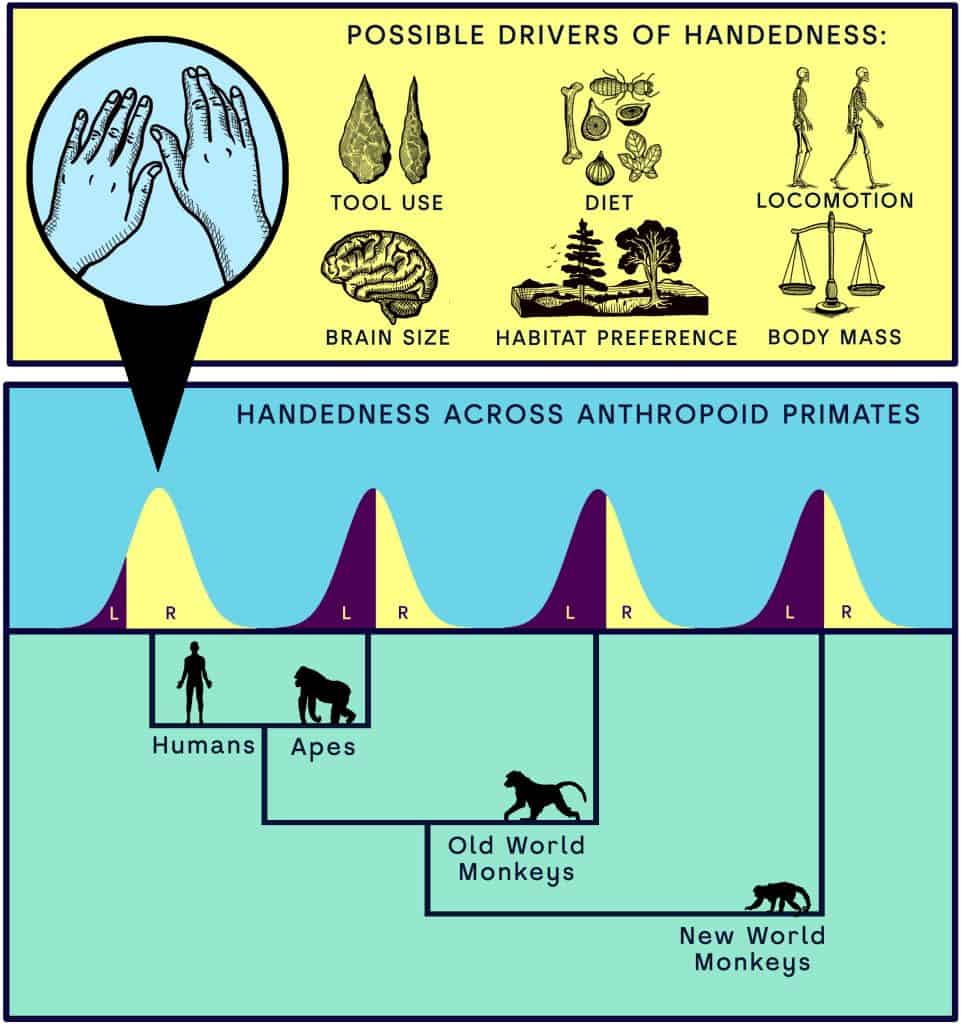
This study is the first to examine all the features proposed to explain why humans uniquely favor one hand over the other.
©Püschel, Hurwitz, & Venditti (2026), DOI: 10.1371/journal.pbio.3003771 – Original / License
“These results strongly support the hypothesis that human exceptionalism in handedness is likely due to strong, human-specific selective pressures,” wrote the study authors.
The shift toward stronger handedness may have evolved alongside bipedalism and increasing brain size. Human ancestors are thought to have made a transition from spending less time climbing in the trees to more time walking on the ground by 6-7 million years ago. A 2023 review study purports, for example, that Australopithecus afarensis was mostly bipedal but also spent some time in the trees, a transitional lifestyle to full bipedalism.
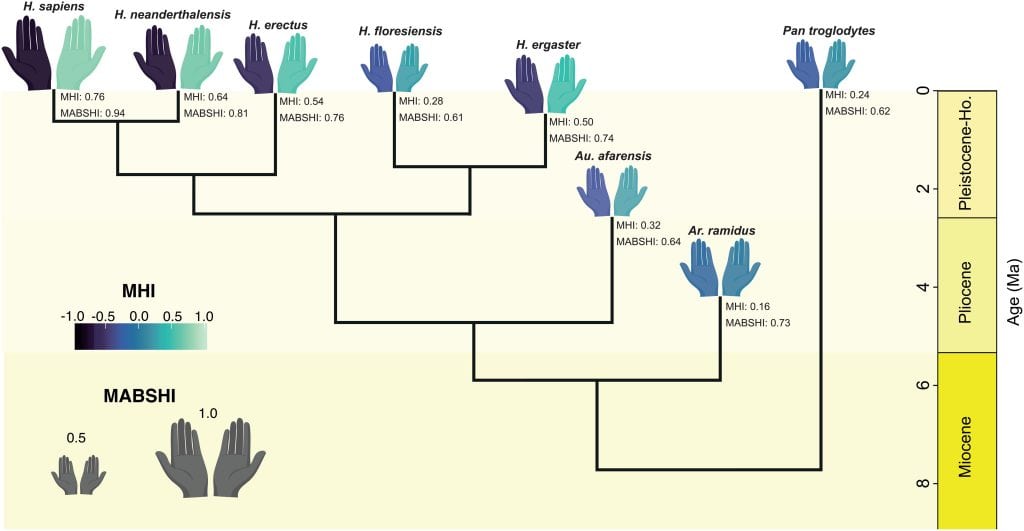
See Homo sapiens at top left in this hominin family tree; darker hand color indicates more bias toward that hand. Compare to chimpanzees (Pan troglodytes) at top right.
©Püschel, Hurwitz, & Venditti (2026), DOI: 10.1371/journal.pbio.3003771 – Original / License
One of the earliest known species on the human lineage is the “Southern ape from Africa,” Sahelanthropus tchadensis. A recent study in Science Advances concluded, based on the skeletal anatomy, that it walked on two legs. For example, features of its skull and femur suggest adaptations for upright walking, such as a bony bump on its leg bone (femoral tubercle) that in humans provides a place for the ligament to attach for upright walking, though its pelvis and knee bones have not been found.
When an animal walks on all fours, its hands are mostly used in locomotion, with limited availability for other things. But once humans adopted an upright bipedal stance, their hands were freed to hold babies or food or tools, which likely drove natural selection in favor of one side over the other. Initially, actions such as throwing rocks and swinging clubs may have provided key advantages, according to a 2003 study. Over time, our hands, with their unique opposable thumbs, became capable of wielding a wide variety of objects.
“This is also likely connected to the high level of manual dexterity seen in humans,” says Püschel. “In our view, this strong population-level bias is consistent with selection acting on the establishment of directionality itself, rather than necessarily on right-handedness specifically.” So, the bias could have developed toward either the right or left hand, but regardless of direction, lateralization supported our unique human ability to skillfully manipulate tools.
How Bigger Brains Reinforced Handedness
As the lateralized use of hands evolved, our brains were simultaneously growing and reorganizing to accommodate it. The basis of handedness is known to be rooted in specialized regions of our brains and linked to our asymmetrical right-left brain functions. As we began walking upright and using our hands, our brains adapted neurologically to become more left-right specialized.
“The brain and body do not develop as perfectly symmetrical systems. Instead, small early asymmetries in neural organisation, motor control, posture, and sensorimotor experience can become progressively stabilized as the child develops,” explains Püschel. More specialized brains made for higher efficiency in guiding the use of our hands. “Over time, these early biases may be reinforced through repeated action, practice, and the increasing specialisation of each hemisphere for different tasks.”

Our upright walking and larger brains set us on a unique evolutionary path relative to other primates.
©CJW Evans/Shutterstock.com
So, one of humanity’s most ordinary traits—which hand we favor for daily activities—may trace back to the moment our ancestors smartly freed their hands by walking upright.