
Quick Take
- For decades, experts and the general public believed that shark attacks on humans were a case of mistaken identity.
- Some researchers suggest that this may not always be the case, and that some shark bites are simply sharks exploring their natural environment.
- All can agree, though, that shark attacks on humans are not because sharks view people as prey.
When a surfer is bitten by a shark, especially in surfing hotspots in the U.S. and Australia, the story often goes viral. After all, movies like Jaws leaned hard into the idea that big sharks have it out for humans. So, when an attack happens, it seems like proof that these pelagic apex predators do indeed have it out for us.
But do sharks actively look for humans to bite? Experts all agree that is doubtful. There is no scientific evidence that any shark species proactively hunts humans, no matter what Jaws would have you believe.
However, not all experts agree on why sharks attack surfers and swimmers. While the “mistaken identity” theory has long been accepted by many researchers and the general public, some experts propose alternative explanations for why sharks attack humans.
How Sharks Hunt
Sharks have several unique strategies to hunt and find prey. One is electroreception. Sharks use specialized organs called the ampullae of Lorenzini—small, jelly-filled pores clustered around the shark’s snout and head. These pores are connected to sensory cells that can pick up electrical signals in the water, such as those emitted by every living creature through muscle movement, heartbeat, and nerve activity. Sharks can sense this from several feet away, which is why they can find prey even in murky water.
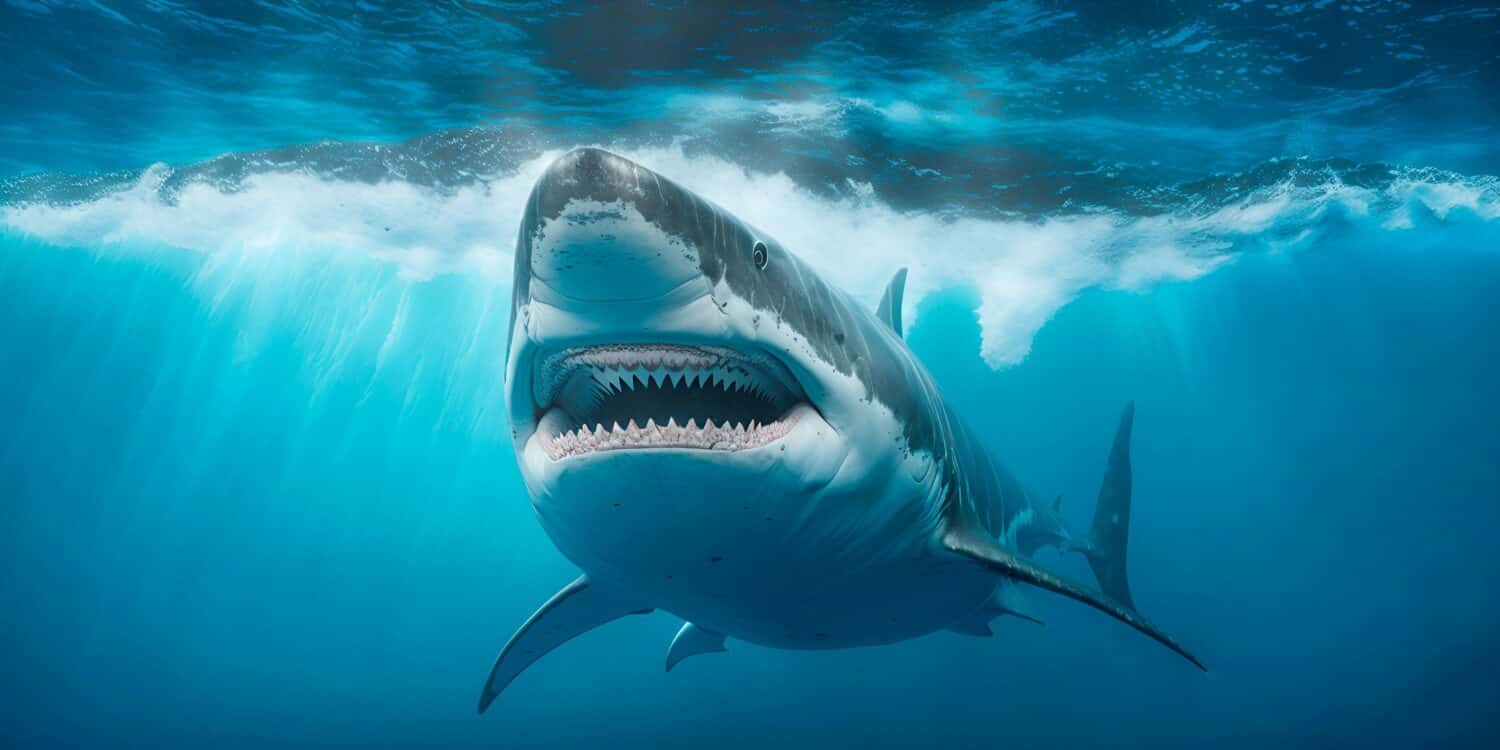
Sharks have clusters of pores around their head and snout that transmit electrical signals in the water to sensory cells, alerting a shark to another living thing nearby.
©LuckyStep/Shutterstock.com
Another is the lateral line. This is a sensory system found in fish and aquatic amphibians that helps them detect vibration, movement, and pressure changes in the water. The lateral line runs along both sides of a fish’s body and contains clusters of neuromasts – sensory cells with hair-like tentacles called cilia. The cilia are displaced when the water moves or vibrates nearby. It’s the physical equivalent of electroreception.
Sharks use both electroreception and their lateral line, along with sight, to detect prey. That’s why erratic splashing by surfers and swimmers catches a shark’s attention. It’s also why some researchers don’t believe “mistaken identity” is the cause of shark attacks on people.
Why Do Sharks Attack People?
The “mistaken identity” idea is rooted in the belief that sharks confuse surfers with sharks’ natural prey – seals. The theory was first introduced in 1974 by a researcher named H. David Baldridge, in his book Shark Attack. In it, he noted that some shark attacks may have resulted from mistaken identity, with black-suited divers resembling seals.
The theory was reinforced in a 2021 study that compared video footage of humans swimming, humans paddling surfboards, and pinnipeds at the surface. The video was shot from below to mimic the perspective of a great white shark eyeing up potential prey at the surface. The study found that the movements of all three groups looked fairly similar. It noted that white sharks are probably colorblind and have poorer eyesight than humans, which supported the idea of mistaken identity.

The mistaken identity theory believes that sharks mistake surfers for seals because they look similar from below.
©Wirestock/ via Getty Images
But some scientists take a different view. In a newer study, researchers point out that over 75 percent of shark-surfer altercations resulted in only superficial or moderate injuries. These injuries were not significant enough to incapacitate a seal, calling into question the theory that sharks mistake surfers for seals before an attack.
The researchers also don’t believe sharks make mistakes. After all, sharks are believed to have excellent eyesight, plus several other natural systems that help them detect prey.
Instead, the authors of that study believe shark-surfer interactions are simply examples of sharks engaging in “natural exploration” of their habitats. Sharks are constantly exploring their environments and checking out new objects to determine if they are potential prey. Since sharks don’t have hands, their mouths are the only way to learn more about an unfamiliar object in the water.

The natural exploration theory believes sharks use their mouths to identify and learn about foreign objects in their aquatic environment.
©Vincent Legrand/Shutterstock.com
This “natural exploration” theory is supported by first-person accounts of survivors of shark attacks – at least for attacks in deeper water. Survivor accounts suggest that sharks may simply have been investigating what they considered to be foreign objects in the water.
Also, attacks on humans in deeper water don’t mimic how sharks naturally hunt for seals. When a shark has a seal in its sights, the shark attacks at high velocity from below, usually tossing the seal high into the air before catching it in the shark’s mouth. In contrast, sharks attacking surfers often happen with little drama at all. One surfer even noted that he didn’t know there was a shark nearby until he saw it nibbling on the surfboard.
Another piece of evidence that supports the “natural exploration” theory is that even when a shark fatally bites a human, the shark usually loses interest after that. The shark simply departs after a few bites, uninterested in devouring its human prey.
Are All Shark Attacks the Same?
When a shark attacks, the human victim is likely not considering what type of attack it is. However, sharks have three different approaches when attacking what they perceive as prey, and the type of attack matters, as some are more deadly than others.
Hit-and-Run
This is the most common type of shark attack and also the least dangerous, according to the Florida Museum’s International Shark Attack File. These attacks typically happen in the surf zone, the area between the shoreline and breaking waves. This is where water visibility is low, making it difficult for the shark to identify its victim.
In these attacks, the shark often inflicts a single bite or slash wound, then disappears. These are the kind of attacks that scientists believe are most often a case of mistaken identity.

In the surf zone, visibility is low for both humans and sharks.
©Jose Luis Stephens/Shutterstock.com
Bump-and-Bite
These are more targeted attacks in which a shark identifies potential prey, then circles the victim and often bumps them before biting. Great white sharks often do this, and scientists call the first bite a “test bite.” The shark is trying to identify what it is hunting.
These attacks often happen in deeper water. They also result in more serious injuries. These types of attacks are more closely related to the natural exploration theory.
Sneak Attacks
This is the type of attack that inspired the original movie Jaws. In these cases, the victim rarely sees the shark before it strikes. The shark is in full predator mode and appears intent on consuming its victim, similar to how it attacks a seal. This is the rarest type of shark attack on humans.
It helps to put these kinds of attacks in context. Preliminary 2025 data on documented shark attacks worldwide noted that there were only nine fatal unprovoked shark attacks on humans. Of these, it is hard to distinguish whether the attack was a bump-and-bite or sneak attack. Even if all were sneak attacks (and the data does not suggest that either way), that would still be fewer than ten in an entire year.
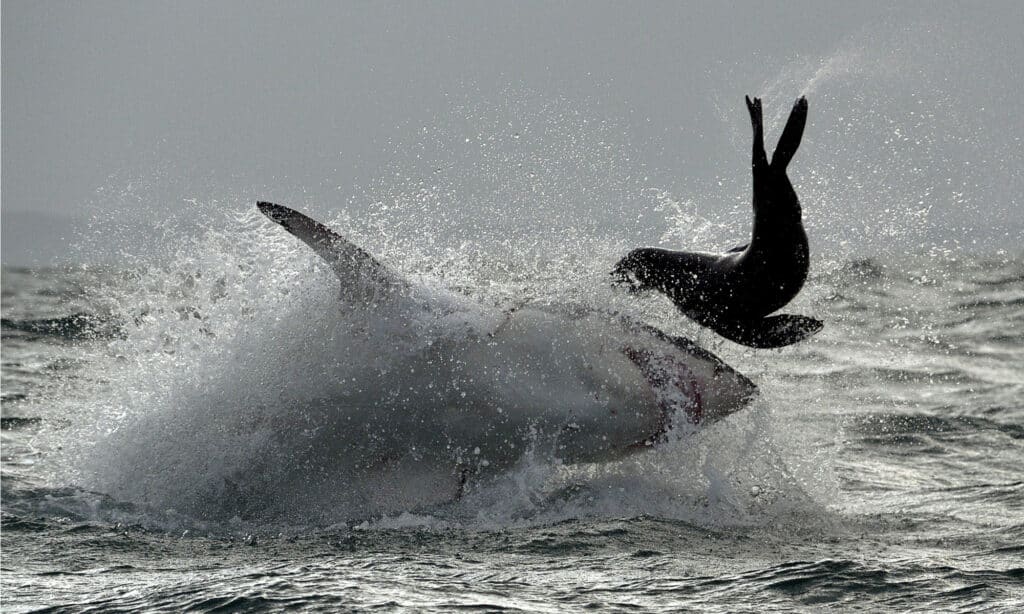
A great white shark breaches during an attack on a seal.
©Sergey Uryadnikov/Shutterstock.com
Sneak attacks can happen anywhere, but most often occur in the open ocean or in deeper water near steep drop-offs. The common thread is that these attacks often occur in places where larger sharks, like great whites, tiger sharks, and bull sharks, are already congregating to hunt for their natural prey.
How At Risk Are Surfers and Swimmers?
Despite what Hollywood wants you to believe, humans are not a preferred shark prey. Data from Stanford University found that surfers, while being the highest-risk group for shark attacks, have a one in 17 million chance of being bitten by a great white shark in California.
Why are surfers the highest-risk group? They spend more time in the water than most other people, often in deeper areas where sharks gather to feed, and from below, surfers paddling on their boards may resemble seals.
Whether you’re a surfer or a swimmer, taking a few precautions could help you avoid a shark interaction altogether.
- Avoid wearing shiny rings or jewelry that may flash underwater
- Avoid high-risk locations like deep channels, steep underwater drop-offs, and river mouths
- Avoid the water at dawn, dusk, and at night, as all are prime feeding times for sharks.
- Minimize erratic splashing
- Surf and swim with others
- Stay aware at all times