Quick Take
- Flying fish escape predators by leaping into the air, yet the sky holds its own dangers they never anticipated. See how fish escape into danger →
- A pelican's bill looks awkward, but there's a hidden anatomical secret that makes it one of nature's most effective traps. Explore the gular pouch anatomy →
- Great white pelicans almost never hunt this way, which makes what this one did all the more remarkable. Discover why this catch is rare →
- Slow-motion footage reveals something about this catch that you'd completely miss at normal speed. Watch the slow-motion catch →
Flying fish have an extraordinary way of escaping danger beneath the ocean’s surface. They can launch themselves out of the water and glide through the air, temporarily leaving hungry predators behind. But one flying fish off the coast of Namibia discovers that the skies aren’t necessarily any safer. In remarkable slow-motion footage, a great white pelican opens its enormous bill just as the fish approaches, turning what looks like an impossible catch into a surprisingly effective meal.
The most fascinating part isn’t simply that the pelican catches a fish in midair. It’s the way the bird’s enormous, flexible throat pouch expands to help capture its prey. Watch closely, because this brief encounter reveals just how unusual a pelican’s feeding adaptations really are.
Watch the Pelican Make an Incredible Midair Catch
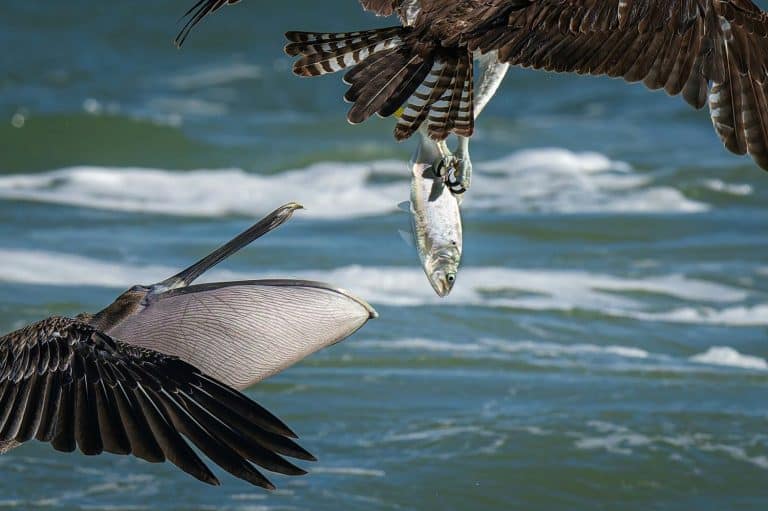
Filmed off the coast of Namibia, the footage captures a remarkable encounter between a pelican and a fish that has left the water. As the fish travels through the air, the bird opens its massive bill and positions itself to intercept the unexpected opportunity.
In slow motion, the pelican’s throat pouch appears to billow outward as the bird tilts its head and opens its jaws. The fish moves directly into the open bill, where the pelican’s specialized feeding anatomy helps secure the catch.
It’s an unusual sight because pelicans normally capture fish in the water rather than plucking them from the air. But their extraordinary bills are remarkably well suited to scooping up moving prey, whether that prey is beneath the surface or briefly airborne.
Why Does This Pelican’s Bill Open Like a Giant Bucket?
The secret lies in a specialized structure called the gular pouch. This large, expandable membrane of skin stretches between the lower portions of a pelican’s bill, creating a flexible scoop that can hold fish and substantial amounts of water.
Unlike a rigid beak, the lower jaw of a pelican can spread apart, allowing the pouch to expand dramatically. When the bird catches a fish, it normally raises its head and drains excess water before swallowing its prey whole.
According to the Smithsonian Ocean, pelicans use their expandable pouches as specialized fishing tools. The pouch isn’t intended for storing meals over long periods. Instead, it helps the bird capture and handle fish before swallowing them.
In this encounter, the slow-motion footage makes the pouch’s extraordinary flexibility especially apparent. Although the bird’s bill seems almost impossibly large when fully opened, that flexibility is an important part of what makes pelicans such effective fish hunters.
Is Catching Fish in Midair Normal for Great White Pelicans?

Great white pelicans usually catch fish in the water, using their expandable throat pouches to scoop up prey.
©meunierd/Shutterstock.com
Great white pelicans typically use a very different hunting strategy. Rather than pursuing flying fish through the air, they usually swim along the surface of lakes, wetlands, estuaries, and coastal waters, scooping fish into their bills.
These birds are also known for cooperative hunting. Groups of pelicans sometimes move together in a line or curved formation, driving schools of fish toward shallow water where they become easier to capture. Once the fish are concentrated, the birds dip their bills beneath the surface and scoop them up.
The species is found across parts of Africa, Europe, and Asia, although populations differ in their seasonal movements and breeding habits. In Namibia, great white pelicans frequent coastal waters, sheltered bays, and inland wetlands.
Unlike brown pelicans, which are famous for spectacular headfirst dives into the ocean, great white pelicans are primarily surface feeders. That makes the airborne catch shown in this footage particularly memorable. It demonstrates how a familiar feeding adaptation can prove useful in an unexpected situation.
What Does This Remarkable Catch Tell Us About Pelicans?
Pelicans have evolved one of the most recognizable feeding structures in the bird world. Their enormous bills might look awkward, but the combination of a flexible lower jaw and an expandable throat pouch allows them to capture fish with remarkable efficiency.
These adaptations are especially valuable in coastal ecosystems such as Namibia’s, where changing water conditions, fish availability, and competition among seabirds can influence feeding opportunities.
Great white pelicans are currently classified as Least Concern globally, but that doesn’t mean every regional population is thriving. Namibia’s conservation assessments have identified concerns involving changing water levels, pollution, disturbance, and the limited number of important breeding sites.
For the flying fish in this encounter, leaving the ocean may have seemed like a way to avoid danger. Instead, it encountered a bird whose extraordinary bill was perfectly capable of taking advantage of the situation.
And that’s what makes this brief moment so fascinating. A pelican’s enormous pouch isn’t just an unusual feature. It’s a highly specialized feeding tool, and as this footage demonstrates, its usefulness isn’t always limited to catching fish underwater.