
Quick Take
- Two eagles locking talons and plummeting toward the ground looks terrifying, though it might not mean what you think. Watch the talon lock →
- Bald eagles steal food in mid-air from other birds and sometimes from people, using one surprisingly bold technique. See the food-stealing tactics →
- Despite being a symbol of American strength, bald eagles have a feeding habit that most people would call lazy or even cowardly. Discover their lazy feeding habit →
- Six bald eagles were once observed doing something in mid-air that had nothing to do with hunting or fighting. See the six-eagle behavior →
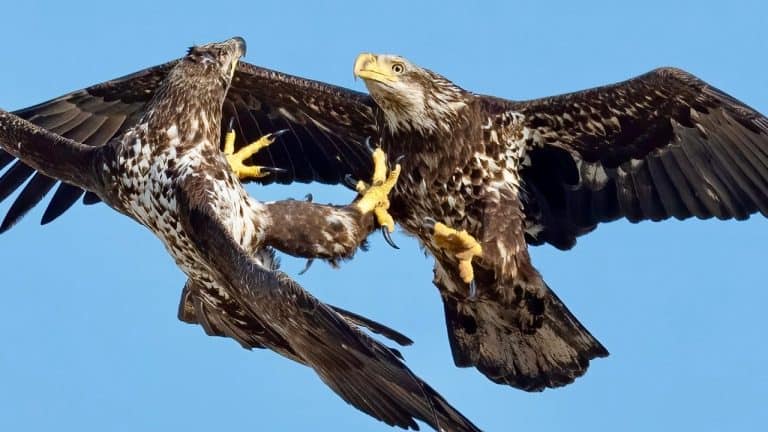
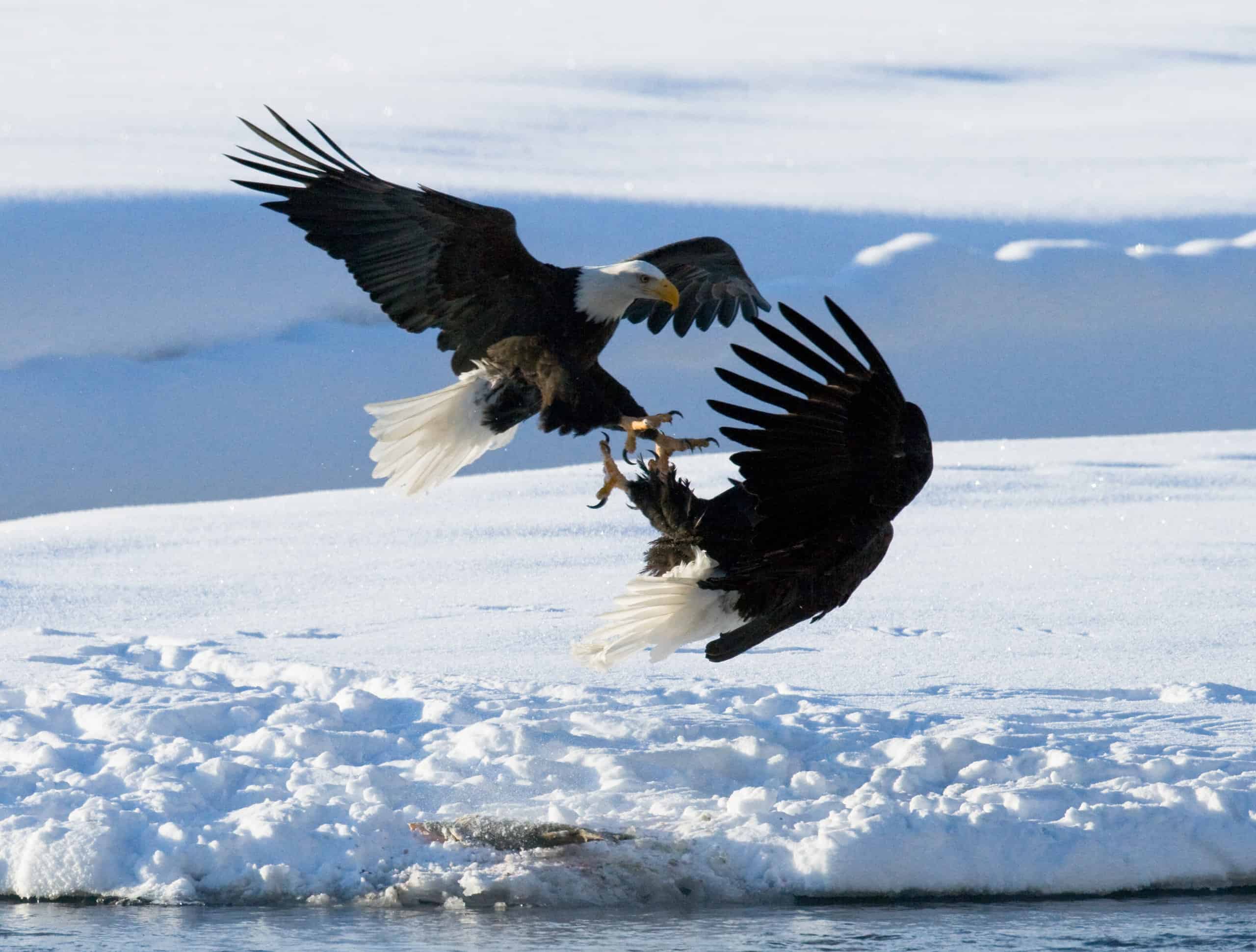
Two bald eagles meet in the air, grab one another by the talons, and begin spiraling toward the ground. For several seconds, neither bird appears particularly interested in the increasingly urgent matter of not crashing. Then they release, spread their wings, and pull out of the fall before disappearing from view.
The plunge resembles the species’ famous cartwheel display, a courtship maneuver in which a male and female lock talons and tumble together. There is one complication: birds of prey also grab one another during serious disputes. The uploader describes this encounter as a fight, but the footage alone leaves us with a much better question. Are we watching bald eagle romance, or an argument with a terrifying amount of altitude?
Watch the Bald Eagles Lock Talons in Midair
Are These Bald Eagles Mating or Fighting?
The honest answer is that we cannot tell with confidence from this clip. The birds clearly make sustained contact, rotate around one another, and release before reaching the ground. Those movements fit a courtship cartwheel, but a territorial clash can also send two eagles tumbling while their talons remain locked. The video does not identify the location, date, sex of either bird, relationship between them, or behavior immediately before and after the plunge.
Context would do most of the detective work. A bonded pair flying together and repeating coordinated aerial displays near a nesting territory would make courtship more likely. A chase, an intrusion near an occupied nest, defensive calls, or repeated attempts by one bird to drive the other away would point toward aggression. Without those clues, calling it a definite mating ritual or definite battle would be more confident than the evidence allows.
This is not merely an internet disclaimer. The National Eagle Center has addressed similar footage and identified the same two possibilities: a cartwheel display or a territorial fight. Even specialists cannot interview the eagles afterward, which feels inconsiderate of the birds but leaves the rest of us working from behavior.
What Is the Bald Eagle Cartwheel Display?
During the best-known version of the display, a male and female climb high, clasp talons, and descend while spinning around a shared center. The Cornell Lab of Ornithology describes the pair breaking apart at the last moment to avoid striking the ground. Bald eagles perform other aerial courtship behaviors as well, including pursuit flights and dives, so the talon-locking cartwheel is the dramatic highlight rather than the entire process.
It is often described as a test or demonstration of strength and flying ability, although scientists should be cautious about assigning a precise message to every spiral. What is observable is demanding enough: both birds must keep their wings controlled while rotating, falling, and maintaining contact with another large raptor. They also need to release with enough height left to regain stable flight. Subtle it is not.
Can Bald Eagles Crash During a Talon Lock?
They can. Most cartwheel displays end with the birds separating safely, but eagles do not receive immunity from physics simply because the maneuver is natural. Documented encounters have ended with birds striking the ground, trees, or other surfaces. In one 2023 Minnesota incident, two bald eagles fell onto an asphalt lot while locked together; one flew away, while the other required treatment for a wing injury.
A genuine fight may add another problem: the birds may be focused on overpowering each other rather than coordinating a release. The grip itself is not evidence that either eagle is trapped permanently, but the shrinking distance to the ground makes every additional rotation more consequential. In this clip, both birds separate in time. That is the only ending the camera confirms.
When Do Bald Eagles Perform Courtship Displays?
There is no single nationwide bald eagle dating season. Timing changes with latitude and climate. The U.S. Fish and Wildlife Service reports that bald eagles across much of their range breed from early spring into summer, while birds in warmer states such as Florida and Louisiana nest during winter. Pair bonding and nest work begin before eggs are laid, and established pairs may return to the same territory year after year.
Northern eagles may migrate south or move toward open water when lakes and rivers freeze. Many adults farther south remain closer to their territories. Food availability, age, weather, and breeding location all influence those movements, so a calendar date would help interpret the video—but it still would not settle the courtship-versus-conflict question by itself.
Where Do Bald Eagles Live?
Bald eagles occur across much of North America, from Alaska and Canada through the contiguous United States and into northern Mexico. They are strongly associated with coasts, rivers, lakes, reservoirs, and marshes because those habitats provide food and open flight paths. Nesting pairs typically choose large trees or other sites with sturdy support and a clear view, although the species is increasingly nesting in farmland, suburbs, and other landscapes farther from major water.
Reliable meals can bring eagles remarkably close to human activity. They gather below dams where fish concentrate, around coastal processing facilities, and at dumps or carcasses. They also form communal winter roosts even though breeding pairs defend territories. “Solitary eagle” and “hundreds of eagles in one place” can both be accurate descriptions; the season and food supply decide which version shows up.
What Do Bald Eagles Eat?
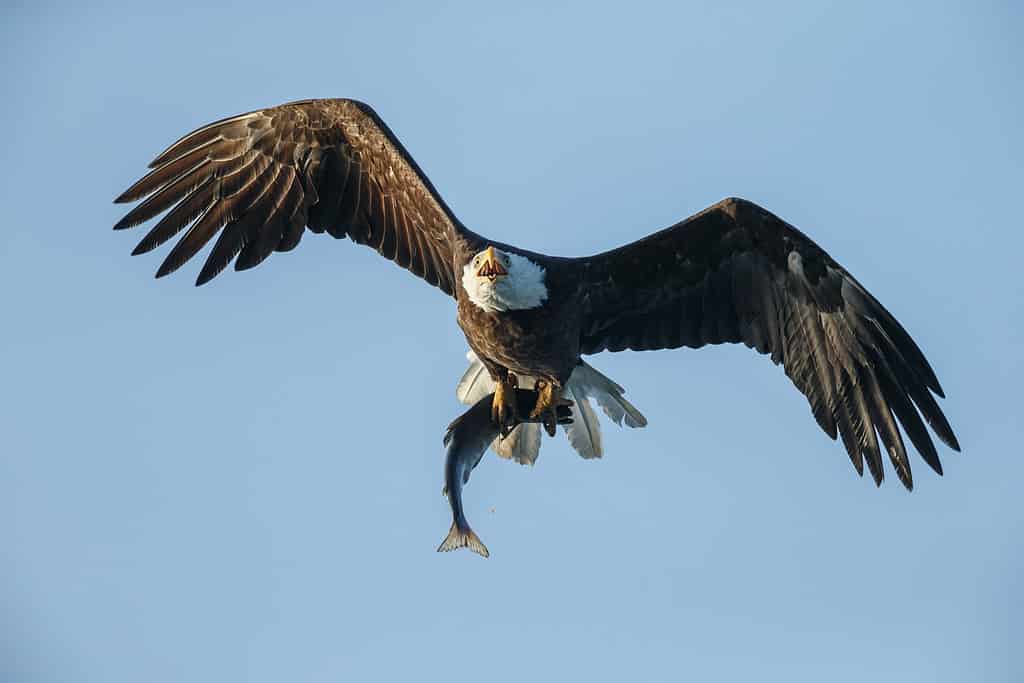
Fish are a major part of the bald eagle’s diet, but these opportunistic raptors eat whatever is locally available.
©iStock.com/Schaef1
Bald eagles are opportunists, with fish forming a major part of the diet in many regions. Depending on what is available, they may take salmon, herring, shad, catfish, and numerous other species. They also eat waterfowl, shorebirds, turtles, snakes, small mammals such as rabbits, and carrion. The national bird is majestic, but it has never been burdened by culinary snobbery.
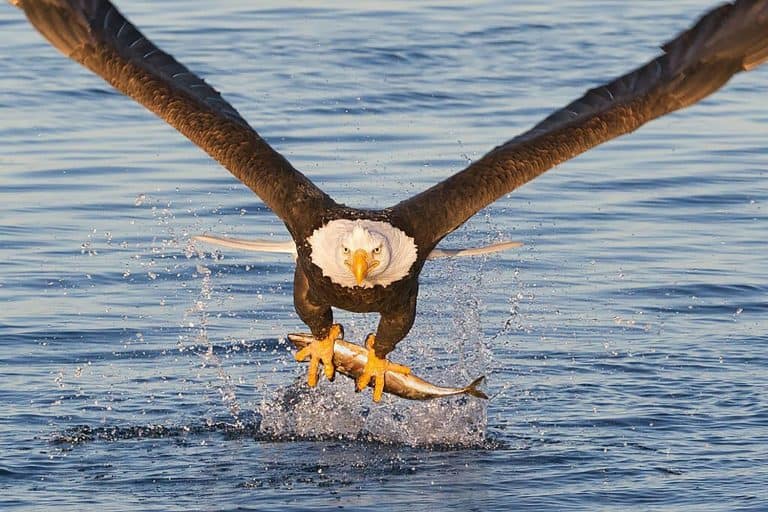
It is also an accomplished food thief. A bald eagle may chase an osprey until the smaller raptor drops its catch, then grab the fish in midair. Cornell has documented eagles taking fish directly from osprey talons and even stealing fish from people. That behavior is called kleptoparasitism, which is the scientific way of saying someone else did the fishing.
Bald eagles occasionally hunt cooperatively, with one bird flushing prey toward another. They have also been observed playing with objects, including a report of six eagles passing sticks in the air. That range of behavior is worth remembering when interpreting a few seconds of video. Eagles court, fight, hunt, steal, cooperate, and apparently mess around. In this case, we know they locked talons and escaped the plunge. Romance or rivalry remains their business.
When Did the Bald Eagle Become America’s National Bird?
The bald eagle has appeared on the Great Seal of the United States since 1782 and served as the country’s national emblem for more than two centuries. Oddly enough, federal law did not formally call it the national bird until much later. Public Law 118-206, enacted on December 23, 2024, added that designation to Title 36 of the U.S. Code.
Eagles also hold longstanding spiritual and cultural importance for many Indigenous peoples and Tribal communities, a history that predates the United States. The modern population is a conservation success story: habitat protection, restrictions on harmful pesticides, and legal safeguards helped bald eagles recover enough to leave the federal endangered and threatened species list in 2007. They remain protected by the Bald and Golden Eagle Protection Act and the Migratory Bird Treaty Act—so admire aerial drama from a distance and let the professionals handle any eagle that reaches the ground badly.