
Coconut tree. Palm tree. You’ve said it. I’ve said it. And, technically, we have been incorrect to refer to these tree-like plants as trees because, well, they aren’t trees. While they appear tree-like, mainly because palms appear to have a tree trunk, palms have vastly different vascular systems from trees. Palms are a type of flowering plant called monocots. Trees are dicots. The biggest difference seems to be between trees and palms, not between coconut palms and palms, although there is plenty to differentiate the two. Let’s explore what distinguishes coconut palms from palms.
Comparing Coconut Palms and Palms

| Coconut Palm | Palm | |
|---|---|---|
| Plant Classification | Cocos nucifera, part of the Arecaceae family but the only living species of the genus Cocos | More than 180 genera under the Arecaceae family |
| Description | Grows up to 100 feet tall with leaves up to 18 feet in length. Leaves are wide and grow diagonally from each other. The trunks are smooth and light in color, and large clusters of coconuts grow at the top of the tree | Averages anywhere from 30 to 200 feet tall, depending on the variety. Leaves also vary in length, but they grow as narrow fans more often than not. Trunks are rough to the touch, frequently dark tan in appearance. Some palms sprout faux trunks in clusters, while others have a more traditional tree-like appearance |
| Uses | An abundance of uses including culinary ones (coconut oil, milk, water). The entire plant is used to make tools, charcoal, fibers, and countless other things | Many uses and among one of the top utilized plants in the world based on the number of varieties. Fibers, wood, and fruit are used, and palm oil is a popular product in a culinary capacity |
| Origin and Growing Preferences | Originated in the Indo-Pacific region of the planet; prefers sandy soil, full sun, plenty of humidity and rainfall, and warm temperatures, as cold will kill it | Originated in South America and the Caribbean; prefers subtropical climates and plenty of humidity. Some varieties can handle more cold than others |
| Presence of Fruit | Yes, large, hairy coconuts | Sometimes, often small. Dates are common |
Key Differences Between Coconut Palms and Palms
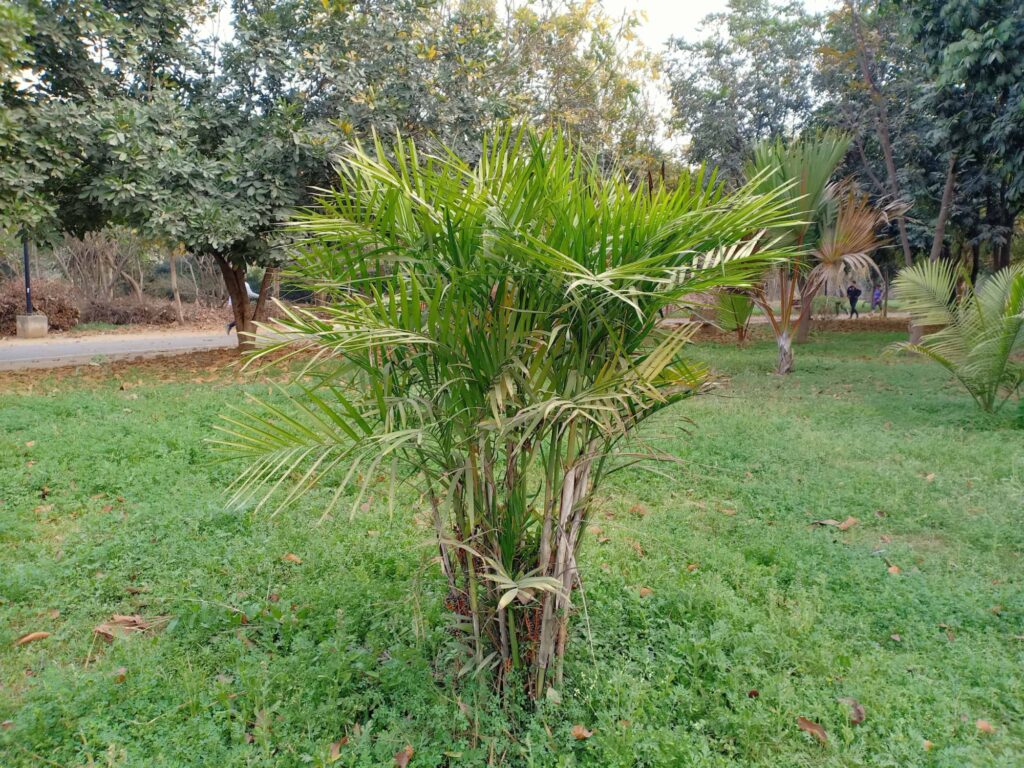
All coconut palms are palms, but the reverse is not true. This palm merely shares the same family as the coconut palm.
©Vipul1989/Shutterstock.com
Both the coconut palm and the palm belong to the Arecaceae (or Palmae) family, and under that family are more than 180 genera. The coconut palm, Cocos nucifera, is one of the 180-plus and the only living species of the Cocos genus. The term palm encompasses the approximately 2,600 known species and varieties of the Arecaceae family.
Given the diversity in the family, there are quite a few differences, primarily in their overall appearance, their uses, and where they live and flourish. Let’s dig in!
Coconut Palm vs. Palm: Description
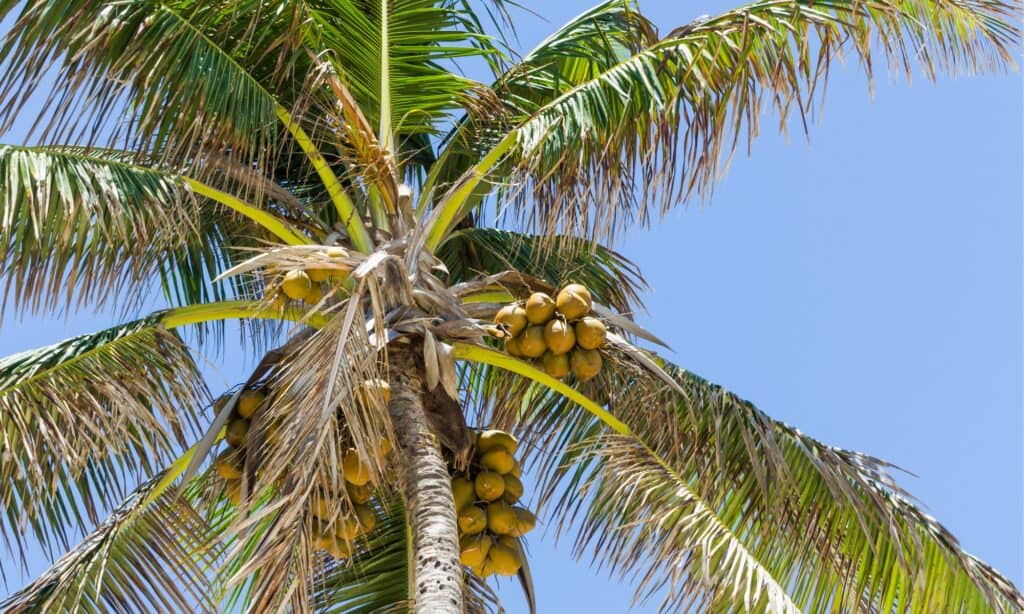
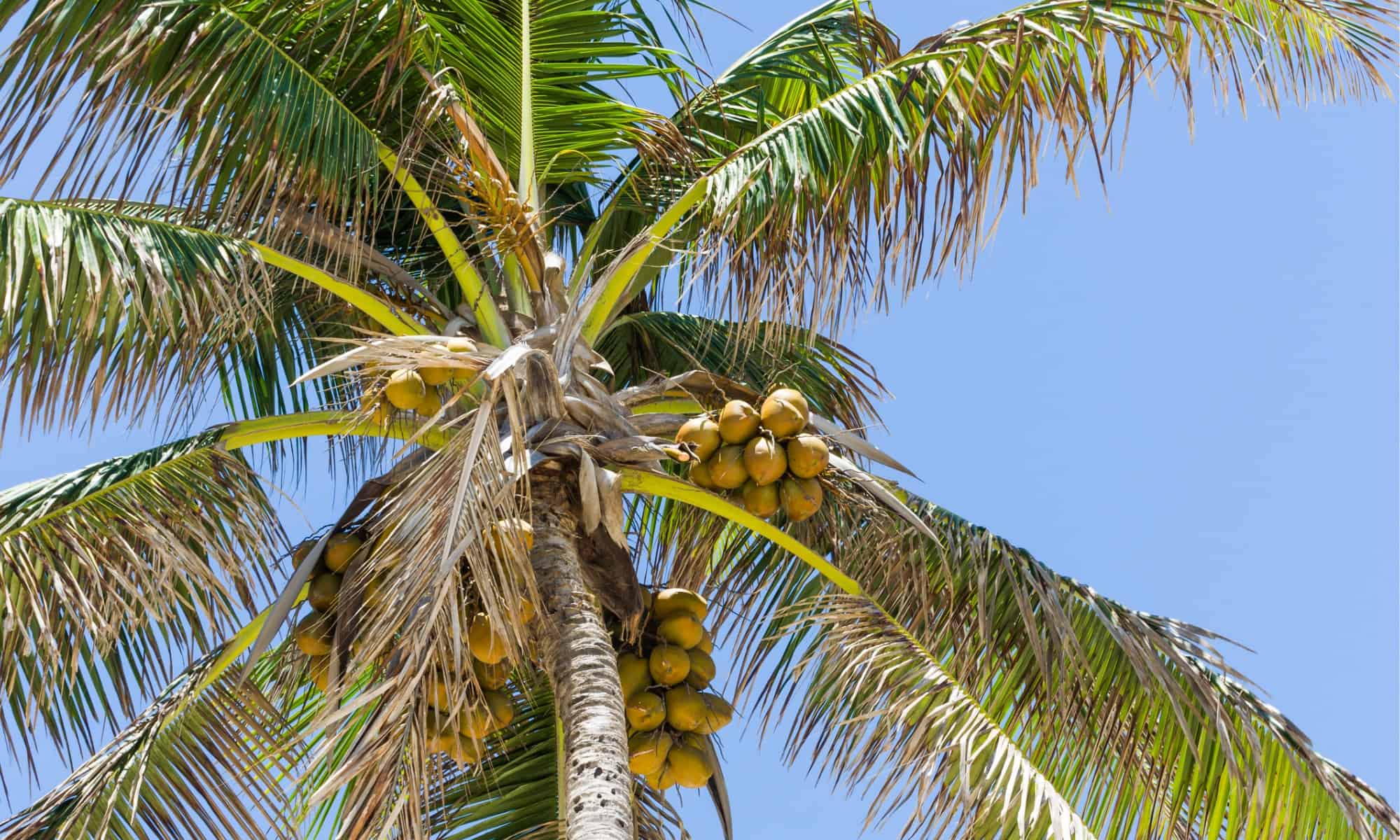
The leaves found on coconut trees are wider compared to the fanned-leaf appearance of many species and varieties of palms.
©iStock.com/Thiago Santos
The quickest and easiest way to identify a coconut palm is by its fruit. Bunches of coconuts appear where the “tree trunk” meets the stems of the fronds. A second way is to examine the trunk. Compared with other palms, the coconut palm’s trunk is smooth and gray and ringed with old leaf scars. When the large fronds fall off, they scratch the trunk leaving their mark, a neat rectangular pattern of circular scars. Typically, the base is wider than the whole, and the trunk is slightly curved. The coconut palm can grow to nearly 100 feet. Its leaves form a feathered (pinnate) crown on top of the trunk and can grow up to 18 feet long and 6 feet wide. Pinnate refers to the leaves growing along both sides of the petiole. Palm leaves also grow palmately, meaning the leaves radiate from the end of the petiole creating a fan-like appearance. Coconut palm leaves do not grow this way.
Palms also have fruit, but not all of them. Palms can also grow to similar heights to the coconut palm, but they can be both shorter and taller (between 30 and 200 feet tall). Some palm species also feature one centralized trunk, but many grow as clustered stalks. , can grow in clustered stalks rather than one centralized trunk, and its trunk dark tan in color. Palms also have large leaves, or fronds, that form a crown on the top of their trunks, but they tend to be either fanned (palmate) or feathered (pinnate). Palms leaves are big, too, but not nearly as grand in length and width.
By process of elimination, appearance alone should reveal whether you’re looking at a coconut palm or one of the many species of palm.
Coconut Palm vs. Palm: Uses
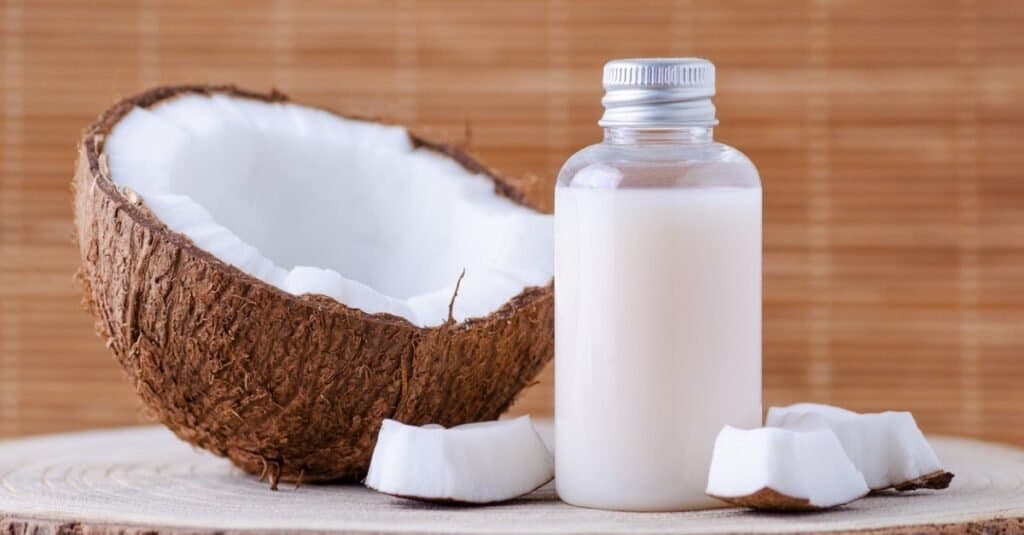
Inside the hard, hairy exterior of the coconut is a white fleshy meat and clear liquid.
©nadisja/Shutterstock.com
The uses for the coconut palm are as myriad as the ubiquity of the plant, which is to say a lot. Coconut is the most naturally widespread fruit plant on Earth. Its uses include:
- Beauty and Cosmetics: Found in soaps, lotions, oils for the face and hair, and make-up due to its moisturizing properties
- Cultural: Used in some Hindu rituals as the plant’s fruit and flowers are associated with well-being and wealth/success
- Culinary: Consumed for its white fleshy meat and water; coconut oil and milk extracted from the fruit for cooking, especially frying, and drinking
- Health and Medicine: Used to manage dental-related pain and as a treatment for dysentery
- Materials and Fuel: Leaves woven to make baskets, mats, and occasionally roofing; wood used to build structures like bridges and huts; husk’s fiber used to make ropes, sacks, and other household items; husks and shells used as fuel.
Like coconut palms, the many species and varieties of palms are used in a variety of ways: food, construction, furniture, landscaping, medicine, and more. Palm oil, which is one of the most available vegetable oils in the world, is extracted from the many palm plants. A number of palms, including the pejibaye, date, African oil, and jelly palms, among others, produce fruits that are used in culinary settings throughout the world. The date palm, for instance, produces dates, which have become popular as a sugar and sweetener alternatives. In construction, because the fronds take a long time to decompose, they are good for making roofs and panels/walls and are an excellent way to insulate a home. The timber is used in building homes and boats in some parts of the world.
A notable way that palms are used is in candles. Because palms grow in warm climates, the wax is naturally able to resist melting in hot weather. Furthermore, palm wax hold and emits fragrances better than candles made from paraffin wax. Palm wax is natural, renewable and friendly to the environment.
Palms get a little extra attention on Palm Sunday, a day that commemorates Jesus’ triumphant entry into Jerusalem the week before his passion and resurrection. At many Christians churches, parishioners are handed palm fronds as they enter church on Palm Sunday.
Coconut Palm vs. Palm: Origin and How to Grow
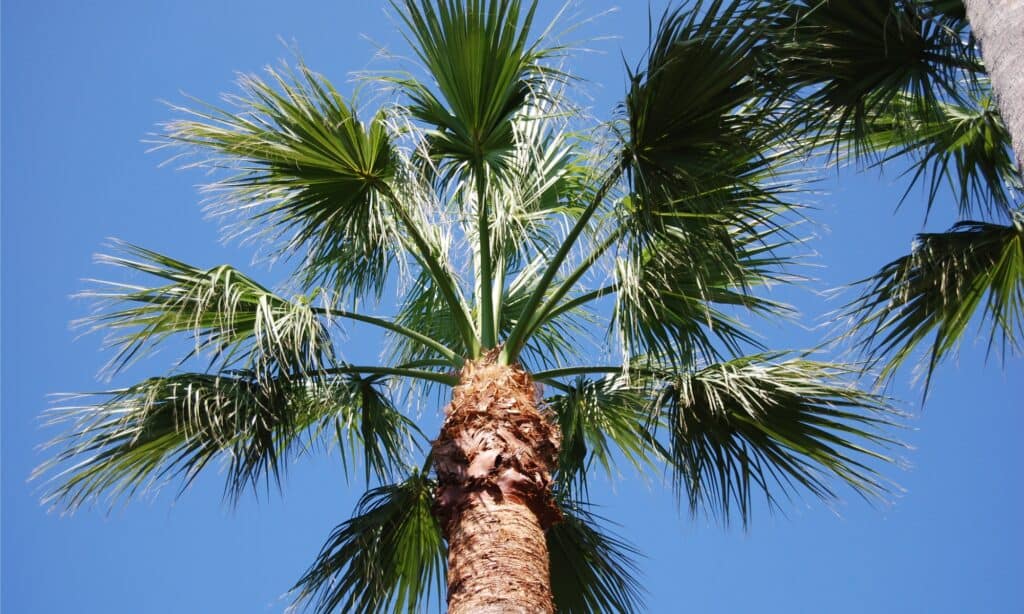
Some palm species and varieties tolerate the cold. Coconut palms do not handle cold weather well at all.
©iStock.com/tadamee
Palms are a symbol of the tropics, so it’s no surprise that these plants originated in tropical locations. The coconut palm is cultivated throughout the world in places with a tropical climate, but it is native to areas in the South Pacific: Bismarck Archipelago, Maluku, New Guinea, Philippines, Queensland (Australia), Samoa, Santa Cruz Island, Solomon Islands, Tonga, and Vanuatu.
It’s hard to say where palms originated, but it is believed that the many species and varieties of palms are from South America and the Caribbean. The common element between coconut palms and palms is that palms do best in warm, humid tropical and subtropical environments, although there are species and varieties of palms that are cold-tolerant, including the date palm. No coconut palm tolerates the cold well.
Bonus: Fun Facts About Coconuts
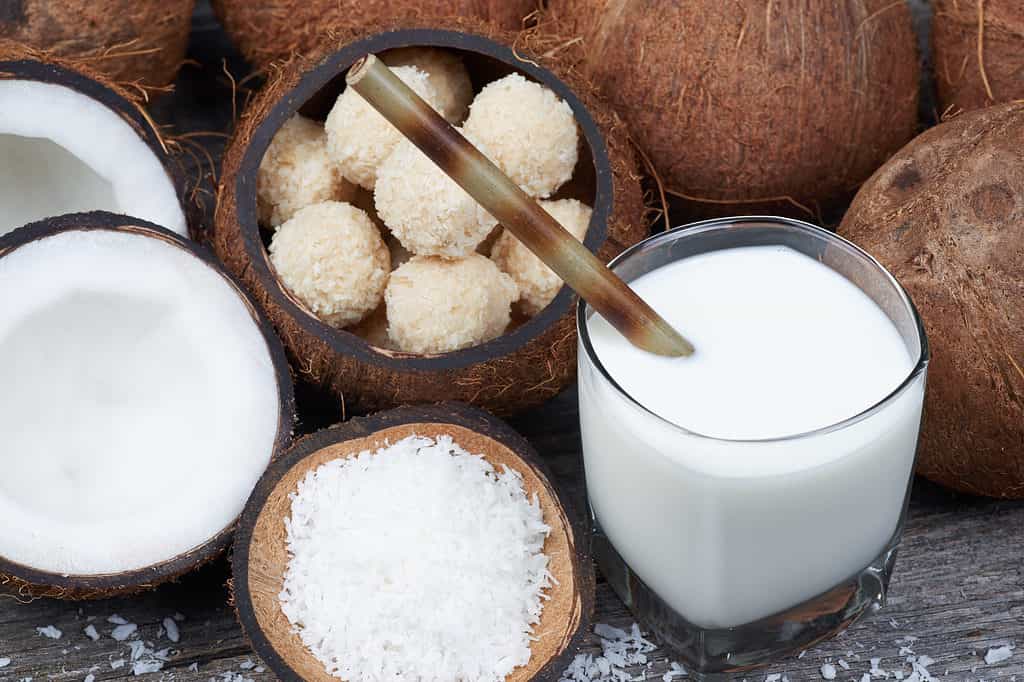
Whole coconuts, coconut milk, and shredded coconut are all delicious and nutritious.
©Krzycho/Shutterstock.com
Here are few extra bits of trivia about the coconut palm to share at your next gathering:
- Coconut palms live around 60 years and produce an average of 15 coconuts each month.
- Coconut milk is made from the expressed juice of grated coconut meat and water.
- During the early stages of its development, a coconut contains high levels of water that can be consumed as a refreshing drink.
- In the United States, coconut trees will grow only in extreme southern Florida and California.
- When buying a coconut, shake it to ensure there is water inside. If you do not hear anything, the coconut is too ripe.
- Never buy a coconut that has a crack or puncture. There should be no leakage from the coconut’s three dark eyes.
- Whole coconuts can be stored in the refrigerator for up to two months; however, once opened, the meat will only keep for a few days.