
Quick Take
- Bees don't actually build hexagons, and the shape forms through a process most people would never guess. See how bees build →
- A Roman scholar posed this exact question in 36 B.C.E. It took nearly 2,000 years for anyone to actually prove the answer. Trace the 2,000-year proof →
- Making wax costs bees far more than you'd expect, and that hidden cost is exactly why the hexagon matters. Discover the wax trade-off →
- The same geometric logic bees stumbled upon is now shaping skyscrapers around the world. See hexagons in skyscrapers →
If you’ve ever walked through a factory or seen mechanical or chemical engineering in any format, you’ve likely seen honeybee-inspired designs. If you’ve ever seen a piece of honeycomb, you’ve seen the little hexagons that bees build into the structure of this honey-rich goodness. But why do bees make hexagons in their hives? Is there a purpose for these shapes, or is it an accident of nature? Read on to find out.
The Short Answer
While it might seem like a simple answer, honeybees make hexagons in their hives because it allows them to efficiently use their space without wasting wax. It’s the most economical way to build their hives. Hexagons fit tightly together, saving space while still providing plenty of storage for that ooey, gooey golden honey.
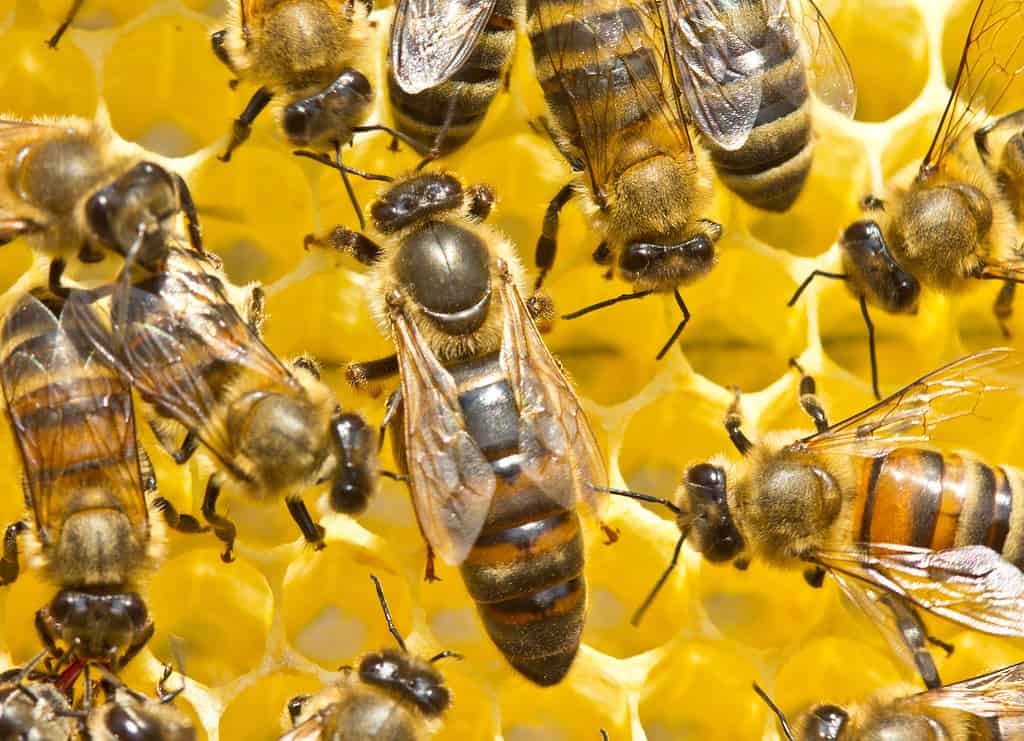
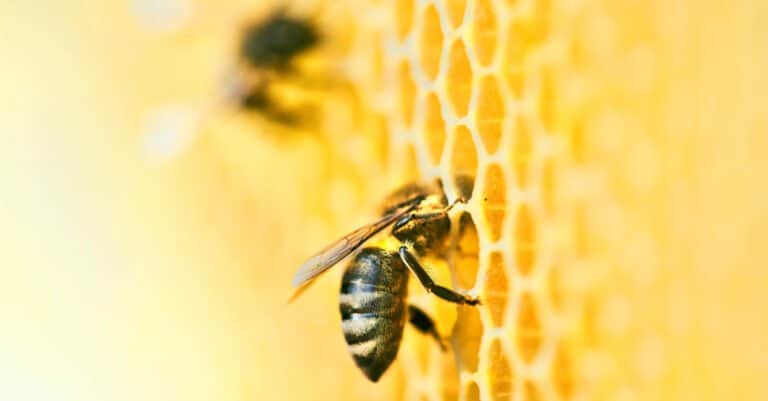
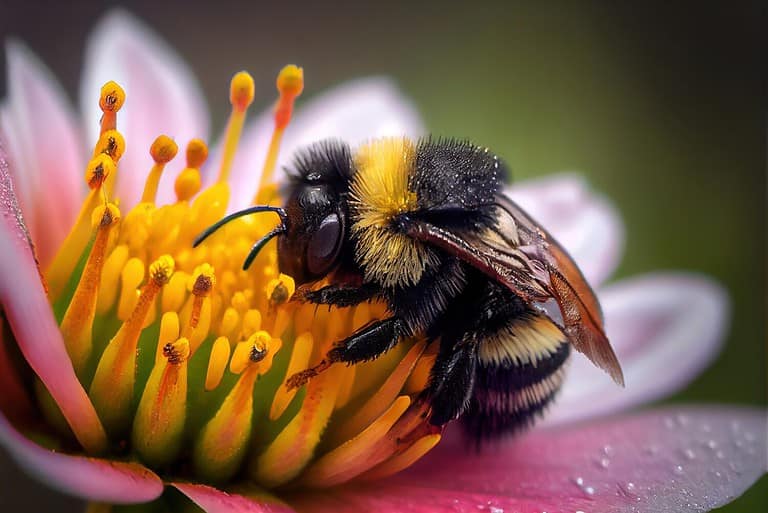
Honeycomb is made from beeswax, a secretion of young honeybees.
©iStock.com/Inventori
How Bees Make Honeycomb
When we consider the use of hexagons in beehives, it’s important to first understand how bees make honeycombs. Young workers first consume honey, whose complex sugars are metabolically converted into wax. This process allows them to secrete wax from specialized wax-producing glands on the underside of their abdomens. The liquid solidifies into flakes as it comes into contact with the air. Then, the bees scrape the wax flakes off their bodies with their legs and put them in their mouths. They chew the wax, and as it mixes with their saliva, it makes the wax soft enough to form, like clay.
Why Hexagons and Not Other Shapes?
The question surrounding the shapes bees build with dates back as far as 36 B.C.E., as far as we know. Records of a Roman scholar, Marcus Terentius Varro, show he asked the same question. He suggested that hexagons hold more honey than other shapes by breaking up the space into tiny units. Varro never got to prove his theory, but the question has become known as the Honeybee Conjecture. Nearly 2,000 years later, modern scientists have tested the theory and produced the proof of the Honeybee Conjecture. The hexagonal grid allows the bees to use the maximum possible area with the minimum perimeter and the least amount of wax.
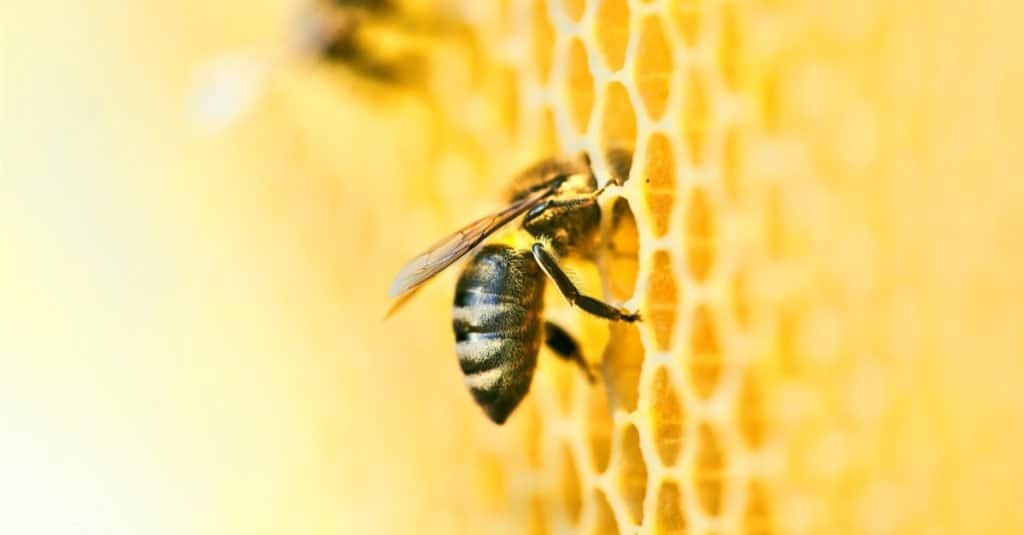
The bees’ unique hexagonal shape was theorized by ancient scholars as the perfect shape for storage.
©Aleksandr Rybalko/Shutterstock.com
However, it’s important to note that a honeycomb does not start out with hexagons. With the softened wax, the bees create cylindrical chambers that conform to the shapes of their rounded bodies. As more and more chambers are created, the bees’ body heat keeps the pliable wax cylinders soft, causing the common sides to flow together. Surface tension then pulls the cooling wax flat where the chambers meet, creating the hexagonal pattern.