
Quick Take
- Moray eels sometimes recruit a completely different species to hunt with them, and the recruitment signal is stranger than you would expect. See cooperative hunting →
- The green moray eel's iconic color is actually an illusion, as its real skin is a completely different shade. Explore moray eel adaptations →
- Electric eels don't just shock prey to kill it. They use a two-stage electrical attack that forces hidden fish to betray their own location first. See the two-stage attack →
- Moray eels evolved a second set of jaws to solve a problem their first jaw simply cannot handle alone. Discover the double-jaw system →
Moray eels (family Muraenidae) and electric eels (Electrophorus spp.) are not closely related. Moray eels are true eels belonging to the order Anguilliformes, while electric eels are a South American knifefish belonging to the order Gymnotiformes. There are over 200 recognized species of moray eels spread across 15 to 16 genera. They range in size from a few inches to over 10 feet long. Moray eels are found in tropical and subtropical seas all over the world. There are three distinct species of electric eels distributed throughout South America. Most individuals grow between 4 and 6 feet long, with some reaching up to 8 feet. The key differences between electric eels and moray eels include their habitat, hunting techniques, mouths, and adaptations.
Electric Eel vs. Moray Eel: Habitat
Electric eels are strictly freshwater fish that live exclusively in the rivers, streams, swamps, and flooded forests of South America. They are native to the vast Amazon and Orinoco River basins, as well as the surrounding Guiana Highlands.
Electric eels are found in slow-moving or stagnant waters, such as murky creeks and inland swamps. Because their muddy habitats often don’t provide sufficient oxygen, electric eels are obligate air-breathers that must surface every 10 to 15 minutes to gulp air.
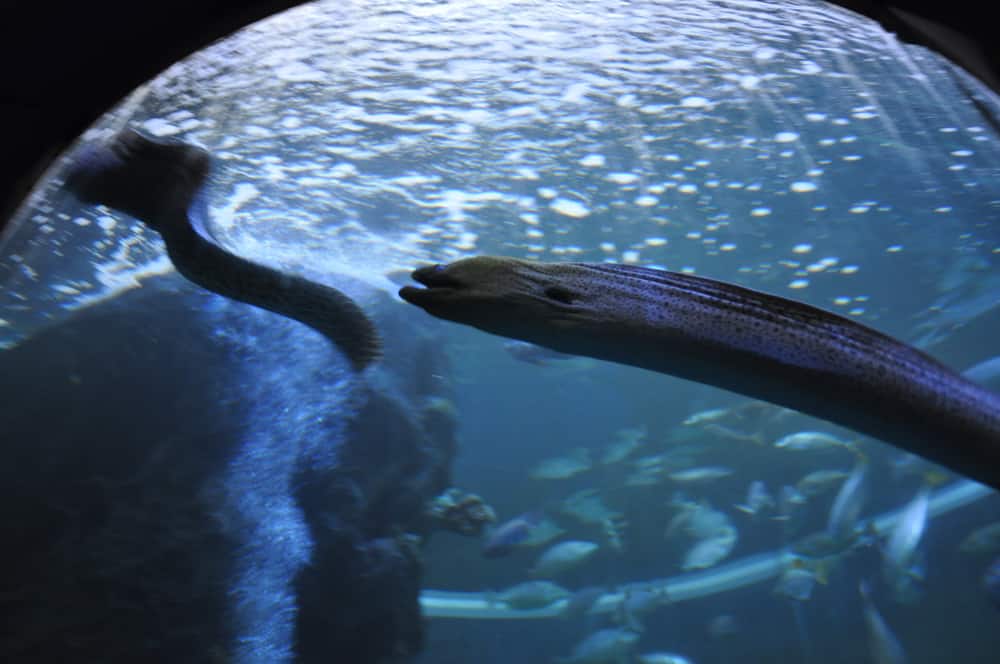
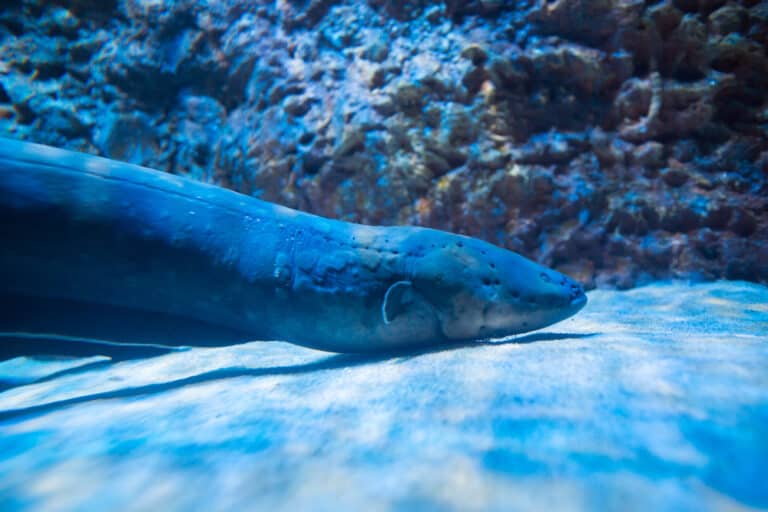
Electric eels can surface multiple times in one hour to breathe air.
©Cattleya2017/Shutterstock.com
Although the vast majority of moray eels are marine fish, a tiny handful of the more than 200 known species can survive in brackish water, and one species, the tiger freshwater moray (Gymnothorax polyuranodon), lives in freshwater rivers and streams in Australia and Southeast Asia.
Moray eels are found primarily in coastal areas. They are primarily benthic (bottom-dwelling) creatures that thrive in shallow, nearshore environments where they can shelter in coral reefs, rocky outcroppings, and seagrass beds.
Hunting Techniques: Electric Eel
Electric eels can generate up to 860 volts of electricity, with the highest recorded voltage produced by Volta’s electric eel (Electrophorus voltai).
Electric eels use this electricity for self-defense, communication, navigation, and hunting. An electric eel produces electricity using thousands of specialized muscle cells called electrocytes, which are stacked inside its body like rows of tiny batteries.
When the eel spots prey or danger, its brain sends a sudden signal through its nervous system that causes all of these cells to open at the same instant. This allows tiny, charged atoms to rush across the cell membranes, instantly combining the individual voltages of each cell into one massive electrical shock that is released into the water.
The surrounding river water conducts electricity much more easily than the eel’s body, so when a shock is released, the current instantly exits the skin and flows outward into the water toward its target. The highest recorded shock from an electric eel is 860 volts, though most individuals produce lower voltages. These shocks are released in rapid pulses that last for milliseconds.
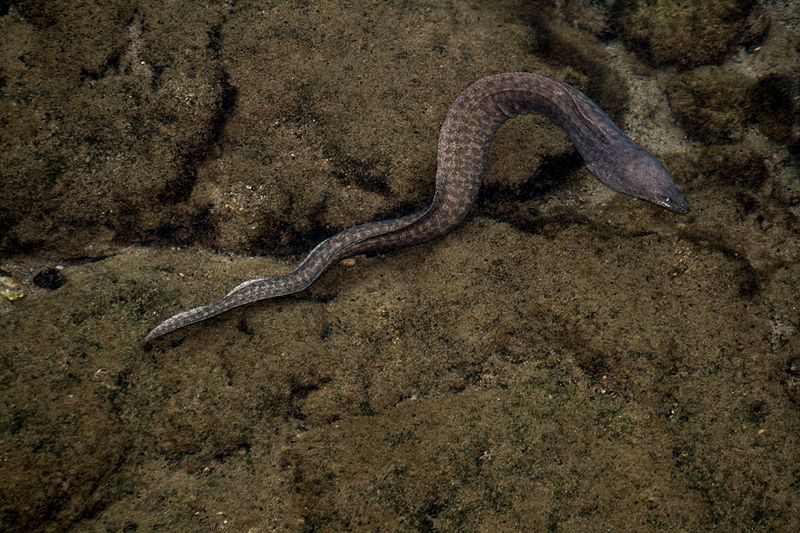
Moray eels actively hunt at night.
©Brocken Inaglory / Creative Commons – Original
Hunting Techniques: Moray Eel
Moray eels are ambush predators. They spend most of their time hiding in rock holes, caves, or coral reef cracks with only their heads showing, waiting quietly for small fish, crabs, or octopuses to swim past before they lunge out to grab them. While they wait in holes during the day, many species leave their dens to hunt actively in the dark.
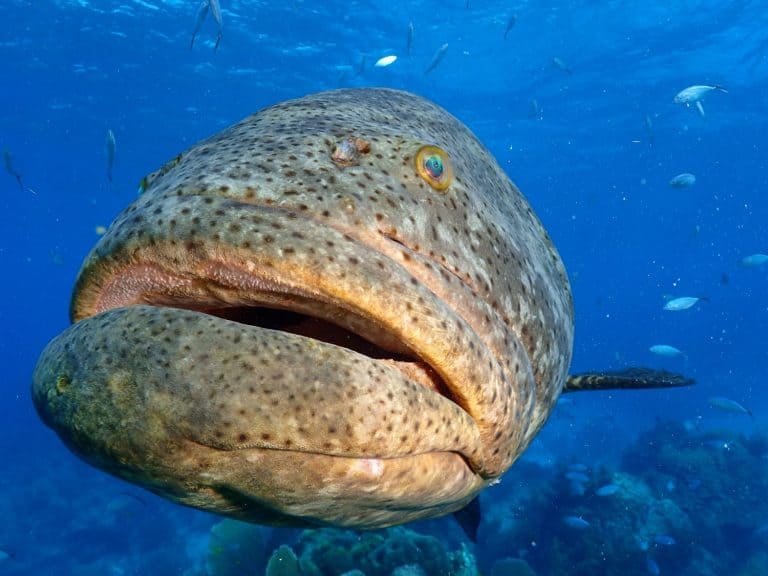
Moray eels and groupers form a rare, cross-species hunting alliance in which the grouper acts as the planner and the eel acts as the enforcer. This partnership is highly effective because their hunting styles perfectly complement each other.
A hungry grouper will swim up to an eel’s den to recruit the eel. The grouper vigorously shakes its head or body in front of the eel to signal that it wants to hunt. The eel then helps the grouper flush out prey. Whichever fish catches the prey swallows it whole.
Studies have shown that this teamwork dramatically increases the hunting success rate for both predators compared to hunting alone.
Electric Eel: Adaptations
An electric eel’s ability to generate electricity is an evolutionary adaptation. Unlike many large river predators, electric eels lack prominent teeth or protective scales.
They adapted a defensive shock that can reach up to 860 volts, acting as the ultimate deterrent.
Millions of years ago, their ancestors were standard, non-electric knifefish. Over generations, they developed specialized muscle cells called electrocytes to survive in their harsh environments. Electric eels live in muddy, murky Amazon basins where vision is almost useless.
They developed low-voltage pulses that act like underwater radar. This electrolocation allows them to map their surroundings without relying on their poor eyesight. Tracking fast prey is also incredibly difficult for them.
Their high-voltage doublet pulses force nearby hidden fish to twitch involuntarily, exposing the fish’s exact location to the eel. The eel then follows up with massive shocks to instantly paralyze the prey.
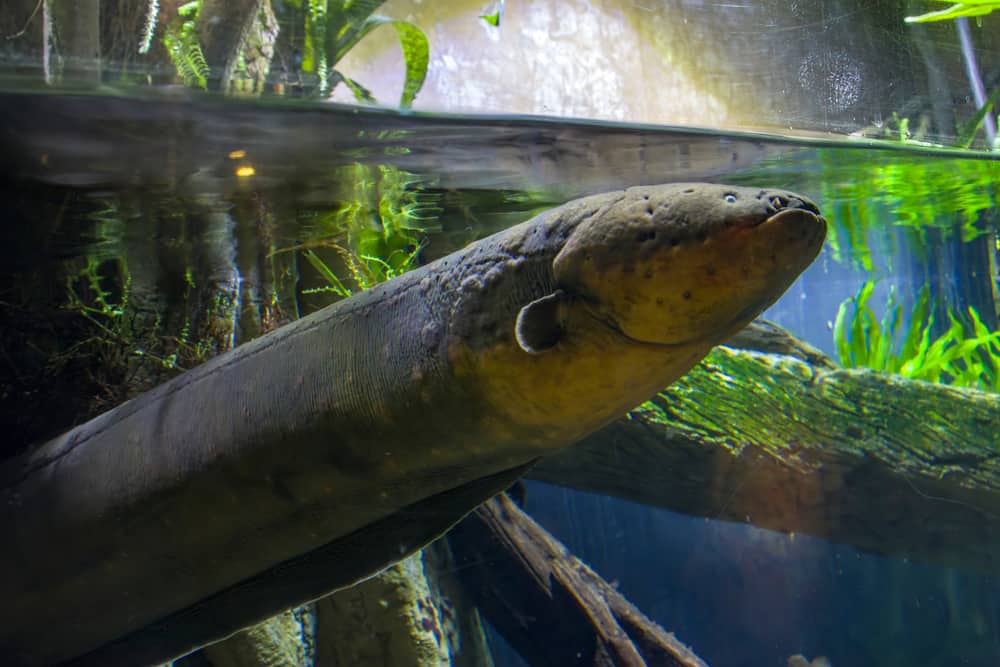
Electric eels can generate up to 800 volts of electricity.
©Danny Ye/Shutterstock.com
Moray Eel: Adaptations
Moray eels can produce mucus that covers their scale-less skin. The mucus protects their skin from abrasions. They can also stabilize their hiding structures by bonding this mucus to the surrounding sand.
Because morays have no scales, squeezing into jagged coral reef pockets could easily damage their skin. This heavy mucus acts like industrial grease, allowing them to slide seamlessly through razor-sharp rock crevices without suffering abrasions or cuts.
The green moray eel (Gymnothorax funebris) isn’t actually green. Its raw, scale-less skin is dark brown or gray. It only appears green because it is completely covered in a thick, yellowish mucus layer that alters how light reflects off its body.
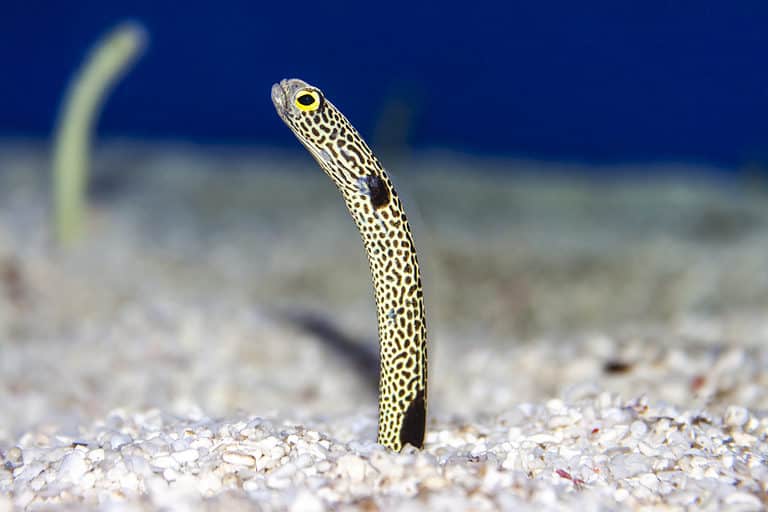
Some sand-dwelling species, such as the ribbon eel (Rhinomuraena quaesita) use their mucus as cement. As they burrow into loose sand, they secrete highly dense mucus that glues the sand grains together and prevents their underground tunnels from collapsing.
Electric Eel vs. Moray Eel: Teeth and Jaws
Electric eels swallow their prey whole after completely paralyzing it with high-voltage shocks. Because they lack traditional teeth for chewing or tearing flesh, their entire feeding process relies on using electricity to render the prey completely defenseless before consuming it.
By completely disabling the prey’s escape response, the eel ensures the animal cannot kick, flip, or escape while being swallowed.
The electric eel manipulates the prey so that it can be swallowed head-first. Swallowing a fish head-first ensures that its fins fold flat against its body, rather than flaring out and getting stuck in the eel’s throat.
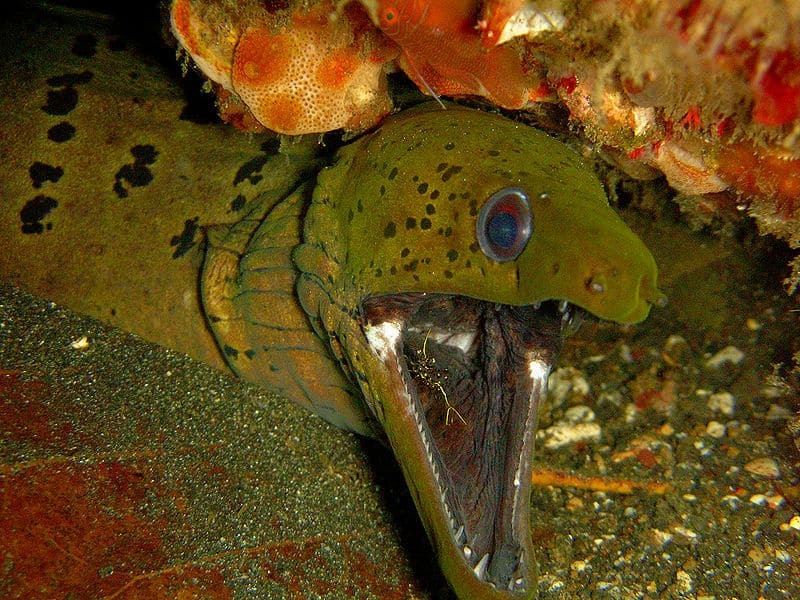
Moray eels have teeth in their mouth and throat.
©Steve Childs / Creative Commons – Original
One of the most impressive features of the moray eel is its teeth. They have razor-sharp teeth and powerful jaws. Their oversized jaws deliver a powerful bite. Moray eels also have a second set of jaws.
Their oversized jaws deliver a powerful bite. Because moray eels live in narrow coral crevices where suction feeding does not work well, this moving secondary jaw evolved as a solution.