
Quick Take
- A famous chimpanzee community in Uganda split into two rival factions after years of social strain, giving scientists a rare look at how even long-stable animal societies can fracture.
- Researchers say the conflict reveals just how politically complex chimpanzee life is, with shifting alliances, hierarchy changes, and group loyalty shaping who belongs and who becomes an enemy.
- The story matters beyond primatology because it challenges simple ideas about animal behavior and shows that social breakdown, violence, and cooperation can all exist within one highly intelligent species.
One day in June 2015, primatologist Aaron Sandel was watching chimpanzees in Uganda’s Kibale National Park when he saw something that did not make sense. A small party of chimps from the Ngogo community heard other members of their own larger community approaching through the forest. Normally, that would not be a big deal. Chimpanzees in the wild often live in what scientists call a fission-fusion society: they split into smaller temporary parties and later reunite. But this time, the chimps he was watching did not behave like they were about to meet familiar companions. They looked tense. They grimaced. They touched one another as if seeking reassurance. Then, rather than mingle, they pulled away.
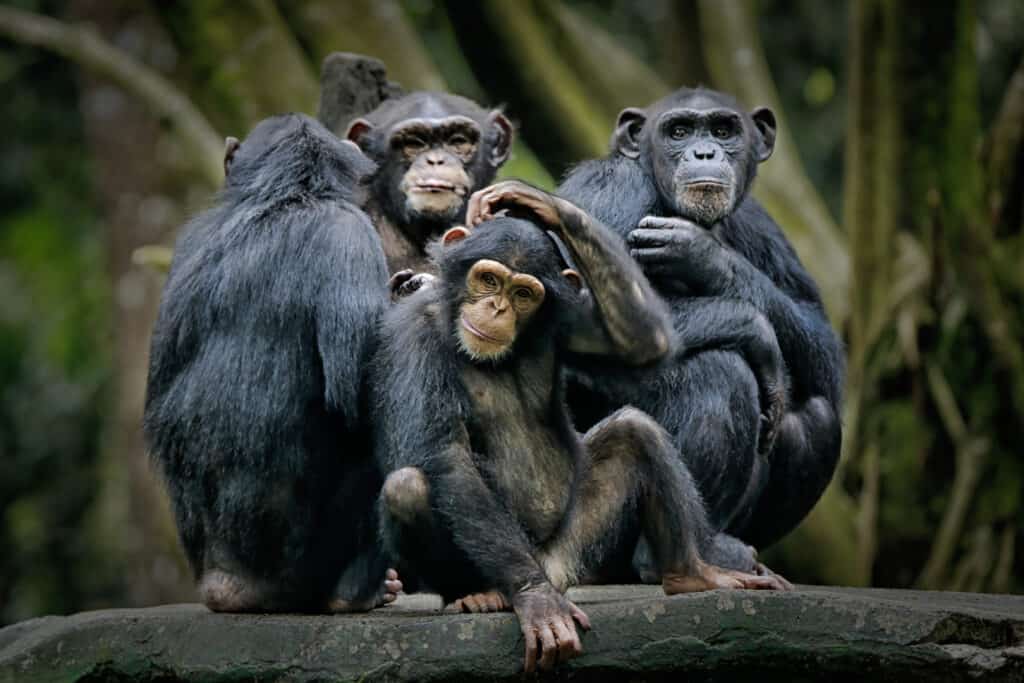
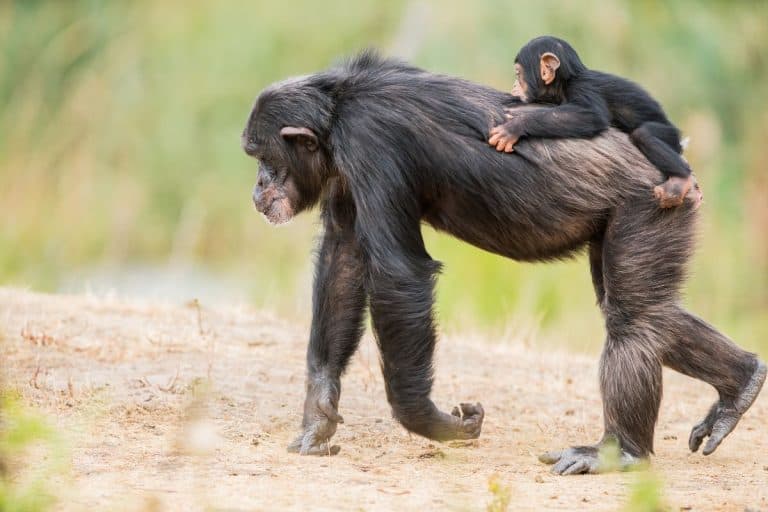
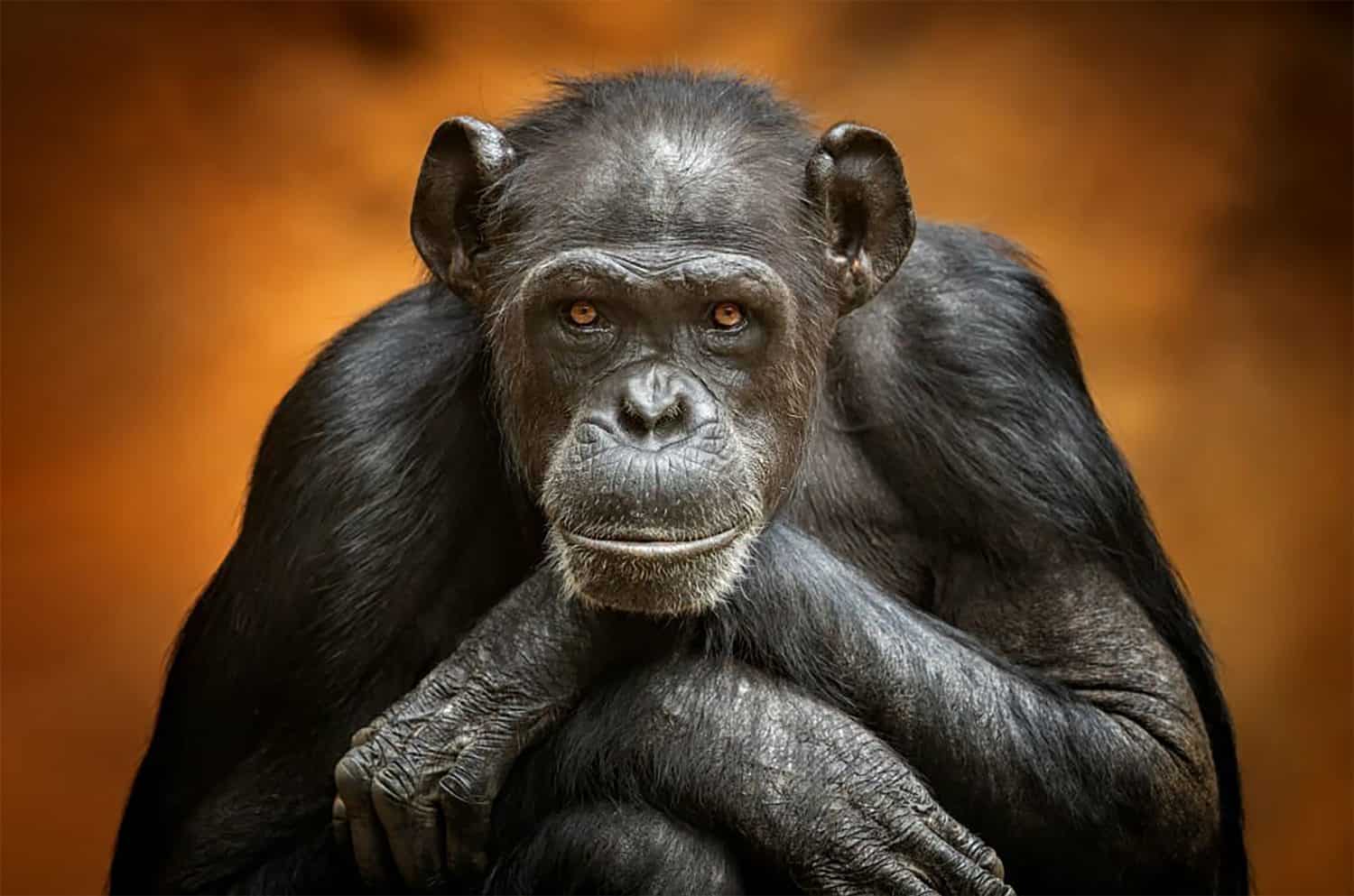
Chimpanzees are highly social animals.
©Ari Wid/Shutterstock.com
In hindsight, that moment seems almost cinematic: the first visible crack in a social world that had appeared stable for decades. What followed was so unusual that researchers have described it as the first clearly documented case of a wild chimpanzee community splitting into rival groups and then turning lethally on itself. The comparison to a human civil war is imperfect, and Sandel himself has cautioned against pressing it too far. But it captures the shock of what happened: neighbors became enemies, and former allies began killing one another.
Who are the Chimps of the Ngogo Community?
The chimps at the center of the story belong to the Ngogo community, the largest known group of wild chimpanzees ever studied. Researchers have followed them in Kibale since 1995, building one of the most detailed long-term records of chimpanzee social life anywhere in the world. At its peak, the community numbered around 200 individuals, far larger than the more typical chimpanzee community, which is typically about 50 members. For years, that large society held together. Individuals clustered socially, in what researchers referred to as the Central and Western clusters, but they still crossed between those clusters for grooming, traveling and mating. It was one community, even if it contained neighborhoods within it.
Then something changed.
What Caused the Split?
Researchers think the split was not caused by one single dramatic event but by a convergence of pressures. The group’s huge size may have increased competition over food and mating opportunities. Several important older males died in 2014, potentially removing social “bridges” that had linked different parts of the community. Around the same time, the male dominance hierarchy shifted, including an alpha male turnover in 2015. A respiratory disease outbreak in 2017 added more disruption. Put together, those losses and stresses appear to have weakened the connective tissue of the group. What had once been a flexible, cohesive social system became polarized.
By 2018, the separation was no longer just a feeling in the forest. It had become a fact on the ground. The Ngogo community had split into two distinct groups with separate territories: a Western group of 83 chimpanzees and a Central group of 107. At that point, the familiar chimpanzee pattern of splitting and reuniting had broken down. These chimps were no longer temporarily apart. They were apart for good.
When the Killing Started
Between 2018 and 2024, researchers documented 24 sustained attacks by the Western group on the Central group, resulting in at least seven adult male deaths and 17 infant deaths. While the primary study documented 24 deaths, researchers believe the violence is ongoing as the two groups continue to patrol their new borders. Some additional chimpanzees disappeared without a known cause, raising the possibility that the true number is even higher.
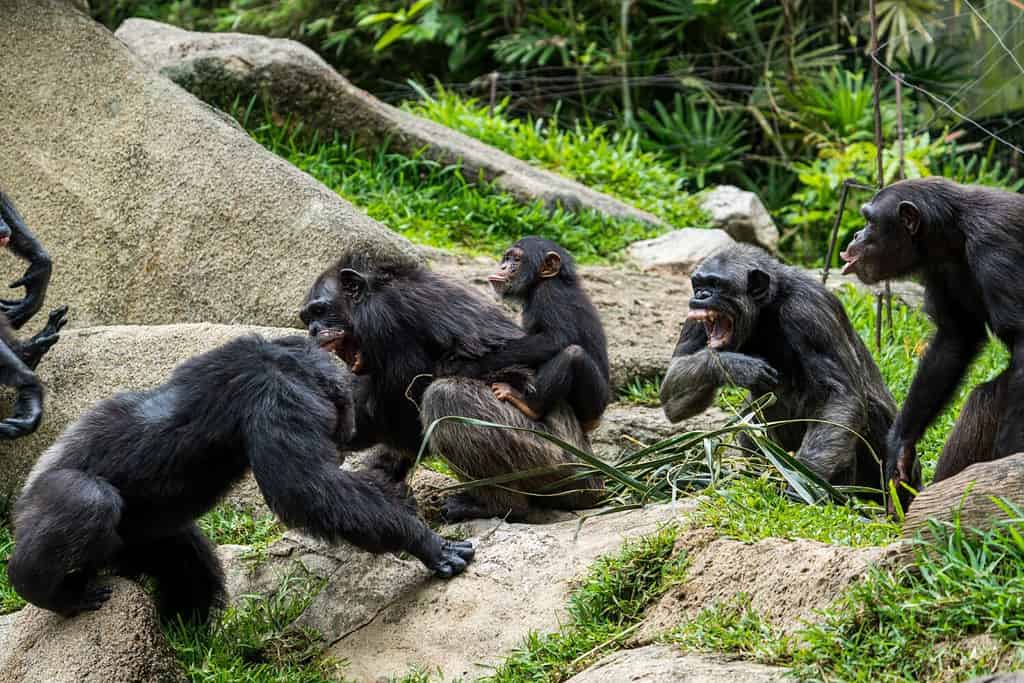
Between 2018 and 2024, researchers documented 24 sustained attacks by the Western group on the Central group.
©Hit1912/Shutterstock.com
The violence was not random chaos. It was coordinated. Adult males were the main attackers, though adult females sometimes joined in. Victims were bitten, beaten, dragged, and kicked. Infants were seized from their mothers and quickly killed. These were organized assaults carried out over years. What makes the story so disturbing is that the attackers were not confronting strangers from a neighboring community, which chimpanzees are already known to do. They were attacking animals they had grown up with, individuals they had once groomed, tolerated, cooperated with, and in some cases known their entire lives.
Why the Ngogo Case Matters
Chimpanzees have long complicated our ideas about animal society. They are intensely social, politically aware, capable of cooperation, alliance-building, reconciliation, and long memory. But they are also capable of severe aggression, especially toward outsiders. The Ngogo split shows just how fluid “outsider” status can be. Group identity in chimpanzees, this case suggests, may depend less on anything like symbolic culture and more on the lived fabric of daily relationships: who spends time together, who grooms whom, who travels together, who shares space. When those patterns break down, the boundary between “us” and “them” can harden with startling speed.
That insight matters beyond primatology. Humans often explain conflict through language, ideology, ethnicity, religion, or politics. Chimpanzees do not have those things in the human sense. Yet the Ngogo split hints that some ingredients of violent division may lie deeper than culture alone. Social cohesion itself — the ordinary, repeated acts that keep a community connected — may be more important than we sometimes admit. When the links weaken, even a sophisticated social species can fracture.
At the same time, this is not a story about chimpanzees being “just like us.” That temptation is understandable, especially when a dramatic animal story seems to mirror human headlines. But the value of the Ngogo conflict is not that it flattens the difference between humans and chimps. It is that it forces us to take chimpanzee society on its own terms. These are not simple creatures running on crude instinct. They live in layered social worlds shaped by memory, hierarchy, alliance, territory, fear, and belonging. Their societies can hold together for decades. They can also come apart.
There is also a conservation lesson here. Chimpanzees are endangered, and the researchers warn that human-driven disruptions such as habitat loss, climate change, and disease could further destabilize already vulnerable communities. If social cohesion is fragile, then protecting chimpanzees may mean protecting not just forest acreage, but the continuity of their social lives.
That may be the deepest takeaway from this story. The Uganda chimpanzee “civil war” is dramatic because it feels so tragic: a community that once functioned as a whole becoming divided beyond repair. But scientifically, it is powerful because it reveals how much lies beneath the surface of animal society. The forest was never just full of individuals. It was full of relationships. And when those relationships changed, the entire world of these chimpanzees changed with them.