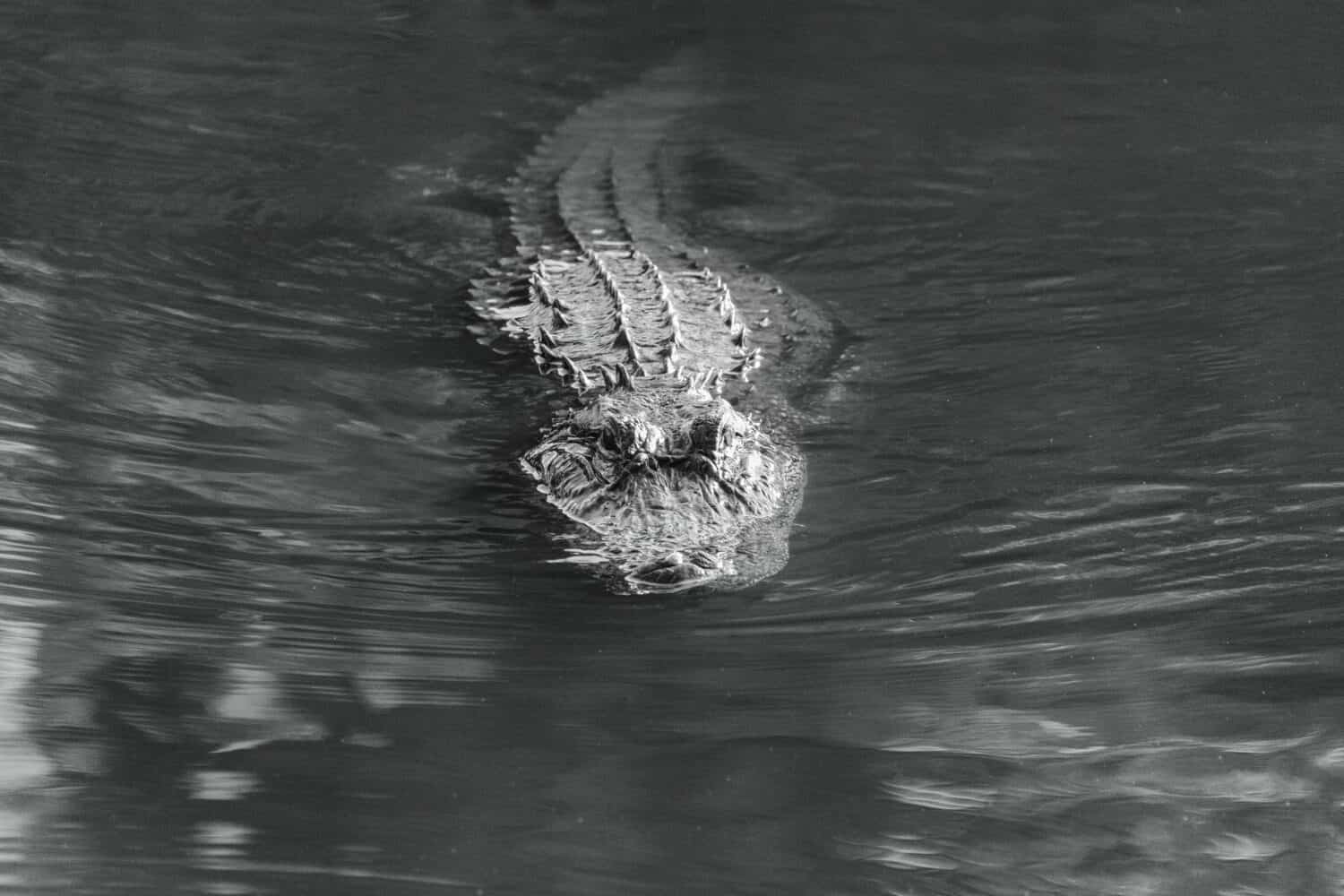

It is no secret that Florida has some of the most dangerous water creatures. We cannot forget their booming population of alligators and crocodiles. We have all seen those shows where a homeowner finds a reptile hiding inside their house, somewhere they do not belong. For example, there is a house in Florida with an alligator hiding in their basement right up next to their washing machine, sniffing out the water in their basement drain.
According to the Florida Fish and Wildlife Conservation Commission (FWC), there are roughly 1.3 billion Alligators within Florida alone. This spans over 67 of the counties within their state. Also, the Official Florida State Reptile is the Alligator.
But have you ever wondered how many alligators live in Florida’s Lake Tarpon? Let’s discover this — and much more — in the article below.
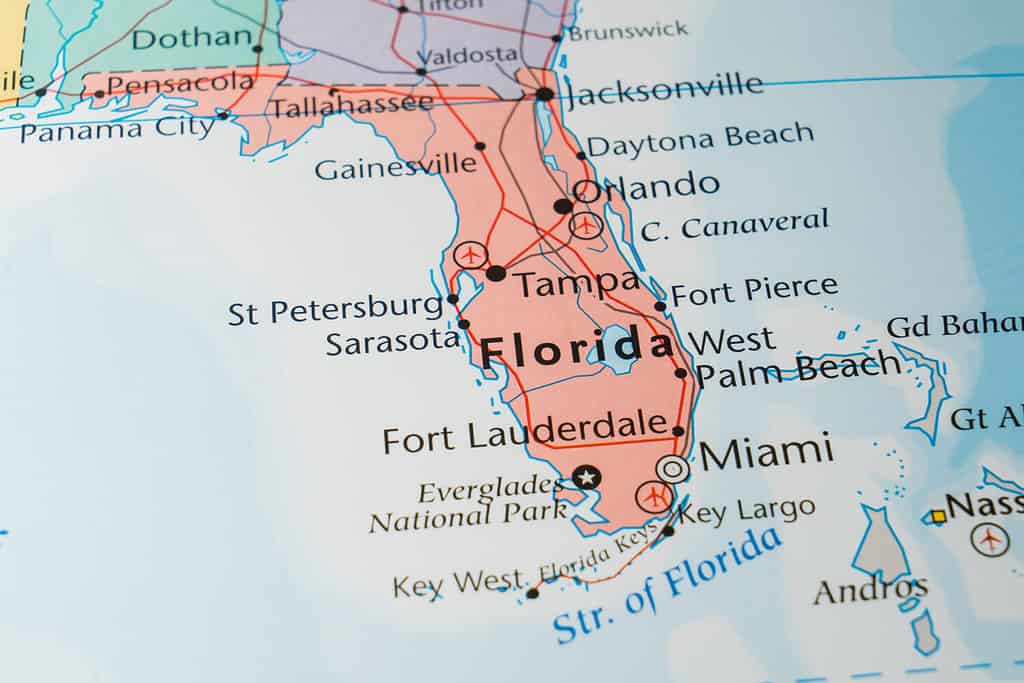
The state of Florida is surrounded by water and wildlife.
©Alexander Lukatskiy/Shutterstock.com
About the Alligator
| Adult Female | Adult Male | |
| Length | 8-10 feet | 11-15 feet |
| Weight | 200-400 pounds | 500-800 pounds |
The name “Alligator” has a Spanish origin for the Spanish settlers called the large beast el legarto, which translates to “the lizard” in English. When the first writings of the animal appeared, it was spelled out as allagarta.
We know they do not live in ocean water, for alligators do not have salt glands. For animals to survive in salty seawater, they need a specific form of gland. Alligators do need fresh water, though. The Smithsonian’s National Zoo and Conservation Biology Institute says, “They also live in swamps, marshes and lakes.”
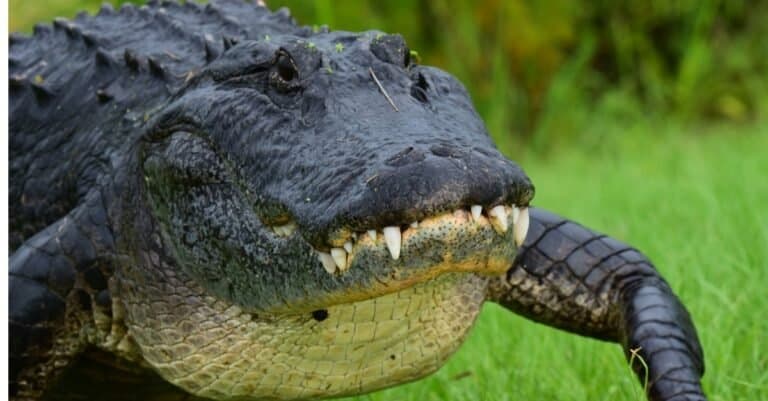
They are usually olive green but can also be gray, black, or brown — even a mixture of anything that camouflages them to their environment best.
Alligator’s Bite
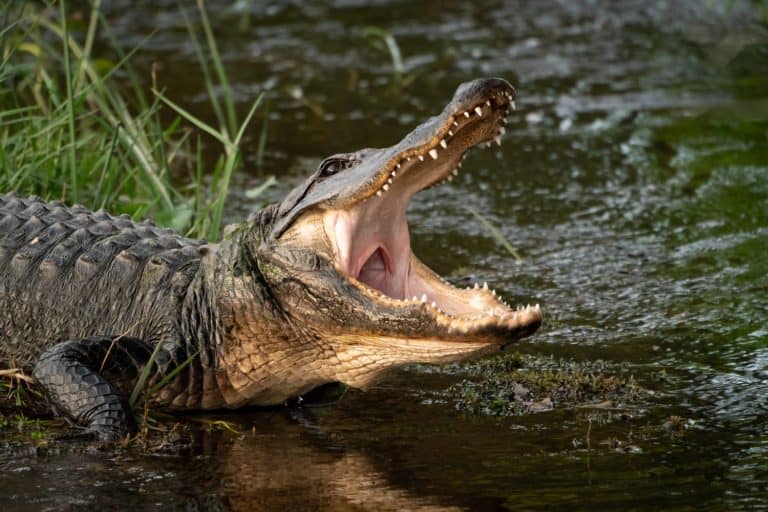
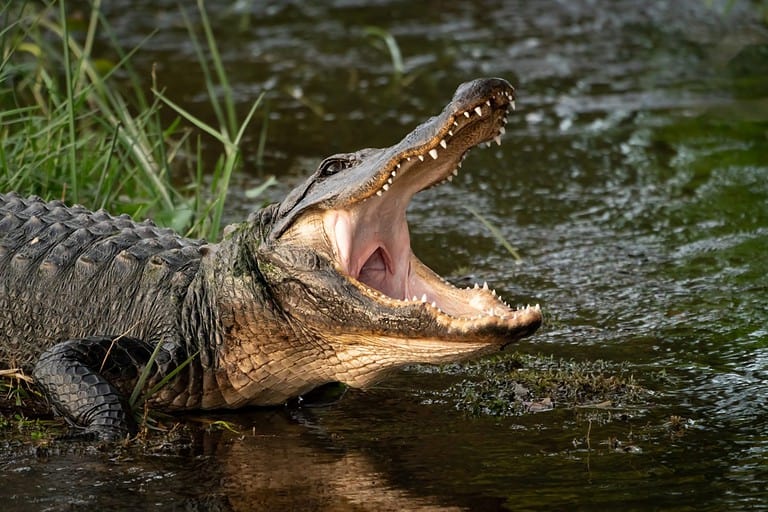
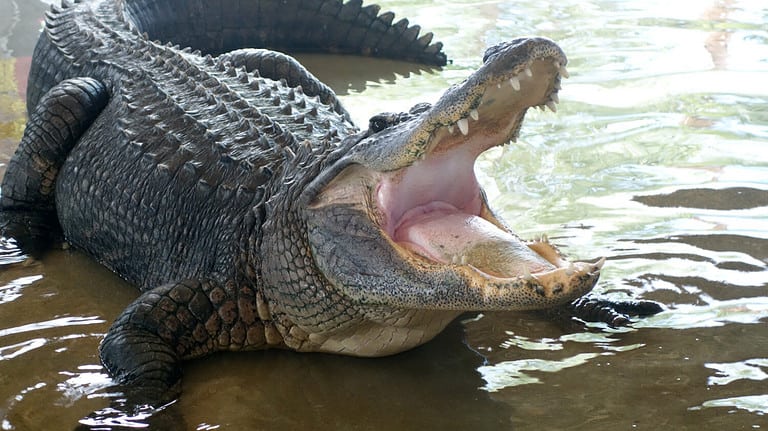
With 75-80 teeth in their mouth, they eat fish, birds, reptiles, and smaller mammals. They are predators who eat anything they can catch and fit into their mouths.
We measure the pain of a bite in pounds of pressure per square inch (PSI). So, how many pounds is pushing or clasping down on each square inch of matter?
As human beings, our “bite” equals 120 pounds of pressure per square inch, while a dog, a Labrador, let’s say, has a bite of 230 pounds of pressure per square inch. A macaw bites at 1200 pounds per PSI. The beak of a bird, you would think, has a pretty hard clamp. But an alligator can outdo it, almost doubling its pressure with a bite of 2000 pounds per PSI.
Besides their ability to nearly split you in half with one chomp, they are very territorial creatures. Territorial and unfriendly. These animals are not social beings, although they live amongst other alligators in the same body of water. They live separately. They are never happy to see you and would most likely prefer you not to be where you are visible to them.
Where Do They Come From?
Alligators evolved from the Crocodiles over 65 million years ago. 32 million years after that, the original Alligator split into two different alligator forms. The American Alligator and the Chinese Alligator.
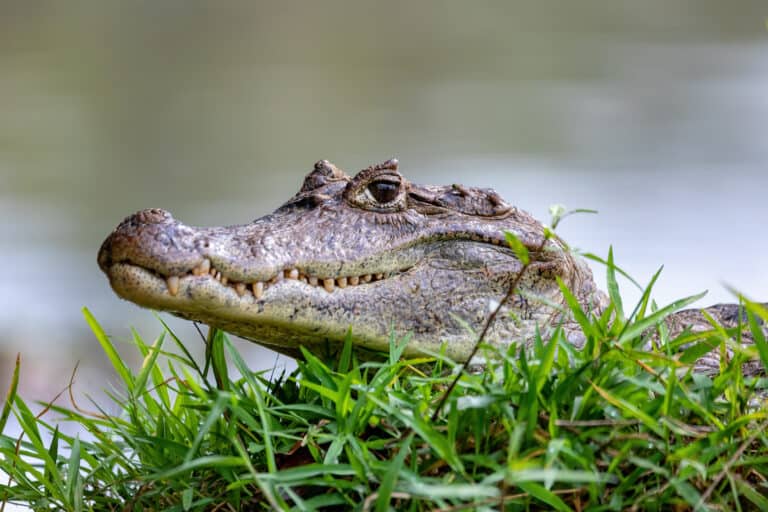
Considering an alligator came from a crocodile, they often look alike. With their relationship so close to the Crocodile, how are you supposed to tell the two apart?
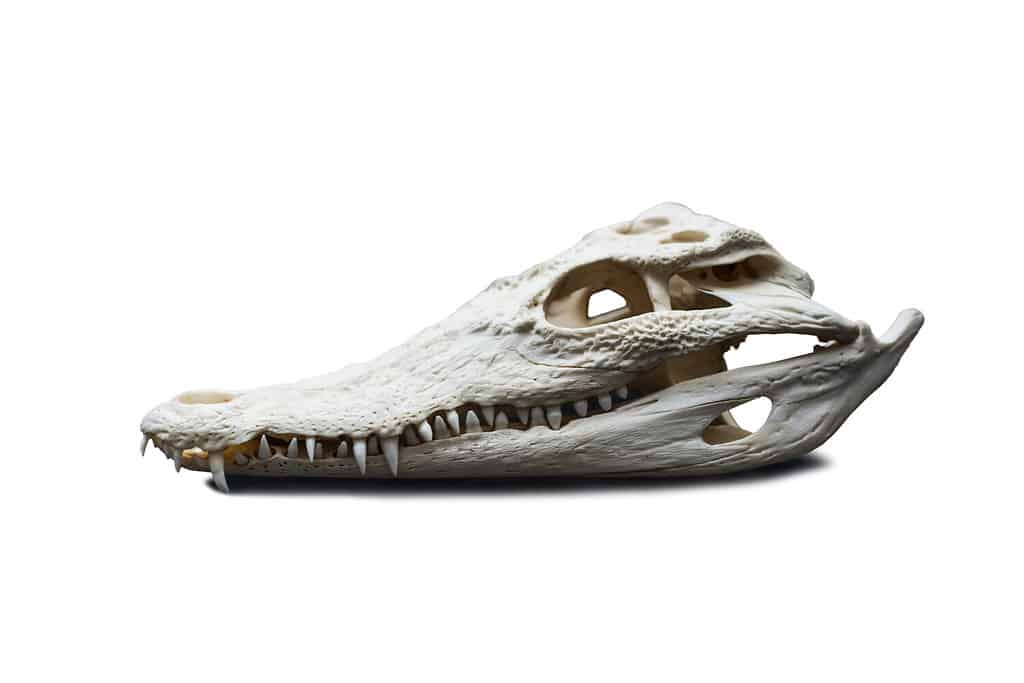
In an alligator skull, the nose is pointed, and the eyes are set more on top of the head.
©specnaz/Shutterstock.com
Alligator vs. Crocodile
I have a few tips for you to look for.
A crocodile can be more enormous, longer for sure.
Crocodiles also have a very pointy snout, usually called a V-shape. In contrast, the Alligator’s nose is broader, known as a U-shape.
The Crocodile has an even smile. The upper and lower jaw are the same size, so they match up when they close their mouth. An alligator has a large overbite. Their top jaw is much bigger than their bottom, so when they complete their mouth, it encompasses the bottom jaw. Crocodiles have fewer teeth and do not have webbed feet. We have a great article that goes into this more in-depth. You can click the link to read that here.
Ultimately, alligators live in the United States all across the Southeastern border. Florida holds enough of them.
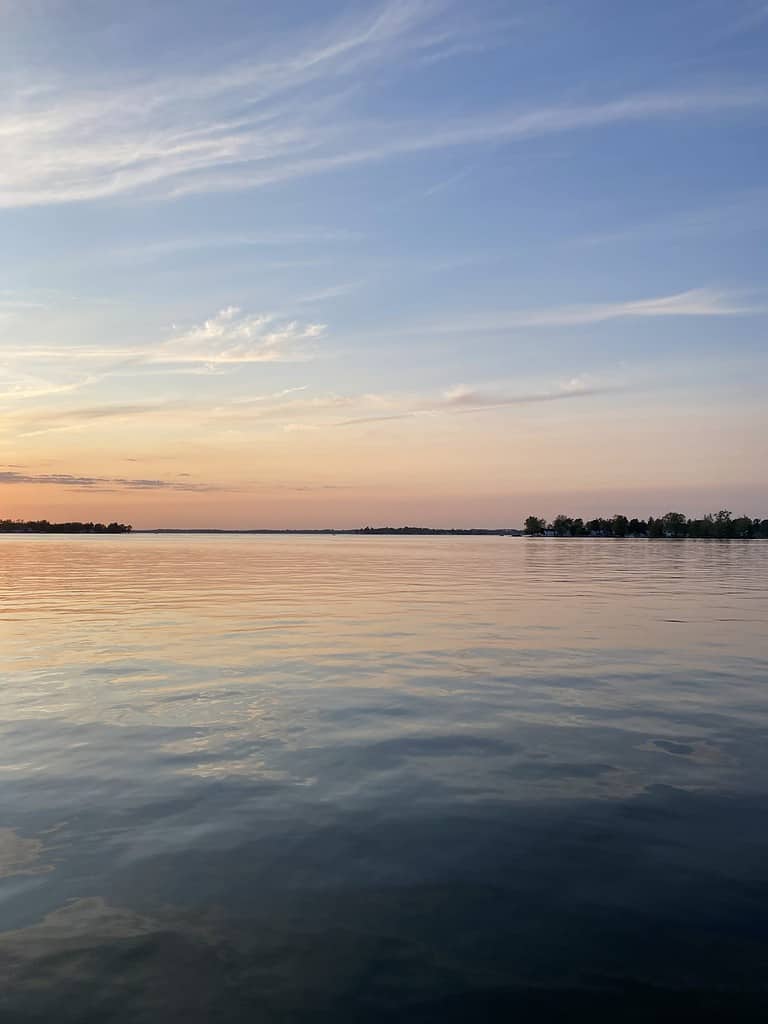
Florida’s Lake Tarpon
It is a 2,534-acre-long Fish Management area. It is a known area for the large amounts of bass it holds. The FWC lists it as 1 of Florida’s Top 10 Bass Lakes.
Due to the large amount of fish and the large body of freshwater, Lake Tarpon is a prime location for alligators to be found. And, in fact, it has an estimated population of 13,000 alligators!
Although it is a place where you can find alligators, it is not the ONLY or BEST location. Lake Tarpon is known for not having the best water quality. In 1987, there was a massive case of algae in the lake, followed by several bouts of eutrophication. This means the water holds too many nutrients. These nutrients could be deemed harmful to the things inhabiting the lake. Afterward, when the water was tested, it was shown to have low oxygen levels.
Even though there are complications with the water at Lake Tarpon, this does not mean there is no wildlife. There are. In 2013, an 11-foot crocodile was pulled from its waters.
In 2021, NDTV posted a video to YouTube they had received of a Florida man being chased from the water’s edge after Fishing at Tarpon Lake. You can check that video out below.
Florida Is “Gator-full”
To live in Florida is to understand that there will be alligators living in Florida. There are lots of freshwater locations throughout the state that are home to these large reptilians. A-Z Animals has a great article called Discover the Most Alligator-Infested Lakes in Florida that lists the MOST alligator-infested lakes. A few listed are Lake Okeechobee, Orange Lake, and Lake George.
Among all the alligator anarchy in Florida, other places have a larger quantity of alligators, like Louisana, where the population of giant lizards outweighs any other State in America.
What Other States Have Them?
Several States are home to this reptile. The gator inhabits the Southeast part of North America. So you will see these four-legged scaley creatures crawling through:
- Florida
- Louisana
- North Carolina
- South Carolina
- Oklahoma
- Alabama
- Mississippi
- Georgia
Make sure to keep your distance. An alligator in the wild is usually not a friendly creature. You are there disrupting its food supply, and that is not something they will be too excited about.
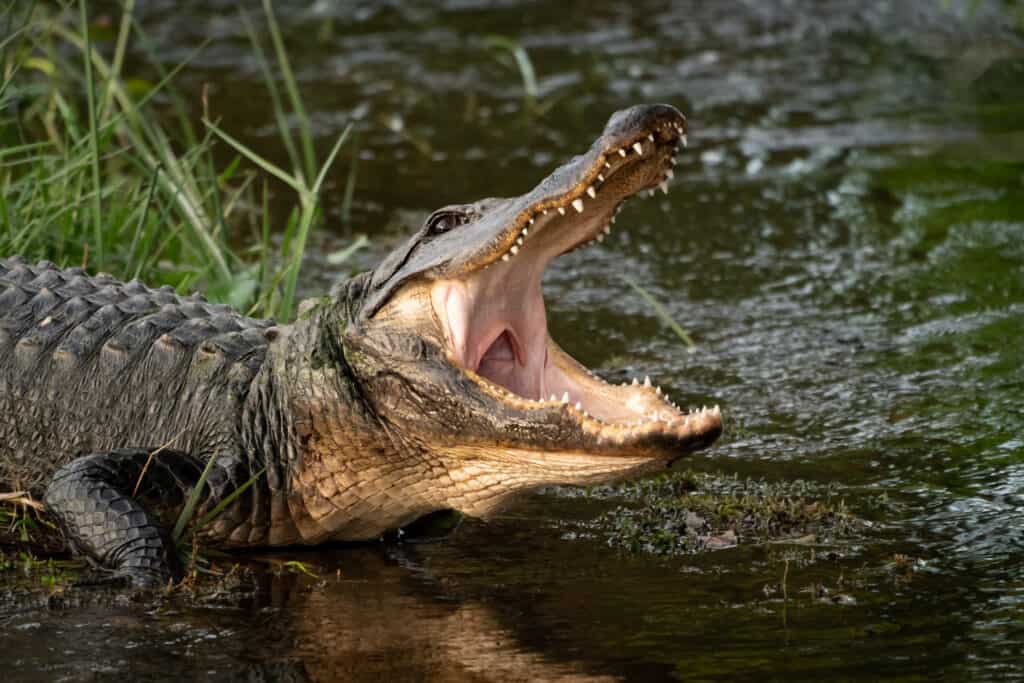
Any standing body of water in Florida could house a gator, making swamps, rivers, lakes, and drainage pools all potentially dangerous.
©Deborah Ferrin/Shutterstock.com