
Quick Take
- The AKC lists four Yorkie coat colors, but breed experts say there is really only one true Yorkie coat. See the standard coat →
- Some "rare" Yorkie colors marketed at premium prices may be a warning sign rather than a selling point. Spot the warning signs →
- Born blue Yorkies carry a hidden risk that can show up before the dog turns two, and most new owners never see it coming. Understand the hidden risk →
- One specific gene can give a Yorkie two different eye colors, and in the wrong combination it causes far worse than a unique look. See the merle gene effects →
While there is only one standard Yorkie coat, there are other coat colors that can crop up, both in purebred Yorkies and mixed breeds that are unfortunately marketed as purebreds. Some are involve inbreeding or other poor breeding practices. Let’s talk about the breed standard for Yorkie coat colors, then dive into other Yorkie colors you might see or hear about.
The Standard Yorkie Coat
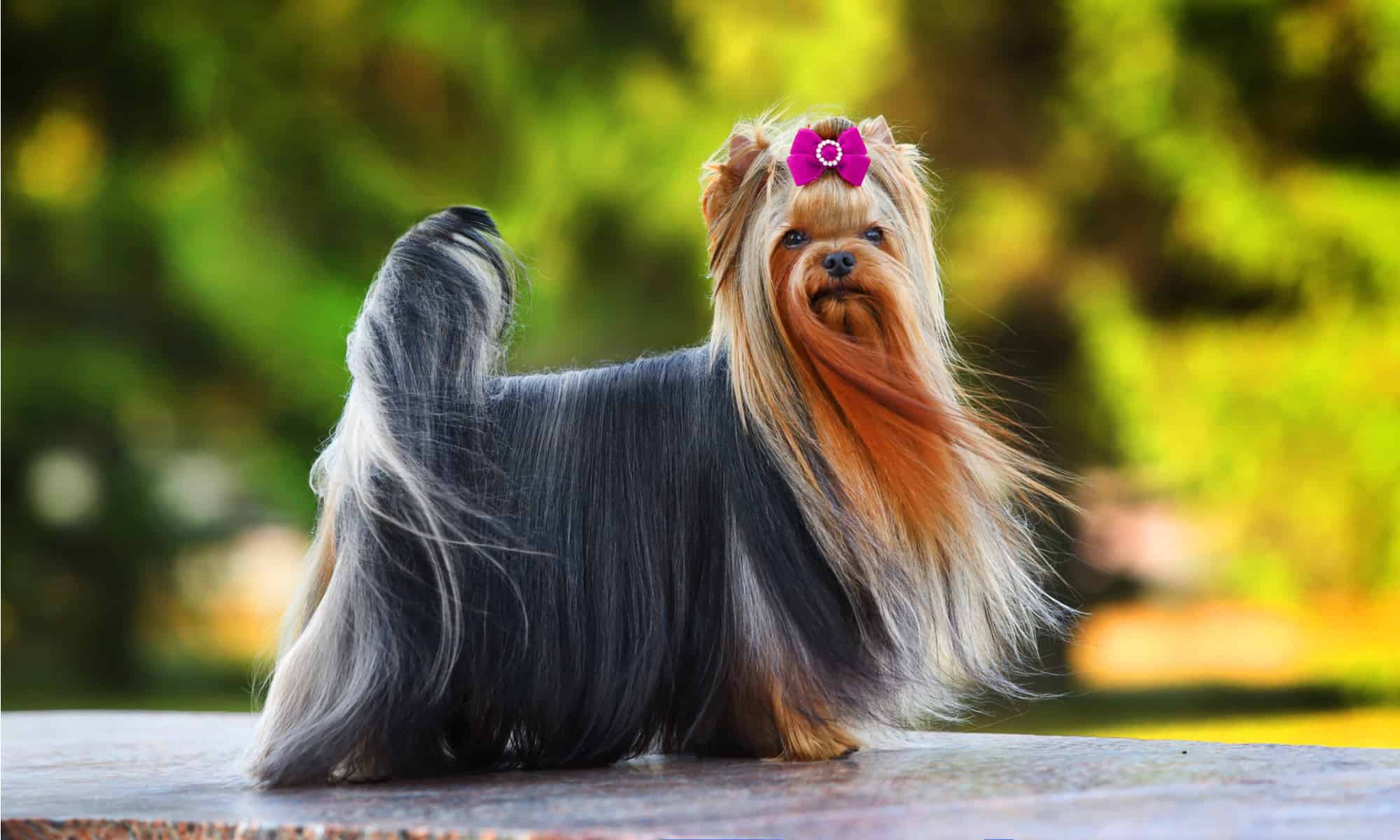
Although the American Kennel Club (AKC) site lists four Yorkie colors, there is actually only one true Yorkie coat if you dive deeper into the breed standard. Yorkshire Terrier puppies are born with a black and tan coat that is mostly black. As they age, their coat lightens and becomes more tan. This color change can begin as early as eight weeks to three months of age and typically completes by one to two years. The black in their coat fades to “blue,” which is a diluted, sometimes silvery black. The tan in their coat becomes more widespread and becomes golden. So, Yorkie puppies are black and tan, while adults are blue and gold.
So, where do the other two coat colors come in? During the transition! While a Yorkie pup’s coat is changing, you might see an intermediate stage where it is blue and tan or black and gold. Yorkies’ coats don’t change overnight. Instead, it’s a gradual process that can leave them with more unique coloring for a short period of time.
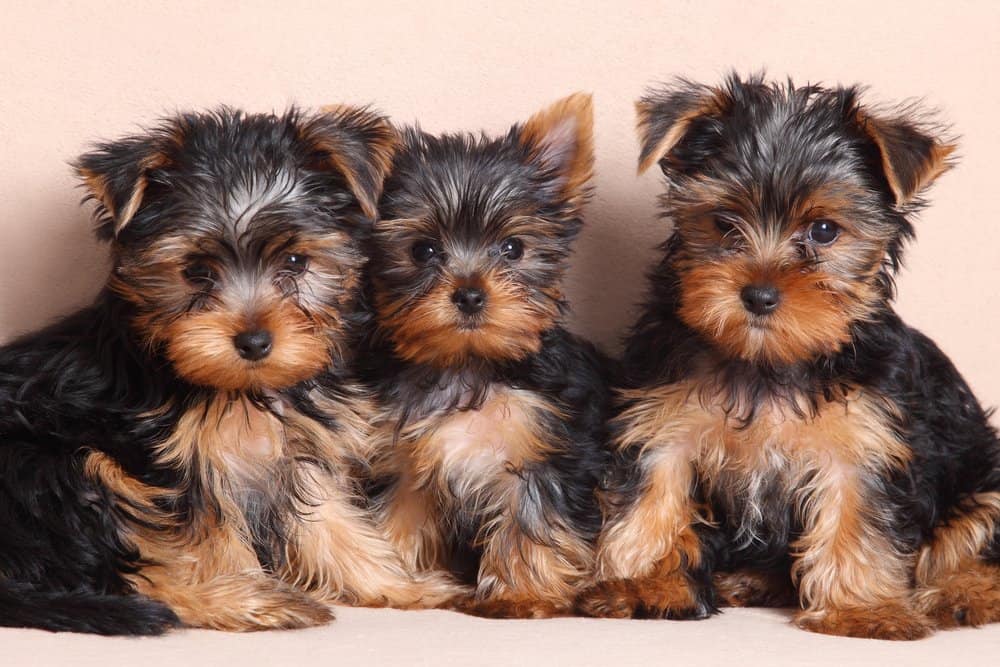
While a Yorkie pup’s coat is changing, you might see an intermediary stage where it is blue and tan or black and gold.
©Pelevina Ksinia/Shutterstock.com
Do Rare Yorkie Coat Colors Exist?
Rare coat colors do exist, though you won’t typically see most of them in purebred, responsibly bred litters. However, rare coat colors are extremely uncommon in purebred litters, as they usually require a mixture of recessive genes inherited from the parents. These dogs are more commonly mixed breeds or another breed altogether. Some unethical breeders may specifically breed these dogs for profit, which often involves inbreeding. The following are some rare coat colors you might see in Yorkies.
Brindle Yorkies
Brindle Yorkies have dark stripes on the tan patches. These dogs are typically crossbred with a dog that already has the brindle pattern. Then, their descendants are bred back only to pure Yorkies.
Blue Yorkies
Blue Yorkies are those born with blue in their coat, rather than black. They are often referred to as “born blue” Yorkies, as opposed to Yorkies whose coats have a blue saddle that develops as they mature. A born blue Yorkie inherits a recessive dilution gene that alters their eumelanin, which is a dog’s foundational black pigment. The dilution gene restricts the amount of pigment deposited on the hair shaft, turning black into a grey-blue. Unfortunately, born blue Yorkies are prone to health and skin conditions, such as Color Dilution Alopecia, which can cause patches of hair thinning or loss typically between 4 months and 3 years of age.
Merle Yorkies
The merle gene randomly modifies the dog’s coat, skin, and eye color. Merle Yorkies have dark patches in their fur and sometimes have two different eye colors. Dogs with two merle genes, also known as double merle, have considerable health problems, primarily deafness and blindness, as well as increased sun sensitivity and higher rates of skin cancer.
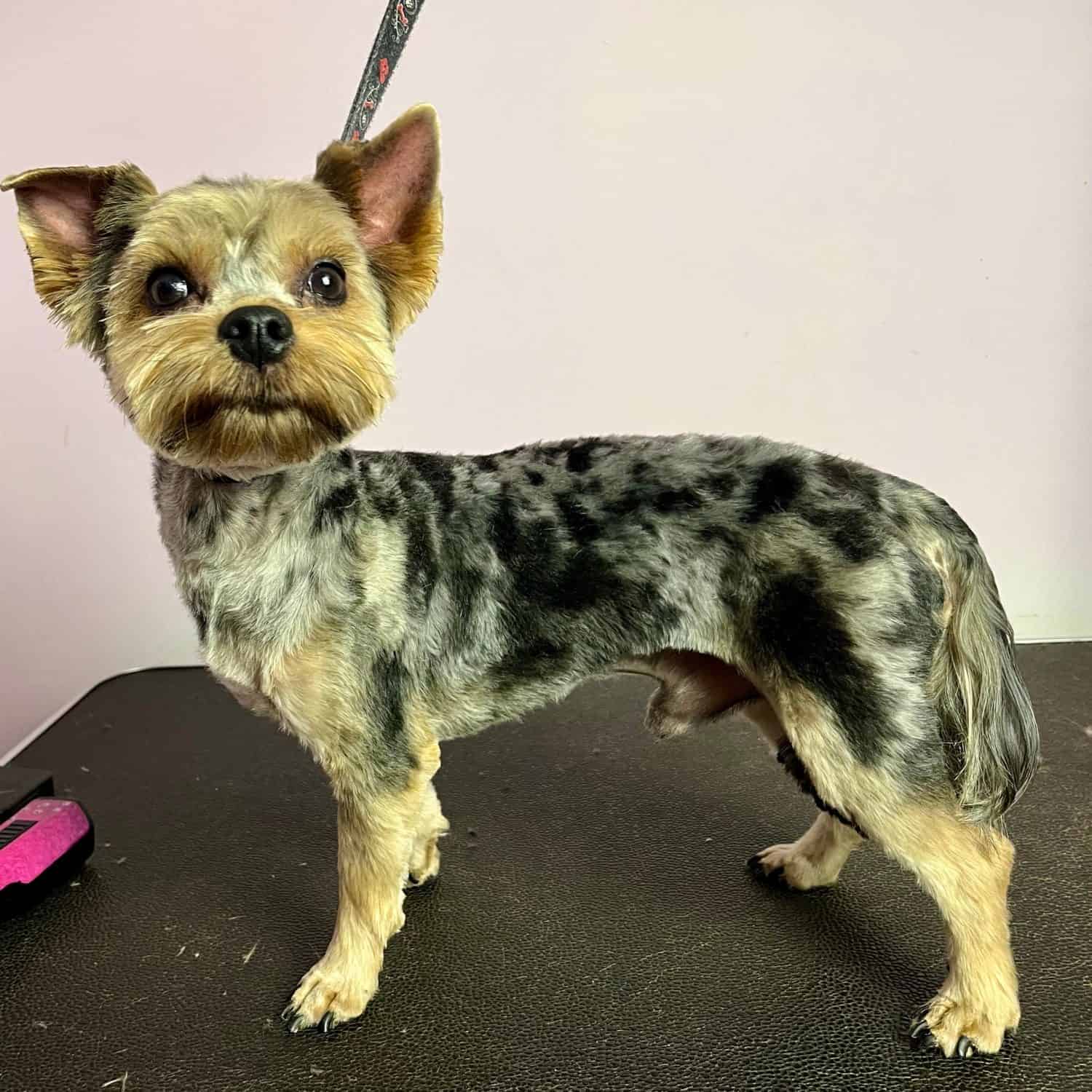
Merle Yorkies have dark patches in their fur.
©NataliSel/Shutterstock.com
Red-Legged Yorkies
Red-legged Yorkies are purebred, but inherit very old, recessive genes that are typically hidden in their ancestry for generations. These dogs have black coats that don’t change to blue, and red on their face and legs, whereas most Yorkies have gold on their face and legs. Their fur texture is also wiry rather than silky. Sometimes these Yorkies are used for breeding due to their rich coloration, as they may produce puppies with more vivid coat colors as adults.
Parti-Colored: Blue, White, and Tan
Some purebred Yorkies are blue, white, and tan. Parti-colored and solid-colored Yorkies are the rarest, but they’re actually not accepted under American Kennel Club (AKC) breed standards. The breed standard specifically disqualifies white in the coat, stating that any white markings other than a small white spot on the forechest that does not exceed 1 inch at its longest dimension are disqualifying.
There is another dog breed that looks similar to a Yorkie called the Biewer Terrier. These dogs are parti-colored, which is accepted under AKC breed standards. This is actually one of the key traits separating them from Yorkshire Terriers as a breed.
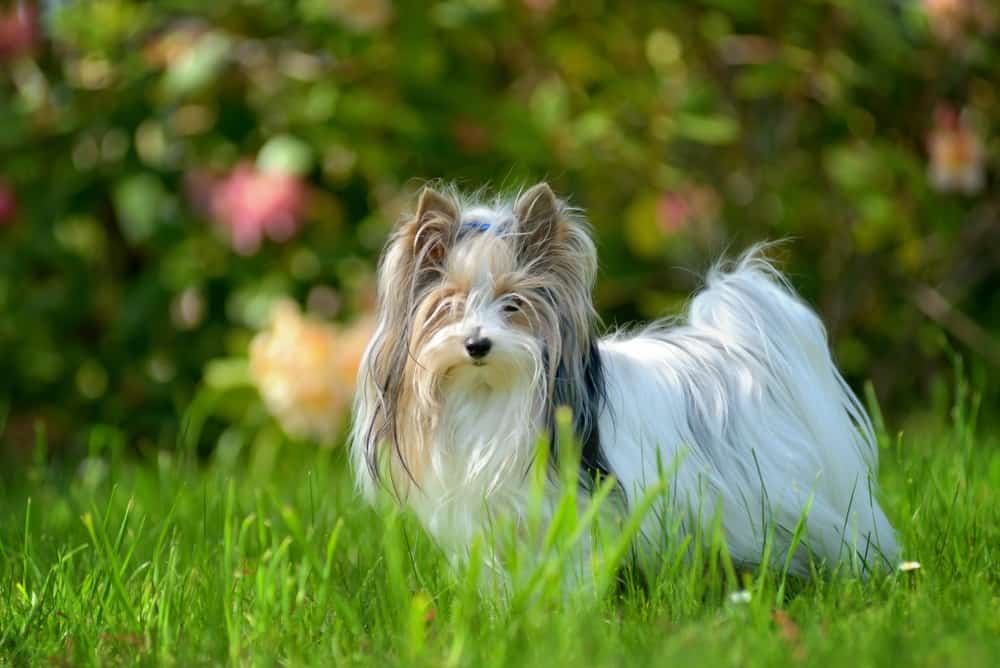
Similar to the Yorkshire terrier, the Biewer Terrier is a rare breed of dog that is parti-colored.
©Radek Havlicek/Shutterstock.com
Solid-Colored: Golden, Tan, Black, Chocolate, or White Yorkies
Some of the most popular solid-colored Yorkies are golden Yorkies and white Yorkies. As we discussed above, these dogs are often bred for profit using unethical practices. Golden Yorkies, sometimes called Golddust or Blonde Yorkies, can sell for up to $4,000. Breeders must either crossbreed their Yorkies with another breed or breed two golden Yorkies to produce a litter of golden pups. Chocolate Yorkies have a recessive gene that causes the black eumelanin to be replaced with brown. Both parents must carry and pass on the recessive gene. Unfortunately, the easiest way to breed for solid colors is through inbreeding.
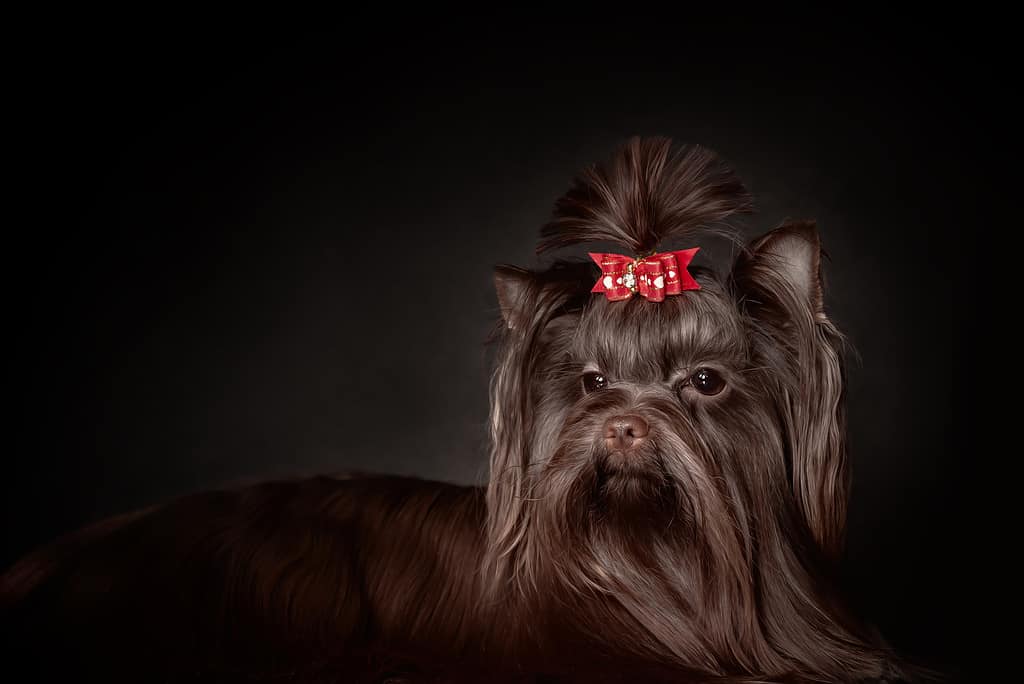
Chocolate Yorkshire terriers have a recessive gene that replaces black eumelanin with brown.
©iStock.com/Irina Nedikova