
Quick Take
- One tiger has done a lot for Thailand's wildlife recovery, and her story is one of hope. Meet Mae Kaew →
- Thailand is the only country in Southeast Asia bucking a devastating regional trend, and the strategy behind it is not what most people would guess. See Thailand's tiger numbers →
- Saving tigers turned out to require saving something else entirely first. That insight changed everything about how Thailand approaches conservation. Discover the key insight →
- A music band and a kindergarten classroom are now central to Thailand's anti-poaching effort, and the logic behind this approach is surprisingly sound. Explore community anti-poaching efforts →
In a remote forest habitat in Thailand, a female tiger leads her cubs through the dark night. She is completely unaware that her nocturnal journey has been captured on camera or that it has triggered such joy and celebration. This year, 2026, the Thailand Department of National Parks, Wildlife, and Plant Conservation announced that their tiger population has increased. This is fantastic news for a beleaguered species. One female is doing more than her fair share to help the repopulation effort! Meet Mae Kaew – mother of nine and now also a grandmother!
The Story of Mae Kaew
Mae Kaew is a female tiger, and she was a resident of the Huai Kha Khaeng Wildlife Sanctuary, around 200 miles from Bangkok. The sanctuary is located in the Dawna Range northwest of Thailand, in Uthai Thani, Kanchanaburi and Tak provinces. The area is mainly hilly and covered in evergreen hill forest. The forests are very dense, and it is not easy to spot the tigers there. As well as tigers, it is home to leopards, jungle cats, and marbled cats, to name just a few.
In 2021, Mae Kaew moved north through the dense, hilly forest and settled in the Upper Western Forest Complex. In the following years, she raised three litters. The first was in 2022 and had two cubs. Her second litter was in 2023 and had three cubs, and the fourth was in 2026 and had four cubs. That makes her a mom to nine cubs altogether!

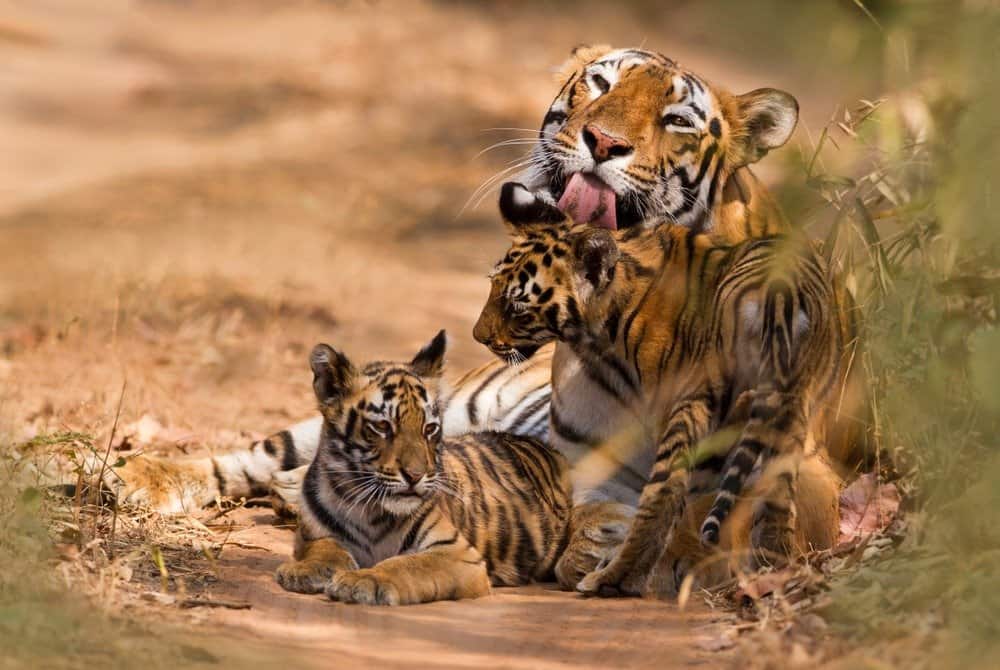
Mae Kaew’s family have been caught on camera traps.
©iStock.com/slowmotiongli
What is even more exciting is that one of her female cubs has had cubs of her own. These were born to one of the female offspring from her 2022 litter. They were caught strolling past a night-time camera trap in the forest.
As a breeding mother, Mae Kaew is an especially important indicator of successful big-cat conservation. Breeding females must have particularly favorable conditions to raise their cubs. They need sufficient prey, a secure habitat, and low levels of disturbance. Her cubs will soon be establishing territories of their own and contributing to Thailand’s recovering population.
Thailand’s Tiger Success Story
After facing years of poaching, habitat loss, and prey scarcity, Thailand’s tiger population is making a comeback! So much so that 2026 (July 29) saw the Royal Thai Government announce that its tiger population was now between 210 and 257 individuals. This makes Thailand the only Association of Southeast Asian Nations (ASEAN) country where the tiger population is showing a sustainable upward trend.
These figures were obtained through a survey completed through a multi-agency collaboration. Partners included the Khao Nang Ram Wildlife Research Station, the Dong Phaya Yen-Khao Yai Wildlife Research Station, Wildlife Conservation Society, World Wildlife Fund Thailand, Panthera, and the Freeland Foundation. They set up camera traps in 30 protected areas and recorded tigers in 26 of them.
The highest number of tigers (100 individuals) were found in the Huai Kha Khaeng Wildlife Sanctuary itself. A further 25 were found in the eastern part of Thungyai Naresuan Wildlife Sanctuary, and another 15 were found in the western part. More were found in other forest complexes, including the Kaeng Krachan-Kui Buri forest complex.
How Has Thailand Saved Its Tigers?
In 2010, Thailand signed the St. Petersburg Declaration, which has the aim of doubling the wild tiger population. Since then, they have introduced two National Action Plans for Tiger Conservation. A key aspect of these is the Spatial Monitoring and Reporting Tool Patrol (SMART) system, which enables officials to monitor, prevent, and deter wildlife poaching. The country’s ranger workforce has received significant investment and helps to protect the national parks and wildlife sanctuaries from poaching and illegal activities. The rangers can systematically monitor threats and collect field data.

Thailand’s forests are ideal habitats for tigers.
©iStock.com/Tanes Ngamsom
However, at the heart of Thailand’s success is the way in which forest rangers and WWF-Thailand employees have brought the conservation message to wider communities. They use innovative techniques such as the ‘Big Cat Band’ which uses music to encourage people to value and protect Thailand’s wildlife. The aim is to build awareness and trust between rangers and communities.
WWF Thailand has also been working with educational establishments to connect young people to their forests. A Tiger House and a Tiger Science classroom have been built at Khlong Lan National Park, and there is now a Tiger House and a Tiger Science classroom at Khlong Lan Kindergarten School. These offer children hands-on activities and creative learning.
Finally, WWF-Thailand has worked with the Department of National Parks, Wildlife and Plant Conservation to introduce plenty of food for the tigers into their habitats. Sambar deer and banteng (an endangered wild cattle species) have been moved into the area and monitored through GPS collars and camera traps. This reveals their movement and whether they are surviving. Saving Thailand’s tigers has been inextricably connected with rebuilding the wider ecosystem where they live.