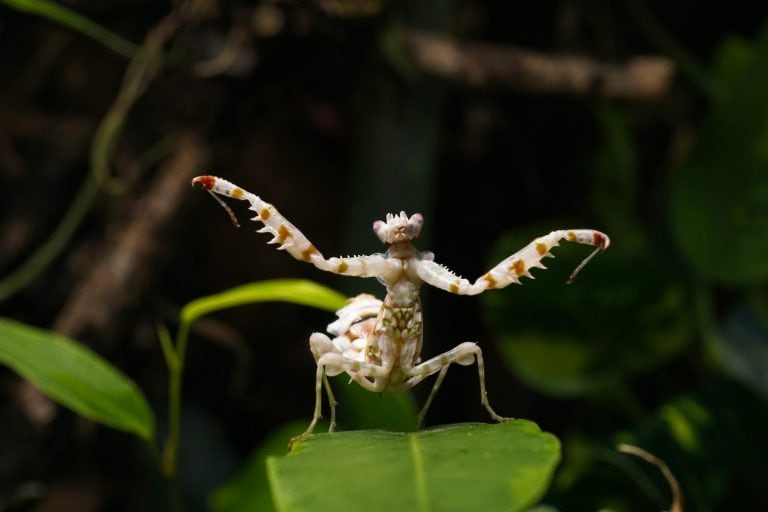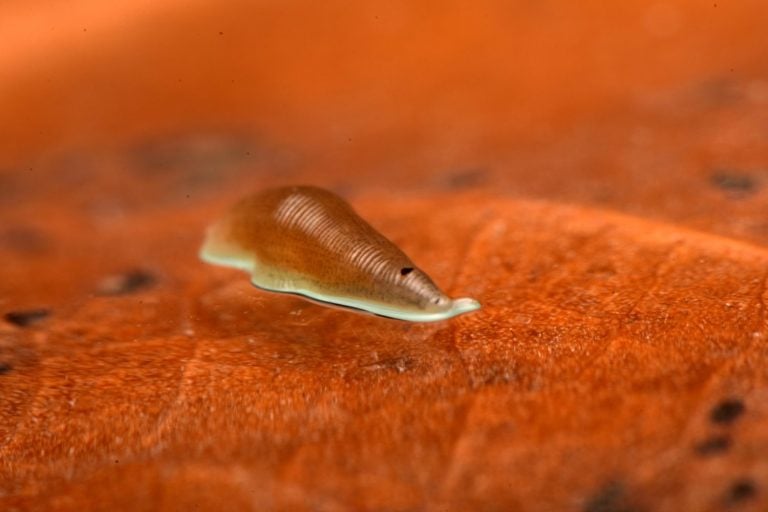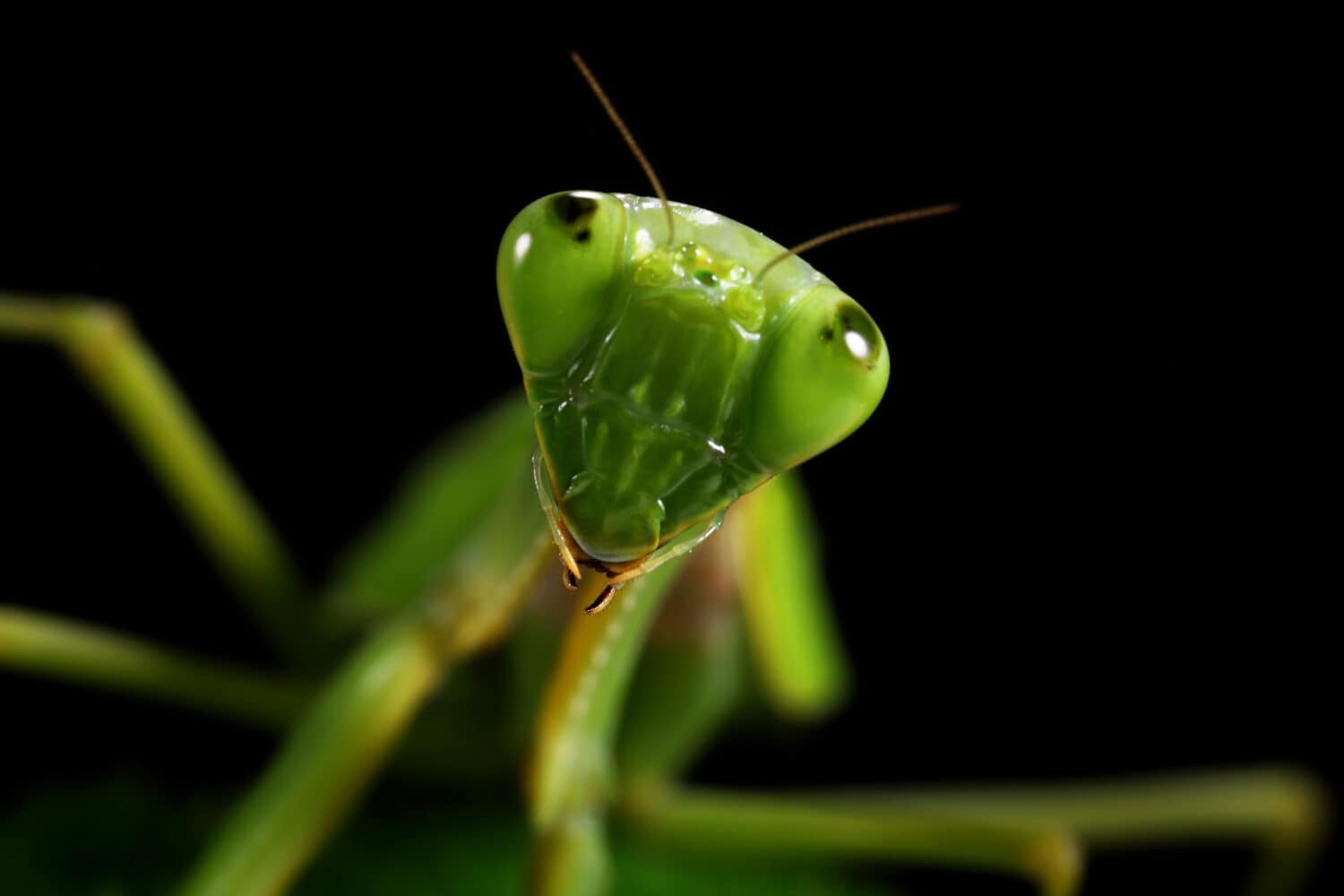

You’re not likely to witness a horsehair worm making its exit from a praying mantis, but if you do, it’s quite a sight. The spaghetti-like worm, under wet conditions, gradually wiggles out of its host mantis, writhing and twisting into loops. With horsehair worms growing up to 3 feet long, it’s extraordinary that they occupy the mantis, which is just a mere few inches long. How do they get into the mantis, and what are they doing there?!
What are Horsehair Worms?

All horsehair worms are parasites, relying on host animals for their lifecycle.
©Tomasz Grygorowicz/Shutterstock.com
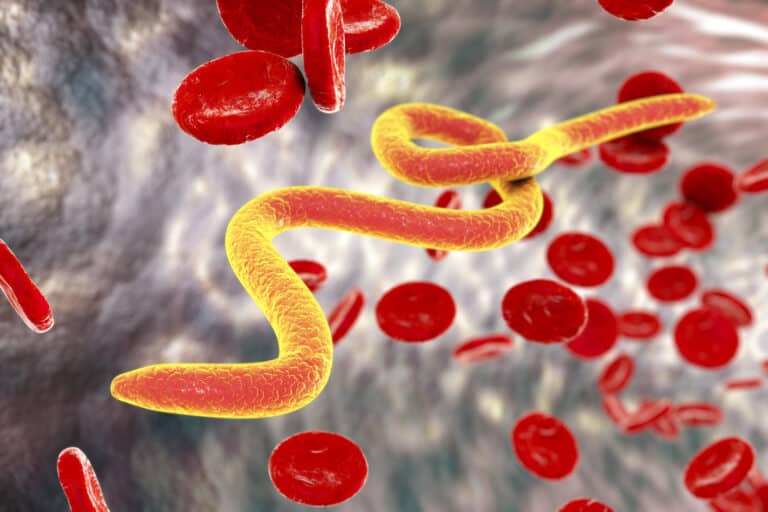
In the animal phylum Nematomorpha (“thread-shaped” in Greek), horsehair worms are long, slender aquatic worms (also called wire worms). Unlike earthworms, horsehair worms’ smooth bodies are not segmented. You can barely distinguish their slightly paler heads from their bodies. Though their common name adequately describes their shape, it was actually coined due to a misconception that they developed from the hairs of horses, springing to life in the water.
Greater than 350 species of horsehair worms are known to exist on every continent except Antarctica, in watery habitats including streams, rivers, lakes, wetlands, and even puddles after rainfall. If you hike on a rainy day, look for adult horsehair worms wriggling in leafy puddles or ponds. Most horsehair worms live in freshwater, but several marine species live in the sea, parasitizing crabs, lobsters, shrimp, and other crustaceans.
All horsehair worms are parasitic, relying on other organisms, mostly insects, for their survival. Hosts for horsehair worms are usually crickets and grasshoppers, but also include mantids, beetles, katydids, cockroaches, spiders, and crustaceans.
Horsehair Worm Life Cycle
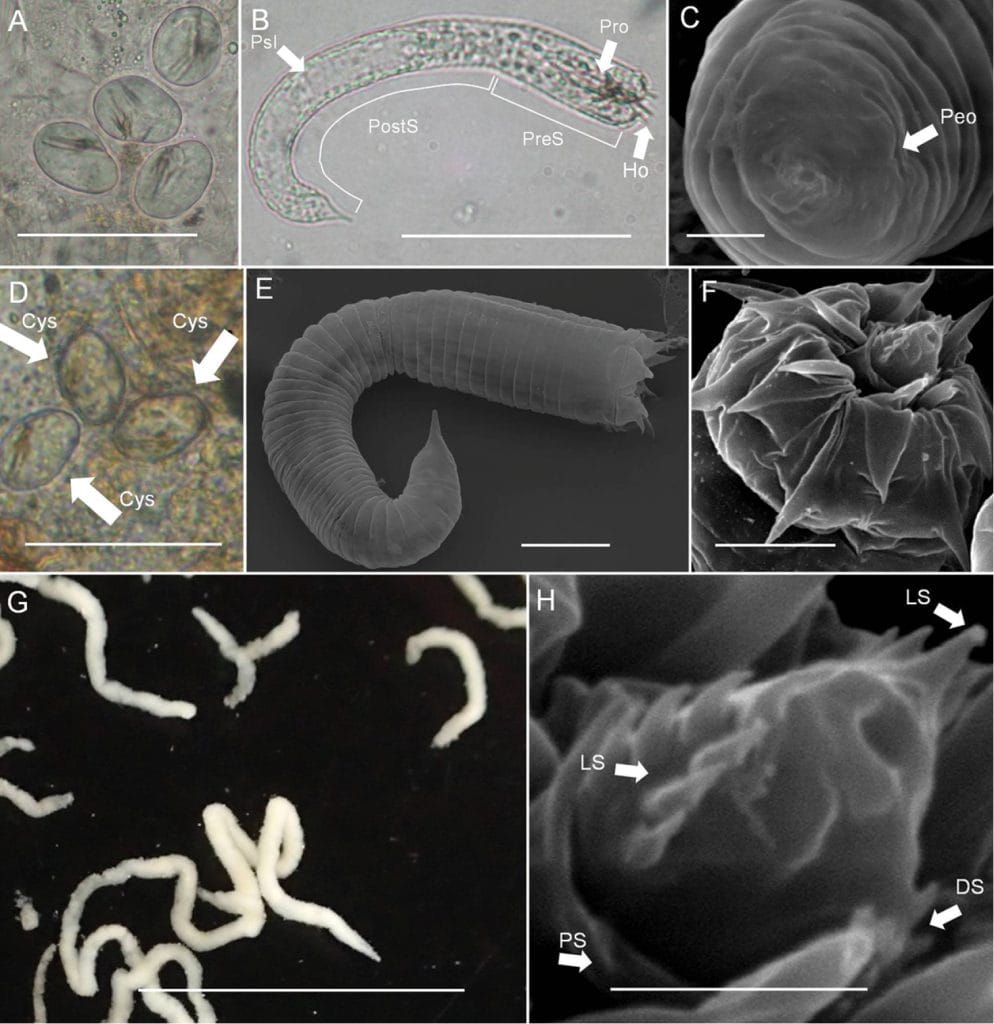
Various life stages of the horsehair worm Acutogordius taiwanensis.
©Chiu M-C, Huang C-G, Wu W-J, Shiao S-F (2017), CC-BY-4.0 – Original / License
The complex life cycle of a horsehair worm has four stages: free-living adults, eggs, pre-parasitic larvae, and parasitic larvae.
Adults
Adults are free-living in water and don’t feed, even if they live for many months. They lack working mouths, guts, and excretory systems. Their main goal is to mate and produce offspring. It’s hard to tell which is the head and tail of a horsehair worm. Females may have slightly larger rear ends, while male horsehair worms taper to a narrower point. A male looks for a receptive female, then wraps his body around her and drops his sperm near her body opening (cloacal pore) from where they may enter and fertilize her eggs.
During mating, groups of horsehair worms get all wound up together in knot-like balls. Another of their nicknames is Gordian worms, thanks to their resemblance—when tangled up in a mating ball—to a legendary Greek mythological Gordian knot. The males die shortly after mating, but the females survive to lay eggs.
Eggs
Horsehair females lay millions of eggs in water, which, depending on the species and conditions, may come out in strings up to 8 feet long, or sticky clumps stuck onto underwater sticks and leaves, or a set of floating strands. Microscopic aquatic larvae hatch from the eggs in as little as 7 or as many as 80 days, depending on the species, and have a lifespan of about two weeks. During this time, they achieve their sole job of finding hosts. They look nothing like the adults, as they are short and stubby with tiny, scaled heads.
Aquatic (pre-parasitic) larvae
Getting inside a host happens in two ways. Firstly, horsehair larvae may stick to vegetation, enclosing themselves in a cyst-like coating, and get accidentally ingested by a host. Once inside the host, they awaken from their cyst state and travel from the host’s gut to its body cavity, where they live on its nutrients. In situations where ponds dry up, a horsehair cyst stuck to a leaf may keep a larva alive, where it can get eaten by a terrestrial animal and revive into its parasitic stage. Known predators of horsehair worm larvae include frogs and various species of fish, such as sunfish and trout.
Secondly, the larvae may use hooked and barbed mouth structures to burrow into the host’s body, depending on the species. Some larvae have a sharp spike on their front end that’s used like a needle to poke through host tissues and enter the body cavity.
Parasitic larvae
What happens next depends on the type of horsehair worm and host. Horsehair worms require a large invertebrate host to complete their life cycle. Inside large, aquatic hosts, such as diving beetles, the larva can grow to their adult size—which nearly fills the host’s body cavity—in 4 to 20 weeks. They subsist on the hosts’ body tissues and fluids, although they’re thought to mostly absorb nutrients rather than eat them, since their digestive systems are simple.
Once mature, the worms burrow right through the host’s exoskeleton, which kills it. In some cases, horsehair worms will emit chemicals that change the host’s behavior, compelling it, for example, to seek water sources and even drown itself. The horsehair worm then exits into its required adult habitat, water.
Often, horsehair larvae have “intermediate” hosts. A larva enters a smaller host, where it remains dormant until the intermediate host is consumed by a suitable host insect. For example, horsehair larvae enter the aquatic larvae, or “midges” of tiny flies, and remain there dormant until the flies transform into adults and go onto land. When a terrestrial insect, such as a grasshopper, eats the fly, it ingests the horsehair larvae as well.
If horsehair larvae are eaten by an unsuitable host (basically anything that’s not an invertebrate), they may survive the experience and just leave the host’s body. Larvae have been observed exiting the gills, mouths, or noses of fish and frogs!
What About the Praying Mantis Host?
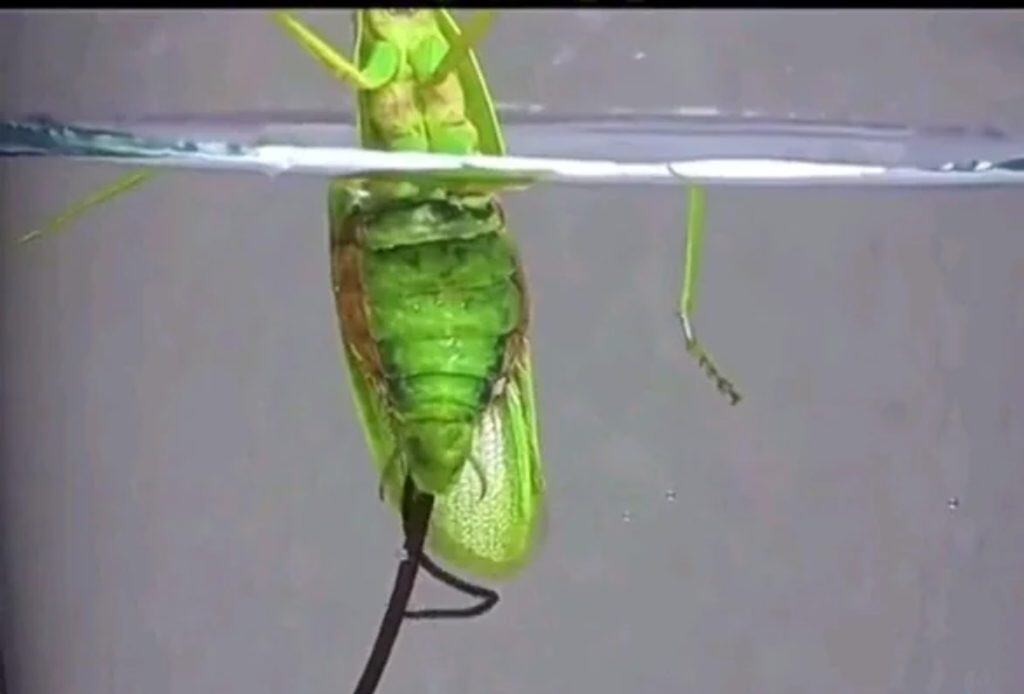
If not already dead from drowning, this mantis will die as the horsehair worm burrows out of its body.
© – Original
Praying mantises are an example of an insect parasitized by horsehair worms but accessed through intermediate hosts. When a praying mantis—a predatory insect—eats infected prey, such as a smaller insect, horsehair worm larvae end up in its gut. From there, the horsehair worm larvae enter the praying mantid’s body cavity and develop into adults.
When infected with parasitic horsehair worms, praying mantids are attracted to light reflecting horizontally off the surface of water, according to a study published in Current Biology. The mantids apparently follow the polarized light to ponds and rivers, where they jump right into the water. The mantid will likely drown, but the horsehair adult worm has found its perfect habitat. The study demonstrates that “parasites can skillfully manipulate these abilities to cause the host animal to exhibit behaviors that benefit the parasite,” according to the study authors.
A recent study published in Currents suggests that the horsehair worm makes proteins that alter the mantid’s nervous system, causing it to head for the water. In a fascinating twist, it appears that the parasitic worms may have stolen genes from the mantids at some point in their evolving relationship; 1,420 of the parasites’ genes were similar to those of their hosts and were activated during the suicidal march to water. Such “horizontal gene transfer” is known from bacteria. However, these study findings need to be confirmed, since it’s possible the genes detected were simply from mantid tissue absorbed by the parasites.
Are Horsehair Worms Dangerous?
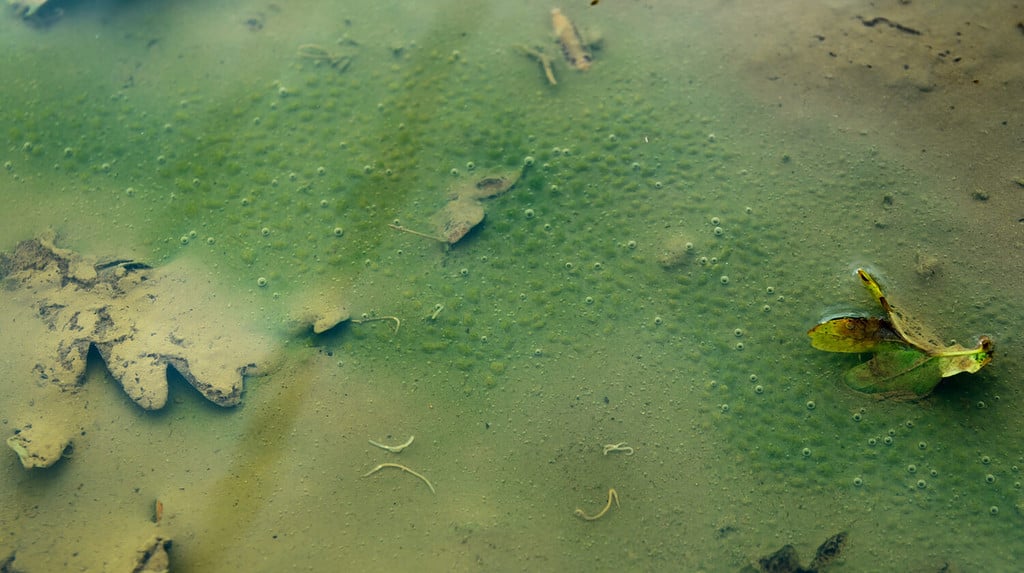
Adult horsehair worms are swimming around in this puddle looking for hosts, but they will not harm humans.
©Marek Polewski/Shutterstock.com
Because they only parasitize insects and other invertebrate animals, horsehair worms are harmless to us. That’s not to say that you would never accidentally ingest one (had any roasted crickets lately?), but if you did, it would just pass through your intestinal system. People do occasionally find horsehair worms in toilet water, shower stalls, dog bowls, or swimming pools where an insect host—such as a cricket—has released the worm.
On a positive note, horsehair worms help reduce populations of insects considered house pests, like crickets and cockroaches. The University of Maine Cooperative Extension posits that “no control measures are needed if you find one of these interesting worms.”