
Quick Take
- Sperm whales have a secret trick for staying suspended mid-ocean without sinking or floating away, and it's not what you'd expect. See how gas bubbles help →
- Scientists only recently figured out why one of the ocean's most powerful predators needs just 13-minute naps, and the reason changes how we think about whale sleep. Discover the 13-minute nap science →
- Resting sperm whales are actually in danger from boats, though not for the reason most people assume. See the boat danger risks →
- Sperm whales hang motionless near the surface despite having lungs that should make them float, which raises the question of how they fight their own buoyancy. Explore their buoyancy secret →
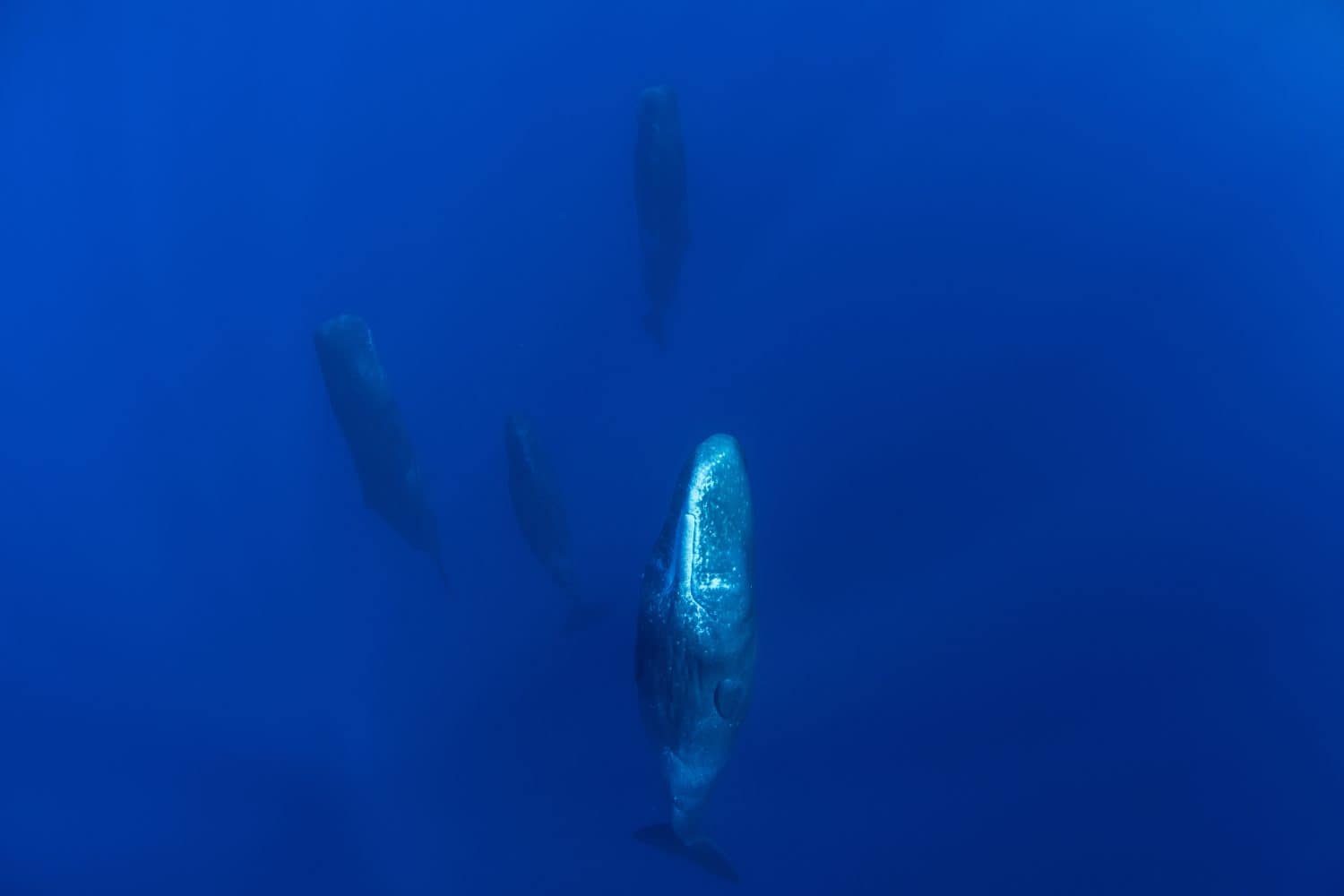
At first glance, these enormous shapes suspended vertically in the ocean look like something out of a science fiction movie. They barely move, hanging motionless beneath the surface like a fleet of submerged submarines. But these aren’t mysterious underwater objects. They’re sperm whales, and they’re taking a nap. As strange as it looks, this is a natural resting behavior for the world’s largest toothed whales. Even more fascinating, researchers recently discovered a clever trick that helps these massive animals maintain their unusual sleeping position.
Watch These Sperm Whales Sleeping Upright
Why Do Sperm Whales Sleep Vertically?
Most of us wouldn’t consider sleeping while standing upright particularly relaxing, but sperm whales have a different approach to getting some rest. These enormous marine mammals sometimes suspend themselves vertically just beneath the ocean’s surface, remaining nearly motionless for several minutes at a time.
In a 2008 study published in Current Biology, scientists used recording devices attached to sperm whales to document this unusual behavior. They found that the animals entered periods of passive drifting, often resting with their bodies nearly vertical. These resting periods lasted about 13 minutes on average.
The researchers also found that these resting dives accounted for approximately 7% of their recorded observation time. That doesn’t necessarily mean sperm whales sleep for only 7% of every day, since researchers cannot yet account for every possible form of rest. Still, the findings suggest that these animals may get much of their rest in relatively short sessions rather than one extended period of sleep.
How Do They Stay Upright Without Floating Away?
Here’s where things get especially interesting. In July 2026, researchers from the University of St Andrews and the Université de Neuchâtel published a study in the Journal of Experimental Biology that helped explain how sperm whales remain suspended beneath the surface while resting.
It turns out that sperm whales release gas bubbles to regulate their buoyancy. As a whale drifts upward, the gas inside its lungs expands, making it more buoyant. By releasing some of that gas, the whale can reduce its tendency to float upward and maintain a relatively stable position in the water.
Researchers studying tagged sperm whales off Norway found that animals performing these resting dives released bubbles, and their computer simulations supported the idea that this behavior helps control buoyancy. Scientists believe the vertical position may also allow the whales to rest beneath surface waves without expending the energy needed to descend into deeper water.
There are still unanswered questions about exactly how deeply sperm whales sleep and how their brains function during these periods. However, the discovery provides a fascinating explanation for how such enormous animals can remain suspended in the ocean with remarkably little movement.
Where Do Sperm Whales Normally Live?
Sperm whales are found throughout the world’s oceans, particularly in deep waters where their preferred prey is abundant. Although the location of this particular video isn’t established, these whales inhabit waters ranging from tropical regions to the edges of the polar ice.
They are extraordinary divers, routinely descending thousands of feet in search of squid, fish, and other marine animals. According to NOAA Fisheries, their hunting dives commonly reach depths of around 2,000 feet and can last approximately 45 minutes. Afterward, they return to the surface to breathe before diving again.
Sperm whales also inhabit the deep waters of the Gulf of Mexico, where scientists have documented resident populations. Their preference for offshore waters means that even in regions where they regularly occur, most people will never have the opportunity to see one in the wild, much less encounter an entire group resting together.
Are Sperm Whales Endangered?
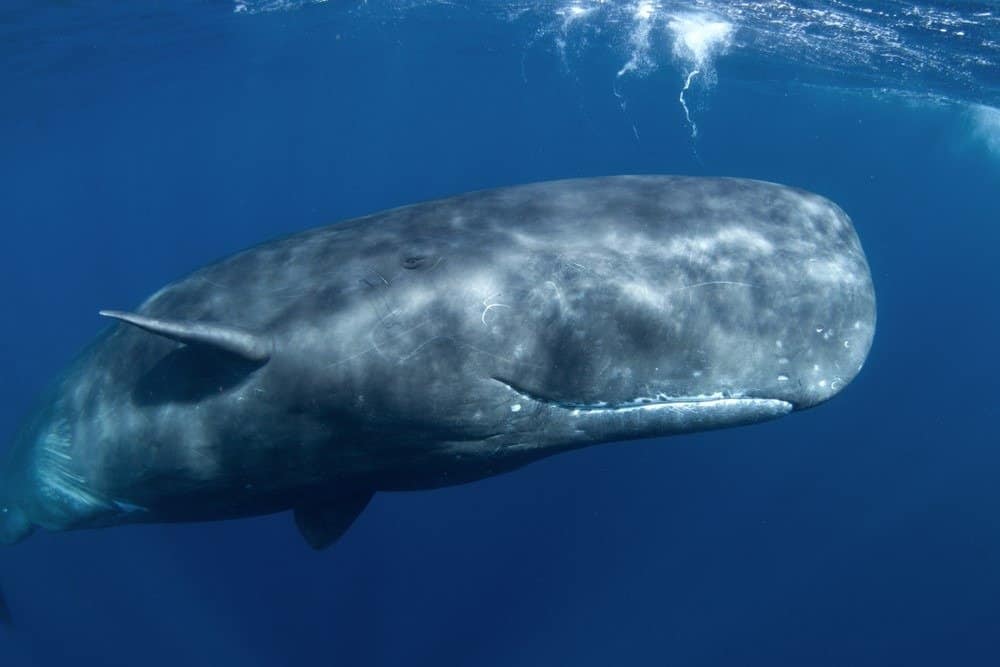
Sperm whales remain vulnerable globally and are federally listed as endangered in the United States.
©Martin Prochazkacz/Shutterstock.com
Despite their enormous size and worldwide distribution, sperm whales continue to face significant conservation challenges. The International Union for Conservation of Nature reaffirmed their Vulnerable classification in its 2025 assessment. In the United States, they receive additional protection as an endangered species under the Endangered Species Act.
Commercial whaling devastated sperm whale populations during the 19th and 20th centuries. Although that industry is no longer the primary threat, modern dangers include collisions with vessels, entanglement in fishing equipment, marine pollution, and underwater noise that can interfere with whale communication and behavior.
The unusual sleeping behavior shown in this video also highlights why giving marine mammals space is so important. Resting whales may be less responsive to approaching vessels, making unnecessary disturbances particularly dangerous. Anyone fortunate enough to encounter sperm whales in the wild should observe from a safe, legally permitted distance without attempting to approach or interrupt their rest.