
Quick Take
- Lobtailing involves whales lifting their tails from the water and forcefully slapping them against the surface. Explore the theories →
- Whales may use lobtailing to help gather prey or communicate with other whales. See what context reveals →
- Humpback whales are the species most commonly associated with lobtailing, but several other whale species do it too. Find out which whales →
- More solitary whale species are less likely to use lobtailing than those that regularly interact with other whales.
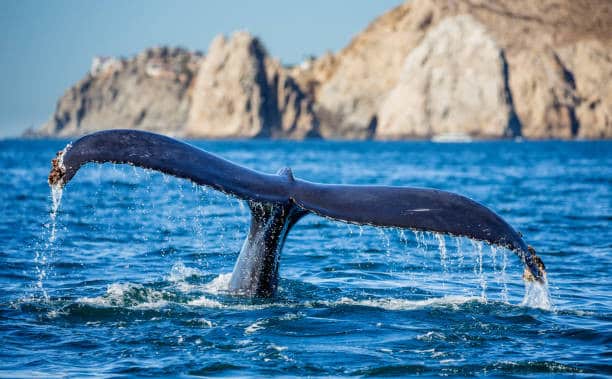
Whales are known for a wide range of impressive behaviors at the surface of the ocean, such as breaching and spy hopping. They are also known to lift their tail above the water and slap it back down forcefully, which is known as lobtailing. Whales have immense power, and the force of the slap creates a large splash. You can see this act in the Instagram post linked above. While it might look like simple playful behavior, there’s actually much more to it.
Why Do Whales Lobtail?
Whales are incredibly powerful animals, and lobtailing is just one display of this strength. When lobtailing, whales position themselves vertically downwards and lift their tail out of the water. They then bring their tail crashing down on the surface, often repeatedly, creating a large splash and a loud sound. Scientists aren’t entirely sure why whales lobtail. However, they theorize that there are several different reasons for the behavior.
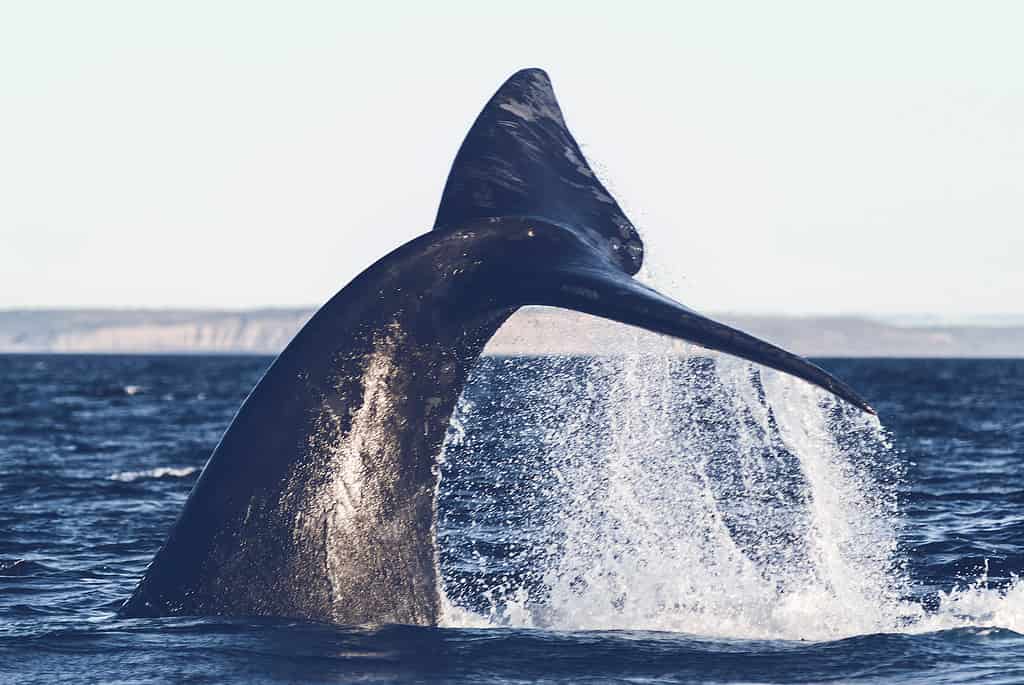
Lobtailing can be used to herd prey into a tighter group.
©Foto 4440/Shutterstock.com
One of the main theories for lobtailing is that it is used as a hunting strategy. The loud slap of the tail on the water scares the fish, which gather into tighter shoals for easier hunting. This can be particularly useful for whales that hunt in pods, as keeping prey close together makes it easier for several whales to feed at the same time.
Another theory is that lobtailing is used for communication. Whales use a lot of power when they slap the water with their tail. In general, the more forceful the slap, the louder the sound. Typically, sound travels four times faster in water than in air, meaning the sound can be heard at great distances underwater. In this way, the act can be used to warn other whales of danger. It can also be used to establish dominance or to gain the attention of other whales during the breeding season. Lobtailing can also be used to communicate within a pod by signaling to other members where they are. Ultimately, a tail slap can have different meanings depending on context.
Do All Whales Lobtail?
Lobtailing is actually only associated with a few species. Humpback whales are the most commonly known to lobtail. However, species such as gray whales, orcas, North Atlantic right whales, southern right whales, and North Pacific right whales have also been seen lobtailing.
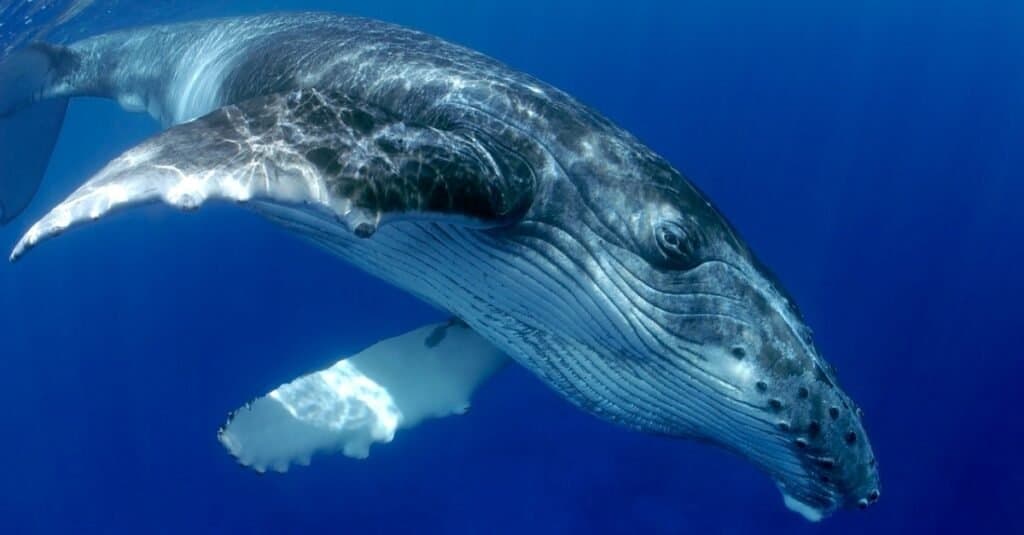
Lobtailing is most closely associated with humpback whales.
©iStock.com/Yann-HUBERT
It’s not entirely understood why only some species of whales lobtail, but the act might correspond to social structure and hunting behavior. Humpback whales, for example, also use a surface feeding behavior known as bubble-net feeding. This involves a group of whales working together to gather fish into a group. After releasing bubbles, the whales lunge into the fish at the surface. Sometimes lobtailing is used as a precursor to bubble-net feeding. The behavior can begin gathering the fish before the whales release the bubbles, as humpbacks are also lunge feeders.
Of course, not all of the whale species that lobtail are doing it for the purpose of feeding. Some might be bottom feeders or might feed on prey other than fish. Instead, these whales likely use lobtailing for communication purposes. Additionally, species that are more solitary often don’t use lobtailing at all. For whales that spend much of their lives alone, there are fewer situations where they need to communicate with other whales.