Quick Take
- Researchers dressed men and women identically, controlled for height, and hid long hair, yet birds still treated them differently. See the study setup →
- The pattern held across 37 species in five different countries, ranging from bold pigeons to skittish magpies. View results across species →
- Scientists have three leading theories for why birds react this way, though they are not sure any of them are right. Explore possible explanations →
- The results have researchers questioning a basic assumption made in nearly every wildlife behavior study ever conducted. See what comes next →
Urban birds are everywhere: in parks, on street corners, in neighborhood trees. They typically take flight when approached by a human. But how long do they stick around before flying off? Turns out, that depends on the gender of the person approaching.
Research recently published in the journal People and Nature suggests that birds, including great tits, house sparrows, and blackbirds, tend to fly away sooner when approached by women than by men. The study results raise new questions about how birds perceive people.
How Was the Study Conducted?
The study took place in five different European countries, including France, Spain, the Czech Republic, Poland, and Germany. In each test, four women and four men were selected based on similar heights, then dressed in similar clothing. Each of them walked directly toward birds in city parks and other areas with trees and grass.

The study took place across five countries, focusing on birds in city parks and green spaces.
©John_T/Shutterstock.com
The study ran from April to July 2023, typically in the morning hours just after sunrise. The men and women selected to participate were all expert bird scientists, and anyone with long hair had it hidden. Typically, the subjects walked towards single birds that were feeding or relaxed, with 82 percent of the birds being solitary.
What Did the Study Show?
The men in the study were typically able to approach about one meter closer than the women before the birds flew away. The average was 8.5 meters for women versus 7.5 meters for men. The results also showed that male birds were bolder than female birds overall.
The researchers labeled the distance a person could get before the bird took off the “flight initiation distance.”
The study results showed the same pattern across all countries and all 37 bird species studied. The birds included easily-startled magpies and pigeons.
Are Birds Really More Afraid of Women?
The researchers do believe that city birds can distinguish between male and female humans. But they aren’t sure which characteristics, exactly, the birds recognize. They also don’t know why birds appear more cautious around women.
“I fully believe our results, that urban birds react differently based on the sex of the person approaching them, but I can’t explain them right now. We used cutting-edge comparative analysis techniques that showed our findings were consistent across cities and species, but we simply don’t have a conclusive explanation yet,” Professor Daniel Blumstein of the University of California, Los Angeles told Science Daily.
The female researchers involved in the study were surprised by the results.
“As a woman in the field, I was surprised that birds reacted to us differently. This study highlights how animals in cities ‘see’ humans, which has implications for urban ecology and equality in science. Many behavioral studies assume that a human observer is neutral, but this wasn’t the case for urban birds in our study,” Dr. Yanina Benedetti of the Czech University of Life Sciences Prague told Science Daily.
What Could Cause the Different Reactions?
The researchers aren’t sure what is behind the surprising results. One theory is that the birds are reacting to chemical signals, like pheromones. Another is that the birds observe variations in body shape or differences in how men versus women walk.
But they caution that, at this point, they cannot draw any conclusions with certainty. They point out that additional research and experiments will be needed to try to pinpoint a cause.
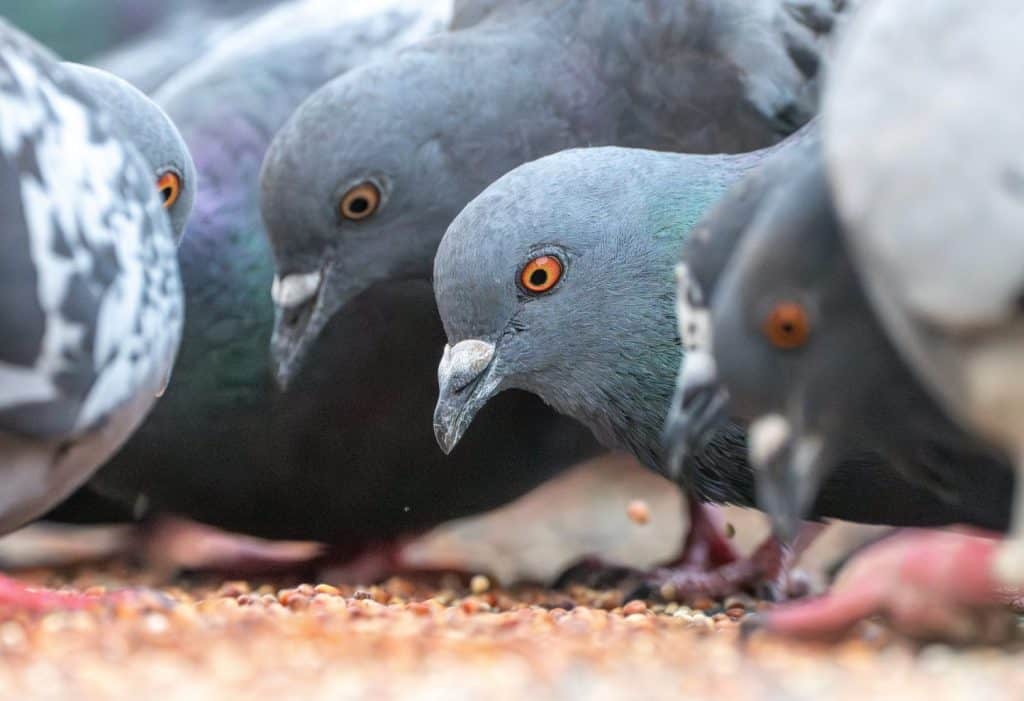
The study included several species of birds, including pigeons.
©Cami Johnson/Shutterstock.com
“This is maybe the most interesting part of our study,” Dr. Federico Morelli from the University of Turin and a co-author of the study, told Science Daily. “We have identified a phenomenon, but we really don’t know why. However, what our results do highlight is the birds’ sophisticated ability to evaluate their environment.”
The research team thinks it is possible that urban birds are more sensitive to human characteristics than humans are. While people may not notice subtle differences among other people, birds might be aware of these differences. Figuring out what those signals are could help future researchers identify how wildlife determines threats in the environments they share with humans.
“Urban birds clearly react to subtle cues that humans do not easily notice. Follow-up studies could focus on individual factors such as movement patterns, scent cues, or physical traits, testing them separately rather than grouping them under observer sex. This approach would help identify the specific cues birds detect,” Benedetti told Science Daily.
What’s Next?
This first study included 2,701 unique observations. However, the research team notes their findings are still preliminary. They say that future studies will be necessary to determine if the different bird responses to women and men translate to other environments and populations.
For now, the team is content with the possibility that city birds are paying more attention to people than anyone ever thought.