Quick Take
- A team of four specialists attempted a procedure no one had tried on a wild bird, and it took far longer than anyone would guess.
- One tip about a federal permit led to something no one in the region had before. What changed for a tribe's traditions?
- Why do these birds get sick first, and what does that warn us about?
When Beauty, a bald eagle, arrived in care after being shot in the beak, her injuries were devastating. For many, the damage would have seemed impossible to overcome. But for Janie Veltkamp, founding director of Birds of Prey Northwest, Beauty represented something else: a reason to try.
Beauty and Her Beak
“When I first met Beauty in Alaska, I remember thinking, why not try a 3D prosthetic beak on this special bald eagle in need?” Veltkamp says. “We put prosthetics on children and veterans — why not a bald eagle? 3D printing was new at the time and offered a new way in animal prosthetics.”
That instinct — equal parts compassion, creativity, and refusal to give up too soon — became the beginning of one of the most remarkable wildlife rehabilitation stories in recent memory.
Beauty’s case later drew national and international attention after she received a 3D-printed prosthetic beak, an innovation that helped show what might be possible when science, advocacy, and persistence come together. But the process was anything but simple.
“To approach this procedure, which had never been attempted before, I flew Beauty the eagle to Idaho and assembled a Beauty Team,” Veltkamp says. “It included a veterinarian, a dentist, a mechanical engineer, and myself, a raptor biologist.” This bold, cross-disciplinary collaboration demanded patience at every step. “It took us 18 months to create a working prototype,” she says. “Beauty had to be awake for the three-hour procedure to ensure the fit was perfect.”
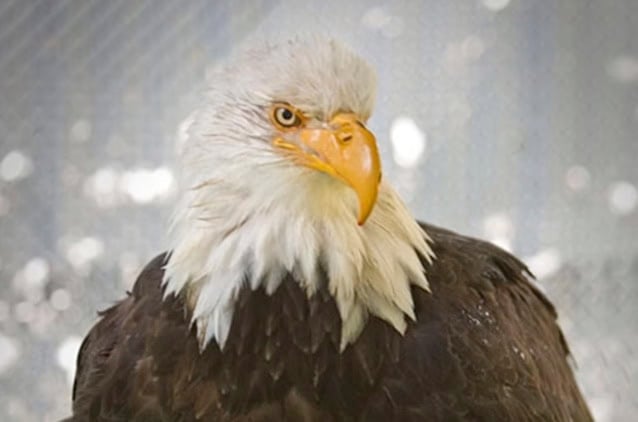
Beauty and her beak.
Even now, the details are astonishing: an injured wild bird, a team of specialists, a procedure no one had tried before, and technology still in its relative infancy, adapted for animal care. For Veltkamp, the experience reinforced a lesson she has carried throughout her work.
“Through it all, I learned that solving a problem through advocacy and persistence can pay off,” she says.
That mindset has shaped far more than one eagle’s recovery. It runs through the broader mission of Birds of Prey Northwest, where Veltkamp’s unusually varied background has helped define her approach to rehabilitation and education. “My unique background offers an unusual skill set which ultimately benefited birds of prey,” she says.
A Life Dedicated to Raptors
©Sanket C Bokil/Shutterstock.com
Veltkamp brings together experience as a raptor biologist, a nurse, and a master falconer — roles that might seem unrelated at first glance but, in practice, give her a rare perspective on caring for injured raptors.
“Falconry taught me the caring and training of these magnificent birds of prey — each unique as an individual,” she says. She explains that her nursing degree and training at the Gabbert Raptor Center at the University of Minnesota “provided a way to treat and manage these unique patients medically.”
Her academic work deepened that foundation even further. “My master’s degree from Purdue University allowed me to better understand the habitat requirements that the bald eagle in North America would need to thrive after recovering from endangered status,” Veltkamp says.
- Least Concern LC
- NT Near Threatened
- VU Vulnerable
- EN Endangered
- CR Critically Endangered
- EW Extinct in the Wild
- EX Extinct
Population trend: Increasing
That blend of hands-on handling, medical knowledge, and ecological understanding helps explain why Birds of Prey Northwest has become known not only for rehabilitation, but also for its broader commitment to conservation and public education.
One of the most meaningful examples of that wider mission is the organization’s partnership with the Coeur d’Alene Tribe, which helped lead to the tribe’s first eagle aviary. “Since I moved to north Idaho 25 years ago, I have enjoyed a mutually beneficial partnership with the Coeur d’Alene Tribe,” Veltkamp says.
The project grew out of both relationship-building and timely awareness of a new federal opportunity. “When I learned of a newly created federal permit offered by the U.S. Fish & Wildlife Service to the national Native American tribes, I quickly informed the biologists in their natural resource department,” she says.
From there, the collaboration moved forward in practical and culturally important ways. “Together we moved forward to build aviaries here at Birds of Prey NW to house non-releasable eagles until their newly constructed aviaries were ready to house both bald and golden eagles for the sole purpose of collecting natural molted eagle feathers for their cultural ceremonial use,” Veltkamp says.
The result was more than a facility. It met a real community need with dignity and respect. “This allowed tribal members immediate access to the feathers rather than a long wait from the federal repository in Colorado,” she says. That story reflects something central to Veltkamp’s work: raptor care is never only about the birds in isolation. It is also about habitat, culture, human responsibility, and the relationships communities build around conservation.
The Bigger Picture

©neil bowman/iStock via Getty Images
When asked what she most wants people to understand about raptors and the threats they face, Veltkamp goes straight to connection. “I want people to understand that healthy birds of prey populations benefit human populations,” she says.
That point is both ecological and deeply practical. Raptors, she explains, indicate environmental health. “We learned from the once-endangered eagles, ospreys, and peregrine falcons that these birds are bio-indicators,” Veltkamp says. “They tell us how well we are taking care of the habitats that we all depend on — falling ill first when we pollute and mistreat the environment.”
In other words, when birds of prey are in trouble, people should pay attention. Their struggles often reveal larger problems in the ecosystems that wildlife and humans share. That belief is one reason education remains such an important part of Birds of Prey Northwest’s mission. Rehabilitation may happen one bird at a time, but lasting protection depends on what people learn and choose to do next.
“That’s why we offer several types of interactions [where] the public can view our birds under our care through appointments for tours here and off-site programs with our educational ambassadors in the classroom and other public programs,” Veltkamp says.
For visitors, those encounters offer something powerful: the chance to see these birds not as distant symbols, but as living creatures whose survival depends on informed, sustained stewardship.
“We learned from the once-endangered eagles, ospreys, and peregrine falcons that these birds are bio-indicators. They tell us how well we are taking care of the habitats that we all depend on — falling ill first when we pollute and mistreat the environment.”
Janie Veltkamp, founding director of Birds of Prey Northwest
A Landmark Moment in Wildlife Care
Beauty’s story points to a larger truth about the work Veltkamp has spent decades doing. Rehabilitation is rarely neat; conservation is rarely quick. Meaningful change often begins with someone willing to ask an unusual question — and keep going until an answer takes shape. In Beauty’s case, that question was simple: if prosthetics can help humans rebuild their lives, why not try the same for a bald eagle?
For Veltkamp, the answer became a landmark moment in wildlife care. For the public, it became a story of resilience. And for the birds still arriving in need, it remains part of a much longer commitment to innovation, protection, and the belief that even in the most damaged lives, recovery may still be possible.