
Quick Take
- Falling from a greater height can actually reduce a cat's chance of injury, and the physics behind it are more surprising than you'd expect. See how terminal velocity helps →
- Cats don't just 'land on their feet' by luck. Their bodies execute a precise multi-step reflex that most owners have never heard of. Explore the righting reflex →
- One common scenario makes a cat far more likely to skip its own survival instinct entirely, and it is not the one most people worry about. See when instincts fail →
- A cat once survived a fall most humans wouldn't walk away from, and the way it pulled it off defies what vets initially expected. Read the survival story →
While cats may have nine lives, their fondness for heights might not always end in them landing on their feet. Sometimes curiosity really does kill the cat. However, many cats reported to have fallen from second-floor windows, trees, and high-rises manage to survive, which raises the question: how far can cats fall without getting hurt? Higher falls usually give cats time to position themselves for landing, called terminal velocity. However, this does not mean it’s a guarantee, and owners should never let their furry friends sit at open windows on higher floors — especially older cats or kittens, who are more susceptible to injury.
Are Cats Always Injured When They Fall?
Many owners are shaken when their cat falls from a tree, second-story building, or high-rise, but then they walk away as if nothing happened. However, it is important to note that the cat could hide its pain, so it needs to see a vet for a check-up. It’s hard to say what could cause a cat to hurt itself during a fall, but factors include:
- Senior cats or kittens are more prone to injury because they have weaker bones.
- Cats that are overweight have a greater chance of hurting themselves.
- The area where they land is a huge factor. Softer surfaces reduce the risk of injury.
- Falling from higher positions sometimes results in fewer injuries.
Cats can survive falls from great heights because of the strength of their legs. While their legs don’t seem very strong, they are full of muscles. In addition, their paw pads play a role in landing as they are natural shock absorbers. Therefore, the impact spreads evenly over the entire body when they land on their feet.
Why Do Cats Always Land on Their Feet?
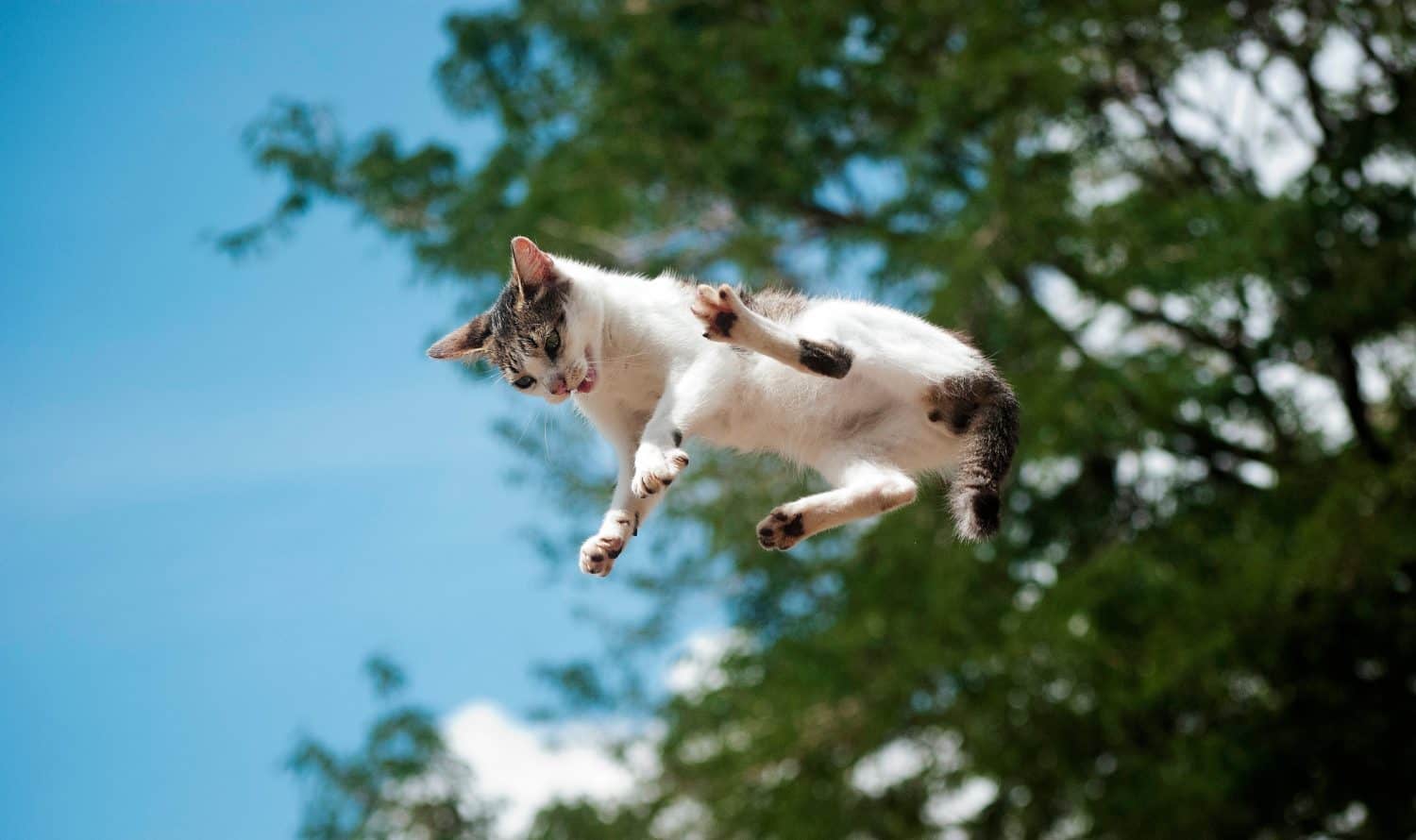
Firstly, cats don’t always land on their feet. However, generally, if they fall from a considerable height, they will position themselves to land on their paws. Cats perfect this technique as kittens. It’s called a righting reflex. For example, when a cat falls, the vestibular apparatus in its ears naturally enables the cat to balance itself. When falling, cats instinctively follow a process; the steps include:
- Realization of the fall
- Bending their torsos inward into a V-shape
- Rotating the body by tucking the front legs and extending the rear legs
- Completing a second rotation by folding the back legs and extending the front legs
- Making a 180-degree turn by rolling
The cat will do this several times to ensure they land on their feet. Unfortunately, this does not guarantee a safe landing, as it also depends on the cat’s physical condition and the landing surface.

If cats fall from a considerable height, they will position themselves to land on their paws.
©Vikafoto33/Shutterstock.com
Falling Off High Items in Homes
It’s hard to keep your cat off high furniture in your home. They are curious natural-born climbers and are often found on top of closets, refrigerators, and kitchen cabinets. But falling from high items in the house rarely causes injury. For example, the height of a ceiling in an American home is generally 8 or 9 feet, and cats can leap approximately 8 feet. Therefore, cats can typically jump from near ceiling height to the floor, or vice versa. However, not all cats are safe from falling in a home. Older cats generally have degraded cartilage in their legs, making it uncomfortable or painful to jump. As a result, if they fall, there is a good chance injuries can occur. So, if you have an older cat that still loves to climb, you can prevent them from getting hurt by placing soft landing spaces, like cushions, under their favorite spots.
Falls from Trees
Unfortunately, cats falling from trees are more problematic than falling from furniture. The environment is different. Anything can happen, such as the cat being startled by a sudden noise. In a stressful situation, the cat’s instincts can be impaired. Furthermore, trees are not smooth or flat with horizontal surfaces, making falls more probable. While it’s easy for a cat to clamber up a tree chasing prey, it might not realize how high it’s climbing. Once it realizes how high it has climbed, it may get stuck and refuse to come down. Cats also enjoy falling asleep in trees and might lose their balance. Some cats don’t wake up in time to use their righting reflex, causing injury or death.
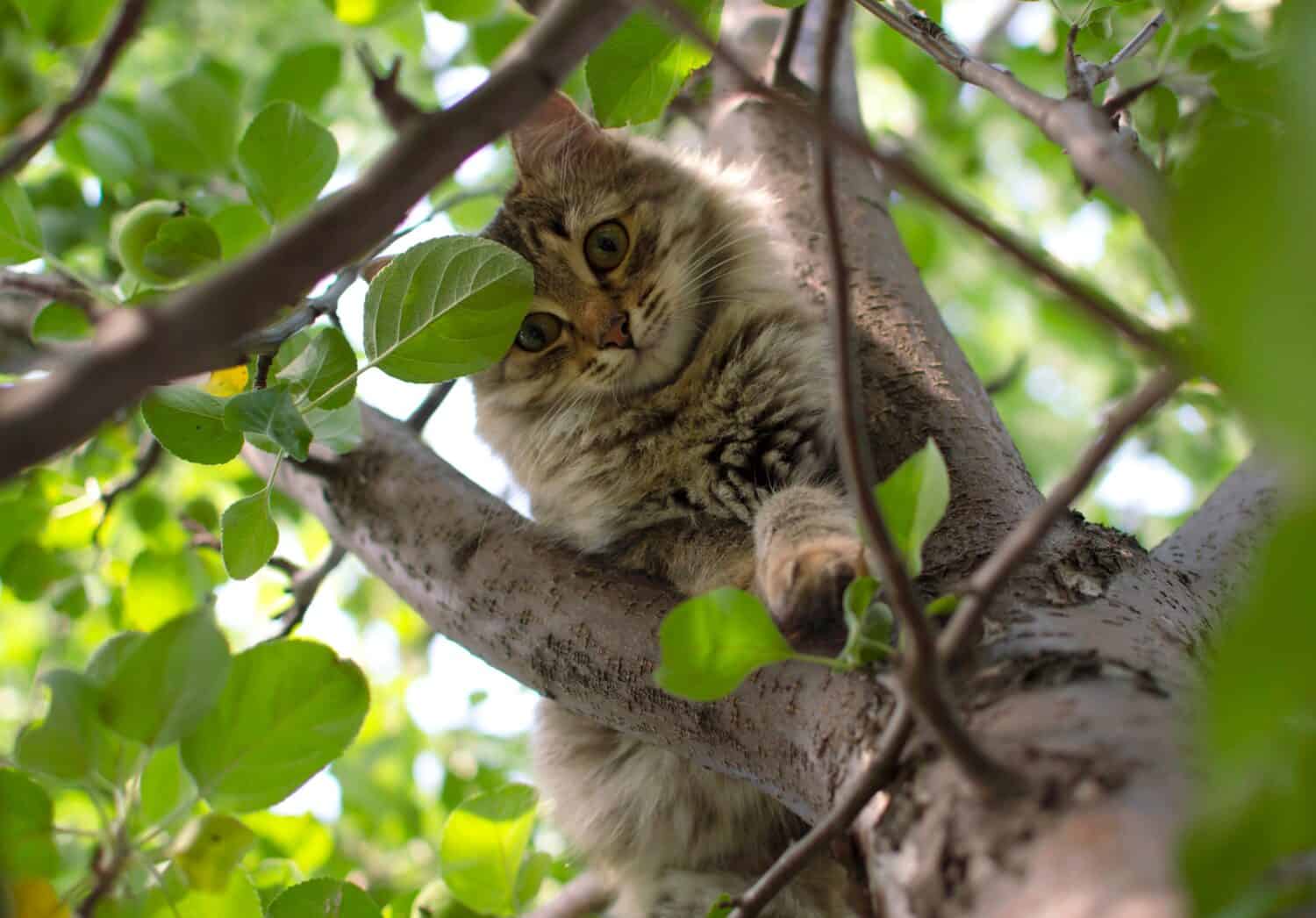
In a stressful situation, the cat’s instincts can be impaired.
©Inna_Kandybka/Shutterstock.com
Falls From a Second-Floor Landing
As mentioned above, cats can leap up to 8 feet, roughly the same height as a ceiling in a single-story house. However, if they fall from a second-floor landing, it is around twice as high as they can comfortably leap. Therefore, there is a possibility a cat can get hurt if it falls from a second story. Healthy cats of average weight should spread their bodies to distribute the impact of the landing evenly. If they do this, they will be shaken, but recovery is likely.
However, overweight or older cats are more susceptible to injury as their weaker bone structure may result in fractures or breaks. The most common injuries include limb fractures — particularly of the tibia and radius or ulna — as well as jaw and pelvic fractures. Lastly, the outcome will depend on the cat’s reflexes. If they don’t have enough time to implement the righting reflex, injury is certain.
Falls from High-Rise Buildings
There is a name for cats that fall from a height of at least two storeys: high-rise syndrome. Surprisingly, cats are more likely to survive falls from greater heights, although scientists have found that falls from the seventh or higher stories were associated with more severe injuries, especially thoracic trauma. Researchers surveyed 132 cats that fell from an average height of five stories. Only 37% needed emergency treatment, 90% experienced blunt force trauma, 30% required non-emergency assistance, and some didn’t require treatment. Additionally, 90% of the injured cats that saw the vet survived. The reason for this miraculous result is terminal velocity.
Cats that fall from a height of at least two storeys are said to have high-rise syndrome.
©Pimonpim T/Shutterstock.com
What Is Terminal Velocity?
Feline terminal velocity is the maximum speed a cat reaches when falling from great heights with its limbs extended. Therefore, when a cat falls from a high-rise or tall building, it will reach terminal velocity, slowing its fall. This increases the likelihood of survival, and there is less chance of injury. Unlike humans, cats are lighter and fall at a speed of 60 mph. This gives them more time to position themselves for impact. Once the cat achieves terminal velocity, it will relax its body and extend its limbs. It is very similar to the effect of a parachute, which slows the fall. Additionally, the cat’s natural instincts will trigger its righting reflex. However, no matter how prepared the cat is, the shock from a fall from great heights is very dangerous, and injuries can be fatal.
What Is the Highest Fall a Cat has Survived?
The highest fall a cat has survived occurred in New York when a cat fell 32 stories, or roughly 384 feet, from a high-rise apartment building. Astonishingly, the cat only had to endure two days of treatment before it was sent home. Vets believed it spread its legs to reach terminal velocity and landed on its belly. As a result, it prevented its legs from shattering but suffered a mild lung puncture and a chipped tooth. She made a full recovery.
In April of 2025, a 12-year-old tabby cat named Mirage survived a nearly 400 foot fall from a cliff in Bryce Canyon National Park, which left her owners dead. Mirage was found still in her carrier. She suffered broken ribs and teeth, but made a full recovery and was adopted by her rescuer, a Utah Department of Public Safety pilot who flew her to safety.