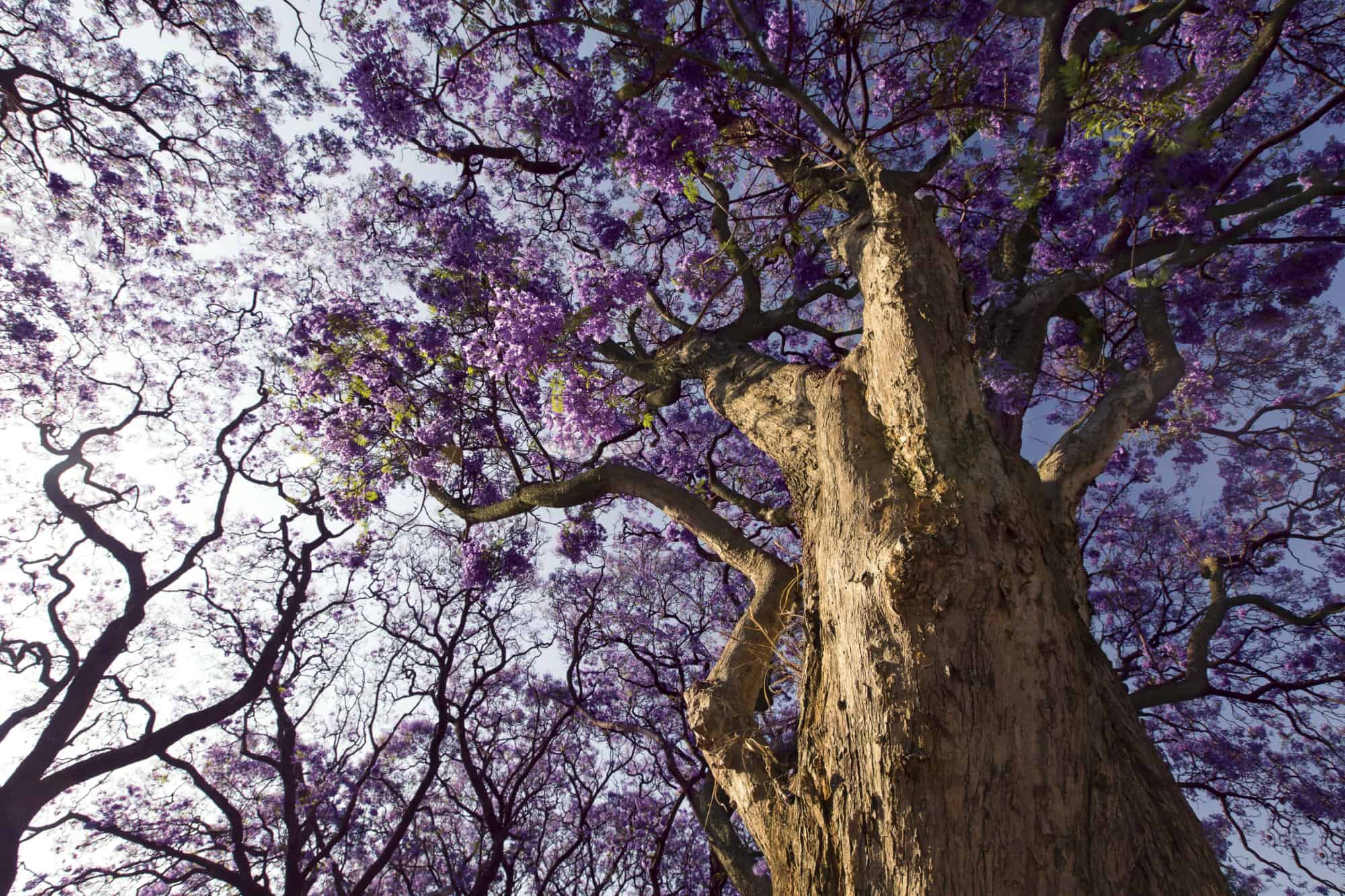

Jacaranda trees are known for their height and spreading canopies, but more so for their brightly colored blooms, making them a beautiful flowering Bonsai tree type. These blooms, which appear throughout the spring and summer and last for months, are usually shades of blue and purple. There are cultivars that boast yellow and red blooms, too!
It is this majestic appearance that makes jacaranda a popular, and beautiful choice, for Bonsai tree art! Read on to discover everything you need to know about growing a jacaranda Bonsai tree!
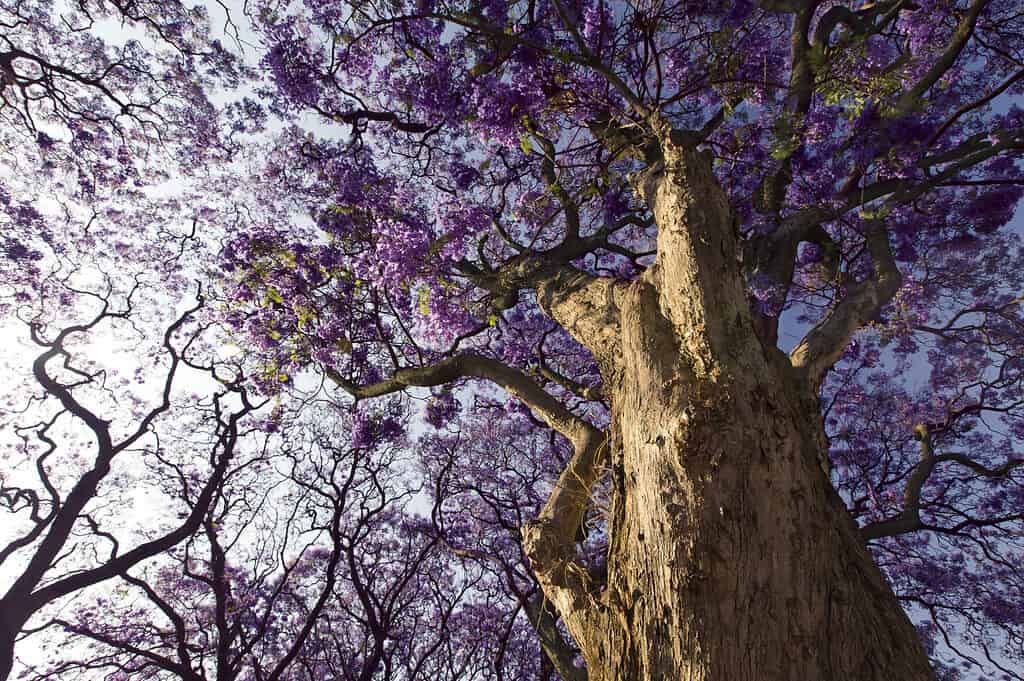
The natural beauty of jacaranda trees make them perfect for Bonsai tree art!
©Alta Oosthuizen/Shutterstock.com
| Jacaranda Bonsai Tree Information | |
|---|---|
| Botanical Name | Jacaranda Mimosifolia |
| Common Types | Blue Jacaranda, Bonsai Blue, Boxwood Jacaranda, Purple Fern Jacaranda, Yellow Jacaranda, Jacaranda jasminoides, Jacaranda jasminoides ‘Maroon’ |
| Sunlight | Full sun, though some types and cultivars can grow in partial sun and partial shade |
| Soil | Sandy, gritty, loamy, well-draining. Most prefer moist. |
| Water | Thorough watering during first growing season. Keep rootball moist but be wary of overwatering as well as underwatering. |
| For Beginners? | Yes! Jacaranda Bonsai trees grow strong and pruning is rather straightforward. |
| Indoors or Outdoors? | Outdoors in warm, tropical regions. Indoors when temperatures fall below 60F. |
| Pairs Well With… | Rocks and moss, other natural ornamentation |
Common Types of Jacaranda Bonsai Trees

Your jacaranda Bonsai tree will produce beautiful flowers when properly cared for.
©Tamara Kulikova/Shutterstock.com
Jacaranda trees are native to tropical regions. They can be found in South America as well as the islands in the West Indies. Because of their beauty, they are grown all over the world, though. For the most part, most jacaranda trees have similar appearances: bright purple or blue blooms nestled amongst long, fern-like leaves colored just as vividly green. Some types have maroon or yellow blooms! Some are tall, and some are small, but all jacaranda trees are beautiful.
Here are the most common types of jacaranda trees!
Blue Jacaranda
Indigenous to South America, blue jacaranda is one of the most popular types of jacaranda trees. Because of their beauty, they have been planted across the world. The blue-purple flowers on these trees bloom in the spring and summer. Once they have bloomed they last for about two months. The wood is pale, usually a grayish color, and soft to the touch.
Blue jacaranda trees enjoy persistent moisture. They can grow in just any soil condition as long as that soil is well draining. They thrive beneath full to partial sun.
Bonsai Blue
The jacaranda Bonsai blue is a dwarf variety of the otherwise tall jacaranda tree. As with other jacaranda trees, the flowers on these trees are particularly showy. They are small and tubular, often in shades of purple. The vivid green leaves on this tree look like fern leaves. They take well to pruning. Because of their small size and hardy foliage, jacaranda Bonsai blue trees are perfect for Bonsai tree art. It’s even in the name!
Once established these trees are tolerant of drought and heat. Bonsai blue trees need to be watered deeply during their first growing season, though. This ensures an extensive root system. They love moist, well-draining soil.
Boxwood Jacaranda
Boxwood jacaranda trees are native to Cuba, Haiti, the Dominican Republic, and the Bahamas. They are also common in the state of Florida. The flowers on Boxwood jacaranda trees bloom throughout the spring and summer, instead of all at once. They are purple in color and tubular in size. The leaves of these trees can be boiled down and used to treat skin concerns, such as acne and eczema.
Boxwood jacaranda trees need sandy, well-draining soil. They seem to prefer soil that is more alkaline than acidic. They grow their best beneath full sun.
Purple Fern Jacaranda
The purple fern jacaranda comes from South America. It can be found throughout Brazil and Argentina. The flowers on purple fern jacarandas range in shades of blue to purple and in between. They begin blooming in late summer.
These fast-growing trees thrive best beneath full sun. They are tolerant of drought when they are established, but they still need thorough watering to grow their best. As for soil, purple fern jacaranda trees are not particular. In the wild, they can be seen growing in rocky soil but when planted outside of this range, all they need is for their soil to be well-draining.
Yellow Jacaranda
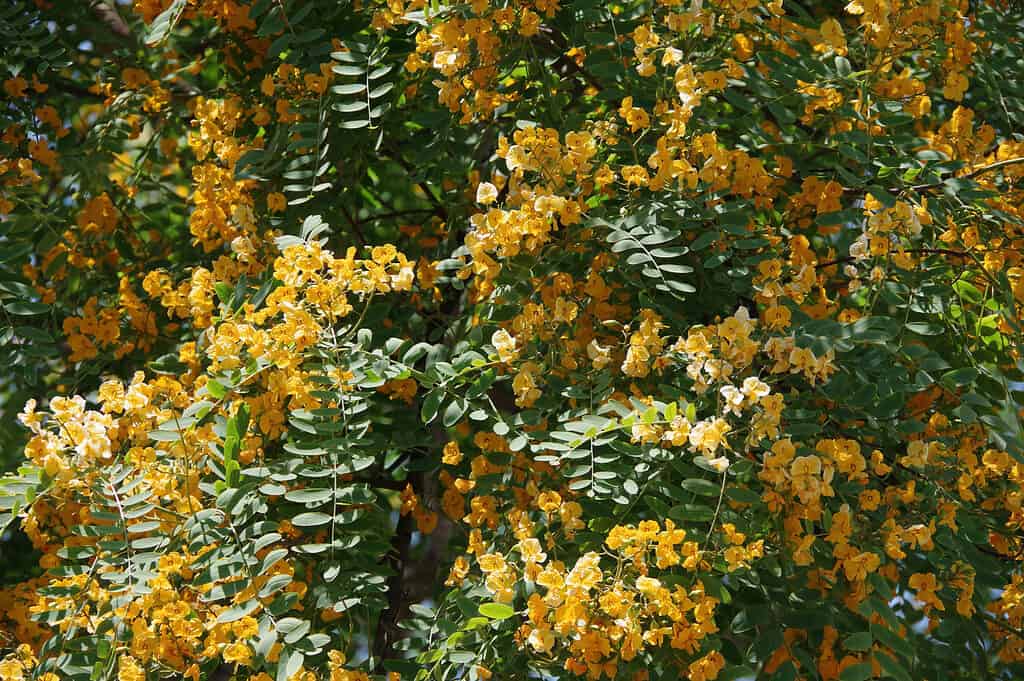
With different colored blooms, jacaranda trees make excellent Bonsai tree specimens.
©Jack N. Mohr/Shutterstock.com
As the name suggests, the flowers on these trees are colored bright yellow. They tend to bloom throughout the late summer season. Another thing that sets yellow jacaranda apart from its blue and purple colored cousins is the fact that these trees are known for being cold hardy. Other jacarandas do not handle cold well, but the yellow variety can handle temperatures as low as 20F. As they grow older and more established, they can handle colder temperatures.
Yellow jacaranda trees thrive best in full sun and well-draining soils.
Jacaranda jasminoides
Another dwarf variety, the Jacaranda jasminoides only grows 10 to 25 feet tall when planted naturally. When young, these trees are sensitive to the cold. But as they get older and grow more established, they can handle temperatures around 20F. The flowers on this tree bloom throughout the summer, ranging in shades of blue and purple.
Jacaranda jasminoides thrive best beneath full sun when planted in sandy, gritty, or loamy soil. They prefer their soil to be moist and well-draining.
Jacaranda jasminoides ‘Maroon’
As the name tells us, the Jacaranda jasminoides ‘Maroon’ is a cultivar of the hybrid Jacaranda jasminoides. This means that this maroon variety is also a dwarf variety. They don’t grow much taller than 20 feet, though some have been known to reach 25 feet.
The only main difference between this plant and its parent plant is the color of their blooms. While the flowers on the regular Jacaranda jasminoides bloom in shades of purple and blue, the maroon variety has dark red blooms. Both trees bloom throughout the summer.
Just like their parent plant, these trees are sensitive to the cold. But as they get older and grow more established, they can handle temperatures around 20F. Jacaranda jasminoides ‘Maroon’ thrive best beneath full sun when planted in sandy, gritty, or loamy soil. They prefer their soil to be moist and well-draining.
Caring for Your Jacaranda Bonsai Tree
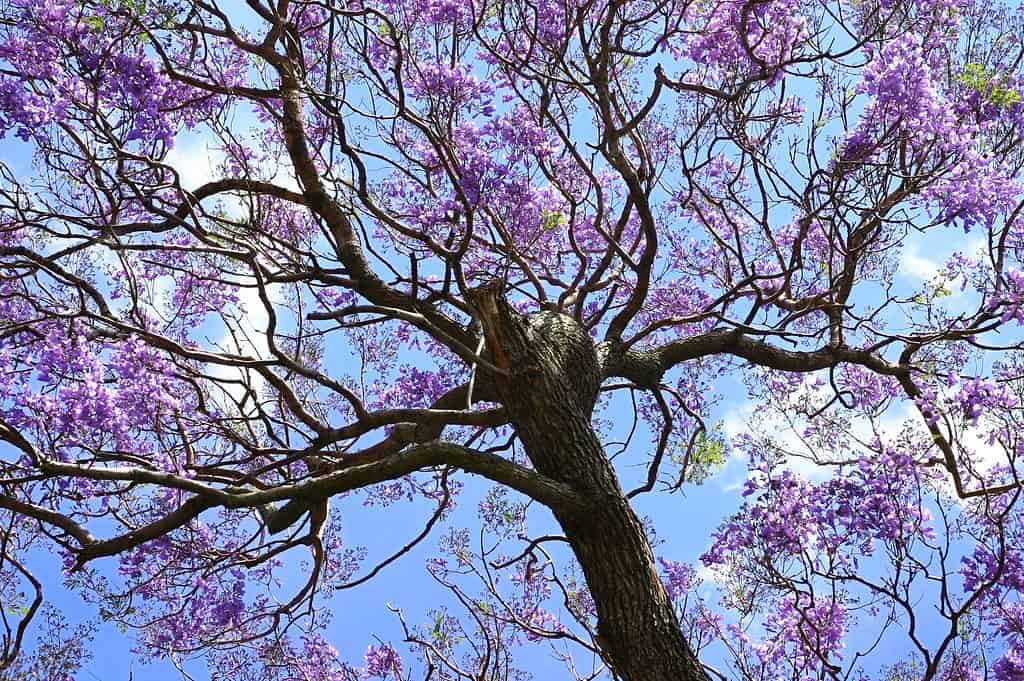
The branches of a jacaranda tree twist naturally, making them ideal for Bonsai trees.
©Rinelle/Shutterstock.com
Since they are native to warm, tropical areas, caring for a jacaranda Bonsai tree can be difficult depending on where you live. Especially if you plan on keeping your tree outdoors. From sunlight and water to soil and placing your tree, here is everything you need to know to properly care for your jacaranda! These tips will help your tree grow its best.
Sunlight
Across the board, jacaranda Bonsai trees love the sunshine. Some of them are tolerant of partial sun or partial shade, but for the most part, a jacaranda needs direct sunshine for at least 4 to 6 hours a day.
Soil Type
Some jacaranda trees can tolerate different types of soil. Generally speaking, though, jacaranda trees are used to sandy, well-draining soils. Specialty Bonsai soil mixes that are made with Bonsai tree art in mind are designed to be well-draining. There are some premade mixtures made with sand that would suit a jacaranda Bonsai tree well!
Water
Most types and cultivars of jacaranda trees are drought tolerant once their roots are established. During their first growing season, though, they need thorough watering to ensure that their roots grow well and deep. It is important to find the balance between well-watered and overwatered, however. If a jacaranda Bonsai tree is watered too much, the leaves turn yellow and drop. However, if a jacaranda is not watered enough, then the leaves will wither and drop.
Placement
If you are growing a jacaranda in conditions that are similar to what they are used to in the wild – warm, damp, humid, tropical climates – then you can keep your tree outside for most of the year. Jacaranda trees are known for being sensitive to the cold, even when established, and when growing in Bonsai pots and containers they are weaker. It is important to keep your jacaranda Bonsai tree away from temperatures below 60F, if possible. You can bring it inside during the winter, but make sure to keep it away from heaters.
Growing a jacaranda Bonsai tree indoors is possible, but it can pose some difficulties. For instance, if it does not get enough light, a jacaranda Bonsai tree will not bloom. If you plan on growing your jacaranda Bonsai tree indoors, make sure to keep it where it can get direct sunlight for a few hours a day.
In the winter months, when light is less, most jacaranda Bonsai trees will lose their leaves. This is normal! The leaves return in the spring and summer.
Pruning Your Jacaranda Bonsai Tree
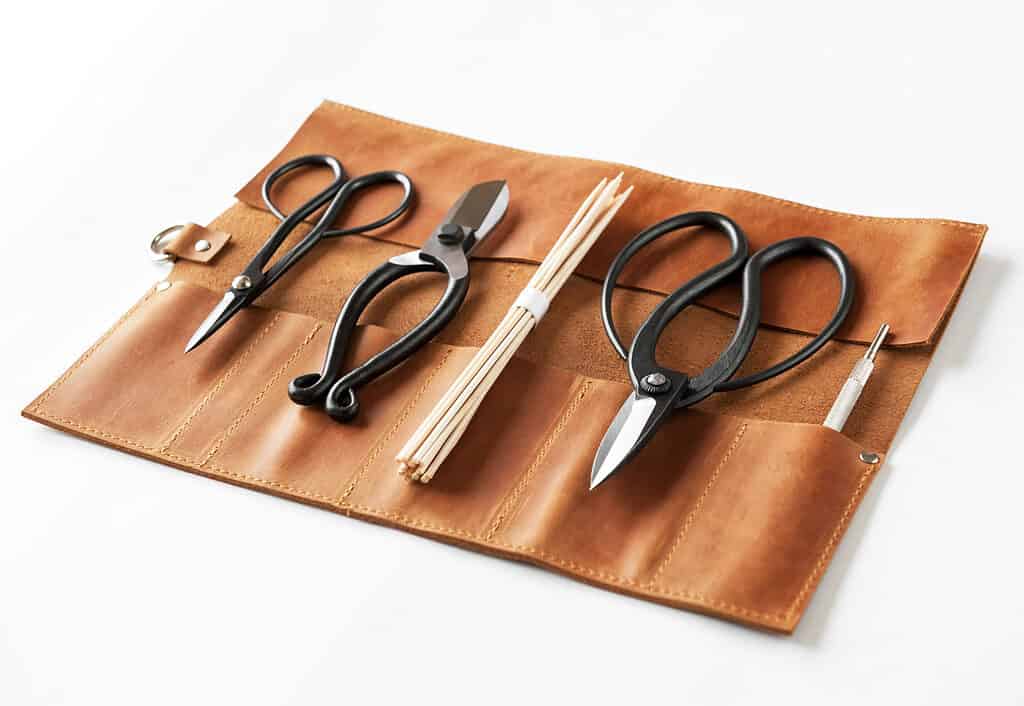
Jacaranda Bonsai trees grow strong and take to pruning well.
©Olena Antonenko/Shutterstock.com
Most types and cultivars of jacaranda Bonsai trees grow quickly. This means that they sometimes need a lot of pruning to keep them at a height and in the style that you want. Thankfully, though, jacaranda Bonsai trees grow strong! Some of the types and cultivars are used to being pruned, too, so they take to it well.
The best time to do heavy pruning is in the spring. When new shoots begin to come in at this time, you can trim them back. Large leaves can be trimmed and pruned throughout the year. Wiring is possible but since jacaranda Bonsai trees have soft wood, they should not be wired for very long. One to two months is ideal.
Ideal Jacaranda Bonsai Tree Styles
In the wild, or when planted naturally, jacaranda trees often grow upright if not slanted a bit. This can easily be replicated in Bonsai tree art. But because jacaranda trees are soft, more complicated styles are not quite so easy. Here are some of the most common, and ideal, Bonsai tree styles for jacaranda Bonsai trees!
First and foremost is the Chokkan style. This style, also known as the formal upright style, involves shaping and styling the Bonsai tree so it grows strong and upright. Jacaranda trees suit this style well and look dramatic with their long, weeping foliage and brightly colored flowers.
Another upright style easily achieved with jacaranda Bonsai tree is the Sokan style. This style involves splitting your Bonsai tree into two distinct trunks. They generally grow in opposite directions.
Another style that involves multiple trunks is the Kabudachi style. In this style, Bonsai trees grow from an initial, single trunk and then branch off into several, usually smaller, trunks. Jacaranda Bonsai trees are suited to this style because of their intricate branches and canopy.
Propagating Your Jacaranda Bonsai Tree
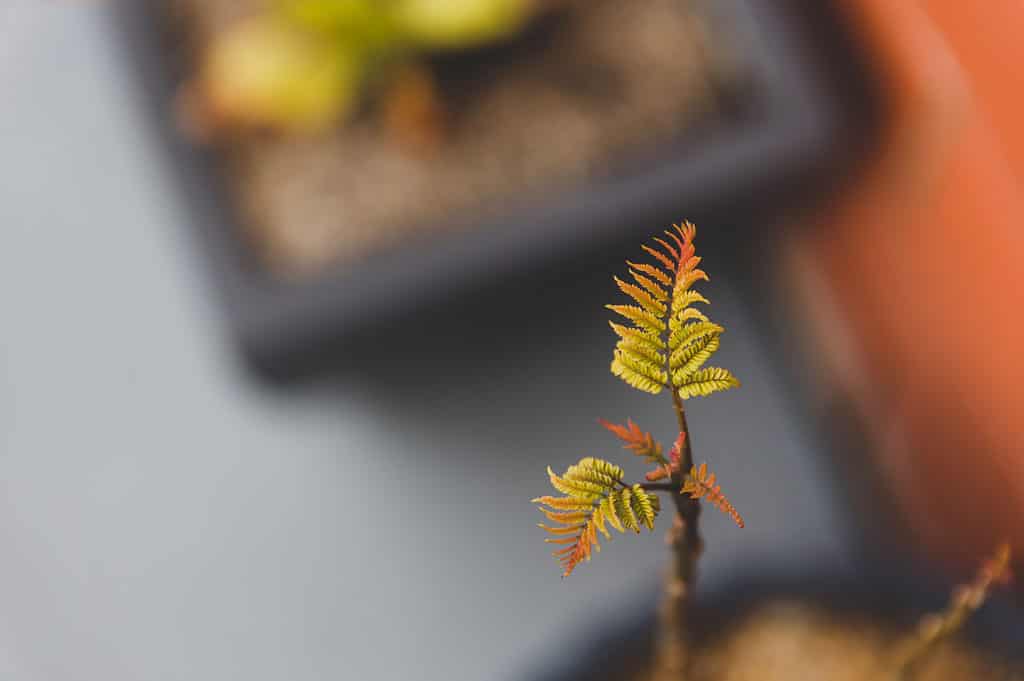
You can grow a jacaranda Bonsai tree from either seeds or cuttings.
©faithie/Shutterstock.com
Jacaranda Bonsai trees are best propagated from seeds. They can also be propagated from softwood cuttings.
Common Problems with Jacaranda Bonsai Trees
For the most part, jacaranda Bonsai trees are hardy and resistant to pests and disease. They can be attacked by scale. This can be treated with specific pesticides.