
If you’ve seen small bamboo-like plants growing indoors, then it’s likely the widely popular lucky bamboo plant. And luckily for you, if you’re interested in learning about and growing them, you’ve come to the place!
In this guide, we’ll cover the botanical classification of the lucky bamboo plant, its characteristics, how to successfully grow it, propagate it, and more.
So, without further ado, let’s get to it!
| Lucky Bamboo Plant | |
|---|---|
| Botanical Name | Dracaena sanderiana |
| Common Names | Lucky bamboo, friendship bamboo, ribbon plant |
| Native Range | Tropical West Africa |
| USDA Hardiness Zones | 10-12 |
| Potting Medium | Succulent potting mix or chlorine-free water |
| Sunlight | Partial shade outdoors, bright, indirect sunlight indoors |
| Watering | If growing in soil: keep soil evenly moist, and water when the top inch of the soil is dry. If growing in water: change out water every 10-14 days. |
| Fertilizer | Feed every 2 months with 1/10th strength, water-soluble houseplant fertilizer. |
Lucky Bamboo: Botanical Classification and a Brief History

Despite its name, lucky bamboo is not true bamboo.
©96 Creative Graphics/Shutterstock.com
Although its common name suggests otherwise, lucky bamboo isn’t a species of bamboo at all! It belongs to an entirely distinct family and order of plants. While true bamboo is actually a type of grass, lucky bamboo is a flowering plant that is a part of the asparagus family (Asparagaceae). Previously, lucky bamboo was grouped into the lily family (Liliaceae), as with several other species now classified into the asparagus family. Lucky bamboo’s botanical name is Dracaena sanderiana, and it is one of about 120 species of trees and succulent-like plants in the Dracaena genus.
Native to the tropics of West Africa, lucky bamboo thrives in warmth and humidity.
A Brief History
Despite its roots in tropical Africa, this plant is now widely associated with China, with many confusing it as a plant native to East Asia as it has become heavily cultivated and marketed in that region. At some point, a group of Chinese growers became acquainted with this African plant, and realizing its superficial similarities to true bamboo, began cultivating it in mass to sell to folks living in urban areas who don’t have the space to grow bamboo. See, it’s much more difficult to grow actual bamboo indoors, but you can quite easily grow Dracaena sanderiana inside. With some clever marketing and specific cultivation practices, “lucky bamboo” was born and widely sold across China where it became especially popular as a gift during Chinese New Year. From China, the popularity of this little plant spread around the world.
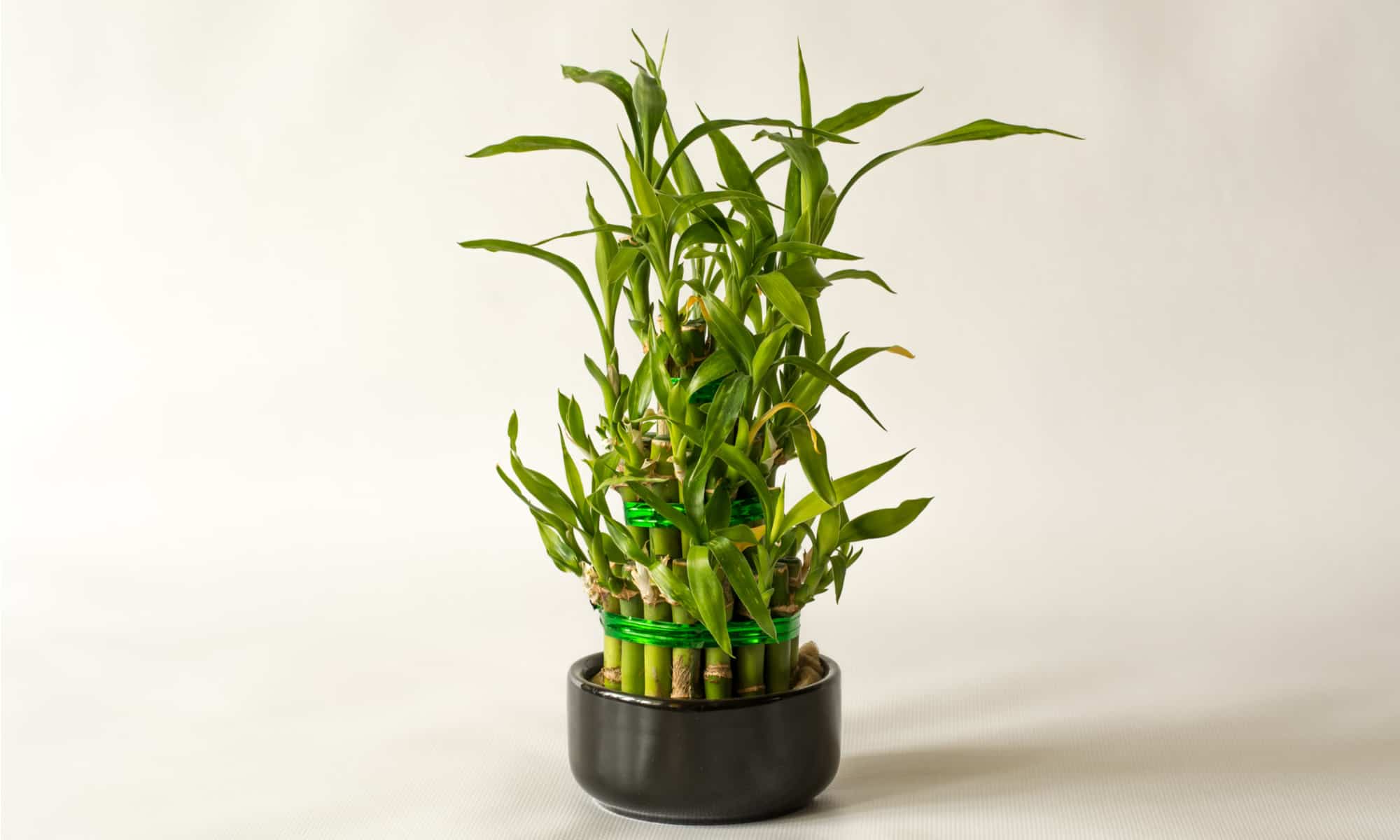
Unfortunately, lucky bamboo is often subjected to cultivation practices that shorten its life span, such as stripping the stalk of most of its leaves to mimic the look of non-bushy bamboo. Some techniques to cause bends and twists in this plant that require a banded restriction of the plant, while aesthetically lovely, can also harm lucky bamboo by reducing the flow of nutrients through the plant. Additionally, some research is finding a correlation between lucky bamboo that undergoes dramatic, stressful manipulation and the development of diseases. The truth is, the healthiest lucky bamboo mimics its native appearance, has all of its foliage, is not forced into dramatic stem bends, and simply looks quite a bit less like true bamboo.
Morphology of Lucky Bamboo: Native and Cultivated
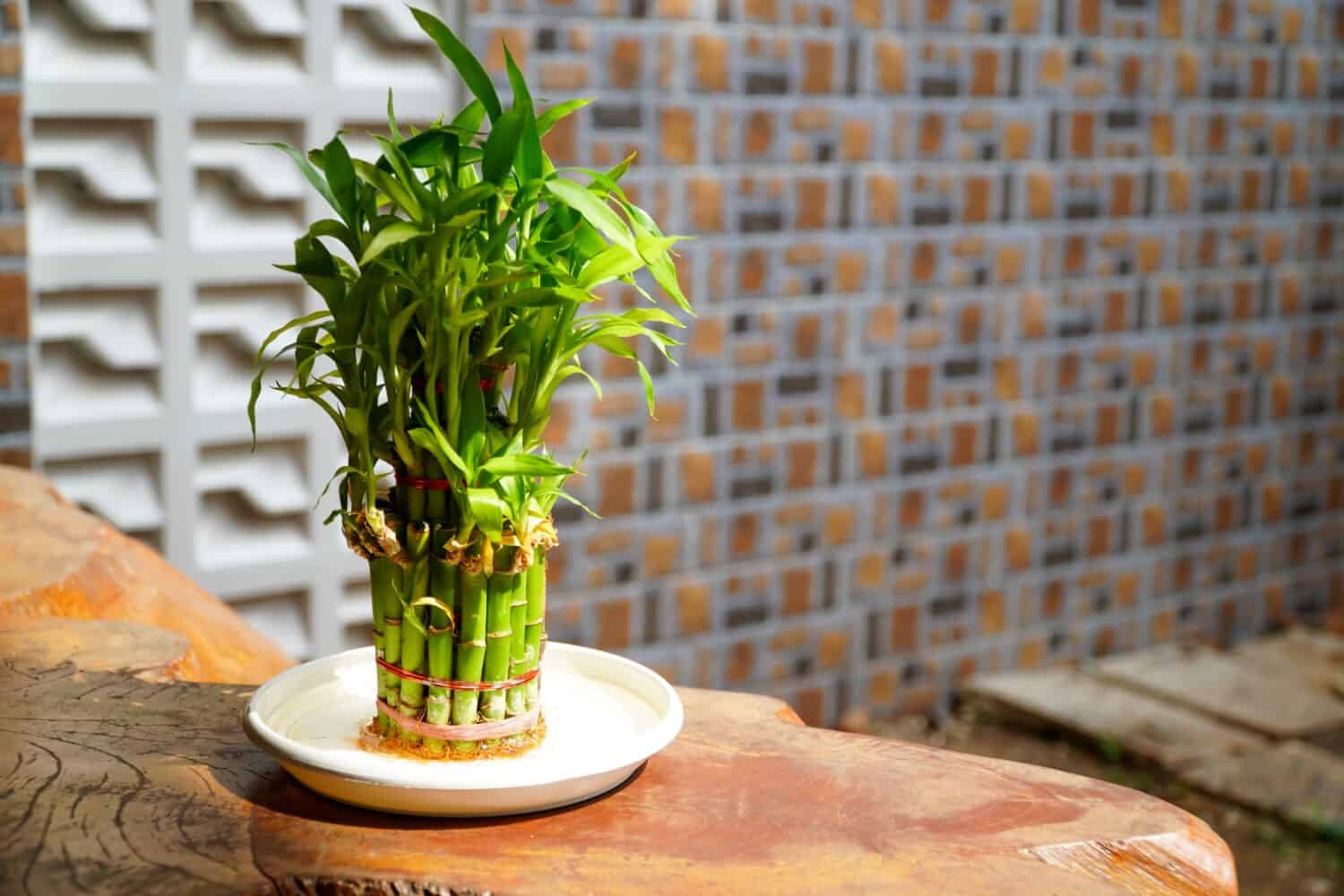
Lucky bamboo is an all-green flowering plant.
©Lakhsmie/Shutterstock.com
The native characteristics of lucky bamboo feature an all-green, bushy plant with elongated, glossy, and smooth leaves emerging vertically along the stalk. As the plant matures, it takes on a bushier appearance, as the increased leaf production supports more photosynthesis and continued growth. In ideal growing conditions, Dracaena sanderiana can reach up to 5 feet tall with an equal outward, bushy spread. The leaves can reach 6-10 inches long.
Cultivated Dracaena sanderiana tends to look vastly different from its native form. You’ll see both the all-green form as well as cultivars that feature bold yellow and green or green and green leaf striping.
How Growers Create the Distinctive Lucky Bamboo Look
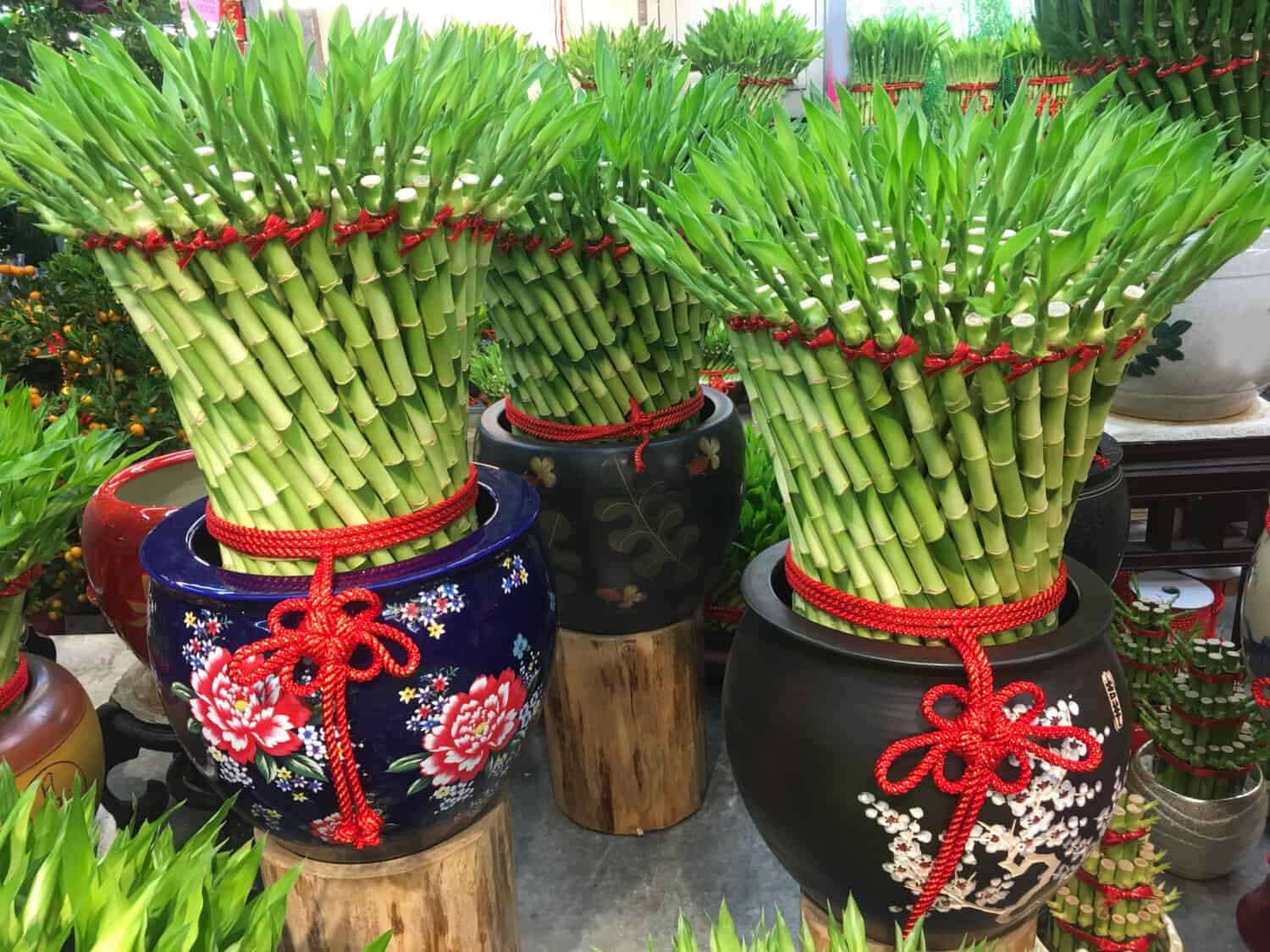
To mimic the look of a sparsely leaved bamboo species, growers strip most of the foliage from lucky bamboo, typically leaving most of the leaves at the top of the stalk. These stalks are usually pruned to stay between 6-24 inches tall. A variety of stem bending occurs that can create heart-shaped, spiral, and braided forms. To create heart-shaped and braided forms, growers usually tie stalks together in various manners. For spiral shapes, growers usually fix the stalks to the ground, and as the plant attempts to reorient itself to the light of the sun, it forms a dramatic u-shape, which can then be repeated a few times with additional manipulation to create spirals.
Bending stalks and stems doesn’t always create long-term harm, and folks who grow bonsai trees often create bends. However, the difference is that successful bonsai growers make careful seasonal and species-informed decisions and understand the balance of stress and growth. As such, the bonsai plant can continue to thrive and heal from the stress of bending and wiring. Mass-produced lucky bamboo plants are typically subjected to unhealthy stress, including often shipping with roots exposed to the air, and then marketed as low-maintenance plants, leading to their vastly shortened life span.
How to Grow Lucky Bamboo
The best way to grow lucky bamboo is to ensure its environment mimics the plant’s natural growing needs. These include its soil, water, and sunlight requirements.
©skywing/Shutterstock.com
In this guide, in the spirit of supporting the health of the species of the plant you have, we’ll discuss how to grow lucky bamboo in a manner that mimics its natural growing needs. Not only will you better support the health of your plant, but you’ll be able to enjoy it much longer. When forced to grow in a highly unnatural manner, lucky bamboo is a short-lived plant, typically surviving as a houseplant for only 6 months to 2 years. However, if you grow this plant to mimic its natural environment, it can often thrive for over 10 years.
Below, we’ll discuss this plant’s soil, sunlight, watering, temperature, humidity, and fertilizer requirements, and how to successfully propagate it.
Ideal Soil Conditions
You can grow lucky bamboo in a variety of soil or soil-less conditions. The ideal soil type for this plant is well-draining, fertile, and consistently moist. Many people have great success with using succulent soil mixes that contain perlite for added drainage and aeration. Dracaena sanderiana naturally grows in loamy, moist soils in the understory of tropical jungles, so mimicking this soil type will help your plant thrive.
Additionally, you can also grow this plant in water, however, this is not ideal and your plant will typically not last more than 2 years growing in this condition. If you do choose to grow your plant in water, it’s important to change out the water every 10-14 days in order to maintain a fresh supply of oxygen. The water will also need to be from a chlorine-free source, such as distilled, spring, or rainwater.
Lucky Bamboo Plant: Ideal Sunlight Conditions
As a plant that is native to jungle understories, it grows best in filtered sun or partial shade. Direct sunlight is not ideal for this plant and can result in leaf burn. If you’re growing your plant outside, pick a nice spot that gets a couple of hours of full sunlight in the morning, followed by partial shade for the rest of the day. If you’re growing inside, placing your plant in an area with bright, but indirect sunlight is best.
Watering Requirements
If you’re growing in a succulent potting mix or loamy soil, you’ll want to keep the medium consistently moist. When the top inch of the growing medium is dry, it’s time to water again. Lucky bamboo can handle chlorine in tap water much better when it grows non-hydroponically, but you can maximize the health of this plant by watering with a chlorine-free source.
How to Grow a Lucky Bamboo Plant: Temperature and Humidity
This tropical plant loves warmth, so you’ll need to make sure temperatures stay above 60 degrees year-round. As such, you can only grow lucky bamboo outside all year if you live in USDA zones 10-12. If a cold snap is forecasted in these areas, bring your plant inside as lucky bamboo is notably not cold hardy.
A humidity range of 50-70% is ideal for lucky bamboo. May air-conditioned households have a humidity range of 30-50%, so if you’re home’s humidity level is too low, you can place a humidifier a few feet from your lucky bamboo.
Fertilizer Requirements
Lucky bamboo can benefit from very light feedings once or twice a month. Ideally, use 1/10th strength, water-soluble houseplant fertilizer and feed when you water. If you’re growing this plant in water, apply fertilizer at the same time that you change out the water in the container.
How to Propagate Lucky Bamboo
Since they’re a popular gift, you may be interested in propagating your lucky bamboo to share with friends and family. Additionally, if you bought a lucky bamboo plant cultivated to appear like true bamboo, you can propagate cuttings to grow new plants in a healthier manner. This will result in longer-lived plants.
To propagate lucky bamboo, you can grow clones of the parent plant by taking stem cuttings and growing those cuttings into new plants. You can propagate your plant either in soil or water. Note that some plants have a difficult time adjusting to soil if they initially grew in water.
Propagating Lucky Bamboo in Water
- Prepare a clean container with fresh, chlorine-free water.
- With a clean pair of sharp scissors, cut a healthy stem off the parent stalk. This stem should have a few healthy leaves and be about 4-6 inches long.
- Trim leaves so that only the top 2 inches of the stem have foliage. You’ll need to do this so that the bare stem is submerged in water with the foliage on top out of the water. If the leaves are submerged, they’ll rot. Additionally, trimming the bottom leaves will help the shoot focus on root development.
- Place your stem clipping (or multiples clippings) in the fresh water, completely submerging the bare portion of the stem.
- Change out the water every 10-14 days. After about a month, you can transfer the new plants into soil or continue to grow them in water. If you choose to grow them in water, you can add a layer of pebbles to the bottom to help stabilize the plants. Remember, this option will shorten the lifespan of your lucky bamboo.
Propagating Lucky Bamboo in Soil
- Prepare a small pot with fresh growing medium. Make sure the pot has a hole for drainage.
- Select a healthy stalk from your lucky bamboo, and with clean shears, snip off a healthy stem right where the stalk meets the stem. As mentioned above, choose a 4-6 inch-long stem with healthy foliage.
- Snip off the bottom leaves so that only a couple of inches of foliage remains at the top of the stem.
- Plant the bare portion of the cutting in pre-watered soil.
- In about a month, your plant should be well-established. Stem growth and new leaf formation are signs that your cutting has developed healthy roots.