B
Species Profile

Black Rhinoceros

Diceros bicornis

Hook-lipped browser, hard to beat
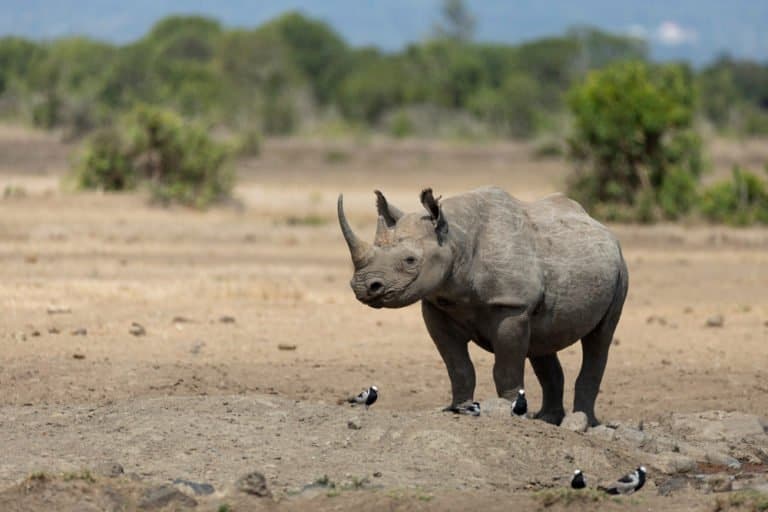
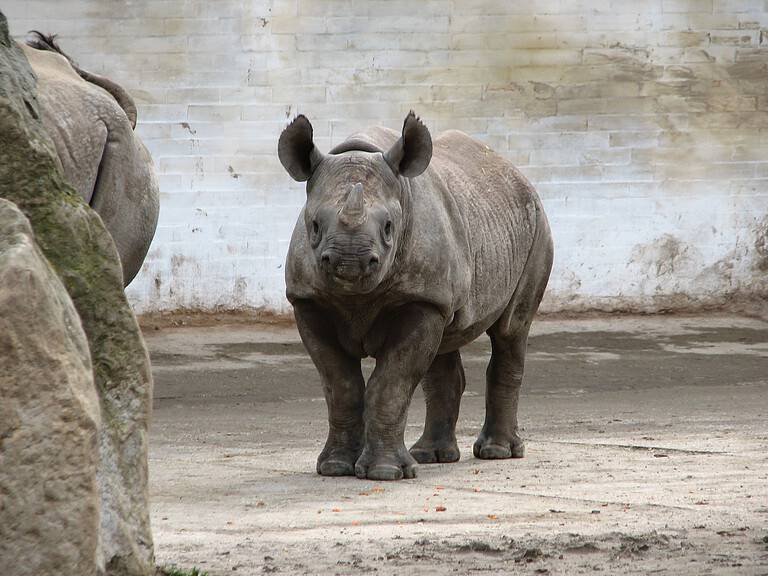
Jerzy Strzelecki, CC BY-SA 3.0, via Wikimedia Commons

Black Rhinoceros Distribution

Click a location to explore more animals from that region

Loading map...

Size Comparison

Human 5'8"
Black Rhinoceros 5 ft 3 in

Black Rhinoceros stands at 93% of average human height.

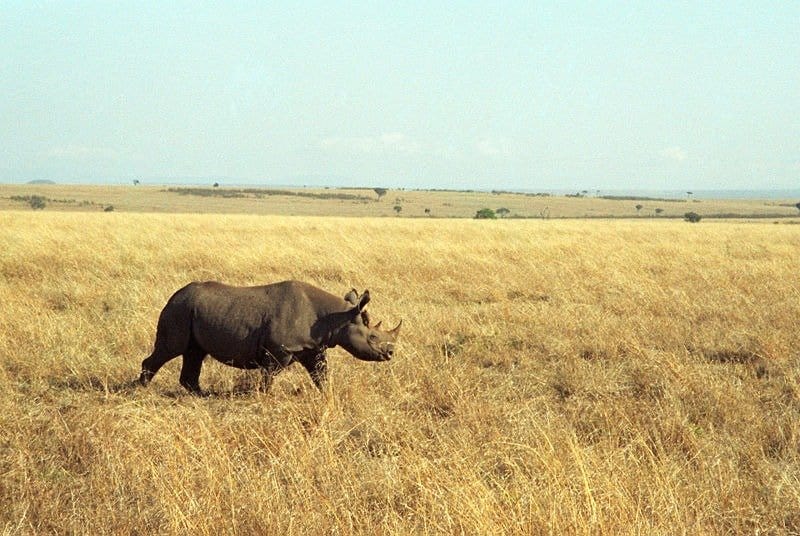
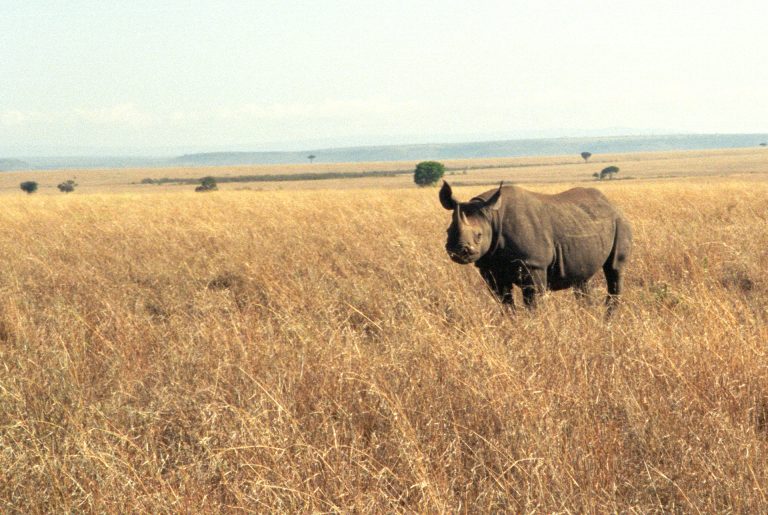
Black Rhinoceros, Masai Mara, Kenya

At a Glance

Wild Species
Also Known As Hook-lipped rhinoceros, Hook-lipped rhino, Thicket rhinoceros
Diet Herbivore
Activity Crepuscular+
Lifespan 35 years
Weight 1400 lbs
Did You Know?

Despite the name, black rhinos are usually gray-brown; "black" mainly contrasts with the "white" rhino (a grazer with a wide, square lip).

Scientific Classification

The black rhinoceros (Diceros bicornis) is a large African rhinoceros species characterized by two horns and a prehensile (hooked) upper lip adapted for browsing shrubs and trees. Despite the name, its color is typically gray to brown; the name contrasts it with the "white" rhinoceros.

Kingdom
Animalia
Phylum
Chordata
Class
Mammalia
Order
Perissodactyla
Family
Rhinocerotidae
Genus
Diceros
Species
Diceros bicornis

Distinguishing Features

  • Two keratin horns (front horn usually longer)
  • Prehensile, pointed upper lip adapted for browsing (distinguishes it from the grazing white rhinoceros)
  • Generally more solitary and browser-oriented than white rhino
  • Thick, folded skin; typically gray-brown coloration despite the common name

Physical Measurements

Males and females differ in size

Height
5 ft 3 in (4 ft 7 in – 5 ft 11 in)
4 ft 11 in (4 ft 7 in – 5 ft 3 in)
Length
10 ft 6 in (9 ft 10 in – 11 ft 6 in)
Weight
1.3 tons (1,764 lbs – 1.5 tons)
1.1 tons (1,764 lbs – 1.3 tons)
Tail Length
229 ft 8 in (196 ft 10 in – 229 ft 8 in)
2 ft 2 in (1 ft 12 in – 2 ft 4 in)
Top Speed
34 mph
Up to 55 km/h briefly

Appearance

Primary Colors
Secondary Colors
Skin Type Very thick, tough, sparsely haired mammalian skin with pronounced folds (notably neck/shoulder region) and frequent superficial cracking/creasing; routinely coated with mud as a protective layer against ectoparasites and sun exposure.
Distinctive Features
  • Black Rhinoceros (Diceros bicornis) has two keratin horns on the nose, the front horn larger (commonly about 50 cm, sometimes over 1.0 m); the rear horn is smaller.
  • Black Rhinoceros (Diceros bicornis) has a prehensile, hooked upper lip for grasping twigs and leaves, unlike the square-lipped white rhinoceros. It mainly eats shrubs, woody plants, and forbs.
  • Typical adult body size: head-body length ~3.0-3.75 m; shoulder height ~1.4-1.8 m; mass commonly ~800-1,400 kg (reported ranges in major references and IUCN species account; values vary by subspecies, sex, and habitat quality).
  • Pregnancy about 15 months; usually one calf. Mothers usually have calves every 2.5–3+ years. Live about 30–35 years in the wild, over 40 years in zoos.
  • Mostly solitary except mothers with calves; males keep overlapping or exclusive ranges and mark with dung piles and urine; females' ranges overlap. Active at dawn, dusk, or night in hot areas, resting in shade.
  • Black Rhinoceros (Diceros bicornis) lives in scattered, closely managed populations across eastern and southern Africa (like Namibia, South Africa, Kenya). It uses savanna woodland, bushland, thorn scrub, and semi‑arid areas with browse and water.
  • Black rhinoceros (Diceros bicornis) status: Critically Endangered (IUCN). Conservation actions include strong anti-poaching protection, translocations, reintroductions, and metapopulation management to keep growth and genetic diversity.

Sexual Dimorphism

Sexual dimorphism is modest. Males are typically larger and more robust, with proportionally thicker neck/shoulders; horn size differences are variable and overlap widely, but males often have heavier horn bases in many populations (species accounts/field guides; IUCN notes substantial overlap).

  • On average larger body mass and heavier build (notably head/neck and shoulder musculature).
  • Often more pronounced territorial behavior and more frequent dung midden/spray marking in adult males (field ecology summaries cited by IUCN).
  • On average slightly smaller and more slender; females typically range more with calves and show strong maternal defense.
  • Horn dimensions can be similar to males; overlap is substantial, so sex cannot be reliably determined by horn size alone in the field.

Did You Know?

Despite the name, black rhinos are usually gray-brown; "black" mainly contrasts with the "white" rhino (a grazer with a wide, square lip).

Adults typically measure 2.8-3.75 m head-body length and 1.40-1.80 m at the shoulder, weighing ~800-1,400 kg (IUCN/standard mammal references).

They have two horns made of keratin (like hair and nails). The front horn is usually longer; typical front-horn length is ~20-60 cm, but exceptional horns can exceed 1 m.

The prehensile (hooked) upper lip is a precision tool for plucking leaves, shoots, and thorny browse-very different from the white rhino's grazing mouth.

They can sprint up to ~55 km/h over short distances, making them surprisingly fast for their mass.

Reproduction is slow: gestation is ~15 months (≈450-480 days), and females often have a calf only every ~2.5-3 years.

One subspecies (Diceros bicornis longipes, the western black rhino) was declared extinct, highlighting how quickly local populations can vanish (IUCN).

Unique Adaptations

  • Prehensile upper lip: a specialized grasping structure for browsing thorny, woody plants-key to niche separation from grazers like the white rhino.
  • Two-horn morphology: horns are solid keratin with no bony core; damage can be followed by regrowth from the horn base.
  • Thick, resilient skin plus mud-wallowing: helps protect against sun, abrasions from thorn scrub, and ectoparasites.
  • Powerful neck and shoulder musculature: supports horn use in defense and intraspecific combat.
  • Large nasal passages and acute olfaction: critical for detecting predators, locating mates, and interpreting scent marks across territories.
  • Flexible ear movement: independently swiveling ears improve sound localization in dense bush.
  • Digestive adaptation of hindgut fermentation (Perissodactyla): allows processing of fibrous browse, albeit less efficiently than ruminants, supporting long daily foraging bouts.

Interesting Behaviors

  • Mostly solitary: adults usually travel alone; the most common social unit is a mother with her calf.
  • Territorial scent-marking: they use urine spraying and "dung middens" (communal dung piles) to advertise presence and reproductive status.
  • Browsing strategy: they feed selectively on shrubs and small trees, often choosing high-quality shoots and leaves and moving between patches.
  • Daily heat-management: they rest in shade during the hottest hours and may wallow in mud to cool down and reduce biting insects.
  • Ears-first vigilance: when alarmed, they often stop, listen, and scent the air; eyesight is relatively poor compared with smell and hearing.
  • Agonistic displays: head held high, horn-forward postures, and short charges can resolve disputes without prolonged fighting-though serious horn injuries can occur.
  • Range use is highly variable by habitat and water availability; individuals can have small, resource-rich core areas and larger seasonal movements in drier landscapes (reported in field studies).

Cultural Significance

Black Rhinoceros (Diceros bicornis) is a key symbol of conservation in eastern and southern Africa, bringing tourism money. Protecting it needs anti-poaching, moving animals, and sometimes dehorning. Horn use drove illegal trade; it appears in rock art and stories.

Myths & Legends

San (Khoisan) rock-art traditions of southern Africa depict rhinoceroses among powerful animals; in some ethnographic interpretations, such imagery is tied to potency, trance, and rain-associated beliefs in hunter-gatherer cosmology.

Medieval and early modern travel literature sometimes described a fierce, two-horned "abada/abadda," a creature likely inspired by rhinoceroses and later echoed in European bestiary traditions as an exotic near-mythic beast.

Pliny the Elder's Natural History (1st century CE) repeats stories of the rhinoceros as an elephant's rival-an enduring classical motif that shaped later European ideas about rhinoceroses.

Rudyard Kipling's 1898 Just So Story "How the Rhinoceros Got His Skin" tells a folk tale explaining a rhino's folded, plate-like skin — a well-known modern myth many people link to rhinos.

Southern African colonial-era hunting narratives often framed the black rhino as a near-invulnerable "bush phantom," a storytelling trope that blended real behavior (dense thicket habitat, sudden charges) with legend-like exaggeration.

Conservation Status

CR Critically Endangered

Facing an extremely high risk of extinction in the wild.

Population Increasing

Protected Under

  • CITES: Appendix I (international commercial trade in specimens of Diceros bicornis is generally prohibited; tightly controlled exceptions exist under specific annotations for some populations and products).
  • Range-state legal protection: generally fully protected under national wildlife legislation in countries where the species occurs (e.g., prohibitions on hunting/possession/trade without permits; penalties for poaching).
  • Protected-area reliance: a large proportion of the global population occurs within fenced or intensively managed protected areas and conservancies with dedicated anti-poaching and monitoring programs (metapopulation management, translocations).
  • HUBS (Rhinocerotidae conservation landscape): statuses range from Near Threatened (e.g., Ceratotherium simum) to Vulnerable (Rhinoceros unicornis) and Critically Endangered (Diceros bicornis, Rhinoceros sondaicus, Dicerorhinus sumatrensis). Common cross-cutting threats include horn-driven poaching and illegal trade, habitat loss/fragmentation from agriculture and infrastructure, and small-population genetic/demographic risks; the most at-risk species include the Javan and Sumatran rhinoceroses (both CR, extremely small and fragmented populations).

Life Cycle

Birth 1 calf
Lifespan 35 years

Lifespan

In the Wild
30–40 years
In Captivity
35–50 years

Reproduction

Mating System Polygyny
Social Structure Solitary
Breeding Season Year-round (no distinct breeding season; mating and calving recorded in all months)
Breeding Pattern Transient
Fertilization Internal Fertilization
Birth Type Internal_fertilization

Black rhinoceros (Diceros bicornis) are solitary and territorial, with mostly polygynous mating. Males defend areas overlapping several females and mate with receptive females. Associations are brief around estrus; no pair bond or male parental care.

Behavior & Ecology

Social Crash Group: 1
Activity Crepuscular, Nocturnal, Cathemeral
Diet Herbivore Woody browse-especially young leaves and shoots of shrubs and small trees (a classic "browser" diet associated with its prehensile, hooked upper lip).

Temperament

Predominantly solitary, wary, and avoidant; relies heavily on olfaction and hearing with relatively poor eyesight; often chooses to withdraw rather than engage when undisturbed (Estes 1991; Owen-Smith 1988).
Adult males are typically territorial and can be highly intolerant of rival males; intraspecific aggression can be severe, including horn-inflicted injuries, especially where densities are high or territories overlap (Owen-Smith 1988; Emslie & Brooks 1999).
Females are generally more tolerant of range overlap and encounters than males, but are strongly defensive of calves; maternal aggression increases when calves are young (Estes 1991; Owen-Smith 1988).
Black Rhinoceros (Diceros bicornis) activity and tolerance change with temperature, human disturbance, and where food is. In disturbed areas they become more night-active and hidden; in cool, quiet areas they are more daytime active.

Communication

Snorts/blows Alarm or agitation
Grunts Close-range contact, agitation
Squeals/screams High arousal, conflict, distress
Panting/roaring-like exhalations during aggression or intense interactions
Cow-calf contact calls (low-frequency grunts/whines) used to maintain cohesion in dense cover
Olfactory scent marking at dung middens Communal latrines): dung kicking/scattering to spread scent; used for territorial advertisement and reproductive status signaling (Owen-Smith 1988; Estes 1991
Urine spraying/urination in strategic locations as chemical signaling Owen-Smith 1988
Foot scraping and ground marking associated with territories and routes; often combined with defecation/urination Owen-Smith 1988
Rubbing horns/head on vegetation and objects Visual + scent deposition) (Estes 1991
Close-range olfactory investigation of conspecifics and dung middens to assess identity/sex/reproductive state Owen-Smith 1988
Visual/body-language signals: head posture, ear orientation, and presenting/turning Including mock charges) during threat displays; mother positions body between calf and threat (Estes 1991

Habitat

Biomes:
Savanna Tropical Dry Forest Desert Hot
Terrain:
Plains Hilly Plateau Valley Riverine Rocky Sandy +1
Elevation: Up to 9842 ft 6 in

Ecological Role

Megaherbivore browser that structures woody vegetation communities and influences plant regeneration and habitat heterogeneity.

Shapes shrub/tree architecture and density through repeated browsing, helping maintain habitat mosaics (woodland-thicket-savanna structure) Can suppress encroaching woody plants in some systems, indirectly affecting grass availability and fire dynamics Seed dispersal for some browse/fruiting species via endozoochory when fruits are eaten (localized/seasonal) Nutrient cycling via dung and urine inputs, redistributing nutrients across the landscape Creates/maintains trails and disturbed patches that can be used by other animals and can influence plant community turnover

Diet Details

Other Foods:
Woody browse Acacia and Senegalia leaves and young shoots Commiphora Grewia Euclea Ziziphus Sickle bush Spurge Forbs and herbaceous plants Seasonal fruits and pods +4

Human Interaction

Domestication Status

Wild

Black rhinoceros (Diceros bicornis) has never been domesticated. Kept in zoos and sanctuaries for breeding, care, and reintroduction, it is not suited to farming. Adults are about 3.0–3.75 m long, 800–1,400 kg, have two horns and a hooked upper lip, and live ~30–35 years wild. Human ties include tourism, protection, veterinary care, and illegal horn trade.

Danger Level

High
  • Defensive/territorial charges at close range; black rhinoceroses are widely regarded as more likely than white rhinoceroses to charge when startled or approached, particularly in dense bush.
  • Severe traumatic injury or death from goring/trampling during a charge (primary direct risk to people on foot: rangers, researchers, tourists, and local residents).
  • Vehicle incidents in reserves if an animal is surprised at close distance (less common than on-foot encounters but possible).
  • Risks increase during veterinary darting/handling, translocation, or when cows have calves; immobilization events carry safety hazards for staff.

As a Pet

Not Suitable as Pet

Legality: Not legal or practical as a pet. International trade is very limited by CITES: most Diceros bicornis are Appendix I; South Africa and Eswatini Appendix II with narrow exceptions. Private ownership needs special permits, facilities, and approvals (U.S. ESA).

Care Level: Expert Only

Purchase Cost:
Lifetime Cost: $3,000,000 - $15,000,000

Economic Value

Uses:
Wildlife/ecotourism (high economic value to range states and protected areas) Conservation breeding, research, and reintroduction programs (institutional value; high management cost) Human-wildlife conflict costs (crop/property damage and mitigation near reserves) Illegal wildlife trade (rhino horn; major driver of poaching risk)
Products:
  • tourism revenue (safari viewing, park fees, guiding, lodging spillover)
  • conservation services (genetic management, translocations, veterinary interventions)
  • rhino horn in illegal markets (no legitimate commercial product; trafficking is criminal)

Relationships

Predators 3

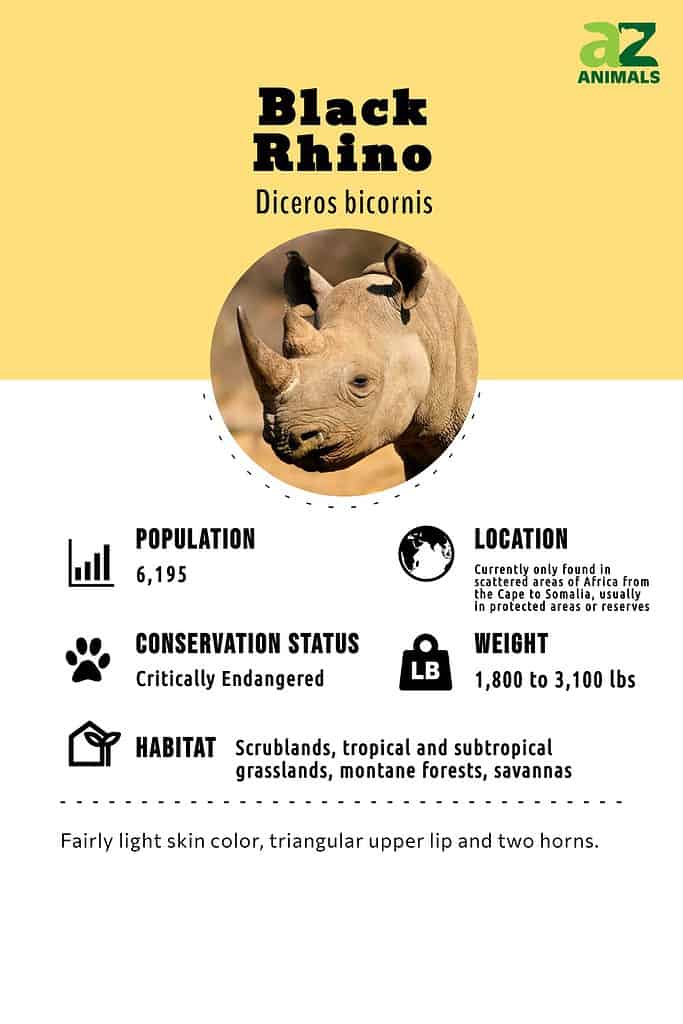
With a population that numbered one million at the beginning of the 20th century, today the black rhino is Critically Endangered 

The black rhino once roamed across a vast range in Africa, but heavy poaching has brought the species to the brink of extinction. Today, the black rhino is seeing its population rebound and is slowly being reintroduced to countries and environments the species vanished from in recent decades. 

Incredible Black Rhinoceros Facts

  • Although critically endangered, black rhino populations have rebounded since hitting a low of just an estimated 2,475 individuals in 1993.
  • The San Diego Zoo reports the black rhino can hit 40 miles per hour (64 km/hr), making it one of the fastest large animals on Earth!
  • While black rhino populations are rebounding, the Western black rhino subspecies were declared extinct in 2011.
Evolution And History
The rhinoceros originated around 50 million years ago, during the Eocene era. Although their DNA shows that they diverged from the tapir sometime around 55 million to 60 million years ago, they then evolved into a multitude of species throughout the world. Early fossil records show that while the earlier species died out, the newer rhinos began to appear in Africa and Asia about 17-26 million years ago, with the African rhino, which included the black and white rhinos, coming from the same common ancestor.

Scientific Name

The scientific name for the black rhino is Diceros bicornis. Diceros is derived from Greek and means “two-horned.” Bicornis once again means “two-horned,” but is Latin. The black rhino is one of three rhinoceros species that has two horns (in addition to the white and Sumatran rhinos).

Appearance
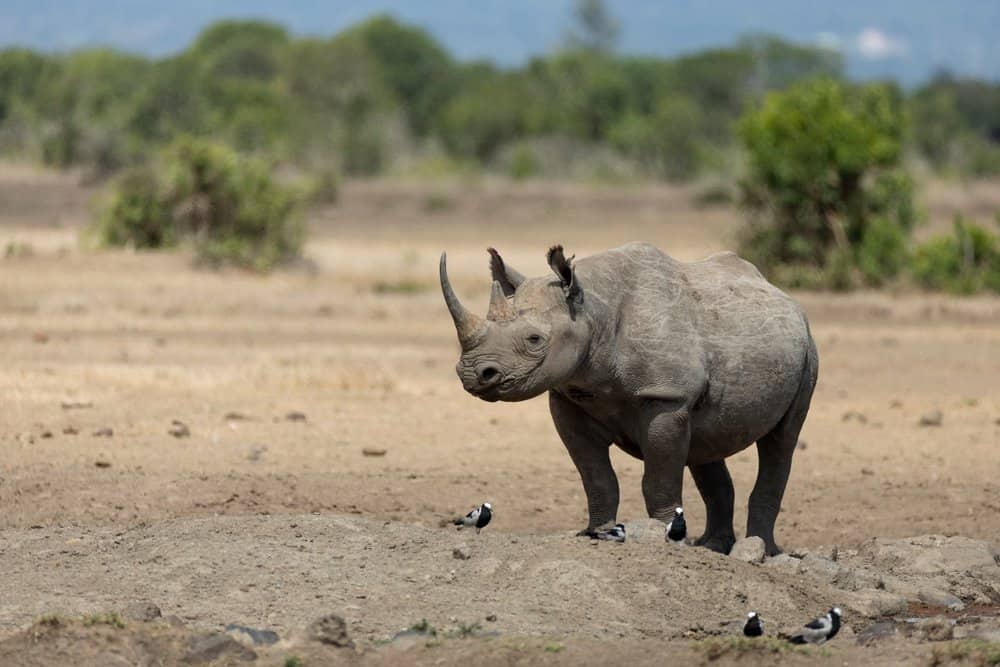
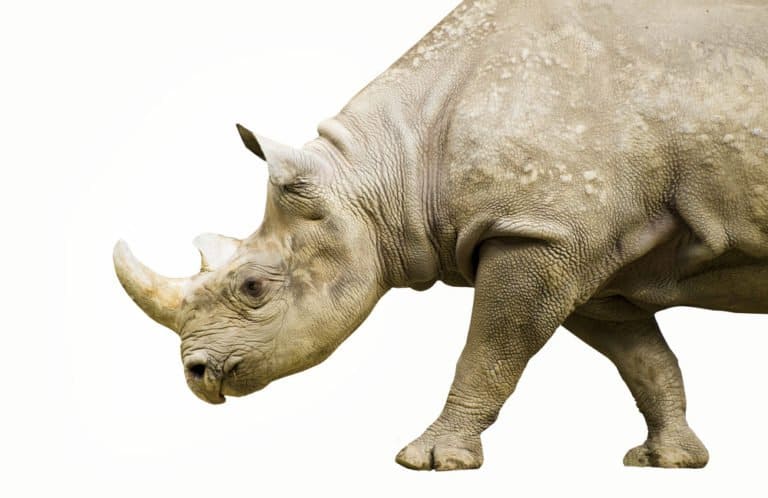
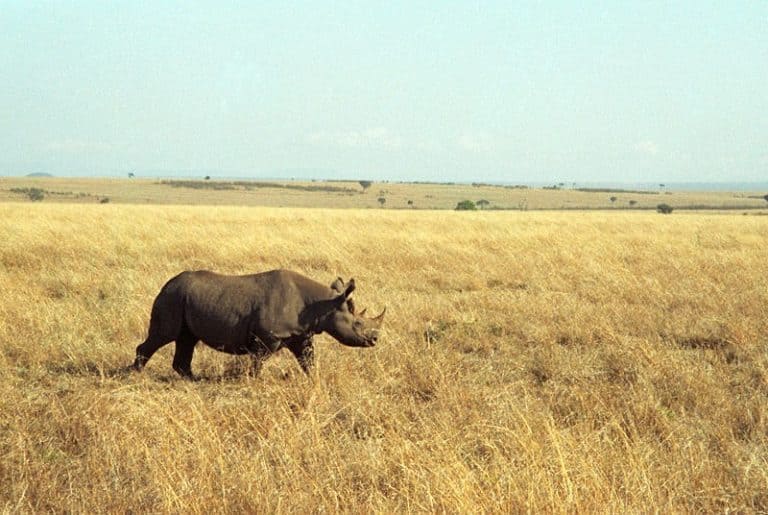
Black Rhinoceros (Diceros Bicornis) - walking through plains

The black rhino is also known as the hook-lipped rhinoceros.

The black rhinoceros (also known as the hook-lipped rhinoceros) is a large species of rhinoceros native to Africa. Despite its name, the black rhinoceros is actually fairly light in color with most black rhinoceros individuals having either white or grey skin.

The black rhino weighs between 800 kg to 1,400 kg (1,800-3,100 lbs). On average, black rhinos weigh less than half the size of the other African rhino species, the white rhino. Their weight is similar to the Javan rhinoceros in Asia.

The most distinguishable physical characteristic of black rhinos is their upper lip, which is triangular and evolved to help the species eat from shrubs and bushes. In addition, black rhinos have a much smaller “hump” on their upper back than white rhinos.

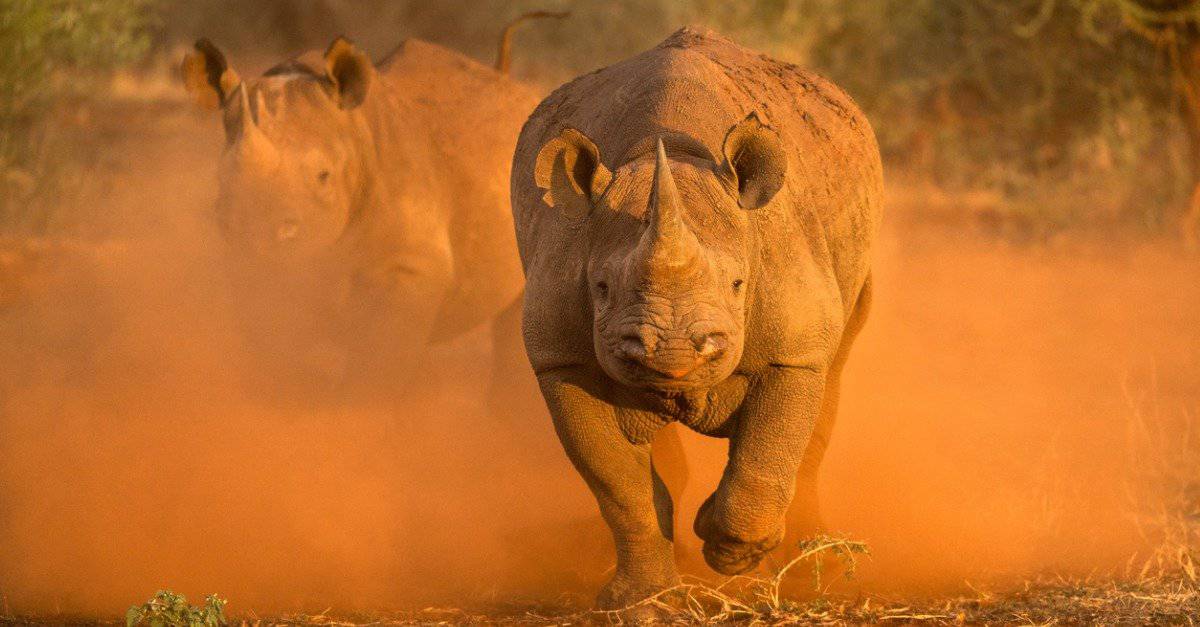
The ears of the black rhinoceros possess a relatively wide rotational range to detect sounds and an excellent sense of smell. However, with its relatively poor eyesight, the black rhino will often charge when startled as a defense mechanism. Black rhinos have been seen charging objects ranging from trees to cars, to passing trains.

Horn

The black rhino has a front horn that can reach incredible lengths relative to its body size. While most black rhino horns don’t exceed 24 inches (61 cm), the longest-ever recorded black rhino horn was 55 inches (140 cm)!

The black rhino’s back horn is generally smaller. Like all rhinos, the horns of the black rhino are made from Keratin, a protein also found in fingernails and hair, and is extremely strong. In addition, for defense, black rhino horns provide intimidation and can help the animal dig up roots and even break branches during feeding.

The primary reason black rhino populations have been declining is poaching for its horn.

Types Of
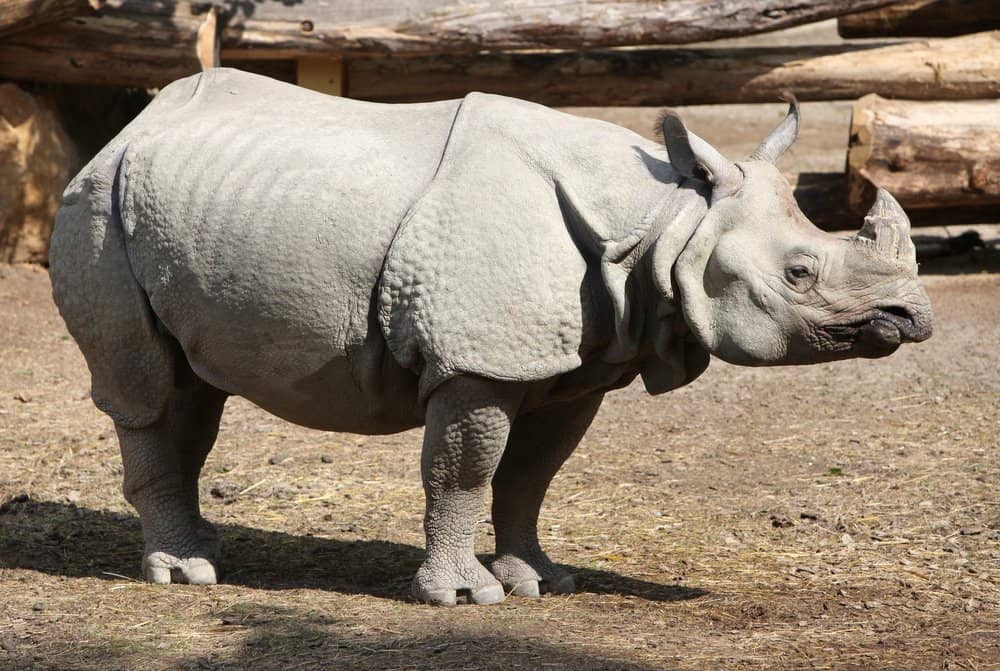
The black rhino is part of the rhino species that has a total of five different rhinos, all of which are listed as critically endangered, vulnerable, or near threatened. These five species are:

  • Black rhino – the southwestern and southeastern black rhino are two subspecies, there are three black rhino subspecies that have been declared extinct.
  • White rhino – the largest of the species, this is split into 2 subspecies, the northern and southern white rhinos. The northern white rhino is almost extinct, with only 2 females left in existence.
  • Javan rhino – this is the rarest of the rhino species.
  • Sumatran rhino – this is the smallest of the rhino species and more closely related to the extinct wooly rhino than any other rhinos.
  • Greater one-horned rhino – this species made a comeback thanks to conservation efforts and now has a population of over 4,000.

Behavior

Compared to the white rhino, the black rhino is a much more solitary animal. The sociability of black rhinos varies by their habitat. In wide-open savannahs, the species can be much more spread out, with a single black rhino in a range of up to 100 square kilometers. In more dense vegetation, their range can decline to one rhino per square kilometer.

Habitat
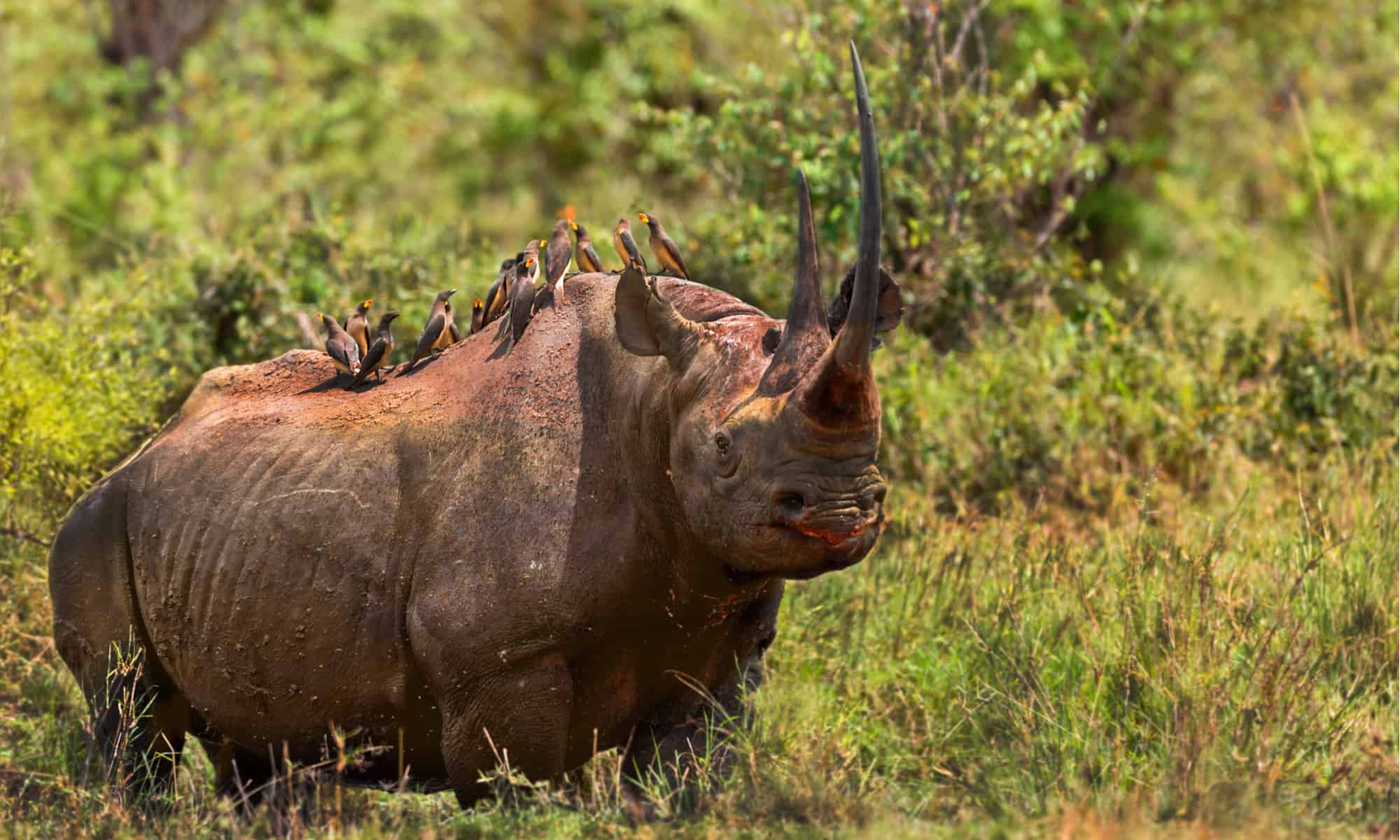
Throughout the past, the black rhinoceros had an ample range across eastern and central Africa in numerous countries including Angola, Cameroon, Kenya, Namibia, Tanzania, South Africa, and Zimbabwe.

Although the black rhino range had been dramatically reduced across the 20th century, it is now being reintroduced into countries it was previously extinct in. For example, in 2017 18 black rhinos were reintroduced into Rwanda after having disappeared from the country a decade earlier.

The climate black rhinos live in can vary by sub-species. The Southwestern black rhino is more adapted to arid savannahs. As a species that prefers woody plants, the black rhino prefers environments with bushes and more leafy plants. Its prehensile upper lip aids in grasping from shrubs and higher-growing vegetation.

Population: How Many Black Rhinos Are Left?

Today, the black rhinoceros is a “Critically Endangered” animal. Throughout much of the 20th century, it saw its population decline at a rapid rate. However, thanks to continued conservation efforts, its population has rebounded from a low point in the early 1990s.

Black rhino population estimates across time

  • 1900: 1,000,000
  • 1960s: 70,000
  • 1980: 10,000 to 15,000
  • 1993: 2,475
  • 2004: 3,600
  • 2018: 5,500
  • 2023: 6195

While the black rhino historically was found across nearly all of sub-Saharan Africa outside the Congo basin, today its population is limited to a small number of countries. The World Wildlife Fund reports that 98% of the population is found in just four countries: South Africa, Kenya, Zimbabwe, and Namibia.

Western Black Rhinoceros Extinction

Until recently there were four surviving subspecies of the black rhino:

  • South Western black rhino
  • Eastern black rhino
  • Southcentral black rhino
  • Western black rhino

As of 1997, it was estimated only 10 Western black rhinos remained. A follow-on survey in 2001 was the last sighting of the species and it was officially declared extinct in 2011.

The Western black rhino once roamed across Nigeria, Cameroon, and Chad. It’s possible black rhinos may one day be reintroduced to these countries, but their repopulation will come through different black rhino subspecies.

Diet
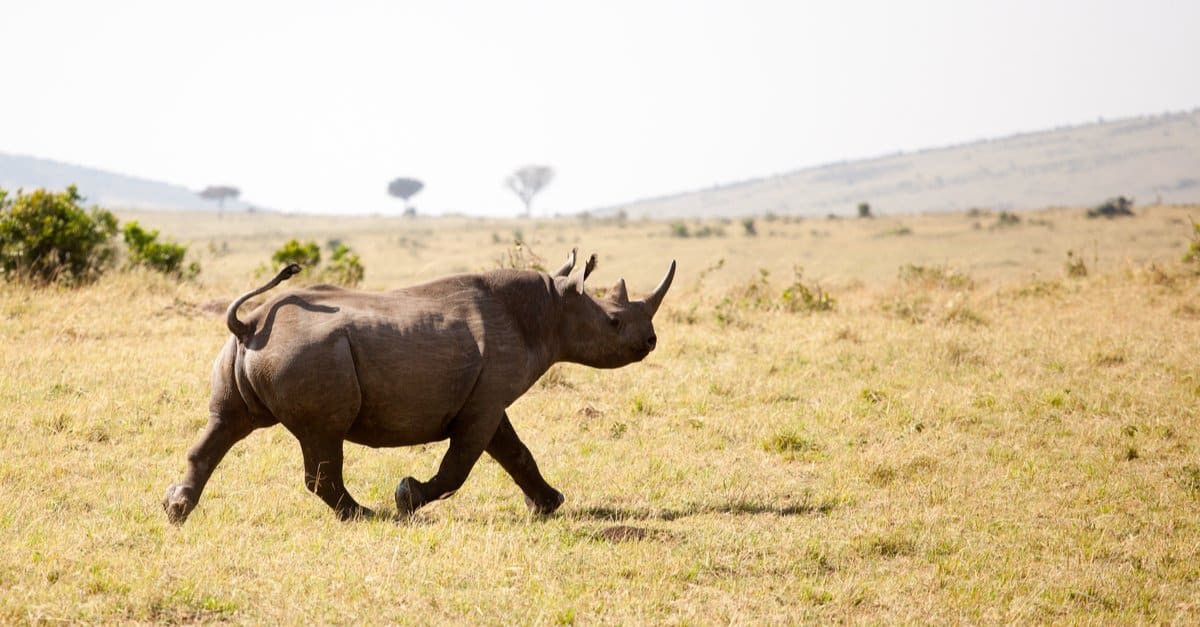
The black rhinoceros is an herbivorous animal which means that it is sustained by eating a purely plant-based diet. Black rhinos browse the heavily vegetated savannah for leaves, buds, flowers, berries, fruits, and roots that they use their horns to dig up from the ground.

In a study by the African Journal of Ecology, black rhino populations in three different national parks were found to eat 51, 53, and 41 plant species. However, in each park, a majority of the black rhinos’ diet was found to come from just three types of plants.

The most common plants eaten by black rhinos include zygophyllums, a type of flowered dwarf shrub, Acacia mellifera, a thorny shrub, and Euophorbia rectirama, a succulent leafless and spineless bush that stands 1 meter (3 ft.) high.

Predators

Due to its immense size, the black rhino’s only real predators in the wild are large wild cats namely lions that will prey on the black rhino calves and weaker individuals. Humans are the greatest threat to the black rhinoceros because they have hunted this mammal to the brink of extinction for their horns.

Reproduction And Life Cycles
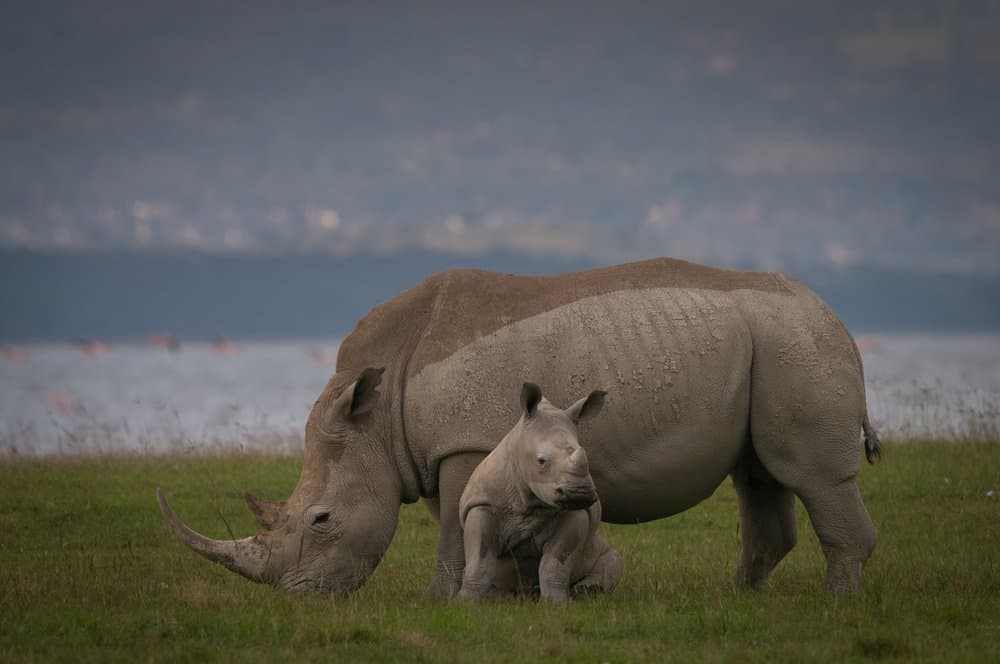
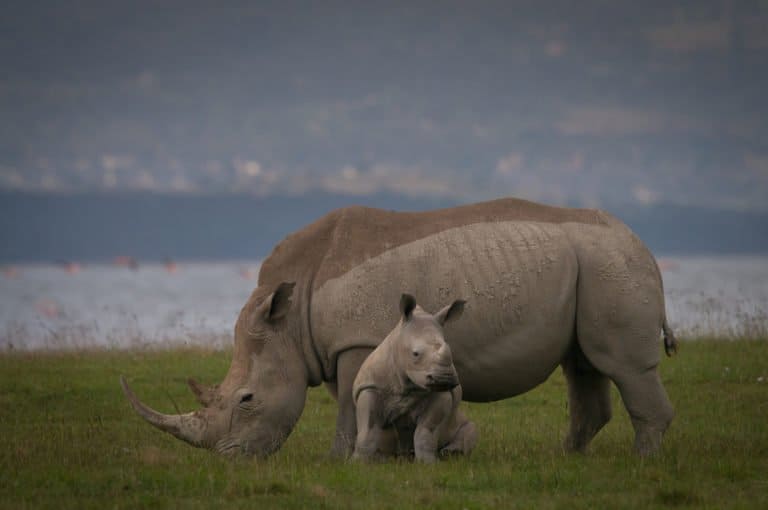
Black Rhinoceros (Diceros Bicornis) - with baby

The black rhino only comes together with other rhinos to mate and gives birth to a single calf after a yearlong gestation period.

The black rhinoceros is a solitary animal and only unites with others of its species to mate. The female black rhinoceros will give birth to a single calf after a yearlong gestation period (about 14-16 months). The World Wildlife Fund reports the longest observed gestation period at 478 days, a figure that’s 70 days shorter than the longest observed white rhino gestation period.

The black rhinoceros calf stays with its mother until it is at least two years old and large enough to become independent.

Black rhinos are generally believed to live up to 35 to 45 years in the wild, with the oldest black rhino in captivity living to be 52 before passing away at the Hiroshima zoo in 2018.

Black Rhinos In Zoos
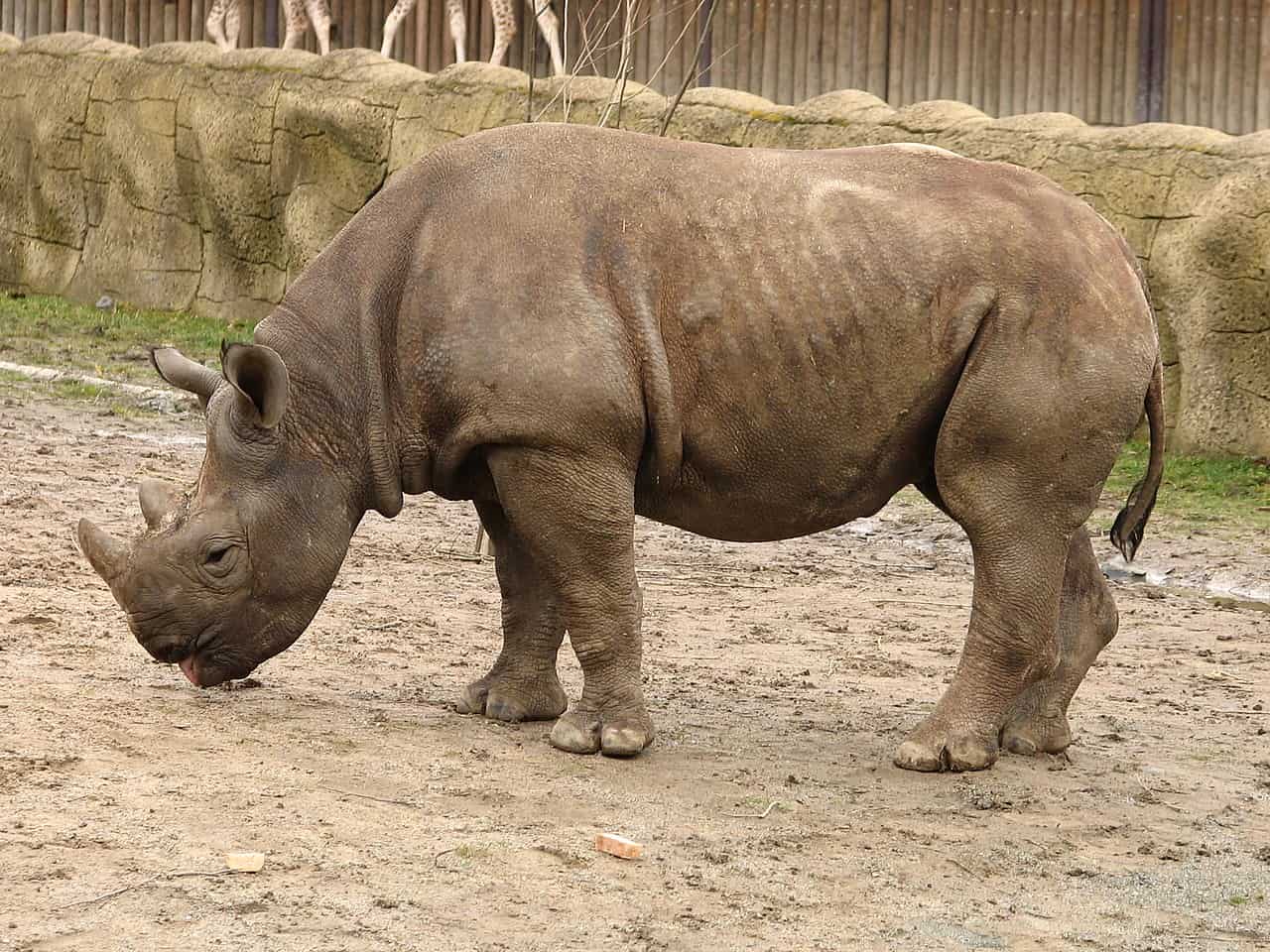
black rhino

Black Rhino, ZOO, Czech Republic

As of 2018, 61 zoos were home to 184 black rhinos. That makes the black rhino the second most common rhino found in zoos after the white rhino.

Select Zoos Where You Can See A Black Rhino In Person!

  • Potter Park Zoo (Lansing, Michigan): Had a black rhino named Doppsee born in April 2019
  • Saint Louis Zoo: As of 2019, 10 black rhino calves had been born at this zoo
  • Lincoln Park Zoo (Chicago, Illinois): Welcomed a new calf in March 2019.

Facts

The Black Rhino Makes A Return After Nearly 50 Years!

In October 2017 the governments of South Africa and Chad signed a memorandum of understanding to relocate 6 black rhinos to Chad. The black rhino was recorded in the country back in 1972. While the black rhino has seen its range significantly reduced across the past 100 years, thanks to reintroductions as of 2017 the species is now in 12 countries across Africa.

Innovative Ways To Stop Poaching?

In 2015, a company named Pembient was announced with the mission of 3D printing rhino horns to flood markets and depress the price of rhino horns. Other strategies have involved dying rhino horns pink to devalue them.

The Most Endangered Subspecies Left

After the Western black rhino was declared extinct in 2011, the most endangered remaining subspecies are the Eastern black rhinoceros. As of 2010, the IUCN estimates the remaining population at 740.

View all 453 animals that start with B
How to say Black Rhinoceros in ...
English
Crni nosorog
Catalan
Rinoceront negre
Czech
Nosorožec dvourohý
Danish
Sort næsehorn
German
Spitzmaulnashorn
English
Black Rhinoceros
Spanish
Diceros bicornis
Estonian
Teravmokk-ninasarvik
Finnish
Suippohuulisarvikuono
French
Rhinocéros noir
Hebrew
קרנף צר שפה
Croatian
Crni nosorog
Hungarian
Keskenyszájú orrszarvú
Indonesian
Badak Hitam
Italian
Diceros bicornis
Japanese
クロサイ
Latin
Diceros
Malay
Badak Hitam
Dutch
Zwarte neushoorn
Polish
Nosorożec czarny
Portuguese
Rinoceronte-negro
Slovenian
Črni nosorog
Swedish
Spetsnoshörning
Turkish
Kara gergedan
Vietnamese
Tê giác đen
Chinese
黑犀

Sources

  1. David Burnie, Dorling Kindersley (2011) Animal, The Definitive Visual Guide To The World's Wildlife / Accessed July 6, 2010
  2. Tom Jackson, Lorenz Books (2007) The World Encyclopedia Of Animals / Accessed July 6, 2010
  3. David Burnie, Kingfisher (2011) The Kingfisher Animal Encyclopedia / Accessed July 6, 2010
  4. Richard Mackay, University of California Press (2009) The Atlas Of Endangered Species / Accessed July 6, 2010
  5. David Burnie, Dorling Kindersley (2008) Illustrated Encyclopedia Of Animals / Accessed July 6, 2010
  6. Dorling Kindersley (2006) Dorling Kindersley Encyclopedia Of Animals / Accessed July 6, 2010
  7. David W. Macdonald, Oxford University Press (2010) The Encyclopedia Of Mammals / Accessed July 6, 2010
  8. San Diego Zoo / Published February 28, 2023 / Accessed March 21, 2023
Melissa Bauernfeind

About the Author

Melissa Bauernfeind

Melissa Bauernfeind was born in NYC and got her degree in Journalism from Boston University. She lived in San Diego for 10 years and is now back in NYC. She loves adventure and traveling the world with her husband but always misses her favorite little man, "P", half Chihuahua/half Jack Russell, all trouble. She got dive-certified so she could dive with the Great White Sharks someday and is hoping to swim with the Orcas as well.
Connect:

Thank you for reading! Have some feedback for us?


Black Rhinoceros FAQs (Frequently Asked Questions)

No. Today there are an estimated 5,500 black rhinos across Africa. However, a subspecies named the Western black rhino was declared extinct in 2011.